


Dubai’s healthcare sector remains one of the Gulf’s fastest‑growing industries. With a supportive regulatory environment, a tax‑friendly regime, and a diverse, high‑net‑worth population, clinic setup in Dubai offers alot of potential for local and international investors. This guide combines the latest regulatory updates, cost data, and real‑world insights to help you turn your medical clinic setup dream into reality. Whether you’re a general practitioner or a specialist, the following sections outline every requirement, cost, and document you’ll need.
Why Establish a Clinic in Dubai?
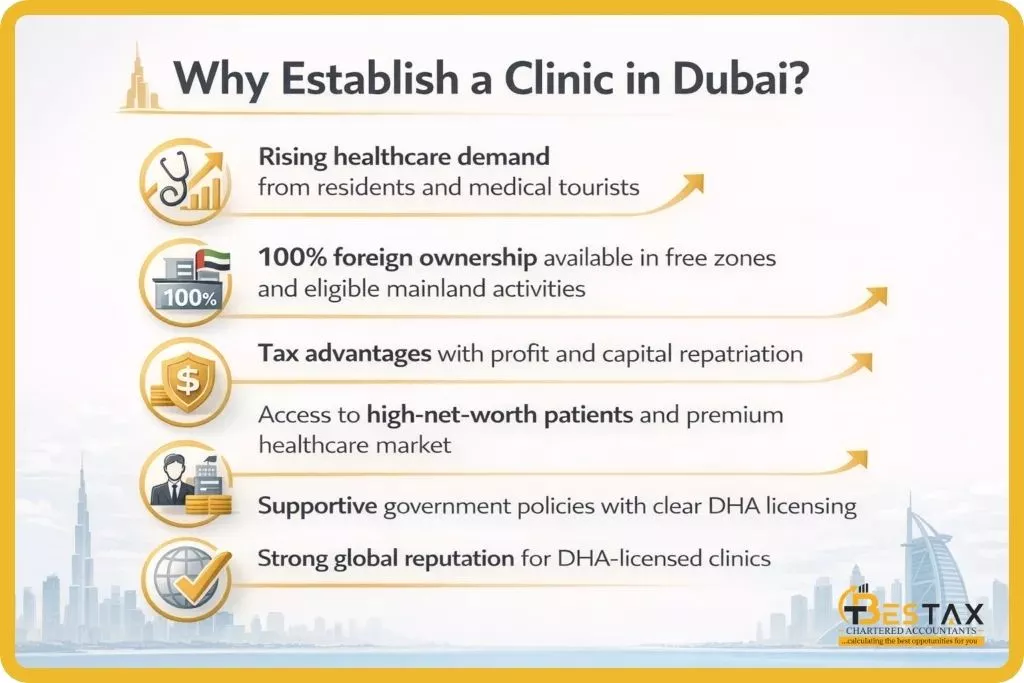
Dubai attracts investors because it pairs world‑class infrastructure with a booming healthcare market. Here are the main advantages:
- Rapidly growing healthcare demand: The city’s population and tourist numbers have rebounded strongly post‑pandemic, driving demand for general practice, dentistry, dermatology, fertility services and other specialities.
- Tax and ownership benefits: UAE free zones allow 100 % foreign ownership, corporate tax exemptions and unrestricted repatriation. As of late 2020, mainland companies can also be 100 % foreign‑owned (Not all business activities qualify). Profit repatriation is therefore straightforward.
- Access to high‑net‑worth patients: Dubai’s mix of wealthy residents and medical tourists means that premium private clinics thrive.
- Supportive government policies: The Dubai government actively encourages healthcare investments; licensing procedures are transparent and built for growth.
- Global brand reputation: A clinic licensed by the Dubai Health Authority (DHA) carries prestige and signals compliance with stringent quality standards.
Choosing Mainland vs Free Zone
Before starting your clinic setup, you must decide whether to operate in Dubai’s mainland or a free zone:
| Factor | Free Zone | Mainland |
|---|---|---|
| Ownership & tax | 100 % foreign ownership with tax exemptions and full profit repatriation | Since 2020, 100 % foreign ownership is also possible; subject to UAE corporate tax laws |
| Permitted business area | Since 2020, 100 % foreign ownership is also possible, subject to UAE corporate tax laws | Clinics may operate anywhere in the UAE and can treat both residents and visitors |
| Office requirements | Flexible: virtual desks or small offices; visa quotas limited according to office size | Minimum 200 sq ft physical office; visa quotas based on floor space |
| Ideal for | Medical tourism centres or telehealth services targeting international patients | Clinics can practise within the free‑zone boundaries or internationally; they cannot treat patients inside the mainland without a local agent |
Pro tip: Free‑zone clinics (for example, Dubai Healthcare City) offer streamlined licensing but require partnership with a mainland agent if you plan to treat patients elsewhere. Mainland clinics enjoy broad market access but involve additional fees such as municipal taxes and office rental.
Regulatory Framework & Key Authorities
Clinic owners must navigate several regulators:
- Department of Economy & Tourism (DET): Issues the trade licence and initial approval for mainland clinics. Free‑zone authorities perform similar functions within their jurisdictions.
- Dubai Health Authority (DHA): Oversees professional and facility licensing, conducts inspections and issues the final medical clinic licence. It also operates the Sheryan portal where applications are submitted and fees paid.
- Dubai Municipality: Verifies land plots via the Makani number, checks building and layout plans and issues permits; also collects 5 % of annual rent as municipal fees.
- Civil Defense & Federal Authority for Nuclear Regulation (FANR): Approves fire safety and radiation equipment when applicable.
- NABIDH (National Backbone for Integrated Dubai Health): Dubai’s electronic medical records platform. Clinics must prove system compliance for health information security.
Pre‑Setup Planning: Market & Location
Conducting Market Research
A successful business setup starts with understanding the city’s demographics and competitive landscape. Evaluate factors such as population density, prevailing health issues, income levels, insurance penetration and cultural preferences.
For example, dermatology and dental services perform well in expatriate‑heavy districts, while general practice suits family‑dense neighbourhoods.
Selecting the Right Location
Consider the following when choosing your premises:
- Underserved areas: Identify suburbs lacking clinics to avoid saturation.
- Traffic flow & visibility: Main roads like Sheikh Zayed Road and Al Khail Road offer high visibility but command higher rents. Assess footfall from nearby schools, offices and malls.
- Infrastructure & expansion potential: Ensure the building meets healthcare specifications (water pressure, waste disposal) and allows future growth.
Pro tip: Use Dubai’s Makani number and Google Maps to verify site details. Pair site visits with demographic studies to match your clinic’s services with local needs.
Crafting a Feasibility Study
Regulators expect a detailed feasibility report explaining clinical services, projected patient numbers, staffing requirements and financial projections. Include an ROI analysis, break‑even point and contingency plans. This report not only convinces regulators but also helps investors and lenders understand the business case.
Step‑By‑Step Guide to Opening a Clinic in Dubai
Setting up a clinic involves multiple approvals. The following sequence outlines each step with required documents and tips. For clarity, bold text highlights critical actions and timelines.
Step 1: Determine Legal Structure & Business Activity
- Decide whether your clinic will operate as a sole proprietorship, limited liability company (LLC), or free‑zone company.
- Choose the medical speciality (general practice, dermatology, fertility, dental, etc.) and ensure that the chosen facility licence category matches your services.
- Prepare your company’s Memorandum of Association (MoA) and shareholder agreements. If establishing a mainland entity, ensure compliance with DET requirements.
Step 2: Reserve Trade Name & Obtain Initial DET Approval
- Select a clinic name that adheres to UAE naming conventions no religious references or offensive words.
- Submit an online application to the DET or the respective free‑zone authority for trade name reservation. You will receive a reservation certificate and an initial approval certificate.
- Pay the required fees (expect ~AED 1,000–2,000 depending on the jurisdiction).
Step 3: Secure Premises & Prepare Engineering Layout
- Sign a lease (Ejari) for a commercial property that meets healthcare zoning rules. A tenancy contract is mandatory.
- Obtain an affection plan from Dubai Municipality outlining the plot and building details.
- Hire a DHA‑approved engineering or architectural firm to draft detailed floor plans and facility layouts that meet DHA standards. These plans must show room functions, sizes, ventilation and sanitary facilities.
- If construction or renovation is required, secure a building permit and ensure compliance with fire safety and sanitation regulations.
Step 4: Draft a Proposal & Undertaking Letter
Prepare two important documents:
- A proposal letter summarising your clinic’s services, staffing plan, facility design and commitment to meet DHA standards.
- A DHA undertaking letter pledging adherence to Dubai’s healthcare regulations.
Step 5: Submit Initial DHA Application
Using the Sheryan portal, submit your initial application with the following documents:
- Copies of partners’ passport, visa and Emirates ID.
- Trade name reservation and initial approval certificate from the DET.
- Affection plan and floor plan.
- Proposal and undertaking letters.
DHA will review your submission and may request additional information or site visits. Approval times vary but typically range from 25–40 days.
Step 6: Submit Final Documents & Obtain DET Licence
Once initial DHA approval is obtained, compile the remaining paperwork:
- Lease agreement and MoA.
- List of medical directors and healthcare professionals along with their DHA eligibility or professional licence numbers.
- No Objection Certificate (NOC) from the property owner.
- Copy of the initial approval certificate.
Pay the DET licence fee (about 5 % of the annual rent for mainland) and collect your commercial licence.
Step 7: Obtain Final DHA Facility Licence
- Create a facility account on the DHA Sheryan portal. Upload the final trade licence, building permit and comprehensive staff list.
- Pay the facility licence fee, which ranges from AED 5,000 for small clinics to AED 40,000 for large hospitals.
- The DHA will conduct a comprehensive inspection to verify building readiness, equipment calibration, fire safety, waste disposal, NABIDH-compliant electronic health records and infection‑control policies.
- Upon passing the inspection, the DHA issues your facility licence, authorising you to operate legally in Dubai.
Step 8: Obtain Professional Licences for Staff
- Medical Director appointment: Appoint a qualified medical director approved by DHA or Dubai Healthcare City; submit their credentials and appointment letter.
- Staff licensing: Doctors, dentists, nurses, lab technicians and therapists must hold individual professional licences. Application fees range from AED 1,000–1,100 and licence activation costs are AED 3,000 for physicians/dentists and AED 1,000 for nurses/allied health professionals.
- DataFlow verification: All professionals undergo a background check and primary source verification of certificates.
Step 9: Purchase Insurance & Draft Operational Policies
- Medical malpractice insurance is mandatory for clinics and individual practitioners.
- Develop infection‑control guidelines, emergency response plans and patient care protocols.
- Establish human‑resource policies defining staff roles, responsibilities and continuous professional development.
Step 10: Final Preparations & Grand Opening
- Fit‑out & interior design: Use ergonomic furnishings, adequate lighting and patient‑centric layouts for optimal comfort. Eco‑friendly materials and smart technology can set your clinic apart.
- Equipment installation: Ensure all medical devices are calibrated and compliant; maintain an inventory list.
- Soft opening & marketing: Train staff, run pilot consultations and finalise billing systems before the official launch. Build awareness through digital campaigns, outdoor signage and partnerships with hotels or insurance firms.
Cost Breakdown & Budgeting
| Cost Component | Description | Typical Range |
|---|---|---|
| Trade name registration & initial DET approval | Administrative fees for reserving a trade name and obtaining initial approval | AED 1,000–2,000 (varies by jurisdiction) |
| Licence registration & DET/DHA approvals | Includes commercial licence, facility licence and initial DHA review | AED 12,500 for registration and approvals |
| DHA approval fees | Application fee payable to the DHA during facility approval | AED 10,000 |
| MOHRE & Immigration registration | Allows issuing employee visas | AED 1,750 |
| Corporate PRO & local agent services | Optional consultancy and PRO assistance packages; mandatory for some mainland licences | AED 15,000 |
| Facility licence (final) | Issued by DHA after inspection; fee depends on facility size and type | AED 5,000–40,000 |
| Professional licence fees | DHA application & licence activation per professional | AED 3,000 for physicians/dentists; AED 1,000 for nurses/allied health |
| DataFlow verification & oral exam | Credential verification; exam fees for professionals | AED 1,100–1,500 for DataFlow; AED 500–2,000 for oral assessment |
| Annual rent & fit‑out | Leasing cost of clinic premises; interior design and medical equipment | AED 150,000+ (varies by size, location and speciality) |
| Dubai Municipality fee | 5 % of annual rent | |
| Staff recruitment & visas | Visa fees, medical tests and Emirates ID | AED 3,000–7,000 per visa |
| Operational & contingency fund | Utilities, marketing, software subscriptions, consumables | AED 50,000–100,000 initial reserve |
Note: These figures are approximations and subject to change. Always check with the DHA and DET for the latest fee schedules.
Additional Costs to Consider
Beyond mandatory fees, you will incur:
- Interior decoration & fit‑out charges: Luxury interiors and state‑of‑the‑art medical equipment dramatically raise set‑up costs. Budget at least AED 2,000–3,000 per square metre for high‑quality finishes.
- Technology infrastructure: Choose a NABIDH‑compliant electronic health record system and integrate telehealth platforms; software subscriptions may cost AED 15,000–30,000 annually.
- Marketing & branding: Website development, signage, SEO, social media campaigns and launch events may require AED 50,000–100,000.
- Working capital: Plan for three to six months of operating expenses before reaching profitability. Consider financing options or investor equity.
Compliance, Inspection & Post‑Setup Obligations
Facility Inspection
The DHA inspection team assesses your clinic’s readiness against criteria such as:
- Infrastructure & safety: Proper ventilation, lighting, electrical safety, waste disposal and radiation shielding (if radiology equipment is used).
- Equipment & calibration: All devices must be functional, calibrated and matched to your licence’s scope.
- NABIDH integration: Electronic medical records must adhere to NABIDH coding standards (ICD‑10‑CM, CPT) and data security protocols.
- Policies & procedures: Documented infection‑control protocols, emergency response plans and staff training logs.
After the Launch
- Licence renewal: Facility and professional licences are typically valid for one year. Renewal fees match the activation fees (AED 3,000 for physicians/dentists; AED 1,000 for nurses). Start renewal at least 60 days before expiry to avoid penalties.
- Annual inspection: The DHA may perform periodic audits to ensure continued compliance. Maintain updated policies, equipment calibration records and staff licences.
- Tax compliance: From June 2023 the UAE introduced a 9 % corporate tax on profits above AED 375,000. Engage an accountant to ensure accurate filings and take advantage of allowable deductions.
- Continuous professional development: Invest in staff training and accreditation. DHA mandates continuing education hours for licence renewal.
Seasonal & Geographic Considerations
Dubai’s desert climate influences construction timelines, patient footfall and staffing:
- Best months for fit‑out: October to April offer milder weather (~18–28 °C), allowing contractors to work comfortably and enabling you to open before the busy tourist season. Avoid peak summer (June–August) when temperatures exceed 40 °C and labour productivity drops.
- High‑season opportunities: Tourist inflows increase between November and March, boosting demand for travel medicine, vaccinations and emergency care. Consider aligning your opening with this period.
- Ramadan adjustments: Business hours shorten during Ramadan (dates vary annually), and employees may work reduced schedules. Plan service rotations accordingly.
- Traffic & accessibility: Proximity to metro stations (e.g., Dubai Healthcare City Station), highways (Sheikh Zayed Road, Al Khail Road) and parking facilities enhances patient access.
Conclusion: Turn Planning Into a Profitable Clinic
A successful clinic setup is not only about approvals and licences. It is about planning early, making the right location choice, and building systems that scale with demand. Clinics that stay organised, invest in patient-friendly design, adopt digital tools, and prepare thoroughly for DHA inspections move faster and face fewer setbacks.
If you want a smooth, compliant, and future-ready clinic launch, contact Bestax Business Setup Consultants. Our team supports you end-to-end, from feasibility and licensing to approvals and post-setup compliance, so you can focus on patient care while your clinic launches with confidence.
Quick FAQs
How much does it cost to set up a clinic in Dubai?
Basic registration and approvals cost around AED 12,500 for trade and commercial licences, AED 10,000 for DHA facility approval, AED 1,750 for MOHRE/Immigration registration and about AED 15,000 for corporate PRO services. A final facility licence can range from AED 5,000 to 40,000 depending on size. Additional expenses rent, fit‑out, equipment, staff visas and marketing, can push total set‑up investment well above AED 500,000 for a modern clinic.
How do you set up a clinic?
The process involves: 1) reserving a trade name and obtaining initial DET approval; 2) leasing premises and drafting DHA‑compliant layout plans; 3) submitting a proposal and undertaking letter; 4) applying for initial DHA approval with the required documents; 5 ) obtaining the commercial licence from DET; 6) registering on the Sheryan portal, paying the facility licence fee and passing the DHA inspection; and 7) licensing all medical staff and purchasing malpractice insurance. The entire process typically takes 25–40 days, though complex facilities may require longer.
How much does a DHA licence cost?
For a facility: AED 5,000 for a small clinic to AED 40,000 for a hospital. For professionals, licence activation costs AED 3,000 for physicians/dentists and AED 1,000 for nurses/allied health, plus DataFlow and assessment fees.
Can foreign nationals open a private clinic in Dubai?
Yes. Both mainland and free‑zone laws permit 100 % foreign ownership. Foreigners must meet DHA eligibility requirements, appoint a licensed medical director and comply with all regulatory procedures.
Do I need a medical degree to own a clinic?
Owners do not need a medical degree, but they must appoint a qualified DHA‑approved medical director and hire licensed professionals for clinical services. Investors can be non‑medical entrepreneurs.
How long is the licence valid and what about renewal?
Facility and professional licences are generally valid for one year. Renewal fees equal the activation fees (AED 3,000 for physicians/dentists; AED 1,000 for nurses) and require updated documents and compliance certificates.
What is NABIDH and why is it important?
NABIDH (National Backbone for Integrated Dubai Health) is Dubai’s e‑health platform that ensures secure electronic medical records. Clinics must integrate an EHR system that meets NABIDH’s data standards and coding schemes before receiving a facility licence.
What are the typical timelines for approvals?
Trade name reservation and initial DET approval: 2–5 days; initial DHA approval: 2–4 weeks; commercial licence issuance: 3–5 days; final DHA inspection and licence: 1–2 weeks. Complex clinics (e.g., radiology or fertility centres) may take longer due to additional clearances such as FANR.
Disclaimer: Regulations, fees and timelines change frequently. Always verify requirements with the Dubai Health Authority (DHA), the Department of Economy & Tourism (DET) and other official bodies before proceeding.
