



Many businesses miss VAT registration for one simple reason: they guess their turnover. They look at bank deposits, use rough maths, and assume they are “probably fine.” Then a large contract lands, imports spike, or a zero-rated deal gets counted wrong, and they realize too late that the clock has already started. This guide gives you a simple system to track turnover properly, month by month, with proof-ready records. You will learn the thresholds, what counts, what does not, and exactly when to move from tracking to registration. If you want one clear goal, it is this: treat the VAT registration threshold in UAE like a checklist, not a guess.
VAT registration is mandatory when taxable supplies and imports exceed AED 375,000 over the past 12 months, or are expected to exceed it in the next 30 days. Voluntary registration may apply at AED 187,500, and non-residents can be required to register even without meeting the threshold in certain cases.
The Rolling 12-Month Tracker
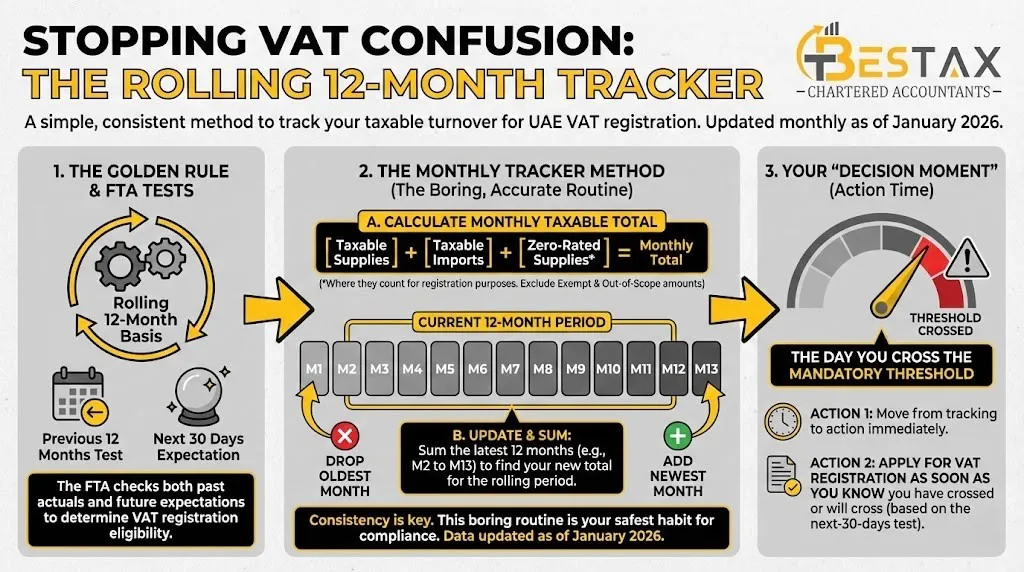
The rule that stops confusion is simple: you track taxable turnover on a rolling 12-month basis, updated every month. The Federal Tax Authority (FTA) tests VAT registration using the “previous 12 months” and the “next 30 days” expectation, which means your tracking must move with time.
Here is the tracker method you can run every month (keep it consistent and boring, because boring is accurate):
- Start with month-by-month totals of taxable supplies and taxable imports.
- Add zero-rated supplies where they count as taxable for registration purposes.
- Keep exempt and out-of-scope amounts out of the taxable total.
- Each new month, add the newest month and drop the oldest month, so your total always reflects the latest 12 months.
Your “decision moment” is the day you cross the mandatory threshold. From that point, you move from tracking to action. UAE rules refer to the next-30-days test, and the safest habit is to apply as soon as you can once you know you have crossed or will cross.
The Evidence Pack
A threshold number with no backup is weak. A threshold number with proof is defendable. That is why your second system is an evidence pack that matches your calculation.
Keep these items together in one folder (monthly, not yearly):
- Sales summary for each month (by invoice date, not by payment date)
- Tax invoice register (or POS summary if relevant)
- Import documents where imports are part of the threshold calculation
- Reverse charge schedule, where it applies to your business model
- A simple reconciliation that ties your monthly taxable totals to your accounts (trial balance or revenue report)
The most common mismatch is confusing exempt and zero-rated. Zero-rated supplies can count toward the threshold even though the VAT rate is 0%, while exempt supplies are treated differently. Another common issue is out-of-scope items accidentally counted as taxable turnover. Those errors usually come from using bank deposits instead of invoice-based reporting.
What is The UAE VAT Registration Threshold and Who Must Track It
In simple terms, the threshold is the line that decides when VAT registration becomes mandatory.
- The mandatory threshold is AED 375,000 in taxable supplies and imports.
- The voluntary threshold is AED 187,500, and it can also apply based on expenses in certain situations.
The two tests you must understand are:
- Past 12 months: if taxable supplies and imports exceed the mandatory threshold over the previous 12 months.
- Next 30 days: if you expect taxable supplies and imports to exceed it within the next 30 days.
Non-resident rule (often missed): a non-resident business may be required to register if it makes taxable supplies in the UAE, even if the value does not exceed the threshold, unless another party in the UAE is responsible for accounting for the VAT.
What Counts Toward Turnover and What Does Not
This is where most “VAT threshold UAE” mistakes happen. People count money that does not belong, or they leave out taxable items that do.
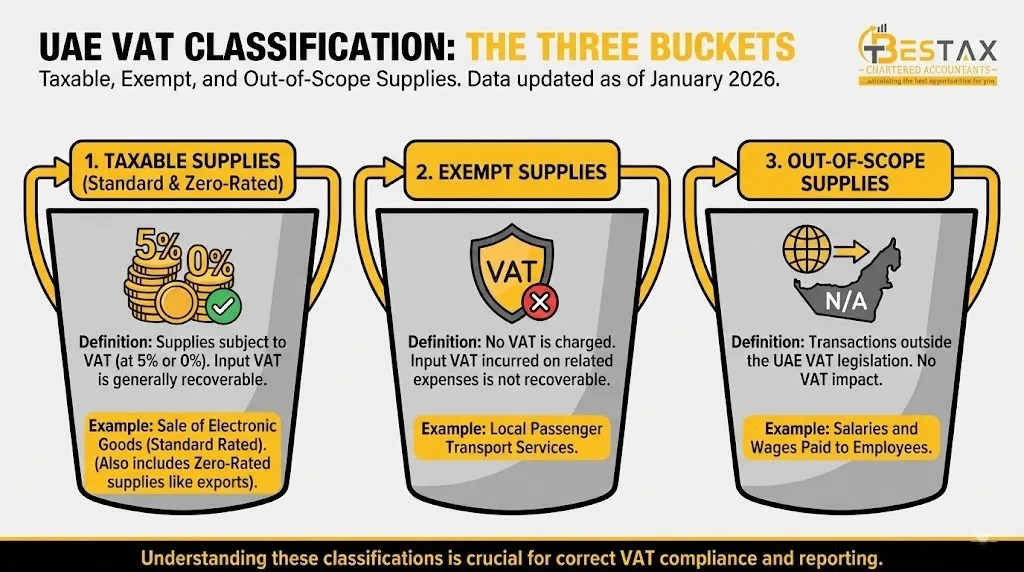
At a high level, the FTA frames the test around taxable supplies and imports. To keep it clean, separate turnover into three easy buckets:
Zero-rated supplies
These are taxable supplies at 0% VAT. They can still count toward the threshold even though no VAT is charged at the point of sale.
Exempt supplies
These are not taxable supplies. They are generally treated differently from zero-rated supplies for registration threshold logic.
Out-of-scope items
These are outside UAE VAT scope, often because of place-of-supply rules or because the transaction is not a UAE taxable supply.
Quick test: if VAT is not chargeable in the UAE because the supply is not considered made in the UAE under place-of-supply rules, it usually belongs in out-of-scope, not taxable turnover. When in doubt, do not “guess include.” Identify the nature of the supply first, then classify it consistently.
Step-by-Step: How To Calculate Your VAT Registration Threshold in the UAE
- Step 1: Pick your measurement window. Use the rolling 12 months for the historic test, and keep a simple next-30-days forecast for large contracts or seasonal spikes.
- Step 2: Build your monthly totals from invoice data, not bank deposits. Bank deposits can include loans, owner transfers, or timing differences that do not represent taxable supplies.
- Step 3: Remove exempt and out-of-scope items before you total. This is where you prevent the classic “we crossed the threshold but only because we counted the wrong bucket” problem.
- Step 4: Add imports and any relevant adjustments supported by documents. If imports are part of your business model, keep the import proof attached to the month it relates to, so your calculation can be verified later.
- Step 5: Record the “crossing date” and lock the supporting evidence pack. Your future self will thank you, especially if a bank or the FTA asks how you arrived at the figure.
The “Crossing Moment” Playbook
When you cross the mandatory threshold, treat it like an operational switch. The law and FTA guidance focus on timely action once you become required to register, including the next-30-days expectation test.
Start with the immediate fixes that prevent messy corrections later:
- Update invoicing format so VAT fields can be added cleanly after registration.
- Decide how you will handle VAT pricing (absorbed vs added) and update quotes and proposals.
- Review contract wording so tax clauses match how you charge customers.
- Set up your accounting system so VAT codes match your supply types (standard-rated, zero-rated, exempt, out-of-scope).
Do not delay just because you are “still organizing.” Portal steps, document review, and internal approvals can take time, and late action usually creates more work than early action.
Mandatory vs Voluntary Registration: When Voluntary Actually Helps
Mandatory registration is triggered by the threshold. Voluntary registration is a choice, but it should still be a smart choice, not a rushed one.
Voluntary registration can make sense when you want to recover input VAT on costs and show suppliers or partners that your tax setup is organized. It is also relevant when your taxable supplies or imports exceed the voluntary threshold, or when qualifying expenses support voluntary registration under the official rules.
This is also where many owners look up the VAT registration threshold UAE again, because the question changes from “Do I have to?” to “Does it help me if I do?”
Practical checkpoint: if most of your sales are exempt, voluntary registration may not deliver the benefit people expect. You may carry compliance work without meaningful recovery, so you need a quick review of your supply mix before choosing the voluntary route.
Special Cases That Change The Answer
Non-resident taxable supplies rule: if you do not have a place of residence in the UAE but make taxable supplies here, you may need to register even without meeting the resident threshold, unless another party accounts for the VAT.
VAT group considerations: group registration can be relevant for related entities under common control. The decision is structural and affects reporting and liability, so it is best treated as a planning step, not a last-minute fix.
Business transfer or acquisition: when you acquire or transfer a business, turnover history and continuity can affect how you assess the threshold. This is an “ask your advisor” checkpoint because the facts matter, and the wrong assumption can push you into late registration.
Common Mistakes That Trigger Delays or Penalties
- Counting bank deposits instead of taxable supplies
- Mixing exempt with zero-rated and inflating turnover
- Missing the next 30-day forecast test when a big contract is signed
- Registering under the wrong legal entity or mismatching the trade licence activity
- Not keeping an evidence pack that proves the VAT registration threshold calculation
At the End
If you take one thing from this guide, make it this: stop guessing turnover. Track it monthly with a rolling 12-month total, keep an evidence pack, and treat the crossing moment as a clear action point. That approach protects you whether you end up in mandatory registration or choose voluntary registration for a strategic reason.
If you want a quick review of your tracker, your supply classification, and your evidence pack before you act, Bestax Chartered Accountants Dubai can sanity-check the numbers and the paperwork so you move forward with confidence, not assumptions.
Quick FAQs
What is the UAE VAT mandatory registration threshold?
The UAE VAT mandatory registration threshold is AED 375,000 in taxable supplies and imports over the past 12 months, or expected within the next 30 days.
What is the voluntary threshold, and who can use it?
Voluntary registration may apply at AED 187,500 (and can also relate to qualifying expenses under official rules), but it should be chosen based on your supply mix and recovery benefit.
Do zero-rated supplies count toward the threshold for VAT registration in UAE?
Yes, zero-rated supplies are still taxable supplies at 0% and can count toward the registration threshold, even though the VAT rate is 0%.
Do exempt supplies count toward the VAT registration threshold in UAE?
Exempt supplies are treated differently from taxable supplies and are generally not counted the same way as zero-rated supplies when assessing the threshold.
What is the rule for non-resident businesses?
Non-residents may need to register if they make taxable supplies in the UAE, even if they do not meet the threshold, unless another party in the UAE accounts for the VAT.
Disclaimer: The information provided in this blog is for general informational purposes only. For professional assistance and advice, please contact experts.
