



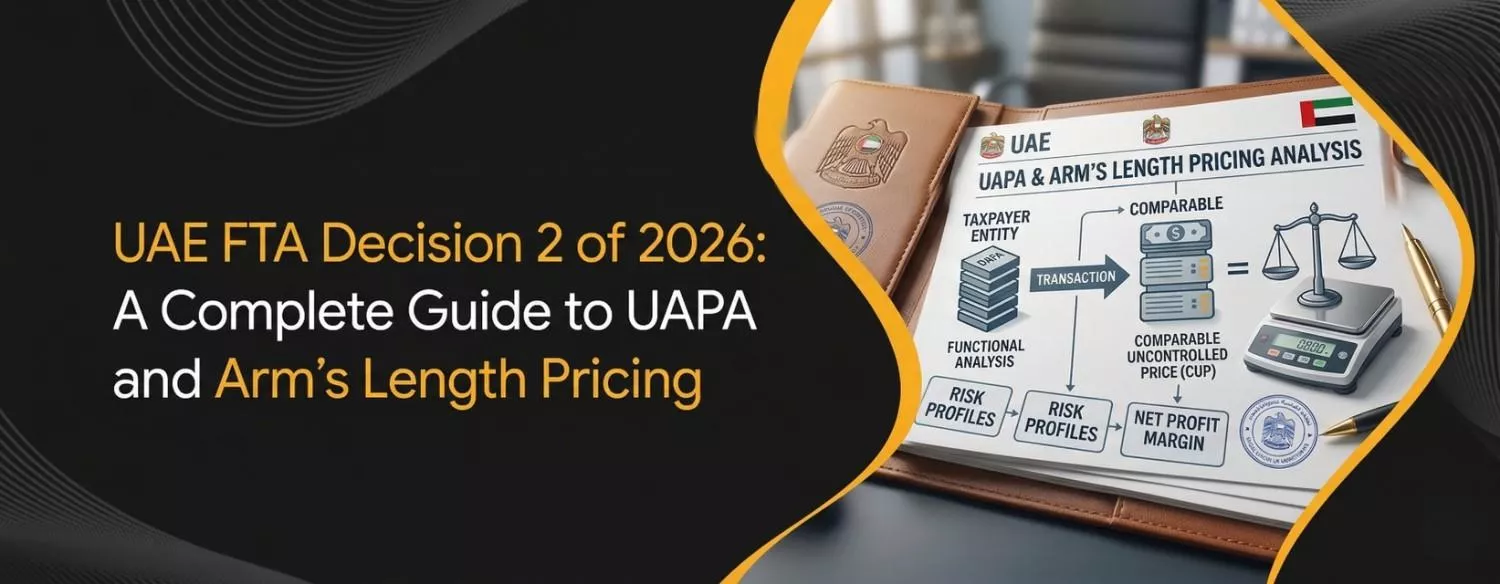
The UAE has now introduced a formal framework for Unilateral Advance Pricing Agreements (UAPAs) under Corporate Tax. This gives eligible taxpayers a way to agree in advance with the FTA on how the arm’s length price should be determined for certain related-party transactions over a fixed period.
For now, the FTA accepts UAPA applications only for domestic related-party transactions. It has also said that in Q4 2026, it will announce when cross-border UAPA applications will begin.
This guide explains what that means, who can apply, how the process works, and why arm’s length pricing matters.
What changed in 2026
The big shift is not that transfer pricing suddenly appeared in the UAE. Transfer pricing was already part of the Corporate Tax Law.
The change is that the FTA has now put a formal APA process on the table, including unilateral APAs, eligibility rules, timelines, and ongoing compliance requirements. Your source material captures that framework well, including the threshold, pre-filing stage, annual declaration, revision, revocation, and renewal points.
The official FTA policy says an APA is an agreement that sets the criteria to determine the arm’s length price for transactions or arrangements with related parties over a fixed period. It then splits APAs into two types: UAPA, which is between the taxpayer and the FTA, and BAPA/MAPA, which involves competent authorities of two or more jurisdictions through a mutual agreement procedure.
The FTA says: “An Advance Pricing Agreement (APA) is an agreement that sets out the criteria to determine the arm’s length price.”
What the UAPA is, in simple terms
A UAPA, or Unilateral Advance Pricing Agreement, is a forward-looking agreement between one taxpayer and the FTA. It does not decide your whole tax profile. It deals with a defined pricing issue for defined related-party transactions.
Think of it this way.
If a UAE group company charges another group company for management services, financing, manufacturing support, or use of intellectual property, the FTA and the taxpayer can agree in advance on the method and assumptions that will be used to test whether that pricing is arm’s length. That reduces uncertainty later. This is the commercial value of a UAPA.
A Bilateral Advance Pricing Agreement (BAPA) or Multilateral Advance Pricing Agreement (MAPA) is different. A BAPA is a bilateral APA between the tax authorities of two countries, while a MAPA is a multilateral APA involving the tax authorities of more than two countries.
So for now, if you are reading about UAE APAs in practice, the live issue is the UAE’s unilateral route.
What “arm’s length pricing” means
This is the core concept.
Under Article 34, transactions between related parties must be priced as if they had taken place between independent parties in similar circumstances. That is the arm’s length standard. The law says a related-party transaction meets that standard if its results are consistent with what unrelated parties would have realised in a similar transaction under similar conditions.
The law also lists the transfer pricing methods that may be used to reach an arm’s length result:
- comparable uncontrolled price method,
- resale price method,
- cost-plus method,
- transactional net margin method,
- transactional profit split method.
If none of those methods can reasonably be applied, the taxpayer may use another method, but only if it still satisfies the arm’s length standard.
The law also says method selection should reflect the contract terms, the transaction itself, economic circumstances, functions performed, assets used, risks assumed, and business strategy.
That matters because a UAPA does not replace Article 34. It is really a way to agree in advance how Article 34 will be applied to specific transactions.
What “related parties” means
Many readers get stuck here, so it helps to keep this simple.
Under the Corporate Tax Law, related parties can include individuals and companies with sufficient ownership or control links. The law specifically refers to cases involving direct or indirect ownership of 50% or more, control, a person and its permanent establishment, partners in the same unincorporated partnership, and certain trust or foundation relationships.
Who can apply and when
The FTA says a UAPA application must be submitted by the person itself, or by its authorised signatory, tax agent, legal representative, or the parent company in the case of a tax group. It must relate to the arm’s length price of transactions or arrangements with related parties.
The expected total value of the covered transactions should generally be at least AED 100 million per tax period. For a tax group, that threshold is tested at tax group level. The FTA may still accept a lower-value case, but only at its own discretion after reviewing the facts, complexity, tax risk, and the overall benefit of entering into a UAPA.
The application must also involve significant uncertainty in determining the arm’s length price, must cover at least 3 tax periods and no more than 5 tax periods, and the first covered tax period must start on or after 1 January 2028.
The FTA guide also says that, at the initial stage, UAPAs are only for prospective periods. That is important. A UAPA is not meant to clean up old years retroactively.
Domestic vs cross-border position in 2026
This is one of the most important points in the entire update.
The FTA policy states that it currently accepts UAPA applications for domestic transactions between related parties only.
It also states that during Q4 2026, the FTA will announce a start date for accepting UAPA applications for cross-border transactions or arrangements.
Annotation: Official wording
“The Authority currently accepts UAPA applications for domestic transactions between Related Parties only.”
For domestic cases, the policy narrows the field further. The covered domestic transaction should generally be between parties that are subject to different Corporate Tax rates or where one of the parties is eligible for tax incentives under the Corporate Tax Law.
That means not every domestic related-party transaction is a strong APA candidate. The FTA appears to be focusing on domestic situations where the tax outcome can materially differ between the parties.
Thresholds, fees, timing, and process
1) Mandatory pre-filing consultation
A taxpayer who wants a UAPA must first request a pre-filing consultation. Both the FTA policy and the APA guide make this stage mandatory. The guide adds an important practical point: the pre-filing stage is for assessing suitability and scope, not for giving binding certainty on the transfer pricing position.
The APA guide says a pre-filing consultation “does not bind the FTA to enter into an APA.” It also says views exchanged at that stage cannot be relied upon as certain.
2) Pre-filing timeline
The current FTA policy says the Authority shall conclude the pre-filing consultation within nine months from receipt of a completed request. The guide describes this more flexibly as six to nine months. Both sources say the taxpayer is expected to respond to information requests within 40 business days.
Practical note: the later 2026 policy is the safer operational benchmark where wording differs, but businesses should still watch for updated FTA guidance and the actual filing instructions in EmaraTax.
3) Filing deadline after pre-filing
Your source material correctly flags the filing window after pre-filing. The official policy says the person must file the UAPA application within two months from the FTA’s notification completing pre-filing, or at least 12 months before the first covered tax period, whichever is earlier. The APA guide states the same rule using the same two-month standard.
4) Fees
The FTA announced that two APA-related service fees took effect from 1 January 2026. The official FTA news item confirms the introduction of the fees for a first-time UAPA request and for a renewal or amendment request.
The APA guide then gives the amounts: AED 30,000 for a new APA application and AED 15,000 for renewal, both non-refundable.
5) FTA review and conclusion
After filing, the FTA may ask for more information, analysis, records, and meetings. It may also gather facts through site visits, interviews, and meetings, then prepare its own transfer pricing analysis.
The taxpayer must provide written feedback on that analysis within 30 business days. The policy says the FTA should conclude the UAPA within 30 months of receiving a completed application, and if it expects the process to take longer, it must notify the taxpayer of the expected timeframe.
What businesses should prepare before applying
A UAPA is not just a form. It is a technical project.
Before applying, a business should be able to explain:
the exact controlled transactions it wants covered,
- Why does pricing uncertainty exist?
- Which transfer pricing method is most appropriate?
- What comparables or benchmarks support that method?
- How functions, assets, and risks are split between the parties, and which critical assumptions must stay true for the agreed pricing to remain reliable.
The APA guide says critical assumptions are central to an APA’s validity and may relate to the applicant, the related party, industry conditions, and general economic factors. If those assumptions change or are breached, the APA may become ineffective.
Let’s Take an Example:
Assume a mainland UAE company provides central procurement and management support to a related free zone entity. The amounts are large, the pricing affects taxable income on both sides, and the parties are in different Corporate Tax positions.
That is the kind of domestic fact pattern the 2026 framework seems designed for. The taxpayer could seek a UAPA asking the FTA to agree, in advance, on the pricing method, markup range, tested party logic, comparables, and assumptions for the covered period. If the agreed facts stay the same, the taxpayer gets stronger certainty for those covered years.
Binding effect, annual declaration, and what happens if facts change
Once concluded, a UAPA is binding on the FTA and the taxpayer that is a party to it. If the FTA later audits the counterparty to the covered transaction, it will take the agreed UAPA position into account, as long as the facts and circumstances remain the same. But the policy is equally clear that a UAPA for specific periods does not create a precedent for other periods or for other taxpayers.
A taxpayer that enters into a UAPA must file an annual declaration for each covered tax period within 90 business days from signing the UAPA, or by the due date for the tax return for that covered period, whichever is later.
If the law changes, business conditions change, or other relevant conditions affect the agreed terms, the taxpayer must notify the FTA within 20 business days. The FTA may revise the UAPA, or cancel it from the period in which the triggering event occurred if revision is not feasible.
Revocation is harsher. The FTA may revoke a UAPA if there is material misrepresentation, failure to comply with material terms, or breach of critical assumptions. In that case, revocation takes effect from the first tax period covered by the UAPA.
If your business has related-party transactions and you are unsure whether the pricing stands up under UAE Corporate Tax rules, this is the right time to review it properly. Contact the tax advisors at Bestax for practical guidance on UAPA readiness, transfer pricing documentation, and arm’s length compliance in the UAE.
Quick FAQs
Is a UAPA available now for cross-border related-party transactions?
Not yet. The FTA policy says the Authority currently accepts UAPA applications only for domestic related-party transactions. It says a start date for cross-border applications will be announced in Q4 2026.
Does a UAPA replace normal transfer pricing rules?
No. The arm’s length rule still comes from Article 34. A UAPA is a way to agree in advance how that rule will be applied to specific covered transactions.
What is the minimum transaction value?
Generally, the expected total value of the covered transactions should be at least AED 100 million per tax period. The FTA can still accept lower-value cases at its discretion.
How long can a UAPA cover?
It must cover at least 3 tax periods and no more than 5.
Can I use a UAPA for past years?
The FTA guide says that, at the initial stage, UAPAs cover prospective periods only.
Is pre-filing mandatory?
Yes. The taxpayer must first request a pre-filing consultation in the form and manner prescribed by the FTA.
What are the official fees?
The FTA has introduced the service fees effective from 1 January 2026, and the APA guide states them as AED 30,000 for a new application and AED 15,000 for renewal.
Does a UAPA bind other tax years too?
No. The policy says it does not create a precedent for other tax periods or other persons not covered by the agreement.
Disclaimer: The information provided in this blog is for general informational purposes only. For professional assistance and advice, please contact experts.
