



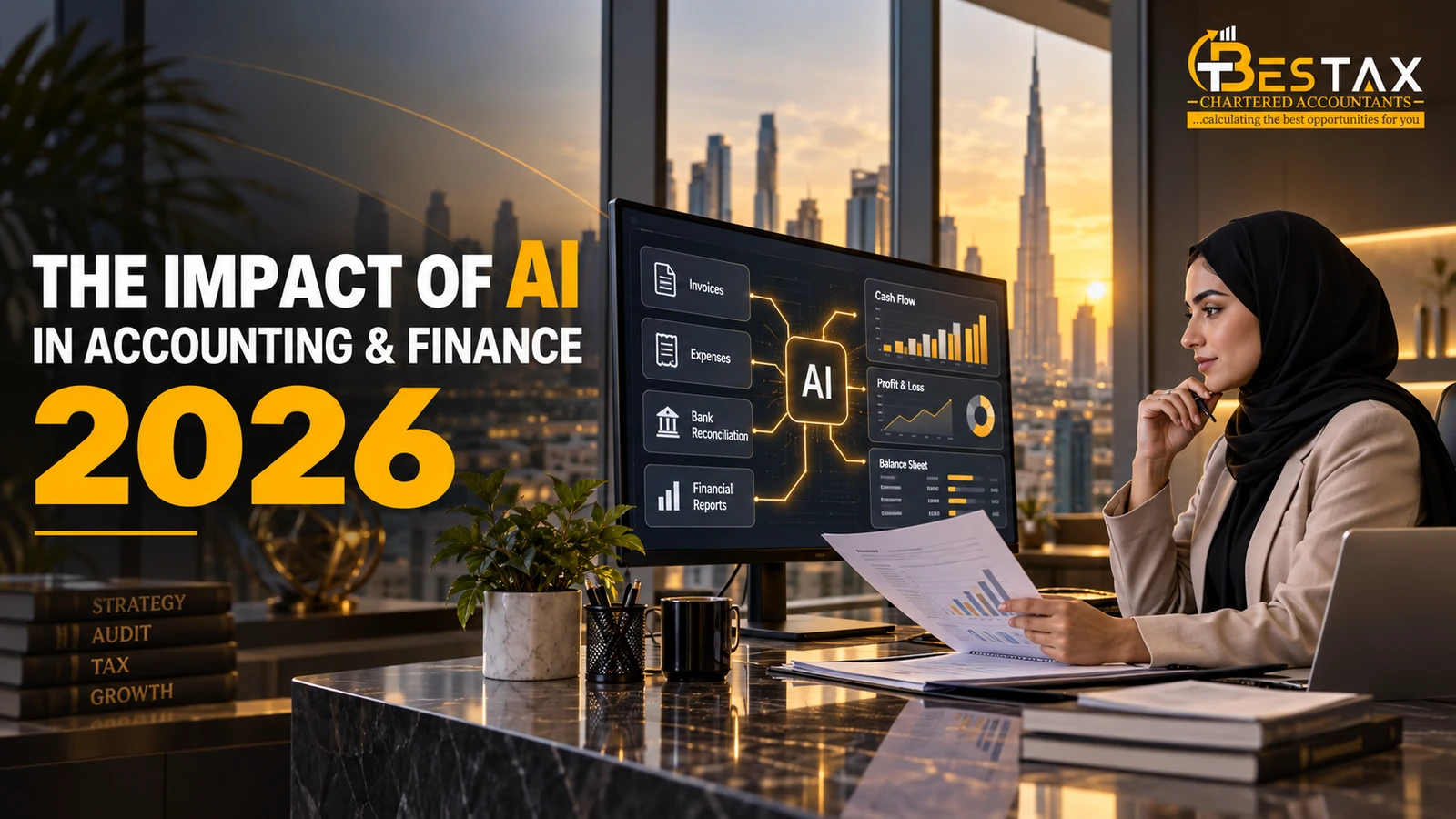
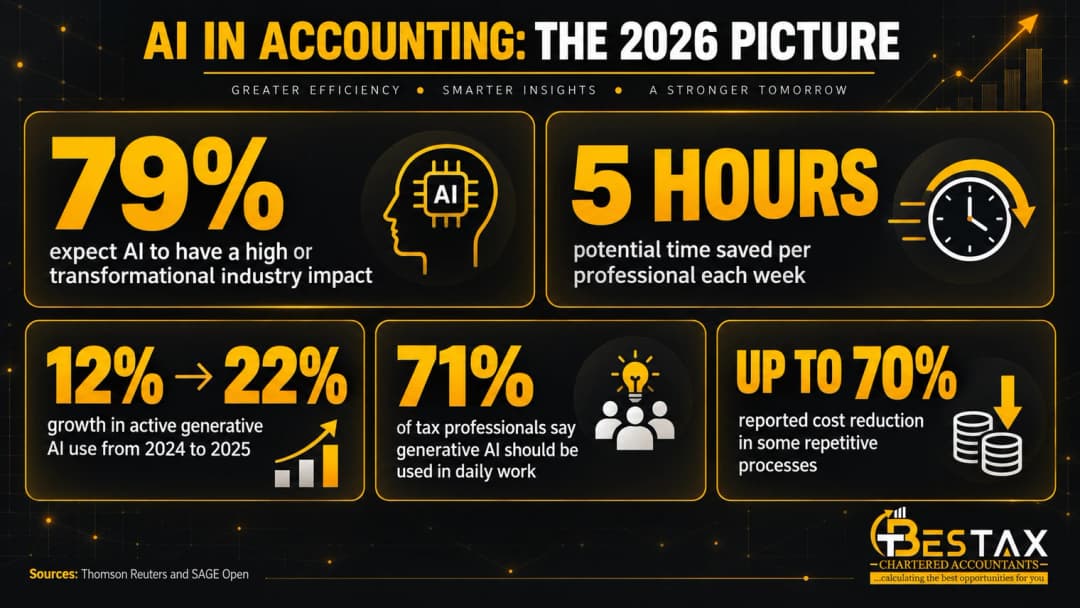
AI in accounting is the use of artificial intelligence to automate, check, and speed up financial work such as bookkeeping, reconciliations, reporting, tax, and auditing. In 2026, it has become a core part of how finance teams operate rather than a side experiment, and the numbers back this up: Thomson Reuters found that 79% of tax, audit, and accounting professionals expect AI to have a high or transformational impact on their industry within five years.
If you run a business, manage the books, or simply want to understand where the profession is heading, this guide explains what AI in accounting really means, how it is used every day, what the official data says, where the risks sit, and what all of it means for companies in the UAE and beyond. No prior technical knowledge is needed. We start with the basics and build from there.
What Is AI in Accounting?
AI in accounting means using software that can perform tasks which normally require human judgement, such as reading documents, spotting unusual patterns, sorting transactions, and predicting outcomes. Instead of an accountant keying in every invoice or scanning every statement line by line, the system handles the repetitive work and flags anything that needs a human decision.
A 2026 systematic review published in the journal Sage Open groups the technology behind AI in accounting into three practical categories:
- Machine learning: software that learns from past financial data to detect anomalies, forecast trends, and classify transactions automatically.
- Natural language processing: tools that read and interpret human language, so they can pull key figures from contracts, disclosures, and reports.
- Robotic process automation: software bots that carry out rule based tasks such as invoice processing, reconciliations, and report generation.
In plain terms, these tools do the heavy lifting on data while the accountant focuses on interpretation, advice, and strategy. AI works best when it sits on top of sound accounting practice, so getting the fundamentals right still matters.
AI in Accounting by the Numbers in 2026
The shift is not hype. It shows up clearly in recent research from official and peer reviewed sources.
Adoption is accelerating fast. According to Thomson Reuters, active use of generative AI among professional services organizations nearly doubled from 12% in 2024 to 22% in 2025, and tax firms saw the sharpest jump of all, nearly tripling from 8% to 21% in a single year.
Attitudes have flipped from doubt to belief. The same research found that 71% of tax professionals now believe generative AI should be applied to their daily work, up from 52% a year earlier, and 77% of clients want the firms working for them to use it.
The biggest gains are in time saved. Thomson Reuters reports that AI could save professionals around five hours per week, which adds up to roughly 240 hours a year that can be redirected toward advisory work. The most common use cases among tax and accounting professionals are tax research at 77%, tax return preparation at 63%, and tax advisory at 62%.
Costs can fall dramatically. The Sage Open review notes that robotic process automation has, in some cases, reduced the cost of repetitive processes such as invoice reconciliation by up to 70%.
Skills are being rewritten. The World Economic Forum's Future of Jobs Report 2025 found that 39% of workers' core skills are expected to change by 2030, and it ranks artificial intelligence and big data among the fastest growing skills of the 2025 to 2030 period. The same report lists accounting, bookkeeping, and payroll clerks among the fastest declining roles as routine tasks become automated, a clear signal that the profession is moving up the value chain rather than disappearing.
Taken together, these figures tell one story. AI in accounting has moved from experiment to expectation, and firms that adopt it thoughtfully are pulling ahead.
How AI Is Used in Accounting and Finance
Here is where the theory turns into daily practice. These are the areas where AI is already doing real work in finance teams in 2026.
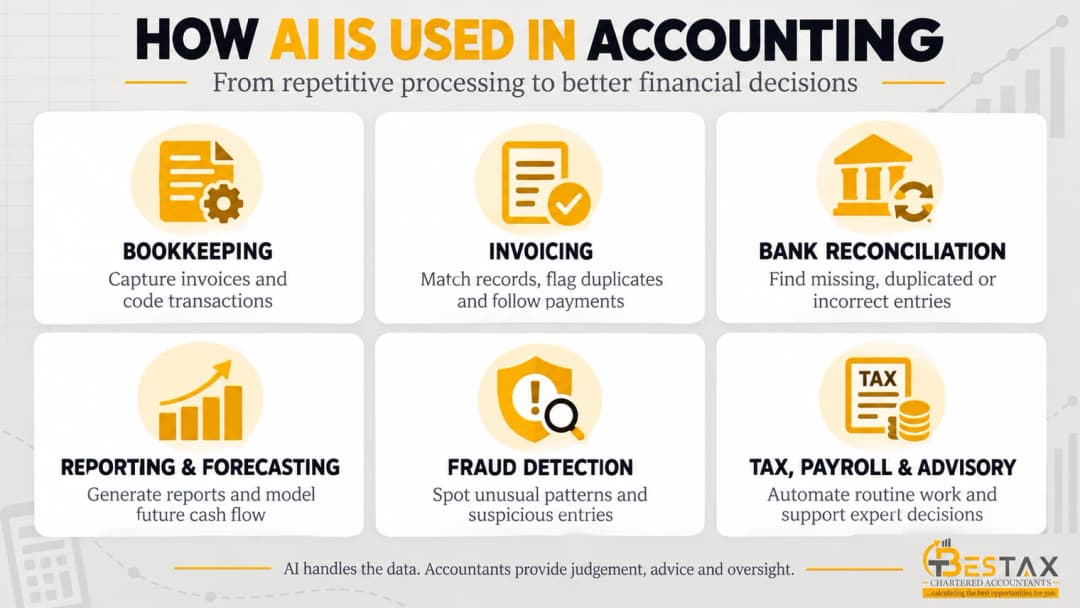
- Bookkeeping and data entry: AI captures invoices, receipts, and bank feeds, then codes transactions automatically, cutting manual entry and reducing errors. Clean, current books are the foundation for everything else, which is why accurate bookkeeping matters more, not less, in an AI driven setup.
- Invoicing, accounts payable, and accounts receivable: systems match purchase orders to invoices, flag duplicates, chase outstanding payments, and forecast cash flow.
- Bank reconciliation: AI compares your records against bank statements to surface missing entries, duplicate transactions, and payment errors in minutes rather than days.
- Financial reporting and forecasting: tools generate profit and loss statements, balance sheets, and cash flow reports, and use historical data to model future performance.
- Fraud detection: according to the Sage Open review, machine learning spots unusual journal entries and suspicious patterns far more reliably than manual sampling, strengthening internal controls.
- Tax preparation and research: AI accelerates research, drafts returns, and helps surface planning opportunities, which is exactly where the highest adoption is happening.
- Payroll: automation handles salary calculations, deductions, and payroll reporting with fewer mistakes.
- CFO level advisory: with routine work automated, finance leaders spend more time on budgeting, scenario planning, and strategy.
Many businesses reach this stage through modern software rather than custom AI. Platforms such as Zoho Books, QuickBooks, Xero, and Tally now build automation directly into everyday accounting, and choosing and configuring the right one is often the fastest path to value. This is a common starting point in our accounting software services, and it pairs naturally with payroll, corporate tax, and VAT work.
The Benefits of AI in Accounting
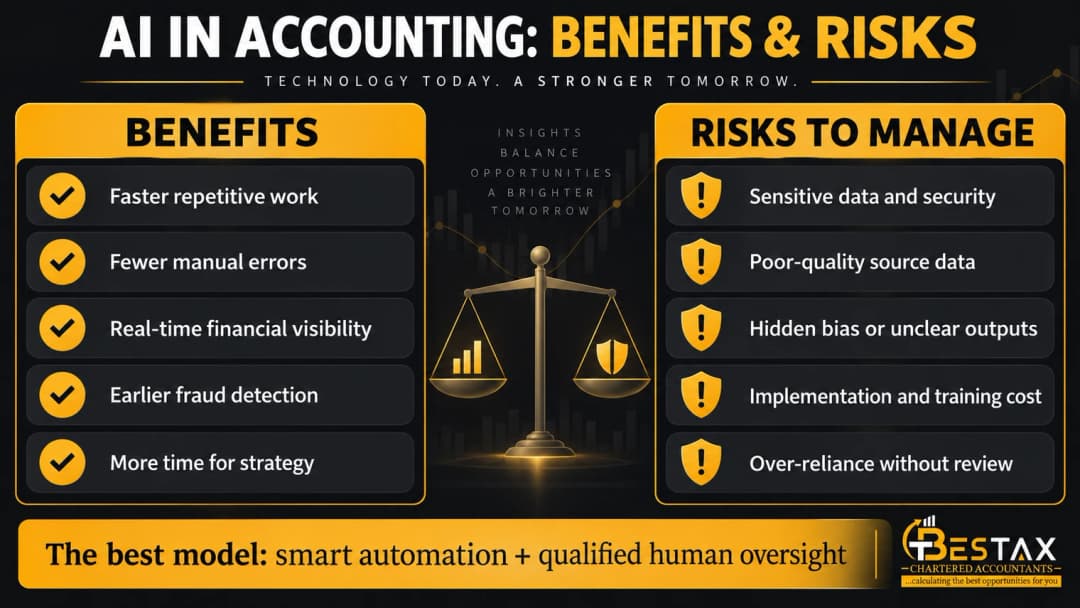
The advantages are practical and measurable:
- Efficiency: repetitive tasks that once took hours are handled in minutes, freeing your team for higher value work.
- Accuracy: automation reduces the human errors that creep into manual data entry and reconciliation.
- Real time visibility: dashboards update continuously, so you see your true financial position whenever you need it, not weeks later.
- Stronger fraud prevention: continuous monitoring catches anomalies early.
- Lower cost over time: less manual effort and fewer errors reduce the cost of running finance.
- Better decisions: with the number crunching automated, accountants deliver sharper analysis and advice.
Challenges and Risks You Should Know
AI in accounting is powerful, but it is not a switch you flip and forget. The Sage Open review is clear that the benefits come with real conditions attached:
- Implementation cost: setting up the right tools and training staff takes investment, which can be a hurdle for smaller firms.
- Data privacy and security: financial data is sensitive, so strong safeguards and clear governance are essential.
- Ethical concerns and bias: algorithms can carry hidden bias and their decisions are not always transparent, so oversight matters.
- Data quality: AI is only as good as the records it learns from, which is another reason clean books come first.
- Human oversight: AI should assist judgement, not replace it. A qualified accountant still needs to review outputs, especially for compliance and complex cases.
- Regulation: rules are still catching up with the technology, so responsible adoption means staying current on guidance.
The takeaway for business owners is simple. Treat AI as a highly capable assistant that needs an experienced professional guiding it, not as a substitute for expertise.
Will AI Replace Accountants in 2026?
This is the question on everyone's mind, and the honest answer is nuanced. AI is automating routine, task based roles, which is why the World Economic Forum lists bookkeeping and clerical positions among the fastest declining jobs. At the same time, it is raising demand for professionals who can interpret data, advise clients, and manage the technology itself.
The evidence points to augmentation, not replacement. Thomson Reuters found that the time AI frees up is being redirected toward advisory services, which are more valuable to clients and more rewarding to deliver. The Sage Open review reaches a similar conclusion, noting that human creativity and judgement remain irreplaceable even as routine work is streamlined. In short, accountants who embrace AI are set to thrive, while those who ignore it risk falling behind. The profession is not vanishing. It is levelling up.
AI in Accounting and Finance in the UAE in 2026
For businesses in Dubai and across the Emirates, AI in accounting is not a distant trend. It sits inside a national strategy. The UAE was the first country in the world to appoint a Minister of State for Artificial Intelligence, and its National Strategy for Artificial Intelligence 2031 aims to generate up to AED 335 billion in extra economic growth through AI adoption across key sectors.
Finance and technology are central to this vision. The Dubai International Financial Centre hosts the largest cluster of fintech and innovation companies in the region, representing more than 60 per cent of all fintechs in the Gulf Cooperation Council. For companies here, that means an environment that actively rewards digital, efficient, and well documented finance functions.
There is a compliance angle too. With corporate tax and VAT now part of doing business in the UAE, accurate, well organized, and audit ready records are more important than ever. Automation makes it far easier to keep invoices, expenses, and revenue records in order for filing and review. As a Dubai based firm of chartered accountants and tax agents approved by the Federal Tax Authority, we help businesses combine AI powered accounting with the human expertise that UAE compliance demands, whether that involves corporate tax, VAT, or audit.
How to Start Using AI in Your Accounting
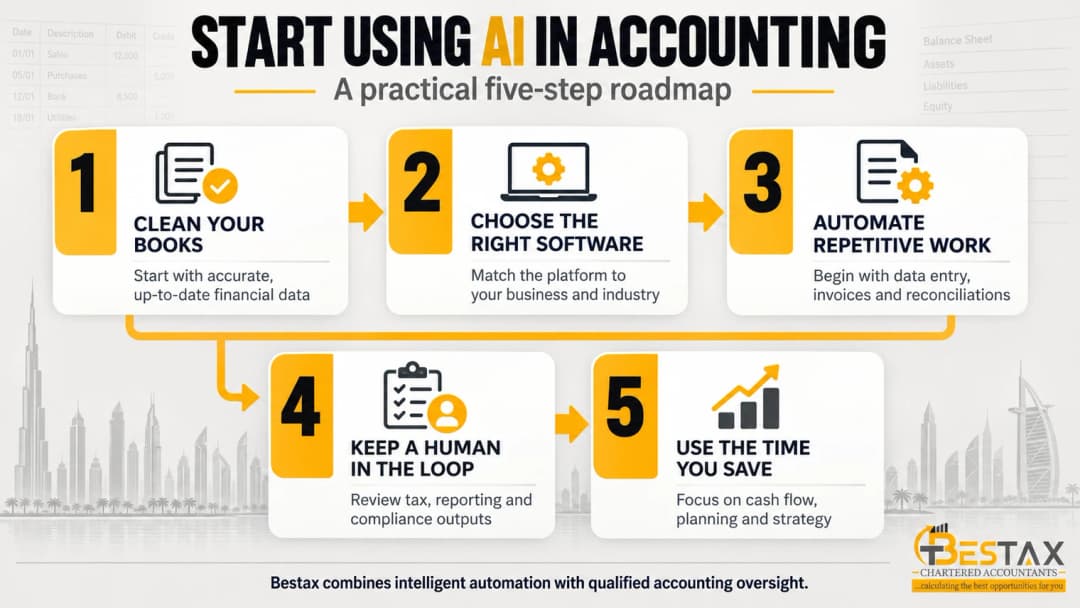
You do not need to overhaul everything at once. A practical path looks like this:
- Get your books clean first. AI amplifies whatever data you feed it, so up to date records are step one. If you are behind, backlog accounting brings you current before you automate.
- Choose the right software. Match a platform such as Zoho Books, QuickBooks, Xero, or Tally to your size and industry, then configure it properly.
- Automate the repetitive work. Start with data entry, reconciliations, and invoicing, where the gains are fastest.
- Keep a human in the loop. Have a qualified accountant review outputs, especially for tax, reporting, and anything compliance related.
- Use the time you save. Redirect freed up hours into planning, cash flow, and strategy, ideally with CFO level advisory support.
This is exactly the kind of work Bestax Chartered Accountants handles for businesses every day. With more than ten years of experience, a team of over thirty five professionals, and more than a thousand companies supported across offices in the UAE, Canada, the USA, and Panama, we help you adopt the right tools without losing the human oversight that keeps you compliant. Clients consistently rate the experience as excellent across close to two hundred Google reviews, describing the team as professional, responsive, and thorough with everything from bookkeeping to Federal Tax Authority matters.
Conclusion
AI in accounting has crossed the line from novelty to necessity in 2026. The official data is consistent across sources: adoption is rising quickly, time savings are real, costs are falling, and the skills that define a great accountant are shifting toward analysis and advice. The businesses that win are the ones that pair smart automation with experienced professionals who know how to use it responsibly.
If you want to modernise your finance function without adding risk, now is the time to act.
Ready to Bring AI Into Your Accounting?
Talk to the team at Bestax Chartered Accountants. We help UAE businesses set up AI powered accounting, choose and configure the right software, and stay fully compliant with corporate tax, VAT, and audit requirements, all with real chartered accountants overseeing the work.
Book your free accounting consultation with Bestax or get in touch with our team to see how much time and cost you could save.
Frequently Asked Questions
What is AI in accounting?
AI in accounting is the use of artificial intelligence to automate and improve financial tasks such as bookkeeping, data entry, reconciliations, reporting, fraud detection, and tax preparation. It handles repetitive work and flags issues, so accountants can focus on analysis and advice.
How is AI used in accounting and finance?
AI is used to capture and code invoices, reconcile bank statements, generate financial reports, forecast cash flow, detect fraud, and speed up tax research and return preparation. Modern platforms such as Zoho Books, QuickBooks, Xero, and Tally build much of this automation directly into everyday accounting.
Will AI replace accountants in 2026?
No, AI is not replacing accountants, but it is changing what they do. Routine and clerical tasks are being automated, while demand is rising for professionals who can interpret data, advise clients, and oversee the technology. Accountants who adopt AI are expected to thrive rather than be replaced.
Is AI in accounting accurate and safe?
AI can be highly accurate and reduce human errors, but it is only as reliable as the data it learns from and the oversight around it. Sensitive financial data needs strong security, and a qualified accountant should always review outputs, especially for compliance and complex decisions.
What are the benefits of AI in accounting?
The main benefits are greater efficiency, higher accuracy, real time visibility into your finances, stronger fraud detection, lower long term cost, and better decision making. In short, it saves time and reduces errors while freeing your team for higher value work.
What are the risks of using AI in accounting?
The key risks are the cost of setup, data privacy and security concerns, potential bias in algorithms, poor results from low quality data, and over reliance on automation without human review. Responsible adoption with expert oversight keeps these risks in check.
Which accounting software uses AI?
Widely used platforms that include AI and automation features are Zoho Books, QuickBooks, Xero, and Tally. The best choice depends on your business size, industry, and compliance needs, which is why professional setup often delivers the fastest results.
Can AI do bookkeeping?
Yes, AI can automate much of bookkeeping, including capturing invoices and receipts, coding transactions, and reconciling accounts. It works best when your records are clean and a professional reviews the output to ensure everything is accurate and compliant.
How does AI help detect fraud in accounting?
AI uses machine learning to monitor transactions continuously and spot unusual patterns, anomalies, and suspicious journal entries far more reliably than manual sampling. This strengthens internal controls and helps catch problems early, though it works best alongside human oversight.
Is AI accounting suitable for small businesses?
Yes, small businesses can benefit greatly because automation reduces manual work, lowers the chance of errors, and gives a clear view of cash flow without a large finance team. Cloud accounting software makes AI features affordable and accessible for smaller companies.
How is AI changing accounting in the UAE?
The UAE has made AI a national priority through its National Strategy for Artificial Intelligence 2031, and finance sits at the centre of that plan. For UAE businesses, AI makes it easier to keep accurate, audit ready records for corporate tax and VAT while improving efficiency and reducing errors.
Do I still need an accountant if I use AI?
Yes, you still need a qualified accountant. AI handles the repetitive work, but a professional is essential for interpreting results, giving advice, and ensuring your reporting and tax filings meet regulatory requirements. The best outcome comes from combining AI with human expertise.

Sophia Müller is a corporate tax consultant with over years of experience advising businesses across Europe and the UAE. She specializes in tax strategy and compliance, helping multinational companies reduce tax risks and follow local regulations.
Learn More About Sophia