



Stop UAE VAT surprises. Understand input vs output VAT, track with a VAT control account, and keep a proof pack that matches your return totals every month
VAT mistakes rarely look dramatic on day one. They show up later as a bigger payment than expected, a rejected input claim, or a return that does not match your records. Most of the time, the cause is simple: people mix up input VAT and output VAT, then guess the totals from bank deposits or rough spreadsheets.
This guide keeps it practical. You will learn the difference, how it flows into UAE VAT returns, and a clean way to track it each month, so you do not end up fixing old periods. By the end, you will know what you owe, what you can recover, and what proof to keep if you are ever asked.
Value Added Tax Basics
VAT is a tax added to most taxable sales and services. In the UAE, VAT started on 1 January 2018 at a standard rate of 5%. Businesses handle VAT because they collect VAT on sales, and you may recover VAT on eligible costs. The simple idea is this: VAT is “collected” on sales and “paid” on purchases, then you report the difference in your VAT return.
What Is Output VAT in UAE? (The VAT you charge on sales)
Output VAT is the VAT you add to taxable invoices you issue to customers. It shows up on sales invoices, POS receipts, and even credit notes when you need to reduce a past sale.
The most important mindset shift is this: output VAT is not your income. It is money you collect on behalf of the government. If you treat it like revenue, you can spend it by mistake and feel pressured at filing time.
Here is a quick example. You sell a service for AED 1,000 (before VAT). You charge VAT, so the customer pays AED 1,050. That extra AED 50 is output VAT. It is not profit, and it should not be mixed with your operating cash.
What Is Input VAT in UAE? (The VAT you pay on business purchases)
Input VAT is the VAT included on supplier invoices and eligible business costs. If you are VAT-registered and the purchase supports taxable business activity, you may be able to recover it through your VAT return.
This is where people get caught. Not every expense is recoverable, and paperwork quality matters. In general, you need proper documentation, and the VAT must be paid or intended to be paid for recovery to apply.
For example, you buy office equipment for AED 2,000 plus VAT. You pay AED 2,100. That AED 100 is input VAT. If the purchase is eligible and documented correctly, it can reduce what you owe.
The Net VAT Formula
The simplest way to think about VAT is one line:
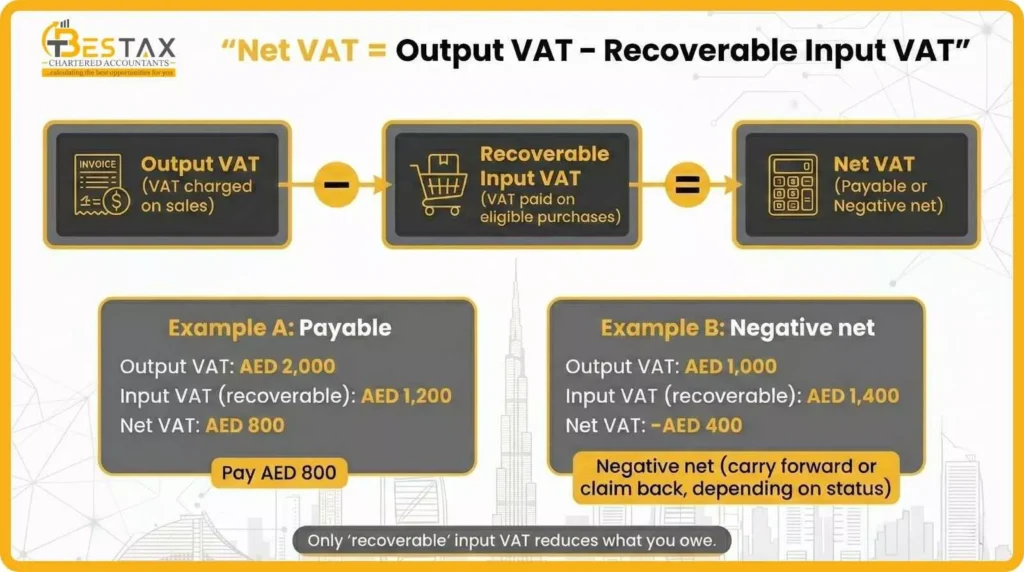
Net VAT = Output VAT – Recoverable Input VAT
What the result means:
- If the number is positive, you pay the difference.
- If the number is negative, you may carry it forward or claim it back, depending on your filing position and rules.
The word “recoverable” matters. Input VAT only helps you if you are allowed to claim it and can support it with valid documents.
The VAT Return Map
Most articles stop at definitions. The real problems happen when you try to file. This is the missing layer that helps you file cleanly.
Use this flow every month:
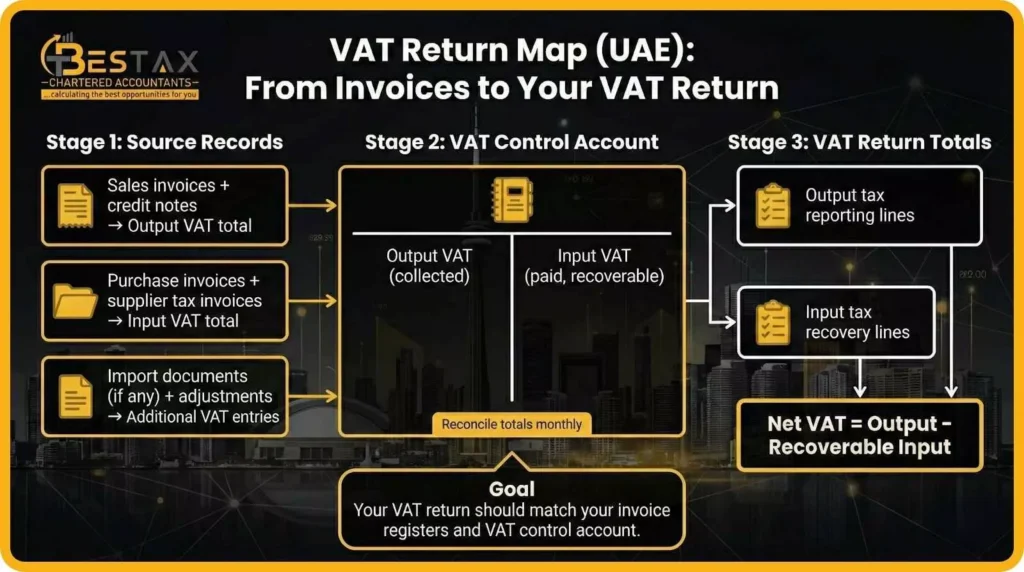
- Sales invoices + credit notes → build your output VAT total
- Purchase invoices + import documents → build your input VAT total
- Adjustments (credit notes, reverse charge, corrections) → reach your final net VAT
Now add a simple “where does it go” guide: output VAT belongs in the output tax reporting lines, while input VAT belongs in the input tax recovery lines. The goal is not just to file. The goal is that your VAT return totals match your invoice registers and your internal VAT tracking.
One practical note: at the end of each tax period, VAT-registered businesses must submit a VAT return to the Federal Tax Authority. That makes monthly tracking easier, because you are not trying to rebuild the story later.
VAT Control Account Method
If you want fewer mistakes and faster filing, use one simple idea: a VAT control account. It is one place in your accounting that holds VAT collected and VAT paid.
This is where you track input VAT and output VAT as two running totals. Output VAT increases what you owe, and input VAT reduces it when it is recoverable. At month-end (or period-end), you clear the control account based on the VAT return result.
Why this works is simple. It forces you to reconcile, not guess. It also makes it easier to show your numbers if a bank, an auditor, or the tax authority asks how you arrived at your return totals.
Real-World Scenarios People Get Wrong
The most common mistakes come from normal business situations, not complex ones.
First, VAT-inclusive vs VAT-exclusive pricing. A quote that says “AED 10,000” can mean two different things depending on whether VAT is included. If your team invoices one way and your accounting assumes the other, your output VAT total can swing without anyone noticing until filing.
Second, blocked or personal expenses. Some purchases feel “business-related” but still do not qualify for recovery. When your team claims everything without checking eligibility, it can inflate input VAT and create risk later. The safest approach is to classify expenses early, then only claim what you can support.
Third, mixed activity. If a business has taxable and exempt activity, input VAT recovery can become limited or require careful allocation. The risk is not that you claimed input VAT. The risk is claiming it as if all activity is taxable.
Fourth, timing mismatch. Many teams build VAT totals from payment dates because bank statements are easy. VAT totals should follow tax invoices and supply timing, not bank timing. Bank deposits can include loans, owner transfers, and old payments that do not belong in the period.
Finally, credit notes. If you refund a customer or discount a past invoice, your output VAT should reduce with it. People often record the credit note in sales, but forget to adjust VAT totals, which makes the return inconsistent.
Reverse Charge: The “Both Input and Output” Situation
Reverse charge is the situation that confuses people the most, because it can affect both sides.
In simple terms, sometimes you must account for VAT as if you sold something, even when you bought from abroad. That can create output VAT reporting, and if you qualify, it can also create input VAT recovery in the same period. The key is eligibility and documentation, not guesswork.
What proof matters most is clear import documentation, contracts that describe the supply, and records that show the purchase supports taxable business activity. When you keep those records clean, reverse charge becomes a reporting step, not a panic moment.
The Proof Pack
If you ever need to defend a VAT return, the proof pack matters more than explanations. Keep these items tidy and easy to retrieve:
- Sales tax invoice register (including credit notes)
- Purchase tax invoices and supplier details
- Import documents (if applicable)
- Contracts or evidence for business use (for higher-risk claims)
- A one-page reconciliation: VAT return totals vs invoice registers vs VAT control account
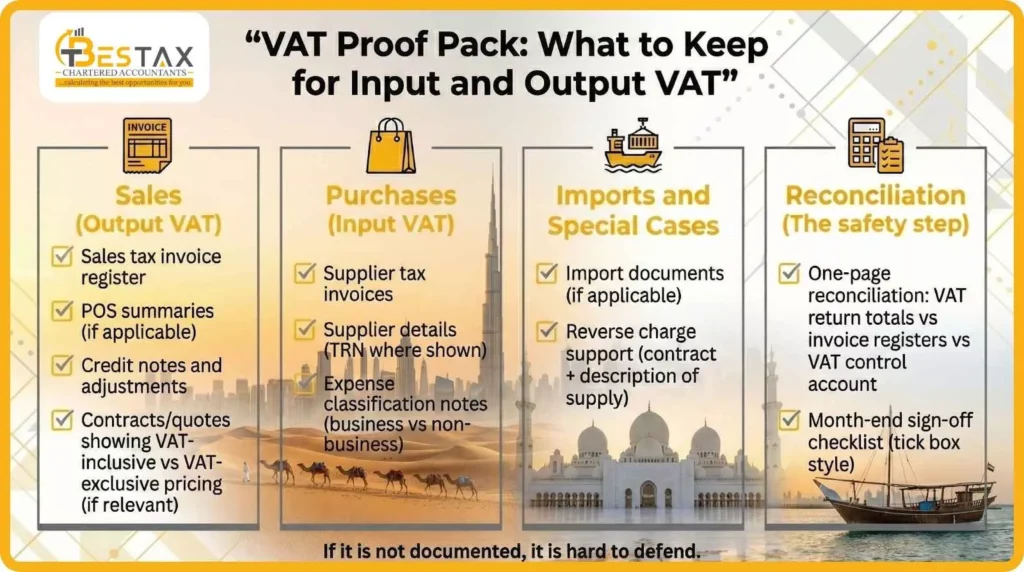
This supports the basic recovery expectation: you should have a tax invoice or supporting documents, and the VAT should be paid or intended to be paid for recovery to apply.
Common Mistakes and How to Avoid Them
Here are the fastest fixes that prevent the most pain later:
- Do not use bank deposits to calculate VAT totals. Use invoices and credit notes.
- Do not claim input VAT without valid tax invoices and supporting documents.
- Do not ignore credit notes and adjustments. They change the output VAT.
- Do not over-claim input VAT for exempt or non-business use.
- Do not skip reconciliation. Your VAT return should match your VAT control account and invoice registers.
One extra situation worth mentioning is business closure. During the liquidation process in UAE, VAT records still need to be consistent, because VAT issues can slow final clean-up. If you are in a company liquidation in UAE, keep your VAT proof pack organized alongside your closure documents, such as a liquidation report and, where issued by the relevant authority, a liquidation certificate.
Concluding Remarks
Output VAT is what you charge. Input VAT is what you pay. The difference is what you settle through your VAT return.
If you want fewer errors, do not rely on memory or bank statements. Use the VAT return map, track it through a VAT control account, and keep a proof pack that matches your totals. That is the clean, repeatable system that holds up over time.
If you want a careful review before VAT filing or before a business closure, Bestax Chartered Accountants can help you reconcile your VAT records, tighten your proof pack, and file with confidence, without turning each period into a scramble.
Quick FAQs
What is the difference between input VAT and output VAT in one line?
Output VAT is what you charge customers on taxable sales. Input VAT is what you pay on eligible business purchases and may recover.
Can I claim input VAT on every business expense?
No. Input VAT is only recoverable when the purchase supports taxable business activity, and you have valid documents to support the claim.
Why does output VAT feel like “extra cash” but is not?
Because it comes in with customer payments, but it is not revenue. It is a tax you hold until you file and pay.
What happens if my input VAT is higher than output VAT?
Your net VAT can become negative. Depending on your filing position and rules, it may carry forward or become refundable.
How do credit notes affect output VAT?
Credit notes reduce taxable sales and reduce output VAT. If you record the credit note but do not adjust VAT totals, your return can mismatch your records.
Disclaimer: The information provided in this blog is for general informational purposes only. For professional assistance and advice, please contact experts.
