



Thousands of businesses delay operations every year because one document is missing: the certificate of incorporation. It happens during the busiest stage, when you are trying to open a bank account, apply for visas, sign a lease, and start invoicing. The confusion usually starts with three traps: picking the wrong jurisdiction, submitting the wrong documents, or underestimating “hidden” approvals that come later. This 2026-ready guide breaks the whole process into clear steps, shows what each authority looks for, and helps you avoid delays that cost time and money. By the end, you will know what to prepare, where to apply, and how to launch faster with compliance handled properly.
Choose your jurisdiction, get trade name approval, prepare MOA/AOA, submit for approval, then collect the incorporation document and related licence outputs once issued.
What Is a Certificate of Incorporation in the UAE and Why Does It Matter
In simple terms, this document is your company’s official “birth certificate.” It proves the business is legally formed and registered under the right authority. If you are asking what a certificate of incorporation is, the shortest answer is: it is the document that confirms your company exists as a recognized legal entity.
Why it matters is practical, not theoretical. Banks often ask for it to verify your entity details before opening a corporate account. Government and immigration processes use it to confirm the company identity behind visa applications. It also supports contracting, especially when a client wants proof that your company is properly formed.
This is also where many founders mix up documents. A trade licence is permission to carry out a specific activity, while the incorporation document is proof that the legal entity has been created. UAE company law includes an “issuance of incorporation certificate” step after required formation documents are completed, which is exactly why this document sits at the centre of your setup process.
If you want a clean setup that banks and authorities understand quickly, the second key benefit is clarity: a properly issued certificate of incorporation reduces back-and-forth because it standardizes your company details across systems.
Mainland vs Free Zone vs Offshore: Where Your COI Comes From
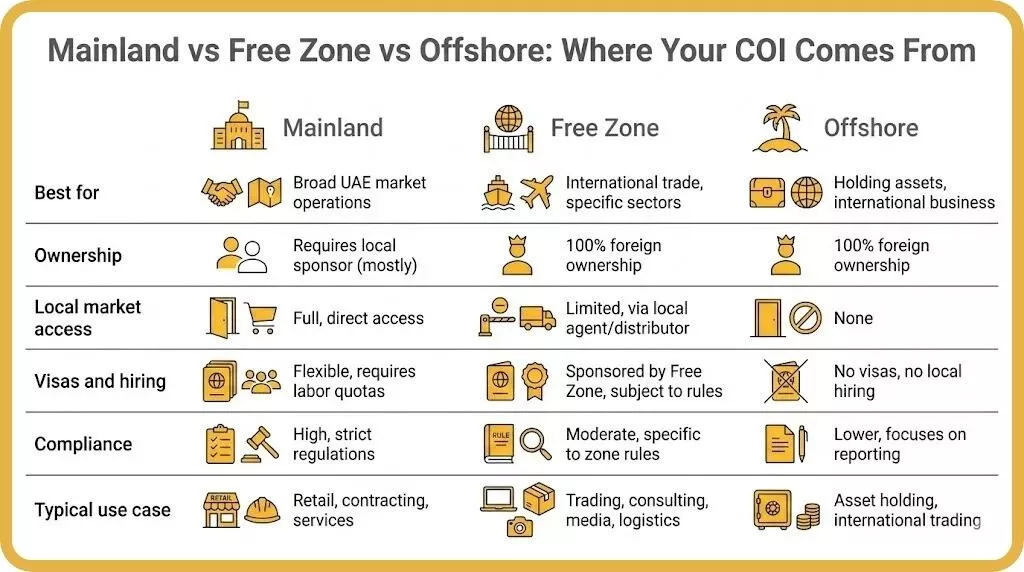
Your COI is issued by the authority that registers your company, and that depends on the jurisdiction you choose. The biggest mistake founders make is choosing a jurisdiction based only on price, then discovering it does not fit banking, visas, or the way they plan to trade.
- Mainland: You register through the relevant economic authority in the emirate. Mainland structures are often chosen when you want to trade directly in the local market, sign a wide range of contracts, and scale hiring.
- Free zone: Your company is registered with a free zone authority. The UAE has more than 40 multidisciplinary free zones, and they are built to support different industries and investor needs.
- Offshore: generally used when the goal is holding assets, owning shares, or specific international structuring needs. Offshore setups often have different operating limits and may not be ideal if you need local visas and a physical operating footprint.
Ownership is often the deciding factor for foreign investors. The UAE Government confirms that full foreign ownership is allowed for many commercial companies under the updated framework, subject to the activity and rules of the licensing authority.
A simple way to choose: if you need local trading flexibility and broader contracting, the mainland often fits. If you want packaged setup options and zone-specific benefits, free zones can fit. If your goal is holding and structuring rather than operating, offshore may fit.
Step-by-Step Process to Obtain a COI in the UAE (2026)
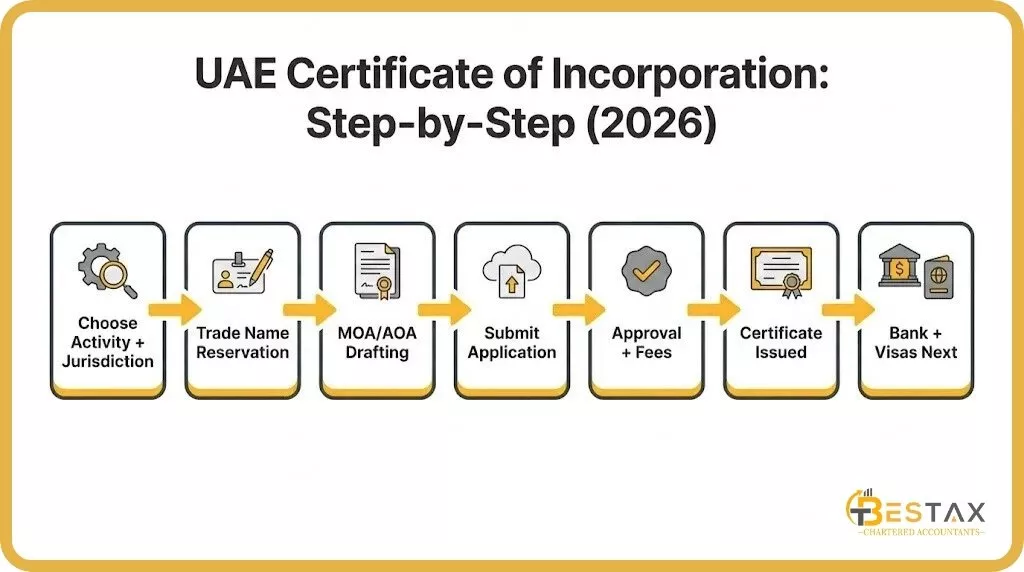
This is the clean, repeatable path most authorities follow. Your exact steps vary slightly by jurisdiction, but the logic is consistent. Use this as your working checklist.
Step 1: Select business activity and jurisdiction
Match your activity to where you want to operate, hire, and bank. Do not pick a jurisdiction first and “force” an activity later.
Step 2: Reserve a trade name
Name rules differ by authority. The faster you align name, activity, and legal form, the fewer resubmissions you face.
Step 3: Prepare MOA/AOA and shareholder structure
Your Memorandum and Articles define ownership, management, and decision rules. In most setups, errors here create the longest delays because fixes can trigger re-approval.
Step 4: Submit the application to the issuing authority
You submit your forms and documents for initial approval, then final approval once requirements are met.
Step 5: Pay fees and complete signing
Depending on the authority, this can include e-signing, in-person signing, or additional attestations.
Step 6: Collect your COI and related outputs
Once approved, you receive the incorporation document and proceed with the next operational steps, like visas and banking.
For timing, UAE company law notes that once the required formation documents are completed, the authority issues the incorporation certificate within five working days in that legal context. Real timelines still depend on completeness and any extra approvals.
If you are eligible for unified digital services, the UAE Government also highlights “Bashr,” an integrated service that can enable company establishment within 15 minutes for certain cases, which shows how much speed depends on choosing the right pathway and being document-ready.
Documents Required to Get a UAE COI
Most applications fail for boring reasons: mismatched names, missing pages, and unclear ownership details. Prepare your documents as a single pack, with consistent spelling across every file.
Here is a practical document that most founders need:
- Passport copy for each shareholder and manager
- Visa copy or entry stamp (if applicable)
- Emirates ID (if applicable)
- Shareholder details (address, contact, share split)
- Draft MOA/AOA (as required by authority)
- Proof of address or lease details (jurisdiction-dependent)
- NOC or sponsor-related documents (only if required for your case)
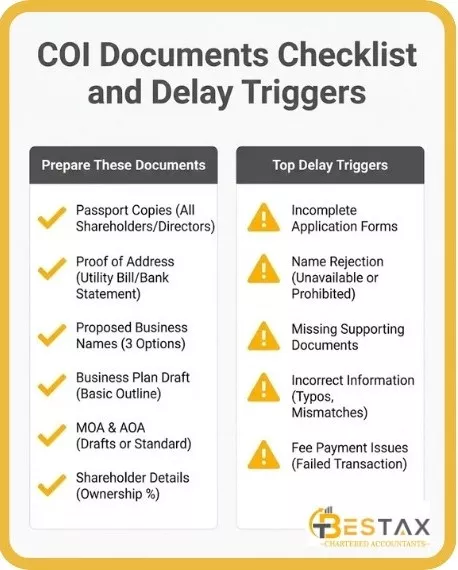
Mistakes that cause delays are easy to avoid: using different signatures across documents, submitting low-quality scans, and having the trade name spelled differently between forms and MOA.
If you are building your setup for banking, also keep a short “company profile” ready: activity summary, owner background, expected revenue sources, and contract types. It often speeds up the next stage.
Common Mistakes That Delay COI Approval
Most delays are predictable, and that is good news because it means you can prevent them.
- Mistake 1: Choosing an activity that does not match real operations. If your invoices, contracts, or marketing do not align with the licensed activity, you may face approvals and banking friction later.
- Mistake 2: Picking the wrong jurisdiction for the goal. A founder chooses a jurisdiction for cost, then discovers it does not support their hiring plan, office needs, or market access.
- Mistake 3: Incomplete or inconsistent documentation. Even small mismatches in names, passport numbers, or share percentages can trigger resubmission.
- Mistake 4: Treating MOA/AOA as “just paperwork.” These documents define control and authority. When they are unclear, the authority can request corrections, and that costs time.
- Mistake 5: Not planning visas and banking early. Visa quotas, office requirements, and bank onboarding questions can all affect how you structure the setup from day one.
The safest approach is to work backwards from your operational plan: where you will sell, who you will hire, how you will bank, and what contracts you need to sign in the first 90 days.
How Businesses Secure Faster Approval With Expert Setup Support
Founders usually seek expert help for one reason: speed without mistakes. The UAE setup process is not hard because it is secret, but because details change by jurisdiction, activity, and authority expectations.
Good setup support is not about “filling forms.” It is about preventing rework by doing three checks upfront: activity-to-jurisdiction fit, document readiness, and signing requirements.
Here is what professional support typically improves:
- A correct pathway choice (mainland vs free zone vs offshore) based on your operating plan and ownership needs, including full foreign ownership rules where applicable.
- A clean document pack with consistent details, so approvals do not bounce back.
- Faster movement through digital or standard channels when you qualify, including services designed for quicker establishment in certain cases.
If your goal is a fast launch with fewer surprises, expert review acts like insurance against preventable delays.
Conclusion
A fast business launch in the UAE is rarely about luck. It is about choosing the right jurisdiction, preparing a clean document pack, and following the authority’s sequence without gaps. If you align your activity, name, MOA/AOA, and submission details from the start, you avoid the most common delays and move to banking and visas with confidence.
If you want a reliable, compliance-first setup, Bestax Chartered Accountants Dubai can guide the process end-to-end, focusing on accurate documentation, correct jurisdiction selection, and smoother approvals without unnecessary rework.
Quick FAQs
What is a certificate of incorporation, and do I need it to start operating?
It is proof that your company is legally formed. Many banks and authorities use it to verify your entity before key steps like account opening and certain approvals.
Is a trade licence the same as a certificate of incorporation UAE?
No. The trade licence permits business activity, while the incorporation document proves the legal entity exists and is registered under the issuing authority.
How long does it take to receive the incorporation document?
Timelines depend on the authority and document completeness. UAE company law references issuance within five working days once required documents are completed, but real-world timelines vary with approvals and corrections.
Do free zones allow full foreign ownership?
Yes. The Ministry of Economy and Tourism notes that free zones enable full ownership for foreign investors, and the UAE has more than 40 of them.
Can I get the company setup done quickly through a government digital service?
In certain cases, yes. The UAE Government describes “Bashr” as a unified service that can enable business establishment within 15 minutes for eligible setups.
Disclaimer: The information provided in this blog is for general informational purposes only. For professional assistance and advice, please contact experts.
