



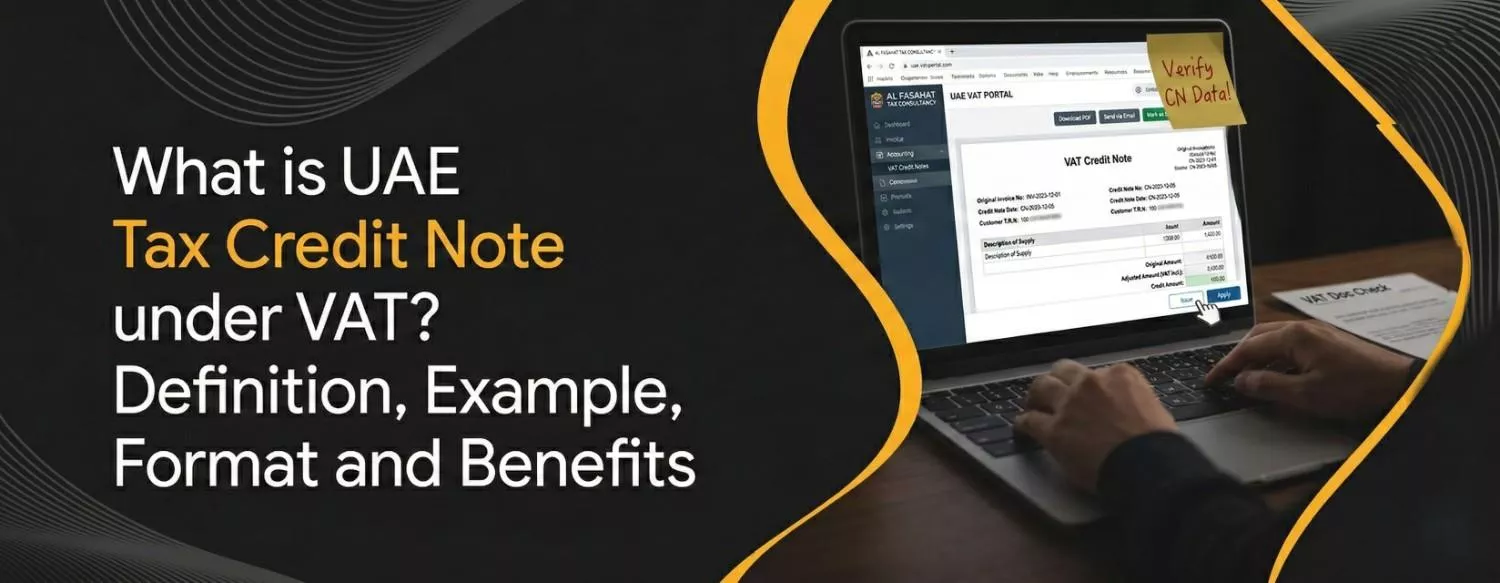
Many businesses do the “nice” thing first. They issue a refund or give a discount. Then they forget the VAT paperwork step. Weeks later, the VAT return does not match the books. The customer ledger looks right, but the tax trail is broken. That is when small adjustments turn into long, clean-up work.
This guide shows you how to handle a tax credit note properly in the UAE. You will learn what it is, when to issue it, the format rules, a worked example, and the benefits for compliance and cash planning.
Two quick facts show why this matters. VAT started across the UAE on 1 January 2018 at a standard rate of 5%.
Key 2026 Rules Most Guides Miss and Why They Matter
If you only remember one thing, remember this: a credit note is not just an accounting adjustment. It is a compliance document with timing and content rules.
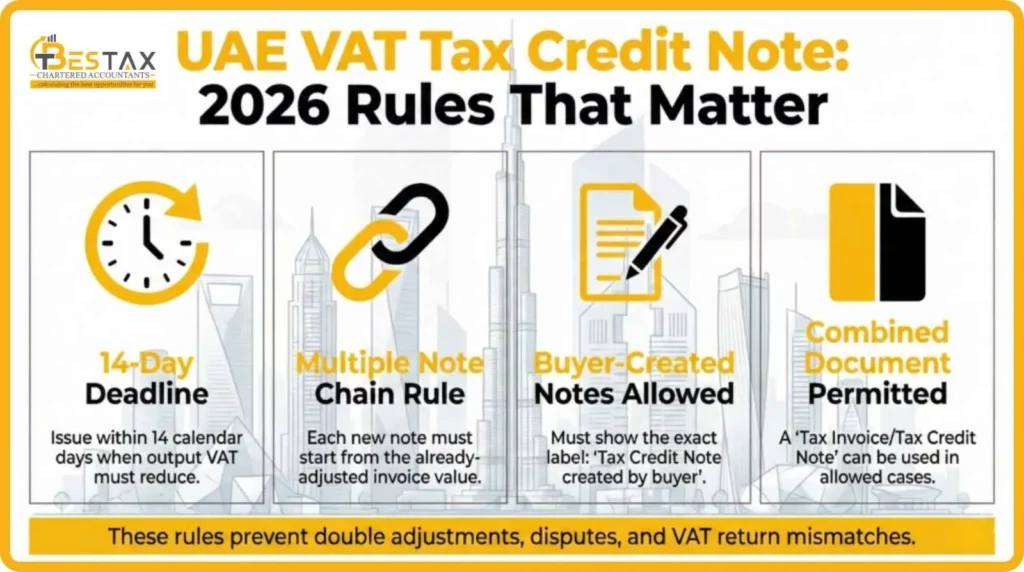
- There is a 14-calendar-day deadline for issuing the document in specific cases where output tax must be reduced after the date of supply under Article 61 situations.
- If you issue more than one credit note against the same invoice, later notes must reflect the already adjusted invoice value, not the original value again.
- Buyer-created credit notes are allowed under conditions and must clearly show the wording “Tax Credit Note created by buyer.”
- A combined document labelled Tax Invoice/Tax Credit Note is permitted for different supplies in the cases covered by the FTA decision.
These points matter because they prevent double adjustments, rejected records, and return mismatches.
Definition of a UAE Tax Credit Note Under VAT
A UAE VAT credit note is the document used to reduce or adjust the value and VAT previously reported on a tax invoice. It links directly to the original invoice, so the audit trail stays intact.
It is not only a refund message. It is not proof of a bank transfer. It is not a casual “credit memo” without VAT fields. A refund can happen with or without proper documentation, but VAT reporting needs the document trail.
The purpose is simple: it keeps output VAT and input VAT reporting accurate and consistent with the original invoice history. That protects both parties. The supplier does not overstate VAT due, and the customer does not over-claim VAT input.
When a Tax Credit Note is Required Under UAE VAT
Most owners recognize the triggers immediately because they happen in daily operations.
A credit note is usually required when any of these happen after an invoice is issued: a return, a cancellation, a post-invoice discount, a pricing error, a wrong VAT treatment, or a partial refund.
Here is the decision rule you can use every time. If the original tax invoice value or VAT must go down, the credit note is the correct document to show that reduction.
One practical checkpoint saves time: confirm the original invoice number, date, and customer details before drafting anything. Most delays come from the simple issue of “we cannot clearly link the adjustment to the invoice.”
The 14-Day Issuance Rule and How To Stay On Time
The deadline is not meant to scare you. It is meant to keep records current. Once you know an invoice needs a reduction that affects VAT, do not let the issue sit in someone’s inbox.
A practical workflow that works in most businesses looks like this:
Start by identifying the trigger date. That can be the date the goods are returned, the service scope is reduced, or the post-invoice discount is approved. Then approve the adjustment internally. Keep it short: one email or one approval note is enough. Next, issue the credit note and send it to the customer. After that, update the sales ledger and the customer statement in the same week.
A simple prevention step is a weekly “credit note queue.” One person owns it. They review returns, cancellations, and discounts every week and close the loop. This one habit reduces end-of-month surprises and makes VAT returns calmer.
Format of a UAE Tax Credit Note Under VAT
A strong credit note format is not about design. It is about clarity. Your document should explain three things without debate: what invoice it relates to, what changed, and why it changed.
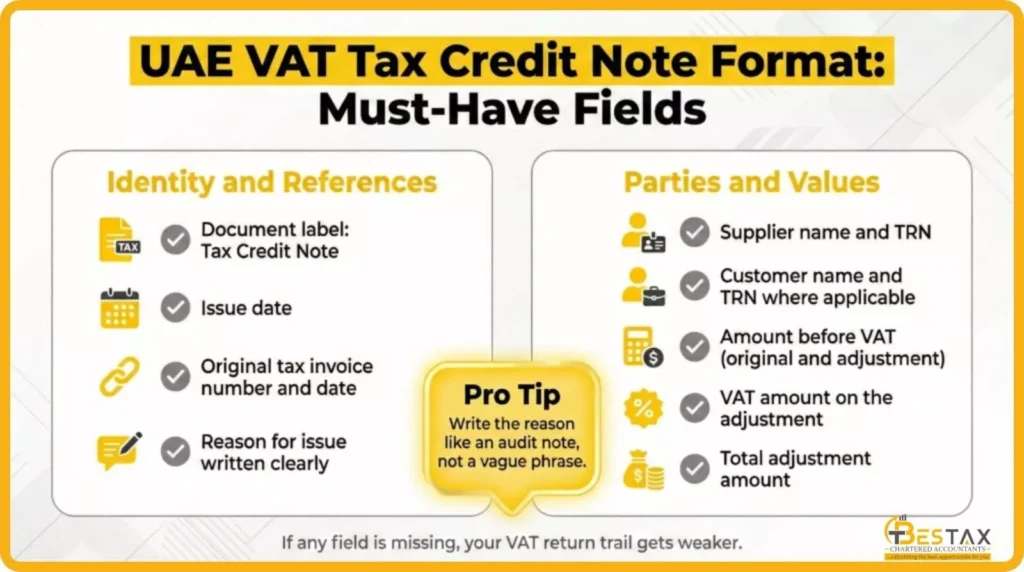
Use this checklist as your base credit note format:
- Clear label that it is a VAT credit note
- Issue date
- Original tax invoice reference
- Supplier details and TRN
- Customer details and TRN, where applicable
- Original value, corrected value, and the difference
- VAT amount on the difference in AED
- A clear reason for issuing the note, written like an audit note
That last point matters more than people think. “Adjustment” is vague. “Return of 5 units due to defects, linked to invoice X” is clear and defendable.
Advanced Compliance Rules That Prevent Rejection and Disputes
These are the rules that save you when you issue more than one adjustment, work with large buyers, or run high-volume billing.
First, treat multiple credit notes like a chain, not separate events. If you issue a second credit note for the same invoice, it should start from the already adjusted value. This avoids double reduction.
Second, buyer-created credit notes exist for a reason. Some large buyers want tight control of their AP process. If the buyer creates the document on behalf of the supplier, the wording must be shown exactly, and both sides must keep records aligned.
Third, combined Tax Invoice/Tax Credit Note documents are allowed in specific situations, but only when the labelling and separation are clear. This is useful when you have many adjustments across different supplies and want clean documentation, not scattered paperwork.
One internal control reduces most mistakes: any credit note that changes VAT treatment should be approved by one owner in finance, not only by sales.
Example of a UAE Tax Credit Note With Numbers
Here is a simple example you can follow.
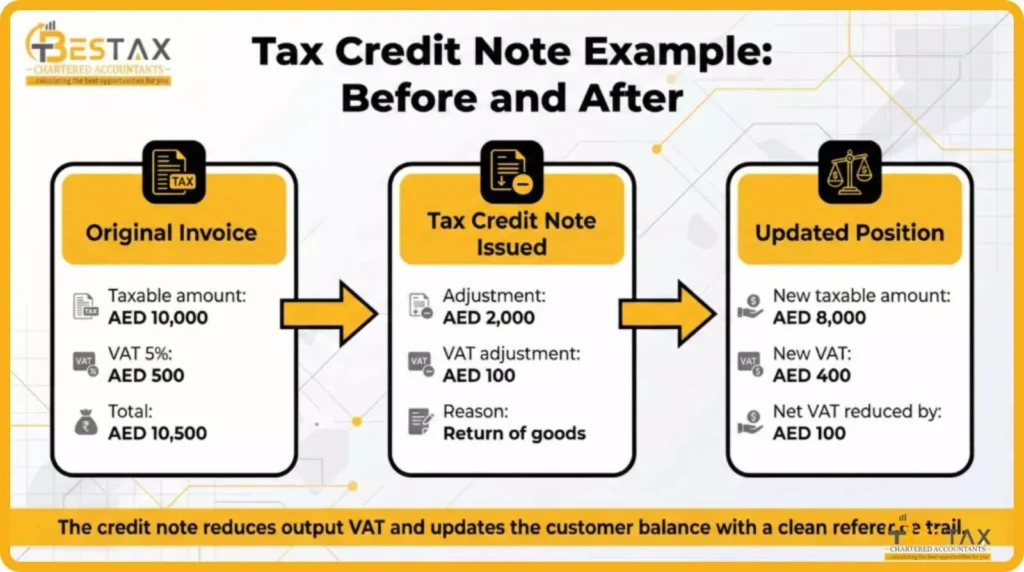
You issue an invoice for AED 10,000 for taxable goods. VAT at 5% is AED 500. Total invoice is AED 10,500. The customer returns goods worth AED 2,000 because of damage. You issue a credit note for AED 2,000 plus VAT of AED 100. That reduces the taxable value and reduces VAT due by AED 100.
Before and after view: the original VAT was AED 500. After the credit note, the effective VAT stays consistent with the new net supply value. Your customer balance is also corrected, with a clear reference to the original invoice.
Micro example for partial discount: you invoice AED 5,000 plus VAT. Later, you agree on a post-invoice discount of AED 500. The credit note shows the AED 500 reduction and the related VAT reduction. It is not all-or-nothing. Partial adjustments are normal.
How Credit Notes Change VAT Returns and Internal VAT Tracking
A credit note is not only a customer document. It is a VAT reporting event.
The reporting flow is simple. You issue the invoice and record output VAT. Then you issue the credit note and reduce output VAT for the relevant period by the VAT amount shown on the note, based on your reporting method.
The bookkeeping flow is also clear. You reduce sales in the ledger (or record it as a sales return/adjustment), reduce the customer receivable balance, and adjust the VAT control account so your return totals match.
Your reconciliation step should be routine. The list of credit notes issued for the period should match the adjustments you reflected in the VAT return and match the customer statements. If any of these three do not match, you will spend time later finding the gap.
If your credit notes, invoice register, and VAT return do not match, VAT return filing services in the UAE can help you reconcile and file correctly.
Benefits of Using a UAE Tax Credit Note Correctly
This is the section where the benefits become real, not theoretical.
When you use a tax credit note correctly, your VAT return numbers match your invoice trail. That reduces mismatch risk and keeps your filing story consistent.
Your customer also benefits because the balance is corrected cleanly, with a clear reference trail. This matters in B2B relationships where AP teams need clean documentation.
Cash planning is another hidden win. When credits are recorded on time, you forecast VAT payable more accurately. You also avoid the unpleasant moment when you discover you overpaid VAT because an adjustment was never properly documented.
Finally, disputes drop. A clear reason and reference stop the “we never agreed to this” problem. The document becomes a shared record of what changed and why.
Common Mistakes and Quick Fixes
Most issues come from a few repeat patterns. The biggest mistake is issuing a refund without issuing the VAT credit note. Later, the business tries to “fix” it solely through journal entries. That is when the tax trail breaks.
If you want to avoid repeat errors, review these common VAT filing mistakes in the UAE and fix them before the next return.
Another common mistake is missing the original invoice reference or using an incorrect TRN. Even if the numbers are correct, the link is weak, and the document becomes hard to defend.
Late issuance is also common. Teams wait until the month-end, then rush. A weekly review queue fixes this.
The quick-fix approach is practical: keep one standard template, one checklist tied to the format section, and require one approval for VAT-impacting changes.
Recordkeeping Proof Pack For 2026
A proof pack is what makes adjustments easy to explain later. Keep it simple.
- The original invoice and the credit note
- Evidence of why the adjustment happened, such as a return note, cancellation email, or discount approval
- Any proof of return or cancellation that supports the reason
- A period-based register of all credit notes with invoice references and reasons
- A one-page reconciliation tying credit notes to VAT return adjustments and customer statements
This is not about paperwork for its own sake. It is about having answers ready when someone asks, “Why did VAT change?”
Final Note
Credit notes look small, but they affect VAT returns, customer balances, and your audit trail. The best approach is boring and consistent: decide quickly, document clearly, and reconcile monthly.
If you want a second set of eyes on your template, your credit note register, or your VAT return alignment, Bestax Chartered Accountants Dubai can review your records and help you keep the filing trail clean without overcomplicating the process.
If you want support that reduces filing risk, a tax agent in Dubai can review your credit note trail and VAT reporting before submission.
Quick FAQs
What is a UAE VAT credit note in one sentence?
It is the VAT document used to reduce or adjust the value and VAT on an already issued tax invoice.
When does the 14-day rule apply?
It applies in situations where output tax must be reduced after the date of supply in the relevant cases. The safest practice is to issue quickly once the trigger is confirmed.
Can a customer issue a credit note on behalf of the supplier?
Yes, buyer-created credit notes are allowed under conditions, and the required wording must be shown clearly.
Can I issue multiple credit notes for one invoice?
Yes, but later credit notes must be based on the already adjusted value, not the original invoice value again.
Can I combine a tax invoice and a credit note in one document?
Yes, a combined Tax Invoice/Tax Credit Note document is permitted in specific cases when clearly labelled and separated.
Disclaimer: The information provided in this blog is for general informational purposes only. For professional assistance and advice, please contact experts.
