


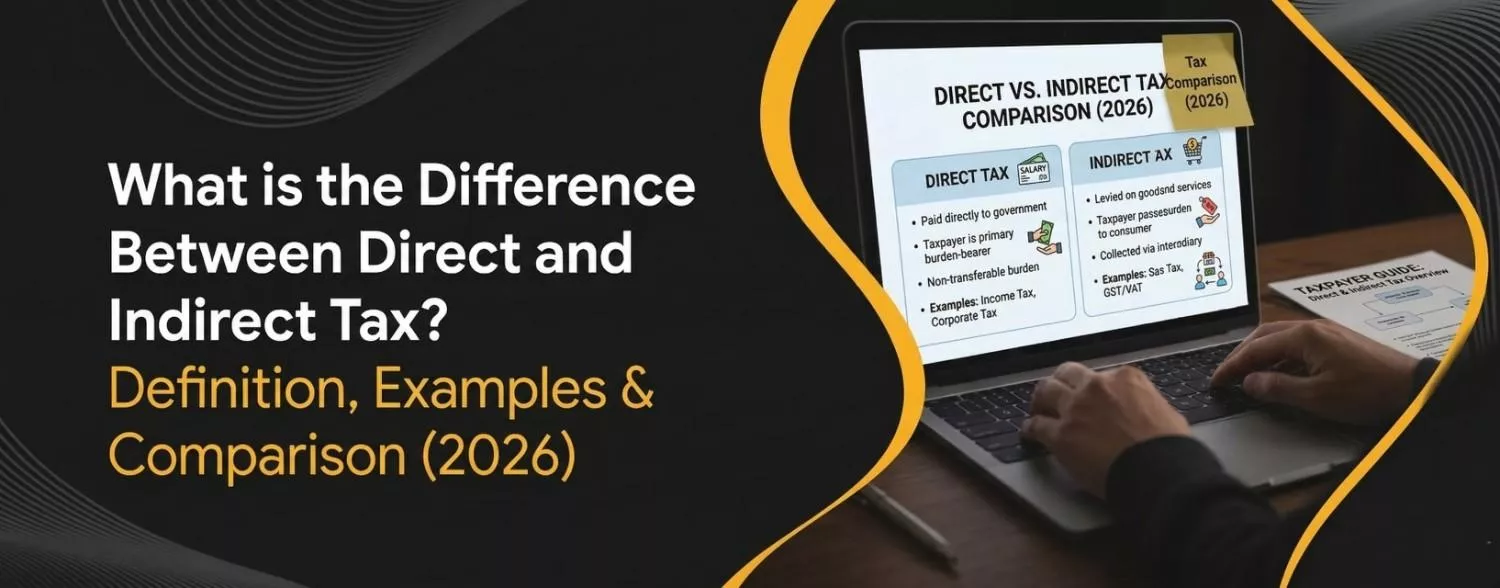
Taxes are not just “something the government takes”. They are also a design choice: who pays, when they pay, and whether the cost can be pushed to someone else. If you run a business in Dubai, Abu Dhabi, Sharjah, or anywhere across the Emirates, this distinction shows up everywhere, from pricing and invoices to profit planning and compliance.
This guide breaks down direct tax and indirect tax in a way you can actually use in 2026. You will get definitions, real UAE examples, a clean comparison, and a few practical pro tips that will save you time (and avoid ugly surprises).
Direct tax and indirect tax meaning in the UAE: the one-minute definition
Here is the simplest way to lock in the direct tax and indirect tax meaning without memorising a textbook.
- Direct tax is charged on you (or your company). You pay it to the authority, and you cannot legally shift the liability to someone else.
- Indirect tax is charged on transactions. A business collects it during sales and remits it, but the cost is usually carried by the final customer through the price.
In the UAE context, that split matters because corporate tax sits firmly on the direct side, while VAT and excise tax are classic indirect taxes.
What is a direct tax?
Direct tax definition
A direct tax is imposed on income, profits, or wealth, and the taxpayer pays it directly to the government. In practice, it attaches to the person or entity that earned the income or owns the taxable base, which is why people call it “non-transferable” in the legal sense.
Direct taxation in the UAE
The UAE’s corporate tax regime is the clearest modern example of direct taxation. The standard structure is:
- 0% on taxable income up to AED 375,000
- 9% on taxable income above AED 375,000
That is why, when someone asks “is corporate tax a direct tax?”, the correct answer is yes: it is assessed on the company’s taxable income and paid by the company to the authority.
Practical examples of direct tax
When people ask for an example of direct tax and indirect tax, direct examples in the UAE are typically tied to business profits and direct obligations, such as:
- Corporate Tax on taxable profits (where applicable)
- Certain government fees that are assessed directly on the payer (while not always labelled “tax”, the economic effect can be similar in planning)
Pro tip: If you want fewer surprises, treat direct taxes like a “profit partner”. Forecast them monthly, not at year-end, so your cash planning stays realistic.
Examples of Direct and Indirect Taxes (Global Perspective)
| Country/Region | Direct Tax Examples | Indirect Tax Examples |
|---|---|---|
| United States | Federal and state income tax; corporate income tax; capital gains tax; property tax; estate tax. | Sales tax; VAT (Puerto Rico); excise taxes on fuel, tobacco and alcohol; customs duties. |
| United Kingdom | Income tax (PAYE system); national insurance contributions; corporation tax; council tax. | VAT (20 % standard rate); excise duty; stamp duty land tax. |
| United Arab Emirates | Corporate income tax (9 % from 2023); municipality taxes on property rentals. | 5 % VAT; excise taxes (50 %–100 %); customs duties. |
| European Union | Progressive income taxes; corporate taxes; wealth taxes (in some countries). | VAT (usually 19 %–25 %); excise duties; customs duties within the EU external borders. |
| Australia | Income tax (progressive); corporate tax (30 % or 25 % for small businesses); capital gains tax. | Goods and services tax (10 %); excise duties; customs duties. |
What is indirect tax?
If you have ever asked what indirect tax is, here is the UAE-first answer.
Indirect tax definition
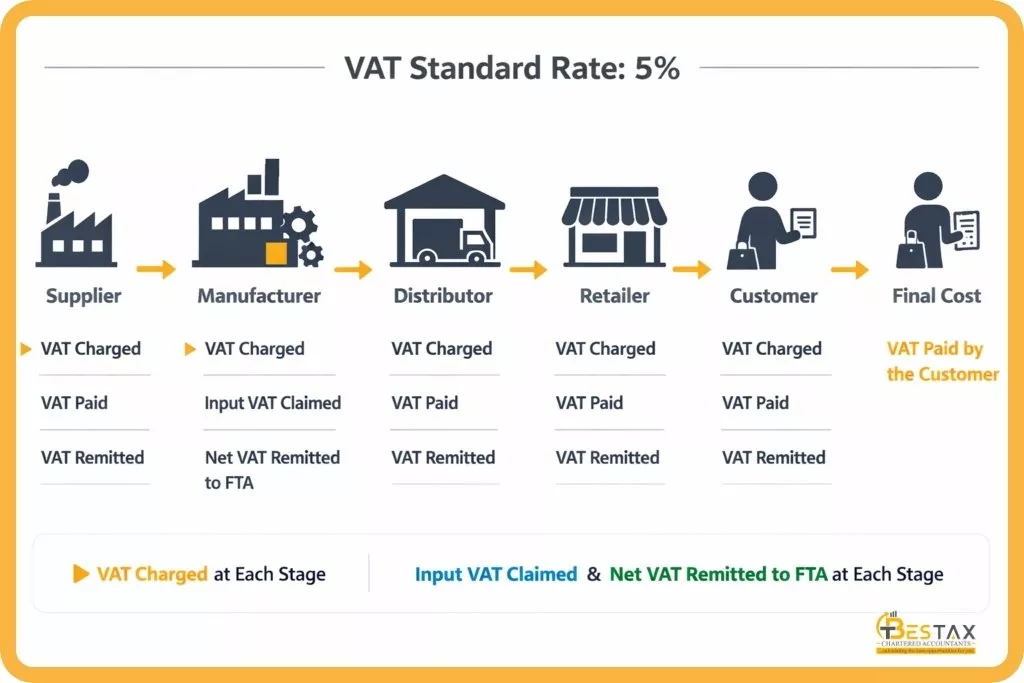
An indirect tax is collected by a business as part of selling goods or services, and then remitted to the authority. The business is the collector; the customer is usually the one who bears the cost through the final price.
The UAE’s everyday indirect taxes
In the UAE, the most common indirect taxes are:
- VAT (Value Added Tax): introduced at a standard rate of 5%
- Excise tax: applies to specific categories, with rates such as 50% and 100% depending on the product type
- Customs duties: applied to certain imports (sector and product dependent)
When a customer pays for a taxable supply, the tax is baked into the pricing logic, even if the invoice shows it as a separate line.
Pro tip: Indirect taxes punish sloppy invoicing faster than almost anything else. If your invoice data is inconsistent, your returns get messy, and your reconciliation becomes a time sink
Direct and indirect tax difference: a side-by-side comparison
Below is a clean way to think about the direct and indirect tax difference in day-to-day decision-making.
| Feature | Direct tax | Indirect tax |
|---|---|---|
| What it is charged on | Income, profits, wealth | Transactions (sales of goods/services) |
| Who remits it | The taxpayer (person/entity) | The business (as collector) |
| Who usually bears the cost | The taxpayer | The end customer (via price) |
| Common UAE examples | Corporate tax on taxable income | VAT (5%), excise, customs duties |
| Behaviour effect | Influences profit planning and investment | Influences pricing, demand, cash flow cycles |
This is why people search direct tax vs indirect tax and get stuck: both are “tax”, but their mechanics are completely different. In UAE operations, that difference affects how you price, how you invoice, and how you forecast cash.
If corporate tax registration or VAT filing feels like a moving target, Bestax can help you structure it properly from the start:
Example of direct tax and indirect tax in a Dubai business day
Let us make it real with a simple Dubai scenario.
- You sell a taxable service for AED 1,000.
- You charge 5% VAT, so the invoice shows AED 50 VAT.
- You collect AED 1,050 from the customer.
- Later, you remit VAT according to your filing cycle.
That VAT is indirect. You collected it; your customer funded it.
Now zoom out to the year:
- If your business has taxable income above the threshold, corporate tax applies at 9% on the portion above AED 375,000.
That corporate tax is direct. It is calculated on your taxable results and paid by your business.
Corporate tax direct or indirect?
This question comes up constantly: corporate tax direct or indirect?
Corporate tax is a direct tax because it is imposed on the company’s taxable income and paid directly by the company. The UAE corporate tax structure (including the AED 375,000 threshold and the 9% rate above it) is designed as a direct levy on profits, not a transaction tax.
Yes, companies can adjust pricing over time, but that does not change the legal character of the tax.
Advantages of indirect tax: why VAT and excise are so common
If you search advantages of indirect tax, you will usually see the same list. Here is the sharper, UAE-practical version:
- Collection is operationally scalable: it rides on invoices and point-of-sale systems.
- The base is broad: economic activity is captured across many categories of spending.
- Cash-flow discipline improves: businesses build stronger reporting rhythms when systems are set up correctly.
- Behaviour can be influenced: excise tax is often used to reduce consumption of targeted product categories.
The trade-off is that indirect taxes can feel “invisible” to customers until prices rise, which is why clean pricing communication matters.
Conclusion
Understanding the direct and indirect tax difference is essential for financial planning, compliance and policy discussion. Direct taxes, including income tax and corporate tax, are paid by those on whom they are imposed and are often progressive.
Indirect taxes, such as sales tax and VAT, are embedded in the price of goods and services and shift the tax burden to consumers. Each tax type has advantages and drawbacks: direct taxes can reduce inequality but introduce complexity, while indirect taxes are easy to collect but can be regressive.
Need help managing your corporate tax obligations? Visit our Corporate Tax Registration and Consulting services to ensure compliance with the UAE’s 9 % tax and optimize your tax strategy.
Quick FAQs
Direct tax vs indirect tax: what is the simplest way to tell them apart?
Direct tax vs indirect tax comes down to the base: direct is on income/profit/wealth, indirect is on goods and services sold through transactions.
Direct vs indirect tax: who pays, and who remits?
In a direct vs indirect tax setup, the direct taxpayer remits directly, while indirect tax is collected by a business and remitted after being charged to customers.
What is indirect tax in the UAE?
If you ask what is indirect tax in the UAE, the everyday answer is VAT at 5%, plus excise tax on specific categories, and customs duties on relevant imports.
What is the indirect tax definition in one line?
The indirect tax definition: a tax charged on transactions, collected by sellers, and typically borne by the final customer.
Direct tax and indirect tax meaning: why does it matter for pricing?
Because indirect taxes affect invoice totals immediately, while direct taxation affects profit after operations, the direct tax and indirect tax mix changes how you price, forecast, and plan cash.
Corporate tax direct or indirect in the UAE?
Again, corporate tax direct or indirect: it is direct, assessed on taxable income, with 0% up to AED 375,000 and 9% above AED 375,000 under the standard structure.
Disclaimer: The information provided in this blog is for general informational purposes only. For professional assistance and advice, please contact experts.
