



The profit margin scheme, a specific mechanism under the UAE VAT law, allows eligible businesses to calculate and pay VAT only on the profit they earn, rather than the full selling price. For many dealers, this makes a significant difference to both cash flow and competitiveness.
Understanding the profit margin scheme VAT in the UAE is not just a matter of saving money. In 2026, the Federal Tax Authority (FTA) continues to actively audit businesses in the used goods market, and non-compliance can result in administrative penalties. This guide covers everything you need to know, so make sure to read it till the end.
What is the Profit Margin Scheme Under UAE VAT?
The profit margin scheme is an optional VAT calculation method available to VAT-registered businesses in the UAE under Article 43 of the UAE VAT Decree-Law (Federal Decree-Law No. 8 of 2017). Normally, VAT at 5% is charged on the full selling price of a taxable supply. The profit margin scheme, however, permits eligible taxable persons to compute VAT on the margin between the purchase price and the selling price of the goods, not on the total sale value.
This scheme was specifically designed to prevent double taxation on goods that have already been taxed once during an earlier transaction. When a dealer purchases goods from an unregistered seller, they cannot recover any input tax (because none was charged). Without this scheme, they would still have to charge output VAT on the full selling price, effectively taxing the same goods twice across the supply chain.
The profit margin is treated as VAT-inclusive. This means the VAT is extracted from the profit margin using the formula:
VAT = Margin ÷ 1.05 × 0.05
If there is no profit, i.e., if the selling price is equal to or less than the purchase price, then the value of the supply for VAT purposes is zero.
The FTA issued Public Clarification VATP002 to provide detailed guidance on how this scheme operates and which goods qualify, specifically addressing the transitional period around VAT implementation on 1 January 2018.
Which Goods are Eligible for the Profit Margin Scheme in the UAE VAT?
Not every product qualifies. Under Article 29 of the UAE VAT Executive Regulations, the profit margin scheme UAE VAT rules apply only to three specific categories of goods:
1. Second-Hand Goods
Defined as tangible movable property that is suitable for further use as-is or after repair. This is the broadest category and includes items such as used vehicles, pre-owned electronics, refurbished furniture, and other resaleable used goods. The goods must retain useful items that are purely scrap or waste typically would not qualify.
2. Antiques
Goods that are over 50 years old qualify as antiques under this scheme. This could include vintage furniture, old paintings, historical artefacts, or aged decorative items. The age must be verifiable, and the item should hold market value as an antique.
3. Collectors’ Items
This category covers stamps, coins, currency, and items of scientific, historical, or archaeological interest. Numismatic collections, philatelic items, and similar specialised collectibles fall here, provided they meet the pre-VAT taxation requirement described below.
Conditions That Must Be Met to Apply the Profit Margin Scheme
Simply selling second-hand goods is not sufficient. The scheme has strict eligibility conditions that must be satisfied simultaneously:
Condition 1: The Goods Must Have Previously Been Subject to VAT
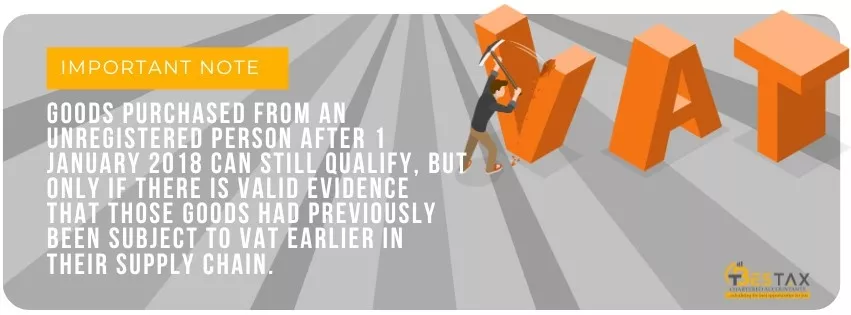
This is the critical rule clarified in FTA Public Clarification VATP002. Only goods that were subject to VAT at an earlier supply are eligible. Goods purchased or acquired before 1 January 2018, when UAE VAT was introduced, cannot benefit from this scheme, because no VAT was paid on them at that point.
Condition 2: The Goods Must Be Purchased from Specific Supplier Types
The dealer must have acquired the goods from either:
- A person who is not registered for VAT (a non-registrant), OR
- A VAT-registered taxable person who themselves applied the profit margin scheme (and who therefore did not charge VAT separately on the supply)
Condition 3: No Input Tax Recovery on the Purchase
As per Article 53 of the VAT Executive Regulations, the taxable person must not have recovered input tax on the purchase of those goods. If a business claimed input VAT credit on the purchase, they cannot simultaneously apply the profit margin scheme on the sale that would amount to a double benefit.
Quick Eligibility Scenarios
| # | Scenario | Profit Margin Scheme Applicable? |
|---|---|---|
| 1 | Goods purchased before 1 Jan 2018 (pre-VAT stock) | No, full 5% VAT applies on selling price |
| 2 | Goods bought after 2018 from an unregistered seller, with valid prior tax invoice | No, full 5% VAT applies unless prior VAT can be evidenced |
| 3 | Goods bought after 2018 from an unregistered seller, with a valid prior tax invoice | Yes, the profit margin scheme can be applied |
| 4 | Goods bought from another VAT-registered dealer who applied profit margin scheme | Yes, the scheme continues to the next buyer |
How to Calculate VAT Under the Profit Margin Scheme
The calculation method under the profit margin scheme is straightforward once you know the purchase price and the selling price of the goods:
- Formula: Profit Margin = Selling Price − Purchase Price
- VAT Due = Profit Margin ÷ 1.05 × 0.05
Key rule: The profit margin is treated as VAT-inclusive. You must extract the VAT from within the margin, you do not add VAT on top of it.
Worked Example 1: Used Car Dealer in Dubai
A pre-owned car dealer in Dubai purchases a second-hand vehicle from a private individual (non-VAT registered) for AED 40,000. The car was originally sold to a private individual with VAT, and the dealer has obtained a copy of the original tax invoice as proof. The dealer later sells the car to another buyer for AED 52,000.
- Purchase Price: AED 40,000
- Selling Price: AED 52,000
- Profit Margin: AED 12,000
- VAT Due: AED 12,000 ÷ 1.05 × 0.05 = AED 571.43
- Compared to standard VAT: AED 52,000 × 5% = AED 2,476.19
Saving: AED 1,904.76, entirely lawful under the profit margin scheme.
Worked Example 2: Antique Furniture Dealer in Abu Dhabi
An antiques business based in Abu Dhabi buys a 19th-century cabinet from an unregistered collector for AED 8,000. The dealer has no proof that VAT was previously charged on this item. They sell it for AED 14,000.
Profit margin scheme: Cannot be applied, because there is no evidence of prior VAT. VAT at 5% applies on the full selling price of AED 14,000, resulting in output VAT of AED 700.
Invoicing Rules Under the Profit Margin Scheme VAT
Tax invoices issued under this scheme have special requirements. Unlike a standard VAT invoice, a profit margin scheme invoice must NOT show the VAT amount separately.
What a Profit Margin Scheme Invoice Must Include
- The words indicate that the supply is made under the profit margin scheme
- Name, address, and Tax Registration Number (TRN) of the supplier
- Date of supply
- Description and details of the goods
- Total consideration payable
- The VAT amount must NOT be stated separately on the invoice
The reason the VAT is not itemised is that, since the margin is treated as VAT-inclusive, showing a separate VAT figure would mislead the buyer into thinking they are entitled to recover that VAT, which they are not. The buyer under a profit margin scheme supply cannot claim input tax credit.
Self-Billing When Purchasing from Non-Registrants
When a VAT-registered dealer buys goods from an individual who is not registered for VAT, there will be no tax invoice from the seller. In this case, the dealer is required to issue a purchase invoice to themselves. This self-billed invoice must include:
- Dealer’s name, address, and TRN
- Name and address of the private seller
- Date of purchase
- Description of the goods acquired
- The consideration paid
- Signature of the seller (or authorised signatory)
Record-Keeping Requirements for 2026 Compliance
The FTA requires businesses applying the profit margin scheme VAT UAE rules to maintain meticulous records. A VAT audit in 2026 will scrutinise your documentation closely. Inadequate records can result in the scheme being disallowed and penalties being assessed on the full sale values.
Mandatory records include:
- A detailed stock book or inventory register listing all goods bought and sold under the scheme, with purchase prices and selling prices clearly noted for each item
- Copies of purchase invoices, or self-billed purchase invoices where applicable, for every item acquired under the scheme
- Evidence that each item was previously subject to VAT, typically a copy of the prior supply’s tax invoice obtained from the seller
- Sales invoices issued to buyers under the scheme (without separately stated VAT)
- VAT return records showing how the profit margin was reported in each tax period
Notifying the FTA That You Are Using the Profit Margin Scheme
It is the responsibility of every tax registrant using the profit margin scheme to notify the Federal Tax Authority that they are applying this method in their business. This notification is not optional. As per Article 76 of the UAE VAT Decree-Law, failure to notify the FTA may result in an Administrative Penalty Assessment being issued against the taxable person.
In practice, the notification is typically done through your EmaraTax portal registration or during VAT return filing. Speak with your tax agent or VAT consultant if you are unsure how this was recorded at the time of your VAT registration.
Common Mistakes Businesses Make With the Profit Margin Scheme
Understanding what not to do is equally important. These are the most frequently seen errors in FTA audits involving the profit margin scheme:
- Mistake 1: Applying the scheme to pre-2018 stock without evidence that VAT was ever charged. This is explicitly prohibited under VATP002.
- Mistake 2: Showing VAT as a separate line item on the invoice. This is not allowed under the scheme, it misleads the buyer into believing they can reclaim the VAT.
- Mistake 3: Failing to obtain self-billed invoices for purchases from private individuals. Without this document, you have no audit trail.
- Mistake 4: Claiming input VAT on the purchase of goods and then applying the profit margin scheme on the sale. The two cannot coexist for the same item.
- Mistake 5: Not notifying the FTA. Running the scheme informally, even correctly, without the required FTA notification, exposes you to penalties.
Why the Profit Margin Scheme Matters for UAE Businesses in 2026
The UAE’s second-hand goods market, spanning used vehicle dealerships across Dubai, Abu Dhabi, Sharjah, and Ajman, antique markets in the Al Quoz and Deira areas, and specialised coin and stamp traders, has grown significantly since VAT implementation. For many businesses in this sector, the profit margin scheme is not a niche technicality, it is a core part of how they price their goods and manage their VAT obligations.
Without this scheme, a used goods dealer would pay VAT on the full sale price despite having purchased goods from a non-registered seller with no recoverable input tax. That is a structural VAT cost that would either be absorbed as a margin hit or passed on to buyers as a price increase, undermining market efficiency and creating an uneven playing field versus informal sellers.
The scheme levels that playing field. As long as the required conditions are met, businesses of any size, from individual antique dealers in Ras Al Khaimah to large used-car supercentres in Dubai Investment Park, can benefit from this provision.
Conclusion
The profit margin scheme is one of the most valuable and underutilised provisions within the UAE VAT system for businesses dealing in second-hand goods, antiques, and collectibles. It eliminates the burden of double taxation, significantly reduces output VAT liability, and keeps used-goods markets economically viable.
If you are unsure whether your current VAT approach is fully compliant, or if you believe you may have been over-reporting VAT on eligible goods, speaking to a qualified VAT consultant is the right next step.
Ready to review your VAT compliance or apply the profit margin scheme correctly? Contact the expert team at Bestax today!
Frequently Asked Questions (FAQs)
Can I apply the profit margin scheme to services?
No. The profit margin scheme under UAE VAT law applies exclusively to goods, specifically second-hand goods, antiques, and collectors’ items. It cannot be applied to services of any kind.
What if I sell an item at a loss, is there any VAT due?
If the selling price is equal to or less than the purchase price, meaning there is zero or negative margin the value of supply is treated as zero for VAT purposes. No output VAT is payable. However, this does not entitle you to a VAT refund; you simply report the supply with a zero taxable value in your return.
Can a buyer who purchases goods under the profit margin scheme later resell those goods using the scheme again?
Yes. If the buyer is a VAT-registered dealer and purchases under the profit margin scheme, they may apply the scheme to their own subsequent sale, provided they satisfy the eligibility conditions at the time of their resale.
Does the profit margin scheme affect how I complete my VAT return?
Yes. Supplies under the profit margin scheme must be reported correctly in your VAT 201 return on the EmaraTax portal. The taxable value reported is the profit margin (inclusive of VAT), not the full selling price.
What is what is profit margin scheme in uae vat in simple terms?
In plain language: instead of paying 5% VAT on everything you sell a used item for, you only pay VAT on the profit you made on that item. So if you bought a second-hand watch for AED 2,000 and sold it for AED 2,800, your VAT is calculated only on AED 800, not AED 2,800. It is a legal VAT relief measure that avoids double-taxing goods that have already gone through the VAT system once.
Is there a threshold for applying the profit margin scheme?
No specific AED threshold applies to individual transactions. The scheme is available to any VAT-registered business dealing in eligible goods, regardless of transaction size. However, your overall business must be VAT-registered (i.e., above the mandatory registration threshold of AED 375,000 in annual taxable turnover, or the voluntary threshold of AED 187,500).
Disclaimer: The information provided in this blog is for general informational purposes only. For professional assistance and advice, please contact experts.
