



Dubai’s reputation as a global trade hub isn’t just a cliché; it rests on tangible advantages that make it a magnet for entrepreneurs. The emirate sits at the crossroads of East and West, with world‑class seaports and airports that enable swift import and export of goods.
For food traders, this translates into efficient supply chains and access to a huge consumer market. An estimated 18 billion USD of food imports are projected by 2025, underscoring the sector’s growth. Dubai’s government has also committed to state‑of‑the‑art infrastructure and 0 % personal and 9% corporate income tax (conditional), which significantly reduces operational costs.
If you’re considering a foodstuff trading license in Dubai, you’re in the right place. This guide outlines everything you need to know.
What Is Foodstuff Trading?
“Foodstuff trading” refers to any business that handles food products, manufacturing, processing, storing, packaging, distributing, importing, or exporting. In practical terms, a foodstuff trading company might ship containers of rice from Asia, import juices and soft drinks for local distribution, export UAE‑grown dates, or wholesale packaged spices. Because food directly affects public health, the trade is tightly regulated by the Department of Economic Development (DED) and Dubai Municipality’s Food Control Department.
A foodstuff trading license is a commercial license issued by the DED. It permits a business to import, export, and trade consumable goods such as grains, frozen foods, spices, beverages, and fresh produce. Without this license, customs clearance and distribution are illegal, and penalties can include fines and product confiscation.
Why Start a Foodstuff Trading Business in Dubai?
Strategic Location and Global Access
Dubai’s location between Europe, Asia, and Africa allows exporters to reach more than 2 billion consumers within a four‑hour flight. Its extensive network of shipping routes and international airports reduces transit times, ensuring perishable goods arrive fresh.
High Demand and Market Diversity
UAE residents consume a diverse diet, including fresh fruits, vegetables, meats, and specialty ingredients. With imports predicted to reach USD 400 billion, the domestic demand for quality food is booming. Large events such as Expo 2020 and ongoing conventions further boost consumption. For traders, this means constant demand for new products and niches, from organic produce to gourmet sauces.
Business‑Friendly Regulations
Dubai offers 100 % foreign ownership for most sectors, including mainland food trading companies. Entrepreneurs benefit from minimal bureaucracy, transparent licensing procedures, and accessible e‑government portals.
Robust Logistics and Infrastructure
The government prioritises cold storage facilities, efficient customs operations, and modern warehousing. Investing in proper logistics prevents spoilage and ensures compliance with food safety standards. You can find warehousing options at ports (like Jebel Ali), free zones (such as Meydan Free Zone), or inland areas where costs are lower.
Cultural Diversity and Skilled Workforce
Dubai’s multicultural population offers a skilled labour pool with expertise in everything from international procurement to Arabic food labelling. Hiring staff with experience in food safety and customs procedures can streamline your operations.
Types of Activities Permitted Under a Foodstuff Trading License
A foodstuff trading license in Dubai covers many activities. Common categories include:
- Spice trading: dealing in spices, herbs, and seasonings such as cumin, saffron, and cardamom.
- Sugar trading: import and sale of raw or refined sugars.
- Beverage trading: juices, carbonated drinks, mineral water, and other non‑alcoholic beverages.
- Fruit and vegetable trading: wholesale or retail trade of fresh produce.
- Pulses, cereals and legumes: trade in grains, lentils, chickpeas, and similar staples.
If your business is more specialised, like seafood distribution, organic foods, or halal meat, include that activity when applying for the license.
Regulatory Bodies and Compliance Requirements
Department of Economic Development (DED)
The DED is the primary authority issuing commercial trade licenses. When you apply for a foodstuff trading license, you choose “Foodstuff Trading” as the approved activity, reserve your trade name, obtain initial approval, and submit your documents. DED rules apply whether you operate on the mainland or in certain free zones.
Dubai Municipality and the Food Control Department
Dubai Municipality (DM) ensures food safety and oversees the Food Import and Re‑Export System (FIRS). Every food trading company must:
- Register with DM’s food safety services by submitting a licence copy and company seal.
- Enroll in the FIRS by paying a refundable AED 15 000 deposit, providing a copy of your valid licence and company details.
- Register all food items in FIRS before import and obtain food label approvals to ensure compliance.
- Obtain a FIT (food inspection test) analysis for imported items and secure food label approval.
The Food Control Department also inspects premises for hygiene, storage standards, and safety. Having an Ejari‑registered warehouse or shop that meets municipal guidelines is mandatory.
Dubai Customs
If your business handles imports or exports, you must register with Dubai Customs to obtain a unique Customs Code. Without this code, your shipments cannot clear customs.
Civil Defense and Other Agencies
Food storage facilities sometimes need approval from Civil Defense to ensure fire safety, especially for warehouses with refrigeration equipment. When trading meat or dairy, additional permits from the Ministry of Climate Change and Environment may apply.
Mainland vs. Free Zone: Choosing Your Business Structure
Mainland companies are registered with the DED and allow you to trade anywhere within the UAE and beyond. With recent legal reforms, foreign investors can own 100 % of a mainland food trading business. You may need a local service agent if establishing a sole proprietorship but not for a limited liability company (LLC).
Free zone companies, such as those in Meydan Free Zone or Jebel Ali Free Zone, offer benefits like full repatriation of profits, zero import/export duties inside the free zone, and simplified regulations. However, trading directly with the UAE mainland requires a local distributor or a dual licence. In some free zones, licences can be issued in as little as 60 minutes via programmes like Fawri.
Which Is Better?
- Choose mainland if you plan to distribute products across the UAE retail market (supermarkets, hotels, restaurants).
- Choose a free zone if your trading is primarily international or limited to the free zone (e.g., bulk import/export, warehousing).
- In both cases, partnering with a local consultant helps navigate compliance and avoid delays.
For more information, read this article: Mainland vs Free Zone: The Ultimate Battle for Business Supremacy.
Step‑By‑Step: How to Obtain a Foodstuff Trading License in Dubai
This section provides a comprehensive roadmap to obtaining a foodstuff trading license. Consider it your action plan from initial idea to trading legally.
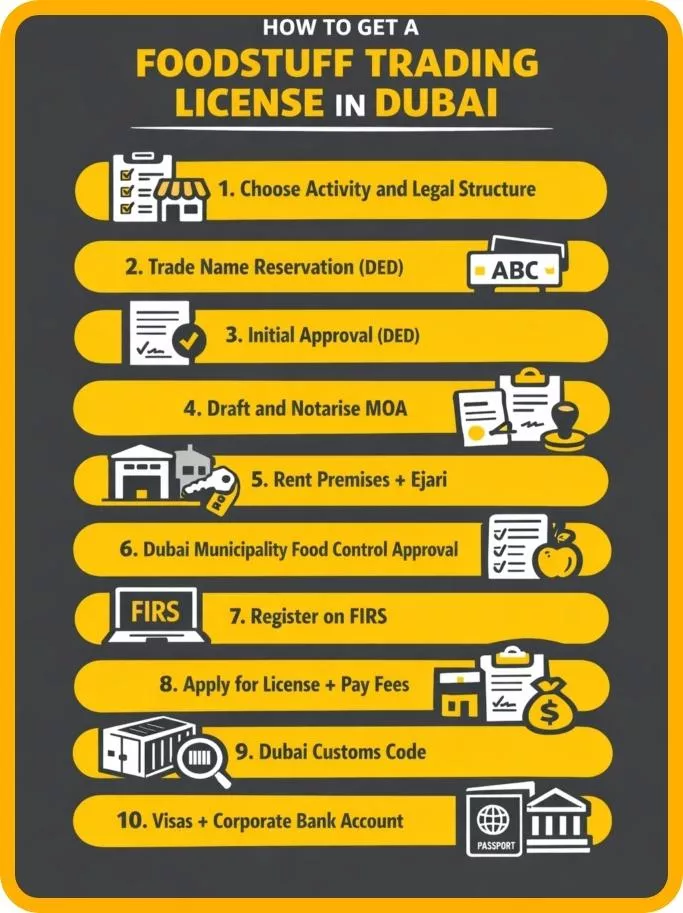
1. Choose Your Business Activity and Legal Structure
Identify the specific food categories you will trade, such as spices, beverages, or frozen goods, and select “Foodstuff Trading” as your activity when applying. Decide whether you’ll set up a sole proprietorship, civil company, or LLC (most popular). For foreign investors, an LLC provides liability protection and, thanks to recent reforms, full ownership.
2. Reserve and Register Your Trade Name
Submit three possible names to the DED for approval. The name must reflect your business and avoid restricted terms. Once approved, you receive a reservation certificate.
3. Obtain Initial Approval from the DED
Provide your proposed business activity, shareholder details, and passport copies to get initial approval. This step indicates that your business plan aligns with UAE regulations.
4. Draft and Notarise the Memorandum of Association (MOA)
For LLCs, draft an MOA outlining share distribution, management responsibilities, and capital contributions. Notarise it in a UAE court or with a public notary.
5. Secure a Commercial Space and Ejari Contract
Rent a warehouse, shop, or office suitable for storing or displaying food items. The tenancy contract must be registered through Ejari, Dubai’s real estate registration system. Consider factors like proximity to ports, cold storage needs, and accessibility for deliveries.
6. Obtain Food Control Approval from Dubai Municipality
Before issuing your licence, the DM inspects your premises for hygiene and storage standards. Provide the Ejari contract, trade name certificate, and initial approval. After inspection, DM issues an approval letter.
7. Register with the Food Import and Re‑Export System (FIRS)
Complete registration on DM’s FIRS portal. The registration requires:
- Copy of your valid trade licence.
- Company details (address, phone, email).
- Payment of a refundable AED 15 000 deposit (conditional).
Register all food products you plan to import and obtain food label approvals to ensure labels meet UAE standards. You may also need a FIT analysis for each imported item.
8. Apply for Your Foodstuff Trading License and Pay the Fees
Submit the final application to the DED (or free zone authority) with the following documents:
- Completed application form.
- Passport copies of shareholders and managers.
- Emirates ID copies (for residents).
- Residence visa copies or No Objection Certificate from sponsor, if applicable.
- Trade name reservation certificate and initial approval.
- Ejari tenancy contract.
- Notarised MOA.
- Food control approval letter from DM.
Pay the licensing fees and collect your trade licence. On the mainland, this step typically takes 5–7 working days.
9. Register with Dubai Customs for an Import/Export Code
If you plan to import or export food, register with Dubai Customs to obtain a unique Customs Code. This code is required for all customs clearance processes.
10. Apply for Visas and Open a Corporate Bank Account
After obtaining your licence, you can apply for visas for shareholders and employees. Requirements vary depending on the number of visas requested and business size. A corporate bank account is essential for transactions; most banks require your trade licence, MOA, and shareholder information.
Required Documents Checklist
For clarity, here is a consolidated list of documents typically required to obtain a foodstuff trading licence in Dubai:
| Document | Purpose | Notes |
|---|---|---|
| Completed application form | Core application | Provided by the DED or free zone authority |
| Passport copies of all shareholders, managers, and directors | Identity verification | Colour copies are recommended |
| Emirates ID and residence visa copies | Residency verification | Required for UAE residents |
| Specimen signatures | Signature registration | For KYC/UBO compliance |
| Trade name reservation certificate | Confirms approved business name | Obtained during name reservation |
| Initial approval from the DED or free zone | Shows regulatory acceptance | Step prior to final application |
| Ejari tenancy contract | Proof of commercial premises | Must be registered with Ejari |
| Memorandum of Association (MOA) | Defines ownership structure | Required for LLCs |
| Dubai Municipality food control approval | Ensures food safety compliance | Inspection of premises |
| No Objection Certificate (if applicable) | Permission from current sponsor | Needed when a shareholder holds a UAE residence visa |
Cost of a Foodstuff Trading License in Dubai
The cost of obtaining a foodstuff trading licence depends on the business structure, visa quota, and location. Typical expenses include:
- DED licence fees: AED 8 000 to AED 12 000.
- Ejari registration and commercial rent: varies based on warehouse or shop location. Premium sites near ports command higher rents; inland warehouses are cheaper.
- Municipality registration: AED 1 000 to AED 3 000.
- Sponsorship or service agent fees (LLCs): varies; some firms bundle this cost in formation packages.
- FIRS deposit: AED 15 000 (refundable).
- Professional services and visa costs: optional; packages offered by consultants like Unicorn Global Solution start at AED 1999 and can exceed AED 9999 for full compliance and annual management.
In total, expect to invest around AED 50 000 to AED 55 000 to launch a standard foodstuff trading business, including licence fees, deposits, and initial rent. Using free zones may reduce or increase costs depending on the chosen zone and benefits.
Running a Foodstuff Trading Business: Compliance and Best Practices
Maintain Accurate Labelling and Documentation
Every product must have clear labels specifying ingredients, nutritional information, country of origin, production and expiry dates, and storage instructions. Dubai Municipality requires label approval before import. Keep records of supplier invoices, health certificates from the country of origin, and certificates of conformity to expedite customs clearance.
Invest in Proper Logistics and Cold Storage
Perishable goods require temperature‑controlled storage and transportation. Cold storage reduces spoilage and maintains quality. Partner with logistics providers experienced in handling food cargo, and allocate budget for refrigerated vehicles if you operate your own fleet.
Understand Cultural and Religious Guidelines
The UAE’s population includes Muslims who only consume halal food. If you trade meat or poultry, obtain halal certification from accredited bodies and ensure suppliers follow Islamic slaughter practices. Pork and alcohol are strictly regulated; businesses handling them require special licences.
Register Employees for Food Handlers’ Health Cards
Workers who handle food must obtain health cards from Dubai Municipality after passing medical tests. Regular training in hygiene and safe handling practices is mandatory.
Schedule Inspections and Renewals
Foodstuff trading licences and food control approvals must be renewed annually. Schedule DM inspections in advance to avoid fines or delays in renewal. Keep your warehouse and vehicles clean, pest‑free, and in good repair.
Geographical and Seasonal Considerations
Dubai experiences extreme heat from June to September, with temperatures often exceeding 40 °C. This raises storage and transport costs due to increased cooling requirements. Set up operations between November and April, when the weather is cooler and there are more daylight hours, ideal for facility preparation and field visits. High tourist seasons (winter months and around global events) also mean increased demand for premium foods. By anticipating seasonal fluctuations, you can adjust inventory levels and shipping schedules accordingly.
Pro Tips for Aspiring Food Traders
- Start with niche products: Rather than competing with established giants, import specialty items like organic spices or gourmet sauces to build a unique brand.
- Leverage e‑commerce: Online grocery platforms and delivery services are booming in the UAE. A strong online presence expands your reach beyond brick‑and‑mortar retail.
- Network within Dubai’s business community: Trade fairs, food exhibitions, and industry events help you connect with suppliers and distributors. Dubai hosts major events such as Gulfood and Middle East Organic Natural Products Expo.
- Monitor global food trends: Stay informed about shifts in consumer preferences (e.g., plant‑based diets or sugar‑free beverages) to identify new opportunities.
- Stay compliant with VAT and excise tax: Some drinks and sugar‑sweetened beverages are subject to UAE excise tax.
Let Bestax Simplify Your Food Trading Setup
Obtaining a foodstuff trading licence can seem daunting, but you don’t have to go through it alone. Bestax specialises in business formation and licensing in the UAE. Whether you need help reserving a trade name, navigating FIRS registration, or finding a compliant warehouse, our team provides end‑to‑end support, so you can focus on building your brand.
After reading our step‑by‑step guide, contact Bestax for a free consultation to discuss the best licence structure and jurisdiction for your goals.
FAQs (Frequently Asked Questions)
What is a foodstuff trading license in Dubai?
A foodstuff trading licence is a commercial licence issued by the DED permitting the import, export, distribution, and sale of food products.
How much does it cost to start a foodstuff trading business?
The cost typically ranges between AED 25 000 and AED 40 000, including licence fees, warehouse rent, municipality registration, FIRS deposit, and professional service fees.
Can foreign investors own 100 % of a foodstuff trading company in Dubai?
Yes. Recent legislative changes allow foreign investors to own 100 % of mainland businesses, including food trading companies. Free zone companies also offer full ownership rights.
What approvals are required besides the DED licence?
You need approval from Dubai Municipality’s Food Control Department for your premises, registration in the FIRS (including a refundable deposit and product registration), and a Dubai Customs code if you import/export. Civil Defense approval is required for warehouse safety.
How long does it take to get a foodstuff trading license?
With complete documentation and expert assistance, you can usually obtain your licence within 5 to 7 working days. Free zones with instant licence programmes may issue licences in less time.
What documents do I need to submit?
You will need passport copies, Emirates ID copies, trade name reservation, initial approval, Ejari tenancy contract, notarised MOA, DM approval letter, and possibly a No Objection Certificate. Our checklist above provides a detailed summary.
Disclaimer: The information provided in this blog is for general informational purposes only. For professional assistance and advice, please contact experts.
