



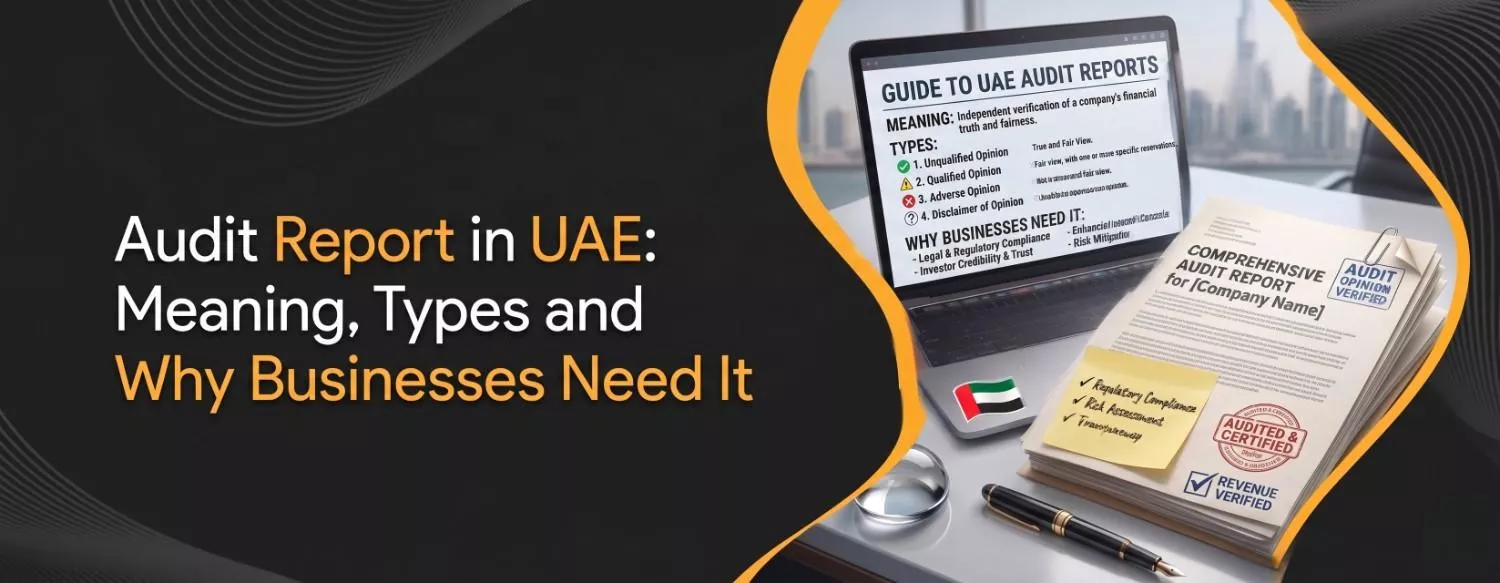
An audit report in UAE is the official roadmap that demonstrates a company’s financial integrity. In the UAE, where banks, investors and regulators expect complete transparency, the audit report carries even more weight.
This guide explains what an audit report is, the different types and their meanings, how UAE laws influence audit requirements:
What Is an Audit Report?
An audit report is a written document issued by an independent auditor after examining a company’s financial statements and related records. The auditor uses International Standards on Auditing (ISA) to test a sample of transactions and assess whether the financial statements present a “true and fair view” of the company’s financial position. In the UAE, auditors must confirm that businesses follow International Financial Reporting Standards (IFRS), which the Commercial Companies Law requires for financial reporting.
The report summarises the auditor’s findings, outlines the scope of the audit and expresses an opinion on the financial statements. A well‑prepared report instils confidence among investors, lenders, shareholders and regulatory authorities. Conversely, a poorly prepared report can signal mismanagement or non‑compliance and harm a company’s reputation.
Key Elements of an Audit Report
Audit reports follow a standardized format so stakeholders can easily navigate them. Common components include:
- Opinion: A concise statement where the auditor declares whether the financial statements present a true and fair view.
- Basis for Opinion: Explains the auditing standards followed and discloses any relationships with the company. When the opinion is qualified, adverse or a disclaimer, this section highlights the issues uncovered during the audit.
- Key Audit Matters (KAMs): Describes areas of heightened risk (e.g., foreign exchange exposure or complex valuations) and how the auditor addressed them.
- Auditor’s Responsibilities: Details the auditor’s duties under ISA, such as evaluating internal controls and performing sample testing.
- Management’s Responsibilities: Outlines management’s obligation to maintain accurate records and prepare financial statements.
- Report on Legal and Regulatory Requirements: Confirms whether the company complied with applicable UAE laws and regulations.
- Emphasis of Matter & Other Matters: Highlights any issues or important context that could affect interpretation of the financial statements.
What the Report Does Not Cover
While the audit report offers assurance about the financial statements, it has limitations. Auditors do not examine every transaction; they use sampling and professional judgement. The report also does not provide business advice or guarantee future performance. Instead, it gives stakeholders reasonable assurance that the historical financial information is reliable.
Types of Audit Opinions
The wording of the opinion section signals the level of confidence stakeholders can place in the financial statements. There are four main types of audit opinions, each with different implications:
1. Unqualified (Clean) Opinion
This is the best outcome. The auditor concludes that the financial statements present a true and fair view and are prepared according to applicable accounting standards. It signals robust internal controls and reliable financial reporting.
2. Qualified Opinion
A qualified opinion means the auditor found significant issues, but they are confined to certain areas and not pervasive. The report will state that the financial statements are fairly presented except for specific matters.
3. Adverse Opinion
An adverse opinion is serious. The auditor believes that misstatements are material and pervasive, so the financial statements do not present a true and fair view. This can severely damage investor confidence and trigger regulatory scrutiny.
4. Disclaimer of Opinion
A disclaimer occurs when the auditor cannot obtain sufficient evidence to form an opinion. This often results from limited access to records or incomplete information. Without adequate data, the auditor declines to express any opinion.
Summary Table of Audit Opinions
| Audit Opinion | Key Message | Stakeholder Response |
|---|---|---|
| Unqualified (Clean) | Financial statements are fairly presented; no material errors | Confidence in reliability; easier access to financing |
| Qualified | The auditor cannot form an opinion due to insufficient evidence | Address specific issues quickly; may still attract investment |
| Adverse | Financial statements are not reliable | Prompt corrective action; risk of regulatory penalties |
| Disclaimer | Auditor cannot form an opinion due to insufficient evidence | Immediate remedial measures; risk of stakeholder distrust |
Types of Audit Reports in the UAE
While the opinion types above focus on the auditor’s conclusions, audit reports themselves vary depending on who conducts the audit and why. Understanding these distinctions helps businesses select the right level of assurance.
External Audit Reports (Statutory Audits)
External audits are carried out by independent firms registered with the UAE Ministry of Economy. They offer unbiased verification of financial statements and are required for many companies under the Commercial Companies Law and corporate tax regulations. In 2026, external audits are mandatory for:
- Taxable persons with revenue exceeding AED 50 million.
- Qualifying Free Zone Persons (QFZPs), regardless of revenue.
- Tax groups, which must prepare Special Purpose Financial Statements (SPFS) for corporate tax filings. These aggregated statements still adhere to IFRS but consolidate members’ results and require independent auditing.
- Some free‑zone companies, such as those in the Dubai Multi Commodities Centre (DMCC) and Ras Al Khaimah Economic Zone (RAKEZ). DMCC requires submission of audited financial statements within six months after the financial year end.
External audit reports assure stakeholders that the company has complied with IFRS and UAE laws. They are critical for renewing trade licences, securing bank loans and bidding on government contracts.
Internal Audit Reports
Internal audits are conducted by a company’s own team or outsourced professionals. They focus on risk management, operational efficiency and compliance with internal policies. While internal audit reports are not always mandatory, they help management detect weaknesses and prepare for external audits. Internal auditors may review non‑financial areas, such as cybersecurity, human resources and environmental compliance.
Tax‑Authority Audits
The Federal Tax Authority (FTA) conducts audits to ensure accurate VAT and corporate tax reporting. During VAT audits, companies must provide invoices, ledgers and documents for at least five years. For corporate tax purposes, records must be kept seven years after the tax period, and in some cases up to 15 years. Failure to maintain proper documentation can result in penalties or disqualification from the zero‑percent tax rate available to QFZPs.
Other Assurance Engagements
Besides full audits, companies may choose review engagements or agreed‑upon procedures when a lower level of assurance suffices. In a review engagement, auditors provide limited assurance based on inquiry and analytical procedures. Agreed‑upon procedures focus on specific issues and result in a factual findings report. Businesses often use these for investor due diligence or contract requirements when a statutory audit isn’t needed.
Audit Report Format in the UAE
Audit reports follow a structured format to satisfy ISA and UAE legal requirements. Although each firm has its own template, the core elements remain consistent. Understanding the format helps business owners anticipate what the final report will include and how to interpret it.
- Title and Addressee – Identifies the report as an independent auditor’s report and names the intended recipients, such as shareholders or regulatory authorities.
- Opinion Paragraph – Presents the auditor’s conclusion. For unqualified opinions, the first sentence may state: “In our opinion, the financial statements present fairly, in all material respects, the financial position of [Company] as of [date] and its financial performance…”
- Basis for Opinion – Specifies adherence to ISA, describes the audit process and notes the auditor’s independence.
- Key Audit Matters – Required for public companies and large private entities. It highlights areas of significant risk and explains how the auditor addressed them.
- Emphasis of Matter and Other Matter – Draws attention to essential information disclosed in the financial statements or previous audit reports.
- Responsibilities of Management and the Auditor – Sets out responsibilities under UAE law.
- Report on Other Legal and Regulatory Requirements – Confirms compliance with local laws and regulations.
- Signature, Date, and Place of Issue – Identifies the audit firm and provides the date and location of the report.
Most firms present audit opinions on letterhead with professional formatting. Audit report samples often include company details, a summary of financial statements and footnotes explaining significant accounting policies. Businesses can request sample templates from their auditors to understand how information will be presented.
How UAE Laws Shape Audit Requirements
The UAE has implemented a robust legal framework to ensure transparent financial reporting. Key statutes include:
- Commercial Companies Law (Federal Decree‑Law No. 32 of 2021) – Requires companies to maintain accounting records, prepare annual financial statements and retain records for at least five years. The law applies to mainland companies and free‑zone entities alike. Auditors must be registered with the Ministry of Economy.
- Federal Decree‑Law No. 8 of 2017 on Value Added Tax (VAT) – VAT‑registered businesses must retain invoices, ledgers and supporting documents for five years (and 15 years for real‑estate projects). The FTA audits businesses to verify VAT returns.
- Corporate Tax Law (Federal Decree‑Law No. 47 of 2022) – Mandates that taxable persons keep all records and documents for seven years after the tax period. For tax groups, special-purpose financial statements must be audited and submitted within nine months after the financial year.
- Ministerial Decision No. 84 of 2025 – Introduced new requirements for Special Purpose Financial Statements and removed the revenue threshold for tax groups, meaning all tax groups must now prepare and audit aggregated statements.
These regulations underscore the importance of audit readiness. Businesses must keep organised records, comply with IFRS and be prepared for potential tax audits.
Why Businesses Need Audit Reports
1. Legal Compliance and Licence Renewal
Many UAE free‑zone authorities and government departments require annual audited financial statements to renew business licences. For example, the DMCC mandates submission of audited accounts within six months of the financial year end. Without a clean audit report, renewal can be delayed or denied.
2. Access to Financing
Banks and investors use audited financial statements to assess creditworthiness. A clean opinion can lead to better loan terms and higher valuations, whereas adverse or qualified opinions may cause lenders to reconsider or demand additional collateral.
3. Building Trust with Stakeholders
Shareholders, partners and regulators rely on audit reports as evidence of responsible management. Transparency fosters trust and can attract new business opportunities. In a competitive marketplace like Dubai or Abu Dhabi, this trust is invaluable.
4. Identifying Internal Weaknesses
Auditors often uncover weaknesses in internal controls, compliance gaps or inefficiencies. Addressing these issues not only improves the quality of future financial statements but also helps prevent fraud and operational losses.
5. Preparing for Corporate Tax and VAT Audits
With the introduction of corporate tax, the FTA has ramped up its audit activities. Businesses that maintain accurate books and undergo regular external audits are better positioned to handle FTA inquiries and avoid penalties.
6. Enhancing Market Reputation
A clean audit report enhances a company’s reputation, particularly if the business plans to list on a stock exchange or attract international investors. In sectors like real estate or finance, where trust is paramount, an adverse or disclaimer opinion can be devastating.
7. Supporting Business Expansion
When expanding into new emirates or seeking partnerships abroad, companies often need to provide audited financial statements. A record of consistent, unqualified opinions signals stability and encourages potential partners to engage.
How to Prepare for a Smooth Audit: Pro Tips for UAE Businesses
Preparation is key to achieving a clean audit opinion. The following steps can help companies operating in Dubai, Abu Dhabi, Sharjah or any other emirate get audit‑ready:
- Organise Records Early – Keep invoices, bank statements, contracts and receipts organised throughout the year. Don’t wait until the audit start date to locate documentation.
- Review Accounting Policies – Ensure your bookkeeping aligns with IFRS and that you’ve applied accounting principles consistently.
- Strengthen Internal Controls – Segregate duties, establish approval processes and implement review systems to catch errors before auditors find them.
- Reconcile Accounts Regularly – Perform bank and inventory reconciliations and review accounts receivable and payable ahead of the audit. The sharpaccounting guide also suggests reconciling subledgers and preparing aging schedules for accounts receivable/payable.
- Assign Responsibilities – Create a responsibility matrix so team members know who should respond to auditor queries in each area.
- Set Realistic Timelines – Schedule the audit during a less busy period. If year‑end is hectic, choose a March 31 close to avoid distractions.
- Freeze a Clean Trial Balance – Before the audit begins, freeze your trial balance and ensure all subledgers reconcile.
- Document Judgements and Policies – Keep written documentation of management’s judgements (e.g., estimates, provisions) and attach relevant policies, contracts and board minutes.
- Leverage Cloud Accounting – Modern cloud systems integrate banking, point‑of‑sale and expenses, making it easier to provide real‑time evidence and maintain secure access for auditors.
- Conduct Pre‑Audit Health Checks – Engage auditors or consultants to perform a pre‑audit review to identify red flags early.
Red Flags to Avoid
Auditors in the UAE pay special attention to the following risk indicators:
- Large manual journal entries near year‑end
- Unreconciled cash or intercompany balances
- Frequent credit notes after the reporting date
- Persistent inventory differences
- Weak going‑concern disclosures
Addressing these issues before the fieldwork begins increases the likelihood of an unqualified opinion and reduces the audit’s duration.
Need Expert Help?
Preparing for an audit doesn’t have to be stressful. Let our audit and accounting experts help you navigate UAE regulations, organize your records and achieve a clean audit opinion. Whether you’re based in Dubai, Abu Dhabi, Sharjah or any of the UAE’s free zones, our experienced team can conduct pre‑audit health checks, align your books with IFRS and liaise with auditors on your behalf.
Ready to strengthen your financial reporting? Contact us today for a consultation and turn compliance into a competitive advantage.
Frequently Asked Questions (FAQs)
What is an audit report in simple terms?
An audit report is a formal document in which an independent auditor states whether your financial statements are accurate and comply with accounting standards. It summarizes what the auditor checked, any issues found and the final opinion.
Do all UAE companies need to be audited?
No. Audits are mandatory for certain entities, including taxable persons with revenue over AED 50 million, Qualifying Free Zone Persons, tax groups and companies required by their free‑zone authorities. However, lenders or investors may insist on audits even when not required by law.
How long must I keep my accounting records?
Under the Commercial Companies Law, you must retain accounting records for five years. For corporate tax purposes, records must be kept seven years after the tax period and up to 15 years for certain cases. VAT law also requires five years of record retention.
How do internal audits differ from external audits?
Internal audits are performed by in‑house teams or consultants to improve processes and manage risks. External audits are conducted by independent firms registered with the Ministry of Economy to provide assurance to third parties.
What is a Special Purpose Financial Statement (SPFS)?
A SPFS is an aggregated set of financial statements prepared under corporate tax rules for tax groups. It combines parent and subsidiary results, eliminates intragroup transactions, and must be audited.
Can I have a review engagement instead of a full audit?
Yes, a review engagement provides limited assurance through inquiry and analytics. It can be suitable for smaller companies or for due diligence purposes. However, statutory requirements or lenders may still demand a full audit.
Disclaimer: The information provided is for general informational purposes only and should not be considered legal or financial advice. Please consult with professional advisors for specific guidance.
