


The United Arab Emirates uses free zones to attract investment and diversify its economy. Businesses incorporated in a designated free zone enjoy 100 % foreign ownership, full repatriation of profits, and no income tax. Free‑zone companies operate under their own regulatory authority, which makes formation faster than on the mainland.
Since June 2023, free‑zone entities that remain within the free‑zone and conduct only qualifying activities may continue to benefit from a 0 % corporate tax rate, while other income may be taxed at 9 % above AED 375 k.
Understanding the types of entities available, particularly Free Zone Establishment (FZE) and Free Zone Company (FZCO), is vital for choosing the right structure for your business.
What Is a Free Zone Establishment (FZE)?
A Free Zone Establishment (FZE) is a limited‑liability entity registered in a UAE free zone that has only one shareholder. This shareholder may be an individual or a corporate entity. Key characteristics include:
- Single ownership: the sole shareholder controls all decisions, making FZE ideal for entrepreneurs and single‑owner businesses.
- Limited liability: the FZE has a legal personality distinct from its owner; liabilities are limited to the paid‑up share capital.
- Independent regulation: FZEs are governed by their free‑zone authority, which issues licences and oversees compliance.
- Flexible share capital: free zones like JAFZA removed fixed minimum capital requirements in 2017; companies must have sufficient capital for their activities.
- Simple governance: the director and shareholder may be the same person; a separate manager is optional.
Documents Needed for FZE Formation (JAFZA example)
The Jebel Ali Free Zone (JAFZA) outlines a digital process for setting up an FZE. After registering interest online, applicants must submit:
- Application forms: JAFZA application and Environment, Health & Safety (EHS) forms.
- Business plan/project summary: a one‑page summary.
- Know Your Customer (KYC) and Ultimate Beneficial Owner (UBO) forms: UBO disclosure is mandated by Cabinet Decision 58 of 2020.
- Passport copies: for the shareholder, manager and secretary; the passport must be valid for at least six months.
- Appointment letter: for director/manager/secretary, plus a no‑objection letter if an existing UAE residence visa is held.
Corporate shareholders must also submit the parent company’s Certificate of Incorporation, Memorandum and Articles of Association, board resolutions detailing capital allocation and appointments, and powers of attorney.
Typical Uses for an FZE
FZEs are popular among consultants, freelancers, small e‑commerce businesses, and entrepreneurs who want full control. They suit ventures that do not expect external investors or co‑founders in the near term. Because there is only one shareholder, decision‑making is straightforward and confidentiality is easier to maintain.
What Is a Free Zone Company (FZCO)?
A Free Zone Company (FZCO), sometimes written FZ Co., FZC or FZ‑LLC, is a limited‑liability entity that has two to fifty shareholders. Depending on the free zone, the maximum may vary (e.g., DMCC and RAKEZ often set a nominal minimum capital of AED 50 k). Important features:
- Multiple shareholders: individuals, corporate entities or a mix may hold shares; JAFZA allows 2–50, while DWTC’s free‑zone company (FZCO) allows 2–10 shareholders.
- Limited liability & separate legal personality: like FZE, an FZCO’s liabilities are limited to its paid‑up capital.
- Collective governance: FZCOs appoint at least one manager and may have up to five directors (DWTC example). Shareholders often sign a shareholders’ agreement to manage rights and responsibilities.
- Flexible share capital: many zones have nominal capital requirements (e.g., AED 50 k), but the capital must still be sufficient for the licensed activities. JAFZA removed the pre‑2017 minimum capital (AED 500 k per shareholder).
- Suitable for growth: FZCOs allow joint ventures, partnerships, family businesses and startups seeking investors. Adding or removing shareholders requires an amended share register and authority approval.
Documents Needed for FZCO Formation (JAFZA example)
The overall process mirrors the FZE but must account for multiple shareholders:
- Application and EHS forms.
- Project summary/business plan.
- KYC and UBO forms for each shareholder.
- Appointment letters and passport copies for directors/managers/secretaries.
- For corporate shareholders: board resolution, Certificate of Incorporation, Memorandum and Articles of Association, and proof of shareholding structure.
Typical Uses for an FZCO
An FZCO suits ventures with two or more co‑founders, joint ventures between local and foreign partners, family businesses where siblings hold shares, and startups looking to attract investors or raise capital later.
The structure allows more flexibility than an FZE because new shareholders can be added without dissolving the company, although authority approval is needed.
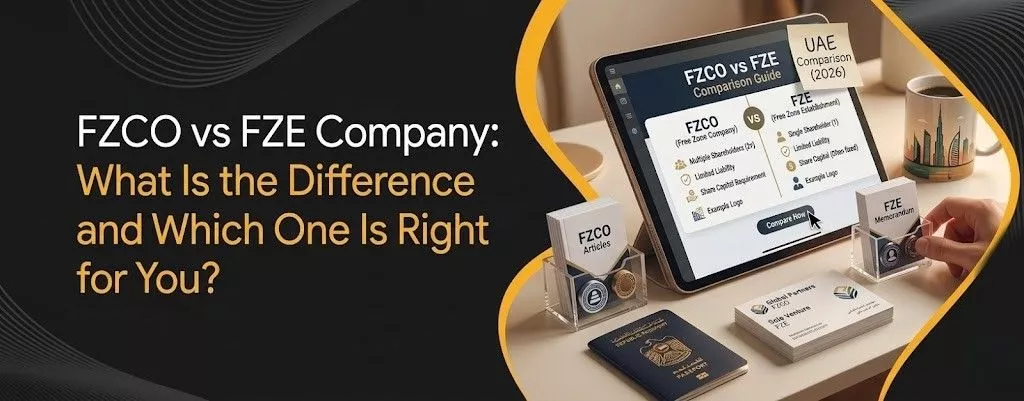
FZE vs FZCO: Key Differences at a Glance
| Feature | FZE | FZCO |
|---|---|---|
| Shareholders | Only one shareholder (individual or corporate) | Two to fifty shareholders; individuals and/or corporate entities |
| Management | Director and shareholder can be the same person; a manager is optional | Requires at least one manager; may appoint a board of up to five directors (DWTC) |
| Share capital | No fixed minimum; must be sufficient for business activities | Nominal minimum (often AED 50 k); capital must be adequate for the licensed activities |
| Best suited for | Solo entrepreneurs, freelancers, consultants, single‑owner SMEs | Partnerships, joint ventures, family businesses, startups seeking investment |
| Decision‑making | Simple, because one shareholder holds all voting rights | Requires shareholder resolutions; decision‑making is shared, which can slow processes |
| Adding partners | Not possible without converting to FZCO or FZ‑LLC | Shareholders can be added (subject to authority approval) |
| Conversion | Can convert to FZCO if new shareholders join; follow authority procedure | Can convert to FZE by buying out co‑owners and restructuring |
Benefits of Operating a Company in a UAE Free Zone
Regardless of whether you choose an FZE or FZCO, free‑zone companies enjoy substantial incentives:
- Full foreign ownership: 100 % ownership is allowed; no local partner is required.
- Profit repatriation: Free zones allow individuals and investors to repatriate profits in entirety.
- No income tax: the UAE does not impose income tax on individuals, investors or corporates (except for oil companies and bank branches).
- Corporate tax incentives: free‑zone businesses that meet the conditions of a qualifying free‑zone person and avoid conducting business on the mainland may continue to enjoy a 0 % corporate tax rate; other income above AED 375 k is taxed at 9 %.
- Customs advantages: many zones provide 100 % exemption from import/export duties.
- Simplified import/export: free‑zone entities can trade with other free‑zones and internationally without paying customs duty; to trade onshore, they must appoint a local distributor.
- Flexible visa quotas: the number of residence visas you can sponsor depends on the size of your leased workspace.
- Streamlined digital setup: most free zones offer an online application, e‑signing of documents and quick issuance of licences. JAFZA’s formation process involves registering interest, submitting documents, selecting a facility and paying fees.
Operational and Legal Considerations
Trade Name & Licensing
When choosing a trade name, check with the free‑zone authority or the Department of Economy and Tourism to ensure the name is not already registered and complies with public morals. The trade name must be followed by the legal form (e.g., FZE, FZCO). After name approval, the business must obtain the appropriate licence, trading, service, industrial or logistics from the free‑zone.
Share Capital
Prior to 2017, JAFZA imposed high minimum share capital thresholds: AED 1 million for FZE and AED 500 k per shareholder for FZCO. These requirements have been abolished; companies must instead maintain capital sufficient for their activities.
Other free‑zones may still stipulate nominal minimums (e.g., AED 50 k), although physical deposit may not be required at formation. Check with your chosen free‑zone for the exact capital rules.
Ultimate Beneficial Owner (UBO) Disclosure
Cabinet Decision 58 of 2020 and subsequent decisions require all UAE companies, including FZE and FZCO, to disclose their Ultimate Beneficial Owners (UBOs).
UBO forms must be submitted with the application, and any changes to beneficial ownership must be notified to the authority. Failure to comply can result in fines or suspension of licences.
Corporate Tax Compliance
Under the UAE corporate tax law, effective from 1 June 2023, free‑zone businesses must register for corporate tax. They may obtain a 0 % rate on qualifying income if they meet the conditions and avoid non‑qualifying activities. Businesses must obtain a Tax Registration Number (TRN) and file returns with the Federal Tax Authority.
Leasing & Premises
To maintain their licence, free‑zone companies must lease a workspace within the free‑zone, which could be a flexi‑desk, office, warehouse or industrial facility. The size of the leased space determines visa quotas. Renewal of licences is annual and requires an active lease and timely payment of renewal fees.
Restricted Activities & Mainland Trading
Free‑zone companies must stick to their licensed activities and cannot trade directly with mainland customers without a mainland branch or local agent. Public listing is not permitted; businesses wanting to list must convert to a mainland structure.
FZCO vs FZE vs Mainland LLC and FZ‑LLC
- FZE is equivalent to a single‑shareholder LLC within a free zone. It offers limited liability and full control, but cannot add additional shareholders without conversion.
- FZCO is similar to a partnership or multi‑shareholder limited liability company within a free zone. It allows 2–50 shareholders and is useful for growing businesses.
- FZ‑LLC (sometimes used by DMCC and other free zones) refers to a free‑zone limited liability company. It typically functions like an FZCO and permits one or more shareholders, depending on the free‑zone’s regulations; DMCC, for example, allows both single and multiple shareholders under an FZ‑LLC licence.
- Mainland LLC: formed under the UAE Commercial Companies Law outside free zones. Mainland LLCs can trade anywhere in the UAE but (in most sectors) historically required a UAE national to hold at least 51 % of shares. Recent amendments allow 100 % foreign ownership in many sectors, but local service agents or sponsors may still be required for certain activities. Mainland LLCs are subject to mainland corporate tax and regulatory requirements.
How to Choose Between FZE and FZCO
When deciding between an FZE and FZCO, evaluate the following factors:
- Number of shareholders: if you are the sole owner, FZE is appropriate. If you have co‑founders, investors or plan to bring partners on board, consider FZCO.
- Growth plans: FZCO offers flexibility to raise capital or add shareholders. An FZE can be converted later, but the process involves regulatory approvals..
- Decision‑making: with one owner, FZE provides agility; FZCO may have slower decisions due to multiple stakeholders.
- Capital: confirm the minimum capital requirement of your free‑zone; some zones set the same requirement for both structures, while others differentiate.
- Governance and compliance: FZCOs may need board meetings and shareholder resolutions; FZEs have simpler governance but cannot appoint corporate directors in some zones.
- Costs: government fees are similar, but FZCOs may incur additional costs for attesting documents of multiple shareholders and drafting shareholder agreements. Renewal fees and visa quotas depend on office size and number of visas needed.
- Industry requirements: certain regulated sectors (financial services, education, healthcare) may impose additional approvals or restrictions. Always verify whether your activity can be conducted within the free‑zone.
- Future exit strategy: investors often prefer FZCOs because shares can be sold to new investors. If you plan to sell part of the business, FZCO gives a clear share structure.
Step‑by‑Step Setup Process for FZE and FZCO
- Register interest online: visit the free‑zone authority’s website (e.g., JAFZA, DMCC) and complete the pre‑approval or registration of interest form. Provide basic information about the business and choose FZE or FZCO.
- Prepare documents: gather application forms, EHS forms, business plan, KYC/UBO forms and passport copies. For FZCOs, prepare shareholder resolutions, MOA and attested company documents for corporate shareholders.
- Submit application and pay fees: upload documents through the authority’s portal and pay the initial registration and licence fees. If physical presence is not required, you can sign electronically.
- Select facility: choose a flexi‑desk, office, warehouse or land plot. The facility determines your visa quota.
- Receive licence and lease: after approval, the authority issues the company licence and lease agreement. Deposit any required share capital (if applicable) into your corporate bank account.
- Open corporate bank account: use the incorporation documents to open a UAE bank account; note that bank KYC procedures can take several weeks.
- Register for VAT and corporate tax: obtain a Tax Registration Number (TRN) for VAT if your annual turnover exceeds the threshold and register for corporate tax even if you expect a 0 % rate.
- Obtain visas: apply for establishment card, labour quotas and visas for shareholders and employees. Each free‑zone has a visa quota linked to the leased space.
- Annual renewal: renew your licence and lease each year. Update UBO information and maintain accounting records.
Conclusion
Choosing between an FZE and an FZCO depends largely on your ownership structure, growth plans and appetite for administrative complexity. Both entities offer limited liability, 100 % foreign ownership and attractive tax incentives, but the FZE is ideal for solo ventures, while the FZCO supports partnerships and growth. When making your decision, evaluate the number of shareholders, future capital needs, governance preferences and the regulations of your chosen free‑zone.
At Bestax, our company‑formation specialists can guide you through every step, from evaluating the right free‑zone and entity type to drafting shareholder agreements and complying with UBO and tax requirements. Contact us today for a tailored consultation and start building your business in one of the world’s most dynamic commercial hubs.
Quik (FAQs)
What is the main difference between an FZE and an FZCO?
An FZE is a free‑zone company with a single shareholder. An FZCO allows two to fifty shareholders. Both structures provide limited liability and full foreign ownership.
What does FZC stand for?
FZC (or FZ Co.) stands for Free Zone Company. The term is interchangeable with FZCO, meaning a multi‑shareholder limited‑liability company within a free‑zone.
Can an FZE or FZCO have 100 % foreign ownership?
Yes. Free‑zone entities allow full foreign ownership, and there is no requirement for a local partner.
Do FZE and FZCO companies need a minimum share capital?
In many free‑zones, the minimum is nominal (often AED 50 k), and the capital does not always need to be deposited immediately. In JAFZA, the pre‑2017 requirements (AED 1 million for FZE and AED 500 k per shareholder for FZCO) have been removed. The company’s Memorandum should reflect a capital sufficient for its activities.
How is an FZ‑LLC different from an FZCO?
The term FZ‑LLC refers to a Free‑Zone Limited Liability Company, used by some free‑zones (e.g., DMCC). It can have one or more shareholders, similar to FZE or FZCO. Always check the rules of your chosen free‑zone.
Can I convert my FZE to an FZCO later?
Yes. Free‑zone authorities generally allow conversion from FZE to FZCO and vice versa, provided you follow their procedures and update the share register. You will need shareholder resolutions, amended MOA and approval from the authority.
Are FZE or FZCO companies subject to corporate tax?
Free‑zone entities must register for corporate tax. Those that qualify as a “qualifying free‑zone person” and do not conduct non‑qualifying activities may continue to enjoy a 0 % rate; otherwise, income above AED 375 k is taxed at 9 %.
Can an FZE or FZCO trade on the mainland?
Free‑zone companies cannot trade directly with UAE mainland customers unless they establish a mainland branch, appoint a local distributor, or obtain a permit from the Department of Economy and Tourism. For retail and direct consumer activities, a mainland entity is often required.
Do I need to be physically present in the UAE to form an FZE/FZCO?
Physical presence is not always required. Many free‑zones allow incorporation through a Power of Attorney and digital signatures. However, banks may require personal visits to open accounts.
What happens if I have a co‑founder but choose an FZE?
An FZE cannot have more than one shareholder. If your co‑founder joins after formation, you must convert to an FZCO or FZ‑LLC. This involves amending the company’s Memorandum and obtaining authority approval.
Disclaimer: The information provided in this blog is for general informational purposes only. For professional assistance and advice, please contact experts.
