


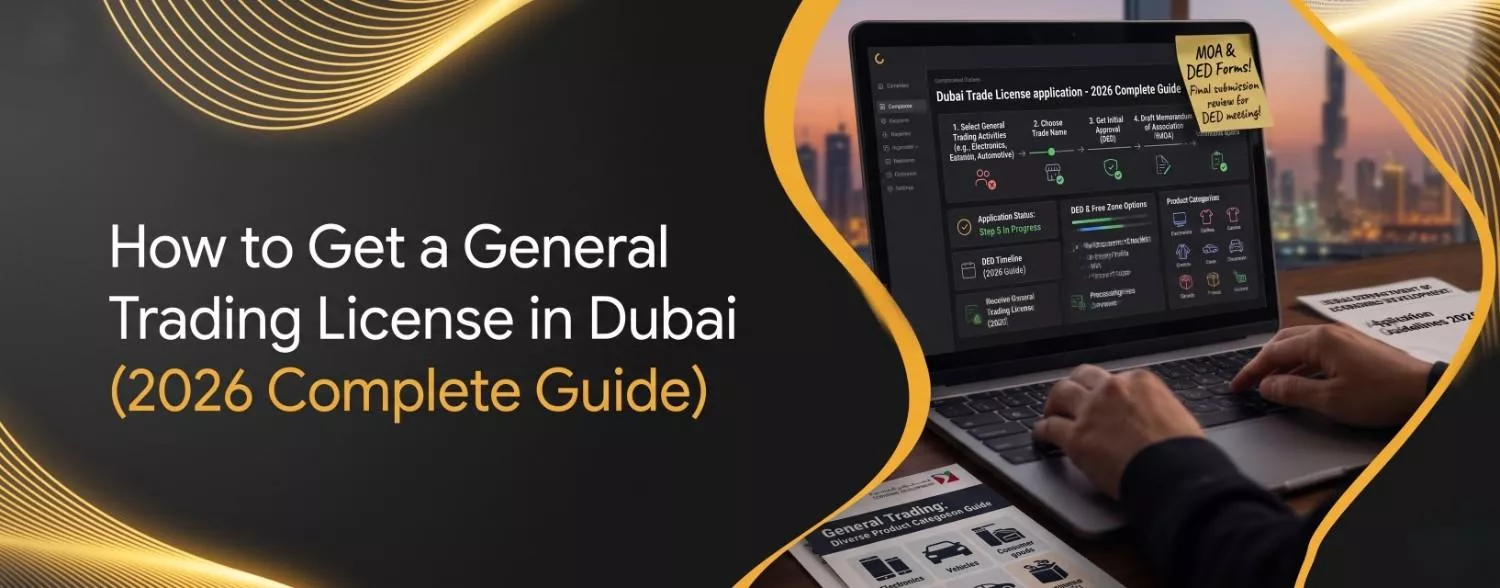
To get a general trading license in Dubai, you must choose your business jurisdiction, select approved trading activities, reserve a trade name, submit the required documents, secure initial approval, pay the license fees, and complete company registration through Dubai mainland or a free zone authority.
As of May 2026, the Dubai Department of Economy & Tourism (DET) and various free‑zone authorities continue to streamline the process. This guide explains everything you need to know, so you can confidently launch your trading business.
What Is a General Trading License?
A general trading license is a commercial permit that authorises a company to trade in a wide variety of goods, both wholesale and retail, within the UAE and internationally. It differs from a standard trade license in scope.
A trade license permits selling a specific type of goods; by contrast, a general trading license covers unrelated product categories, enabling you to handle clothing, electronics, furniture, toys and industrial equipment under one umbrella. Certain restricted items – including cars, alcohol, medical products and weapons, still require additional approvals.
If you need more information, read this article on What is an E‑Trader License in Dubai and how to get it in 2026
Activities Covered under a General Trading License
The license allows you to:
- Import and export a broad range of goods (consumer electronics, textiles, homeware, machinery, toys and more).
- Wholesale or retail these products within Dubai or re‑export them abroad.
- Establish showrooms, shops and warehouses for your products.
Activities requiring separate approvals (not automatically included) include automobiles, precious metals, pharmaceuticals, food products and weapons.
General Trading vs Trading Licence
- General trading license: allows retail and wholesale of any goods except those specifically prohibited; includes import and export rights.
- Trading license: restricts the holder to the specific goods listed on the permit.
Why Choose Dubai for General Trading?
Dubai offers numerous advantages:
- Gateway to local and international markets. With a general trading license, you can distribute goods locally or re‑export to other markets.
- Low tax regime. The UAE has one of the world’s lowest tax rates. Corporate tax only applies at 9 % on profits above AED 375 000.
- World‑class infrastructure. Dubai’s logistics infrastructure, ports, airports, highways and warehousing supports smooth import/export.
- 100 % foreign ownership. Free zones and mainland reforms allow full foreign ownership of mainland companies.
- Ease of doing business. The licensing process is simplified; DET’s “Instant License” and free‑zone initiatives like Meydan’s Fawri allow businesses to obtain a license quickly.
Mainland vs Free‑Zone vs Sharjah: Choosing Your Jurisdiction
The UAE offers several jurisdictions for obtaining a general trading license. Your choice affects cost, ownership structure and market access.
(The cost breakdown can vary; consult a professional consultant for the exact cost)
Mainland (DET/DED)
A mainland general trading license allows unrestricted trading in the UAE market and permits the business to open stores or offices anywhere in Dubai. Key points include:
- Instant license. DET issues an instant license with one‑year validity that does not require office space for the first year; renewal requires leasing premises.
- Unlimited visas. Mainland companies can sponsor as many visas as their office space allows.
- Cost. The cost of setting up a mainland general trading company, including trade license fee, virtual office rent with Ejari for one year and pre‑approvals, is around AED 41,683. The general trading license cost in Dubai typically ranges from AED 15 000 to AED 50 000 depending on activities, visa quota and office requirements.
Free‑Zone
Dubai hosts more than 30 free zones, each with different packages. Free‑zone general trading licenses offer:
- 100 % foreign ownership and full control. No Emirati partner is needed.
- Fixed fees and profit repatriation. Free‑zone authorities offer fixed license fees and allow 100 % capital repatriation.
- Customs duty exemptions and streamlined import/export through dedicated ports.
- Cost range. Packages start from around AED 15 700 for a basic general trading license with one visa quota. Costs can rise to AED 50 000 or more depending on free‑zone location, visa quotas and additional facilities.
- Cheapest options. The lowest‑cost general trading license in the UAE can be obtained in Sharjah Media City for about AED 8 050 with no visa quota. The most affordable option in Dubai is through Dubai Silicon Oasis’s IFZA free zone, starting at AED 11 900.
- Mainland access. Free‑zone companies must appoint a mainland distributor to sell directly on the UAE mainland.
Sharjah
Sharjah offers cost‑effective setups and is suitable for traders focused on regional markets.
- Cost range. A general trading license in Sharjah costs approximately AED 5 000–30 000, depending on whether the company is based on the mainland or in a free zone.
- Factors. Costs vary by license type, activity, location and company structure; free‑zone packages often include visa quotas and office space.
Follow the 10 steps to learn how to get a General Trading License in Dubai (2026)
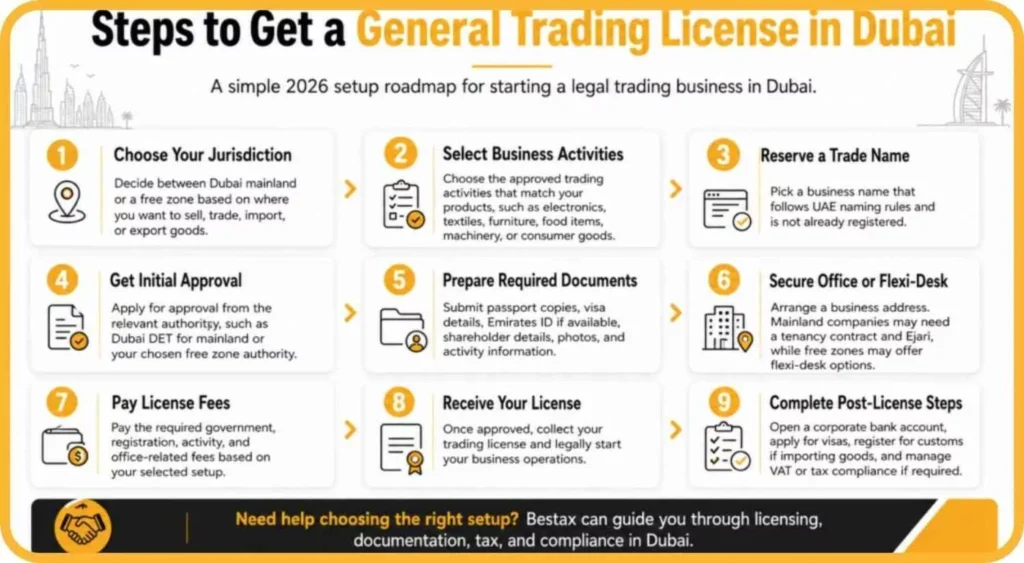
- Choose your jurisdiction and business activity. Decide whether the mainland or the free zone best suits your plans. List the goods you intend to trade and ensure they are permitted under general trading regulations.
- Select a legal structure. Most general trading companies are formed as Limited Liability Companies (LLCs) with one or more shareholders.
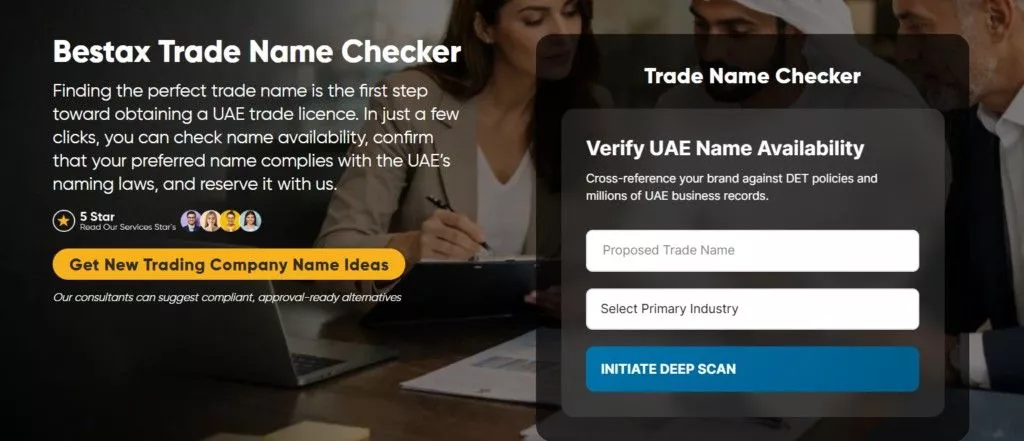
- Reserve and approve your trade name. Submit your chosen company name for approval, following naming rules that prohibit offensive terms or certain words like “Universal” or “International”. The name must be transliterated into English or Arabic, free of special characters and unique.
To quickly check the availability of your trade name, use our 24/7 available free service, Trade Name Checker
- Apply for initial approval. Submit an application to DET (for the mainland) or your chosen free‑zone authority. For free‑zone setups, this is typically an online form.
- Prepare incorporation documents. For individual shareholders, you need passport copies, passport‑sized photos, residence visas and Emirates IDs. Corporate shareholders must provide certificates of incorporation, incumbency, memorandum of association and a shareholders’ resolution authorising the new business.
- Rent office or flexi‑desk. A physical address or flexi‑desk is required; for mainland companies, the tenancy agreement must be registered with Ejari.
- Draft and sign the Memorandum of Association (MOA). In the mainland, this must be notarised. Free‑zone authorities provide standard templates.
- Obtain customs code and import/export clearance. Register with the UAE Federal Customs Authority to secure an import code.
- Pay licence fees and collect your license. Once approvals are granted, pay the government fees (see cost breakdown below) and collect your general trading license. In some free zones, such as IFZA or Meydan, digital licences can be issued within one day.
- Open a corporate bank account and apply for visas. After receiving your license, you can open a bank account, apply for residence visas for shareholders and employees, and start trading.
Documents Required
- For individual shareholders: passport copy, passport‑size photo, residence visa and Emirates ID.
- For corporate shareholders: certificate of incorporation, certificate of incumbency, memorandum of association, and shareholder resolution authorising the new company.
- Additional for mainland (DET) applications: Ejari‑registered tenancy contract, notarised MOA, initial approval form via DET portal, Dubai Chamber of Commerce registration, and any sector‑specific approvals (e.g., Dubai Municipality for food trading, Ministry of Health for medical goods).
- For free‑zone applications: completed free‑zone authority form and a business plan (required by some free zones such as DMCC and DAFZA).
Cost Breakdown of a General Trading License in 2026
| Jurisdiction/Package | Cost Range (AED) | Notes |
|---|---|---|
| Mainland DET License | ~41 683 total (license fee, virtual office & Ejari, initial approvals) | Allows unlimited visas; Instant License valid for one year without office, but office required on renewal. |
| Free‑Zone License | 15 700 – 50 000+ | Includes license fee and one visa quota; costs increase with additional visas, office or warehouse space. |
| Cheapest Free‑Zone Option (Dubai) | ≈11 900 | Offered by IFZA (Dubai Silicon Oasis) with no visa quota. |
| Cheapest Free‑Zone Option (UAE) | ≈8 050 | Available in Sharjah Media City with zero visa quota. |
| Sharjah Mainland/Free Zone | 5 000 – 30 000 | Costs depend on license type, activity and visa requirements. |
| General Cost Range for Dubai | 15 000 – 50 000 | Includes license fee, registration charges and initial approval. |
Additional Costs to Consider
- Office rent: leasing an office or warehouse space adds significant expense.
- Visa fees: investor and employee visas cost around AED 3 500–5 000 per person.
- Document attestation and translations: especially for foreign shareholders.
- Customs code registration: one‑time fee when applying for an import code.
- Bank guarantee or share capital requirements: Some free zones require a minimum capital deposit (often refundable). Mainland licences typically have no paid‑up capital requirement.
Get a free cost breakdown of your business setup in 2 minutes using our Business Setup Calculator.
Tax and Regulatory Considerations
- Corporate tax: Since June 2023, the UAE levies a 9 % corporate tax on profits above AED 375 000. Profits below this threshold remain exempt, offering an attractive environment for SMEs.
- Value Added Tax (VAT): 5 % VAT applies to most goods and services in the UAE. Businesses must register for VAT once taxable supplies exceed AED 375 000 annually.
- Customs duties: Imports to the mainland are subject to 5 % customs duty; free‑zone companies enjoy duty exemptions but must pay duties if goods enter the mainland market.
After reading this guide, you’re ready to launch your trading journey. If you need personalised advice or help navigating the paperwork, our team at Bestax can assist you. We provide end‑to‑end support from licence selection to visa processing and compliance. Contact us today to start your general trading business in Dubai with confidence!
Quick FAQs
What activities are allowed under a general trading license?
A general trading license covers the import, export, wholesale and retail of multiple unrelated products, such as electronics, clothing, furniture, toys and industrial equipment. Restricted goods like vehicles, alcohol, medical devices and weapons require separate approvals.
How long does it take to obtain the license?
If documentation is complete, free‑zone authorities can issue digital licences within 1–3 working days. DET’s Instant License allows mainland entrepreneurs to receive a licence within one day and begin trading immediately; renewal requires office space after the first year.
Do I need a local sponsor?
Reforms allow 100 % foreign ownership of commercial companies in most sectors. Mainland general trading companies no longer require a local Emirati partner but must appoint a local service agent for specific activities. Free‑zone companies enjoy full foreign ownership by default.
Can I trade within the UAE mainland from a free‑zone company?
Free‑zone companies must appoint a mainland‑licensed distributor to sell products directly within the UAE mainland. Alternatively, you can apply for a dual license through your free‑zone authority and DET.
What is the cheapest general trading license in the UAE?
The lowest‑priced package is offered by Sharjah Media City at around AED 8 050 with no visa quota. In Dubai, IFZA’s free‑zone package starts at approximately AED 11 900.
What are the differences between a trade license and a general trading license?
A trade license allows the sale of specific goods listed on the license, whereas a general trading license authorises the business to sell a wide range of goods that are not prohibited.
How many visas can I obtain?
Mainland general trading companies can obtain as many visas as their office space allows. Free‑zone packages include a fixed visa quota; additional visas require upgrading the package and paying extra fees.
Disclaimer: The information provided in this blog is for general informational purposes only. For professional assistance and advice, please contact experts.
