


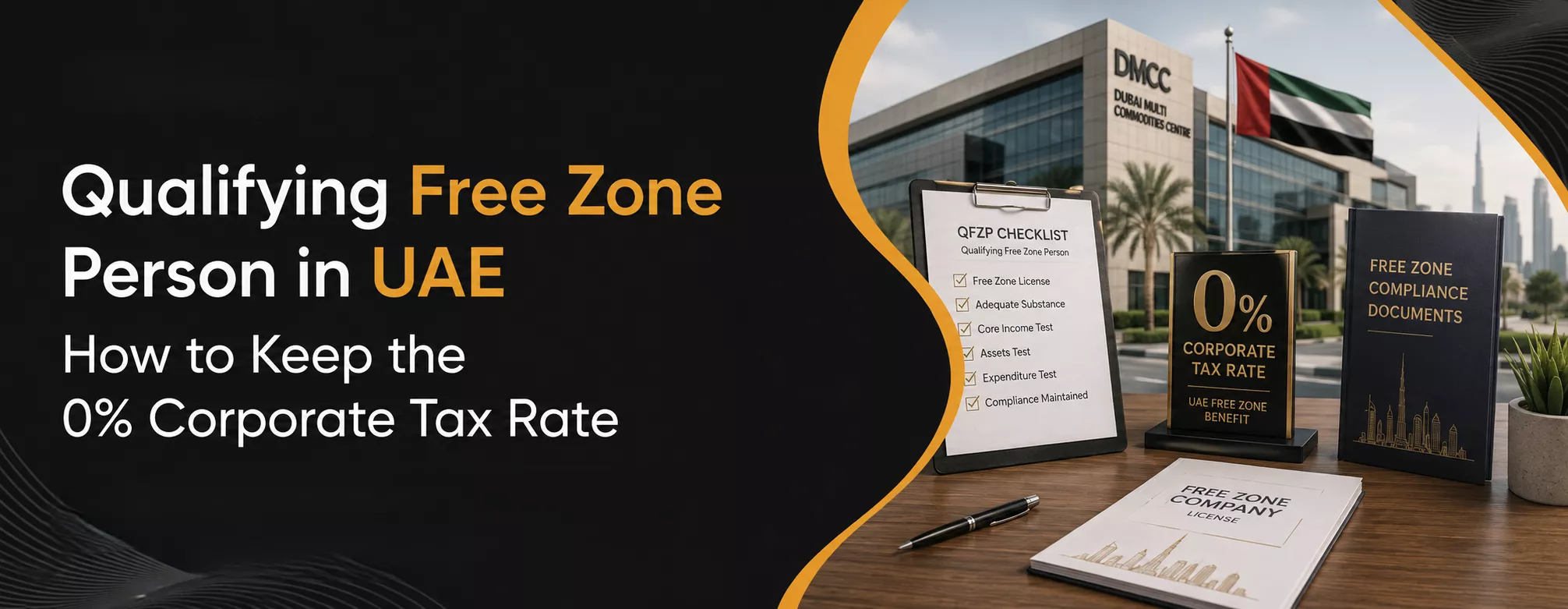
A qualifying free zone person (QFZP) is a UAE free zone company that meets a specific set of legal conditions and, because it meets them, pays 0% corporate tax on its qualifying income and 9% on the rest. To keep that 0% corporate tax free zone rate, your business has to satisfy every QFZP condition in every single tax period, and those conditions were refreshed and clarified in 2025 by Ministerial Decision No. 229 of 2025.
If you own or manage a company in a UAE free zone, this is the most important tax topic you can understand. The 0% rate is real and valuable, but it is not a gift that comes with your trade licence. It is a status you earn and keep by structuring your income, your operations and your records the right way.
First, clear up the biggest myth: free zones are not automatically tax free
Many business owners assume that because their company sits inside a free zone, it pays no tax. That was broadly true before June 2023. It is no longer true today.
Since the UAE corporate tax regime took effect, every free zone company is a taxable person that must register for corporate tax and file a return, even if the tax it finally pays is zero. The 0% rate is a benefit layered on top of the standard system, and it applies only to the part of your income that legally qualifies. Everything else is taxed at 9%. So the real question is never “am I in a free zone” but “does my income qualify, and do I meet all the conditions to be a QFZP.”
What is a qualifying free zone person?
A free zone person is any juridical person (a company, not an individual) that is incorporated, established or registered in a UAE free zone. This includes a branch of a foreign company registered in a free zone.
A qualifying free zone person is a free zone person that meets all of the conditions in Article 18 of the corporate tax law and therefore benefits from the 0% rate on its qualifying income. There is one point that surprises most people: you do not fill in a separate application to “become” a QFZP and you do not receive a QFZP certificate. A free zone person is treated as a QFZP automatically as long as it keeps meeting the conditions and does not choose to opt out. Lose a condition, and you lose the status. You claim the treatment through your normal corporate tax return.
The 0% rate applies for the remainder of the tax incentive period set out in the legislation of the free zone where you are registered. In other words, the corporate tax law respects the tax holiday your free zone already promised you, provided you play by the QFZP rules.
What the 0% corporate tax free zone rate really means
A qualifying free zone person is taxed as follows:
- 0% on its qualifying income.
- 9% on its taxable income that is not qualifying income.
There is an important catch that trips up many owners. A normal business gets a 0% band on its first AED 375,000 of taxable income and 9% only on profit above that. A QFZP does not get that AED 375,000 band. Any income that a QFZP earns that is not qualifying income is taxed at 9% from the very first dirham.
This is why the classification of your income matters so much. Getting income into the qualifying bucket means 0%. Letting it fall into the non qualifying bucket means an immediate 9%, with no small starting allowance to soften it.
QFZP conditions: the full checklist
To be a qualifying free zone person for a tax period, your company must meet all of the following conditions:
- Be a free zone person. You must be a juridical person incorporated, established or registered in a free zone.
- Maintain adequate substance in a free zone. You must actually run your core operations from the free zone, with real people, assets and spending (explained below).
- Derive qualifying income. Your income must come from the qualifying sources defined in the law.
- Not elect to be taxed under the standard rules. You must not have chosen to opt out of the free zone regime.
- Comply with the arm’s length principle. Transactions with related parties must be priced as if between independent companies.
- Maintain transfer pricing documentation. You must keep the required transfer pricing records, including a master file and local file where the thresholds are met.
- Prepare and maintain audited financial statements. Audited accounts are mandatory for a QFZP regardless of how much revenue it earns, in line with Ministerial Decision No. 84 of 2025.
- Stay within the de minimis limit. Your non qualifying revenue must not exceed the de minimis threshold (explained below).
Miss any one of these at any time during the tax period and you stop being a QFZP for that period. As you will see later, the consequences of that last for several years.
What is qualifying income in the UAE?
Qualifying income is the income that gets the 0% rate. Under the law, it falls into these categories:
- Income from transactions with another free zone person, as long as that person is the beneficial recipient of the goods or services and the transaction does not relate to an excluded activity.
- Income from transactions relating to a qualifying activity, again provided it is not an excluded activity.
- Income from qualifying intellectual property that your company has developed.
- Any other income, but only if you meet the de minimis requirements.
Two ideas inside this list are worth pausing on.
The beneficial recipient rule means that a sale to another free zone company only earns 0% if that company actually uses and enjoys what it buys, rather than simply passing it straight on to someone else outside the free zone. You may rely on a written confirmation from your customer that it is the beneficial recipient, unless you have reason to believe otherwise.
Certain income can never be qualifying income, even if it looks like it fits the list above. That includes income attributable to a permanent establishment inside the UAE mainland or abroad, income from immovable property (other than commercial property inside a free zone sold to a free zone person), and income from intellectual property that is not qualifying intellectual property. This income is taxed at 9%.
Qualifying activities list
Ministerial Decision No. 229 of 2025 sets out the current list of qualifying activities. Income from these activities can earn the 0% rate even when your customer is outside a free zone:
- Manufacturing of goods or materials.
- Processing of goods or materials.
- Trading of qualifying commodities.
- Holding of shares and other securities for investment purposes.
- Ownership, management and operation of ships.
- Reinsurance services.
- Fund management services.
- Wealth and investment management services.
- Headquarter services to related parties.
- Treasury and financing services to related parties or for its own account.
- Financing and leasing of aircraft.
- Distribution of goods or materials in or from a designated zone.
- Logistics services.
- Any activity that is ancillary to the activities above.
A few practical notes. Holding of shares only counts as an investment activity when the shares are held for an uninterrupted period of at least 12 months. Distribution only qualifies when it is carried out in or from a designated zone, the goods enter the UAE through that designated zone, and they are supplied to a customer who resells, processes or alters them, or to a public benefit entity.
Trading of qualifying commodities now clearly includes the physical trade, the financial derivatives used to hedge it, and associated structured commodity financing, but this does not apply if your revenue from distribution, warehousing, logistics or inventory management is 51% or more of your total revenue for the period.
Excluded activities for corporate tax
An excluded activity produces non qualifying income, which means 9% tax, and if it grows too large it can cost you your QFZP status entirely. The current excluded activities are:
- Any transaction with a natural person (an individual), except transactions connected to the qualifying activities of operating ships, fund management, wealth and investment management, and aircraft financing and leasing.
- Banking activities.
- Insurance activities, without prejudice to reinsurance and headquarter services.
- Finance and leasing activities, without prejudice to qualifying commodity trading, ship operation, treasury and financing, and aircraft financing and leasing.
- Ownership or exploitation of immovable property, other than commercial property located in a free zone where the transaction is with a free zone person.
- Any activity that is ancillary to the excluded activities above.
The practical takeaway is that selling directly to individual consumers, running a bank, providing insurance, offering general finance and leasing, or earning rent from property outside a free zone will usually generate non qualifying income.
The de minimis rule in the UAE
The de minimis rule is a safety valve. It lets a QFZP earn a small amount of non qualifying income without losing the 0% rate. You meet the de minimis requirement when your non qualifying revenue in a tax period does not exceed the lower of these two figures:
- 5% of your total revenue for that period, or
- AED 5,000,000 (five million dirhams).
Because it is the lower of the two, the AED 5,000,000 figure is a ceiling, not an allowance you always get. A quick illustration. If your total revenue for the year is AED 20,000,000, then 5% is AED 1,000,000, which is lower than AED 5,000,000, so your non qualifying revenue must stay at or below AED 1,000,000. If your total revenue is AED 200,000,000, then 5% is AED 10,000,000, but the AED 5,000,000 cap is lower, so AED 5,000,000 becomes your limit.
Breach the de minimis threshold and you do not simply pay 9% on the excess. You lose QFZP status for the whole period and cannot claim 0% on any of your income. This is one of the most common ways free zone companies accidentally lose their benefit, so monitoring your non qualifying revenue through the year is essential.
Adequate substance in a free zone
Adequate substance is the requirement that stops the 0% rate from being a paper exercise. To keep the benefit, your company must actually operate from the free zone, not just hold a licence there.
In practice, adequate substance means your company undertakes its core income generating activities inside the free zone, and maintains adequate assets, an adequate number of qualified full time employees, and an adequate level of operating expenditure in the free zone to carry out those activities. For the qualifying activity of distribution, the core activities must take place in a designated zone.
Core income generating activities are the essential, value adding tasks that actually earn your revenue. You are allowed to outsource them, but only to another person located in the same free zone or designated zone, and only if you keep adequate supervision and control over the outsourced work. Research and development for qualifying intellectual property is the one exception where outsourcing can reach beyond the free zone.
A registered address and a mailbox are not enough. The level of people, space and cost has to be sensible for the size and nature of what your company does, and the same employee cannot be counted twice across different activities.
Ministerial Decision 229 of 2025: what changed
Ministerial Decision No. 229 of 2025 was issued on 28 August 2025 by the UAE Ministry of Finance. It repeals and replaces the earlier Ministerial Decision No. 265 of 2023, and it applies retroactively from 1 June 2023, which is the start date of the corporate tax regime.
The headline changes are these:
- Commodity trading was widened. Qualifying commodities now include not only metals, minerals, energy and agricultural commodities, but also industrial chemicals, associated by products, and environmental commodities such as carbon credits and renewable energy certificates. A commodity only qualifies where a quoted price for it exists.
- A quoted price framework was added. A companion decision, Ministerial Decision No. 230 of 2025, specifies the recognised price reporting agencies and exchanges that establish those quoted prices for commodity traders.
- Treasury and financing was extended. Treasury and financing services now qualify when carried out for related parties or for the company’s own account, not only for related parties.
- The investment holding period was defined. Shares and securities count as held for investment purposes only when held for an uninterrupted period of at least 12 months.
- Distribution conditions were clarified. The decision spells out exactly when distribution in or from a designated zone qualifies, as described in the qualifying activities section above.
- Audited accounts were tied to the new standard. A QFZP must prepare audited financial statements in line with Ministerial Decision No. 84 of 2025.
The overall effect is that more free zone businesses, especially commodity traders and treasury centres, may now qualify for the 0% rate, while the substance and pricing expectations around them are firmer. Because the decision applies back to 1 June 2023, it is worth revisiting your position for earlier periods as well as the current one.
New for 2026: extra proof for distribution from a designated zone
If your qualifying income comes from the distribution of goods or materials in or from a designated zone, there is a new compliance step you must complete for tax periods beginning on or after 1 January 2026. FTA Decision No. 6 of 2026, issued on 2 June 2026, requires free zone distributors who rely on this activity to obtain an annual Agreed Upon Procedures report from an independent auditor licensed in the UAE.
The auditor performs a set of prescribed checks, for example confirming that your customers buy the goods for resale, processing or alteration, and that the goods entered the UAE through the designated zone, and then reports the factual findings. It is not a full audit opinion, and it is a separate deliverable from your normal audited financial statements. The report must be submitted to the FTA within 30 days of the deadline for filing your corporate tax return for the period.
If you do not submit it, the distribution condition is treated as not met. That means the related income can be treated as non qualifying and you risk losing your qualifying free zone person status for that activity, along with the 0% rate on that income. The decision does not change the tax rate or the definition of qualifying income. It raises the level of evidence you have to keep. It applies only to distribution from a designated zone, so free zone companies relying on other qualifying activities are outside its scope.
A quick note for large multinational groups: the 15% top-up tax
If your free zone company is part of a very large multinational group, there is one more layer to know about. The UAE introduced a Domestic Minimum Top-up Tax that applies to members of multinational groups with annual global revenues of EUR 750 million or more in at least two of the four preceding financial years, for financial years starting on or after 1 January 2025, at a minimum effective rate of 15%.
This can apply on top of the free zone regime, which means a QFZP inside such a group may still face a top-up even where its income would otherwise be taxed at 0%. Most small and mid sized free zone companies are well below this threshold and are not affected, but groups near it should run a separate assessment.
What happens if you lose QFZP status
The penalty for failing a condition is deliberately heavy, which is why prevention matters. If your company fails to meet the criteria to be a QFZP for a tax period, or if you elect out of the regime, it stops being a QFZP from the beginning of that tax period and for the following four tax periods.
That is effectively five years taxed under the standard rules, at 9% on taxable income above AED 375,000, with none of your income getting the 0% qualifying treatment during that window. After those five periods, your company tests its position again and can requalify if it meets the conditions. A single mistake, such as one over sized non qualifying transaction, can therefore be very expensive.
How to keep your 0% rate: a practical checklist
Protecting the benefit is mostly about discipline through the year rather than a scramble at filing time. The core steps are:
- Map every revenue stream to a category, so you know what is qualifying income, what is non qualifying, and why.
- Track your non qualifying revenue continuously against both the 5% and the AED 5,000,000 limits, and act before you approach the ceiling.
- Keep genuine substance in the free zone, with real employees, premises and spending that match the scale of your activities.
- Confirm beneficial recipient status in writing for sales to other free zone companies.
- Maintain audited financial statements and transfer pricing documentation every year, not as an afterthought.
- If any of your qualifying income comes from distribution in or from a designated zone, obtain the annual Agreed Upon Procedures report required by FTA Decision No. 6 of 2026 and file it within 30 days of your corporate tax return deadline.
- Reassess your structure against Ministerial Decision No. 229 of 2025, especially if you trade commodities, run a treasury function, or distribute goods.
- Register for corporate tax and file your return on time, even when the tax due is zero.
How Bestax can help you protect your 0% rate
Staying inside the qualifying free zone person rules is a year round exercise in classification, documentation and timing, and the cost of a slip is measured in years. Bestax is a firm of FTA registered tax consultants in Dubai that helps free zone businesses assess their QFZP eligibility, keep their non qualifying income within the de minimis limit, build adequate substance, and file correctly so the 0% rate is not put at risk.
You can explore the relevant services here:
- Corporate tax consultancy in Dubai for a full review of your qualifying and non qualifying income.
- Corporate tax registration services to get your company registered correctly through EmaraTax.
- Corporate tax return filing services to claim your QFZP treatment accurately and on time.
- Free zone business setup if you are structuring a new free zone company with the 0% rate in mind.
Book a free consultation with the Bestax team to check your free zone tax position before your next filing deadline.
Frequently asked questions
What is a qualifying free zone person in the UAE?
A qualifying free zone person is a company registered in a UAE free zone that meets all the conditions in Article 18 of the corporate tax law and therefore pays 0% corporate tax on its qualifying income and 9% on income that does not qualify.
Are free zone companies automatically exempt from UAE corporate tax?
No. Every free zone company is a taxable person that must register for corporate tax and file a return. The 0% rate applies only to a qualifying free zone person, and only on its qualifying income.
How can a free zone company keep the 0% corporate tax rate?
Keep meeting every QFZP condition in every tax period. That means maintaining adequate substance in the free zone, earning qualifying income, staying within the de minimis limit, keeping audited financial statements and transfer pricing records, and not electing out of the regime.
What are the QFZP conditions?
The conditions are being a free zone person, maintaining adequate substance, deriving qualifying income, not electing out of the regime, complying with the arm’s length principle, keeping transfer pricing documentation, preparing audited financial statements, and staying within the de minimis threshold.
What counts as qualifying income in the UAE?
Qualifying income mainly comes from transactions with other free zone persons who are the beneficial recipient, from qualifying activities, and from qualifying intellectual property. Other income can also qualify if you stay within the de minimis limit. Income from a permanent establishment or from property outside a free zone does not qualify.
What is on the qualifying activities list?
The qualifying activities include manufacturing, processing, trading of qualifying commodities, holding shares for investment, ship operation, reinsurance, fund management, wealth and investment management, headquarter services, treasury and financing, aircraft financing and leasing, distribution from a designated zone, logistics, and activities ancillary to these.
What are excluded activities for corporate tax?
Excluded activities include most transactions with individuals, banking, insurance, general finance and leasing, and owning or exploiting property outside a free zone. Income from these is taxed at 9%, subject to specific exceptions set out in the law.
What is the de minimis rule in the UAE?
The de minimis rule lets a QFZP earn a small amount of non qualifying income without losing the 0% rate. Your non qualifying revenue must not exceed the lower of 5% of total revenue or AED 5,000,000 in a tax period. Go over it and you lose QFZP status for that period.
What does adequate substance mean for a free zone company?
Adequate substance means you actually run your core income generating activities from the free zone, with enough qualified full time employees, assets and operating spending to match your activities. A licence and a registered address alone are not enough.
What is Ministerial Decision 229 of 2025?
It is the Ministry of Finance decision, issued on 28 August 2025 and effective retroactively from 1 June 2023, that sets the current list of qualifying and excluded activities for free zone persons. It replaces the earlier Decision No. 265 of 2023 and widens qualifying commodity trading and treasury activities.
What is FTA Decision No. 6 of 2026 and does it affect my free zone company?
FTA Decision No. 6 of 2026 applies only to qualifying free zone persons whose qualifying income comes from distributing goods or materials in or from a designated zone. For tax periods beginning on or after 1 January 2026, those companies must obtain an annual Agreed Upon Procedures report from an independent UAE licensed auditor and file it with the FTA within 30 days of their corporate tax return deadline. If you rely on a different qualifying activity, this decision does not apply to you.
Disclaimer: The information provided in this blog is for general informational purposes only. For professional assistance and advice, please contact experts.
