




UAE import tax in 2026 usually means two separate amounts: customs duty and import VAT. For most foreign goods entering the GCC Customs Union, the standard customs duty is 5 percent, and UAE VAT is generally 5 percent when the imported goods are taxable.
The final amount depends on the HS code, customs value, origin, VAT status, exemptions, excise tax if relevant, and the charges applied by the customs authority, port, carrier or clearance agent.
What Does UAE Import Tax Actually Include?
UAE import tax is not one single tax. An importer can face several different amounts at the border, and each amount follows a different rule.
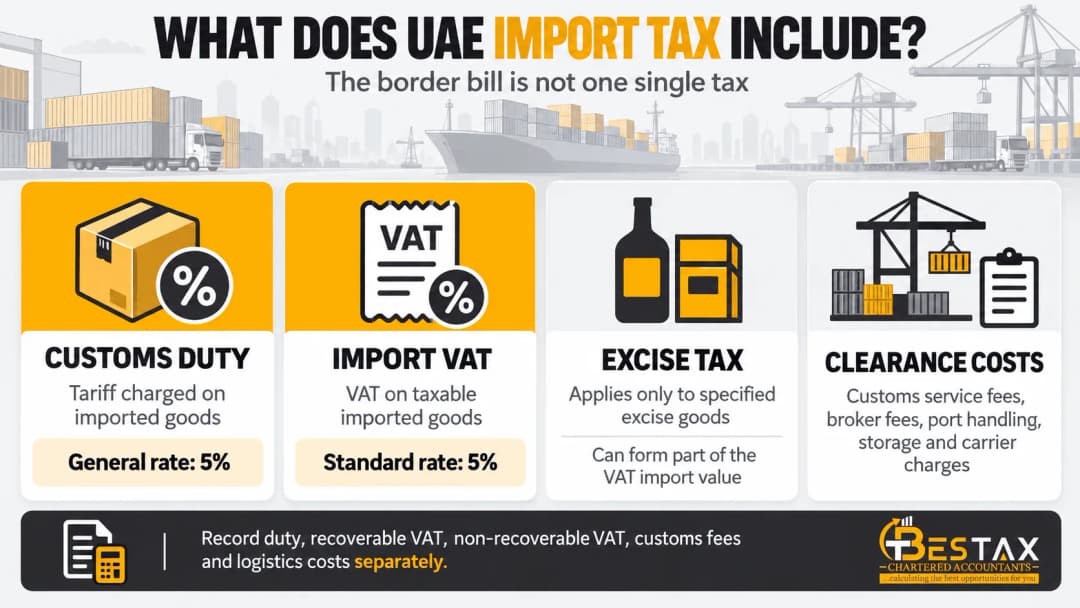
- Customs duty is the tariff charged when goods are imported into the customs territory. The general GCC external tariff is 5 percent on foreign goods imported from outside the customs union.
- Import VAT is value added tax charged on imported goods when those goods would be taxable in the UAE. The standard VAT rate is 5 percent.
- Excise tax can apply to specific excise goods. If excise tax is paid on import, it forms part of the import value used for VAT purposes.
- Customs service fees are government charges for customs services such as declarations, registration, classification or requested inspections.
- Operational clearance costs can include broker fees, port handling, storage, delivery orders and carrier charges. These are commercial costs, not customs duty.
This distinction matters because an invoice from a freight forwarder can combine several amounts. A business should record the customs duty, recoverable import VAT, non recoverable VAT if any, customs fees and logistics charges in the correct accounting categories rather than treating the entire bill as one tax.
How Much Is UAE Import Duty in 2026?
The standard UAE import duty is 5 percent on foreign goods imported from outside the GCC Customs Union. The UAE Government portal and Dubai Customs both state that the usual customs rate is 5 percent of the CIF value, subject to goods that have a different tariff treatment.
CIF means cost, insurance and freight. In simple terms, customs looks at the value of the goods plus the cost of getting them to the point of import, including freight and insurance. The invoice price alone is not always the final customs value.
Simple rule: If taxable goods have a CIF customs value of AED 100,000 and the applicable customs rate is 5 percent, the customs duty is AED 5,000 before considering VAT and other charges.
When Can the Customs Rate Be Different?
A 5 percent rate is the general rule, not a promise for every product. The correct rate comes from the product classification and the applicable tariff schedule.
- Some goods are listed as exempt under the unified GCC tariff or customs law.
- Tobacco and its derivatives can carry a 100 percent customs duty under the GCC tariff framework.
- Dubai Customs currently states a 50 percent customs duty for alcohol and 100 percent for cigarettes in its public customs FAQ.
- Trade agreements and qualifying origin rules can produce preferential treatment when the required origin conditions and documents are met.
- Restricted goods can require approvals before release even if the tax calculation itself is straightforward.
How Customs Value Is Calculated in Dubai
For a normal commercial import into Dubai, the tax calculation starts with the customs value, not the supplier invoice. Dubai Customs explains that the customs value is based on CIF. Customs can examine the declared value and request supporting evidence when the amount appears incomplete or inaccurate.
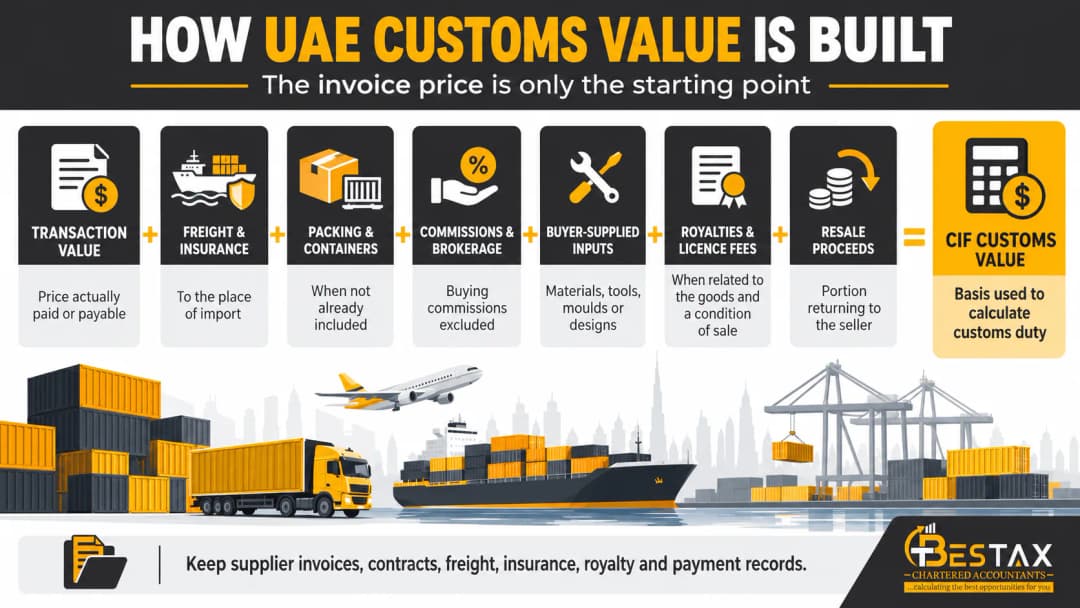
The current customs valuation framework starts with the transaction value, which is generally the price actually paid or payable for the imported goods. Customs then considers required valuation additions when those amounts are not already included in the price.
Valuation Additions to Goods Imported into the UAE
Several costs can increase the customs value even when they do not appear in the supplier price. Under the GCC customs valuation framework used in the UAE, the following can be added when they are not already included and can be supported by objective data:
- Commissions and brokerage other than buying commissions.
- The cost of containers treated as part of the imported goods.
- Packing costs for labour and materials.
- Certain materials, components, tools, moulds, designs and similar items supplied by the buyer for production of the imported goods.
- Royalties and licence fees related to the imported goods when payment is a condition of sale.
- A portion of later resale proceeds that goes directly or indirectly to the seller.
- Transport costs to the port or place of import.
- Loading, unloading, handling and insurance connected with transport to the place of import.
For an importer, the practical lesson is simple. Keep the purchase agreement, supplier invoice, freight invoice, insurance, royalty arrangements, transfer records and any evidence showing how the price was built. Customs can ask for more information if the declared value is doubtful.
UAE Import Duty Calculator: A Practical 2026 Example
No online UAE import duty calculator can replace the tariff classification and customs valuation process. You can, however, estimate a standard import with a simple sequence.
| Step | Example amount | Explanation |
|---|---|---|
| 1. CIF customs value | AED 100,000 | Goods value plus freight and insurance to the place of import |
| 2. Customs duty at 5 percent | AED 5,000 | AED 100,000 multiplied by 5 percent |
| 3. Illustrative VAT base | AED 105,000 | A simplified example using customs value plus customs duty. Actual VAT value can also include specified customs fees and excise tax where applicable |
| 4. VAT at 5 percent | AED 5,250 | AED 105,000 multiplied by 5 percent |
| 5. Total duty and VAT | AED 10,250 | Before customs service fees, port costs, storage and broker charges |
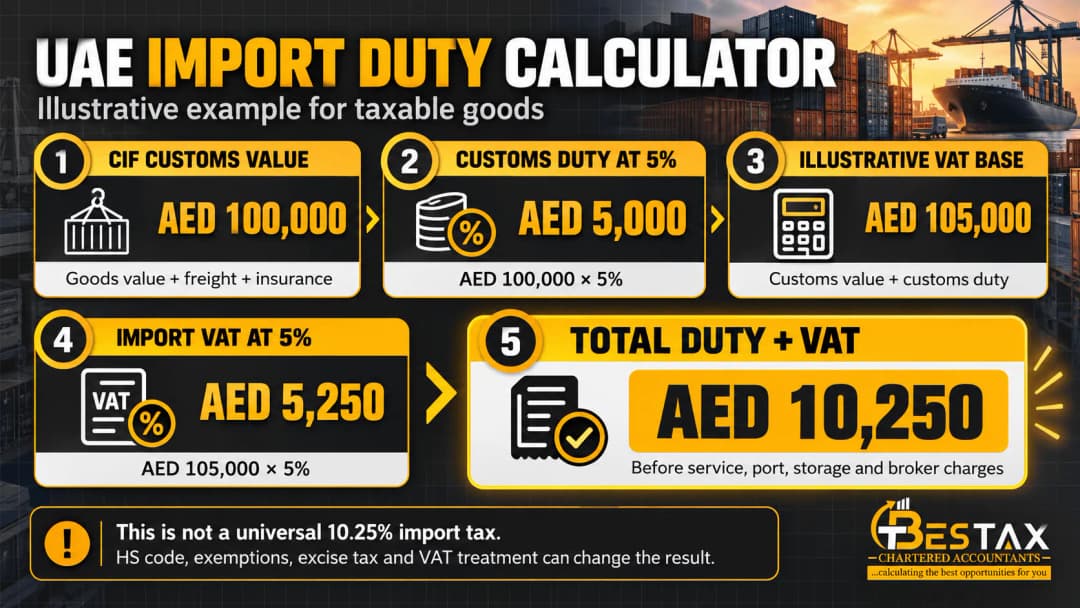
This example is useful for budgeting, but it is not a universal 10.25 percent import tax. A duty exemption, a different customs rate, excise tax, a different customs valuation or a zero rated VAT treatment can change the answer.
How Does VAT on UAE Imports Work?
Import VAT is separate from customs duty. The standard VAT rate is 5 percent, and under the VAT Decree-Law and its amendments the import value is based on the customs value under customs legislation, including insurance, freight, customs fees and excise tax paid on import. VAT itself is not added into its own calculation base.
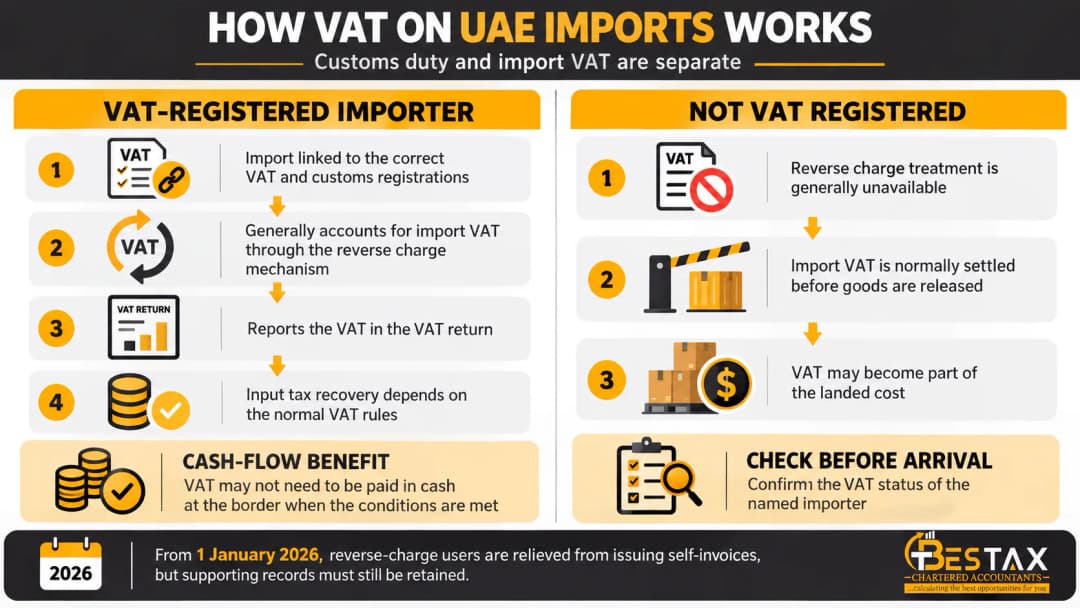
If the Importer Is VAT Registered
A VAT registered taxable person that meets the required conditions can generally account for import VAT through the reverse charge mechanism. In plain English, the importer reports the VAT in its VAT return instead of necessarily paying that VAT in cash at the border. The business must be properly registered, provide its customs registration details and keep the required import records.
For businesses importing stock regularly, this treatment can make a major cash flow difference. It does not mean the VAT disappears. The business still has to report it correctly, and input tax recovery depends on the normal VAT recovery rules.
If the Importer Is Not VAT Registered
When a person is not VAT registered, or a registered person does not meet the import conditions for the reverse charge mechanism, the VAT must generally be settled before the goods are released. This is why the VAT status of the named importer should be checked before the shipment arrives.
If your trading company is approaching the VAT threshold or is already importing commercially, review Bestax guidance on VAT registration in Dubai and the practical guide to the UAE VAT registration certificate before your customs and VAT records start moving at different speeds.
What Changed for VAT in 2026?
Federal VAT amendments took effect from January 1, 2026. One practical change is that taxable persons applying the reverse charge mechanism are relieved from issuing self invoices, while they still need to retain supporting documents as required by the Executive Regulation. For importers, documentation remains essential because the VAT return must be supported by customs and supplier records.
What Are Customs Clearance Charges in Dubai?
Customs clearance charges cover more than customs duty. They can include government service fees and private logistics costs. Calling every charge a tax makes landed cost analysis less accurate.
The government fees below are published in the Dubai Customs Services Guide.
| Dubai Customs service | Current official fee | Practical meaning |
|---|---|---|
| Import customs declaration | AED 15 to AED 100 | Varies by declaration type and shipping channel |
| Business registration with Customs | AED 100 | Used to obtain the company customs code |
| Goods classification request | AED 25 per item tariff | Useful when the HS classification needs an official determination |
| Customer requested customs inspection | AED 150 | A customs demanded inspection has no service fee |
| Knowledge and Innovation fee | AED 20 | Added to service costs of AED 50 and above |
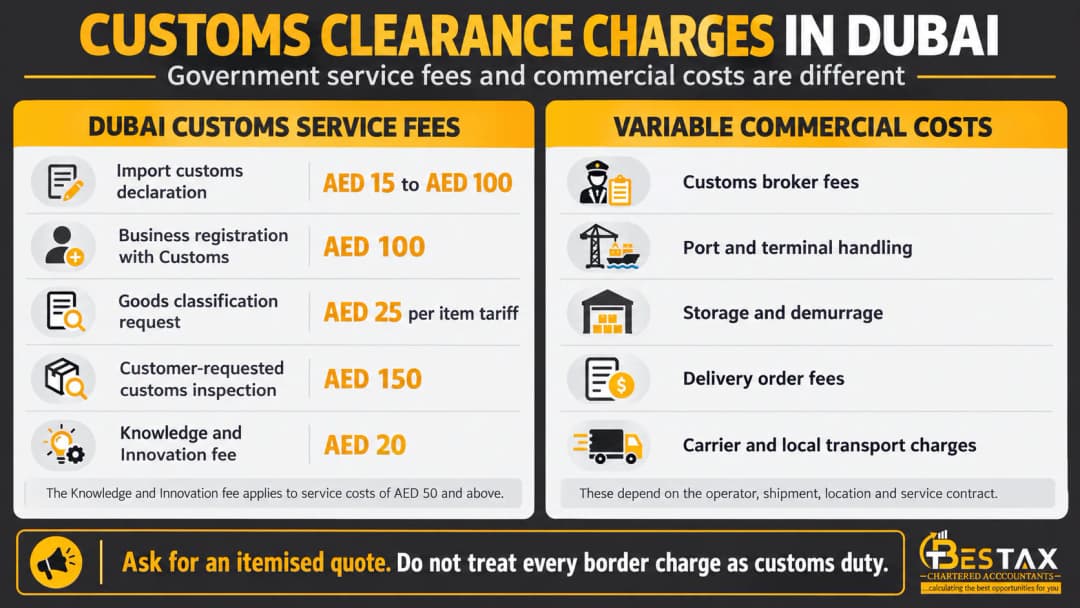
Port handling, storage, demurrage, delivery order fees and customs broker fees are not included in the table because they depend on the operator, shipment, location and service contract. Budget for them separately.
What Do Border Fees Mean in a UAE Import Quote?
"Border fees" is a catch-all phrase that sellers, couriers and freight agents often use. No single federal UAE import tax is officially called a border fee. Ask for an itemised statement so you can identify customs duty, VAT, customs service charges, port costs, storage and broker charges separately.
How to Find the Correct Dubai Customs HS Code in 2026
An HS code is the product classification Dubai Customs uses to determine the customs tariff, restrictions and other customs treatment. A wrong code can produce the wrong duty rate, trigger missing permits or create declaration errors.
Dubai Customs now uses an integrated tariff aligned with the GCC classification system. The GCC moved toward a twelve digit tariff structure beginning in 2025. However, a later Dubai Customs notice extended the flexibility to keep using eight digit HS classifications until further notice, and Dubai Customs continues to accept declarations filed with eight digit codes during that period. Importers should therefore check the current Dubai Customs instruction when they file rather than assume twelve digits are mandatory for every declaration.
For classification research, use the official Dubai Customs Al Munasiq HS code search. If the product is difficult to classify, Dubai Customs also offers an official goods classification request.
Accountant tip: Do not choose an HS code only because it produces a lower customs rate. Classification follows the actual nature, composition, function and tariff rules for the goods. Keep technical sheets, catalogues and product specifications with the customs file.
How UAE Customs Clearance Works for a Dubai Business
A business that uses Dubai Customs services needs a customs business code. The company can submit declarations itself when properly registered, or it can authorise a licensed clearing and forwarding agent to act on its behalf. If you are still setting up, our guide to starting an import and export business in Dubai covers the licence side.
- Confirm the trade licence activity and obtain the customs business code.
- Classify the goods under the correct HS code and check whether any permit or restriction applies.
- Confirm the customs value, origin and applicable customs tariff before arrival.
- Prepare the commercial invoice, packing list, certificate of origin and any permit required by the relevant authority.
- Submit the customs declaration under the correct regime, such as import, transit, transfer or temporary admission.
- Pay the applicable customs duty, VAT when payable at clearance, and customs service fees.
- Complete inspection if Customs selects the shipment or if an inspection is requested.
- Keep the customs declaration, supplier invoice, freight records and VAT evidence with the accounting file.
Dubai Customs currently states a service completion time of two working hours for the declaration service itself, but the full cargo release can take longer when permits, inspections, port processes, document problems or payment issues are involved.
When Can a Duty Exemption Apply?
A duty exemption is a legal rule that removes customs duty from qualifying goods. It is different from a temporary suspension, where duty is secured by a deposit or guarantee and can become payable if the conditions are not met.
- The GCC customs framework lists exempt goods under the unified tariff and exemptions under the Unified Customs Law.
- Qualifying goods of GCC origin are treated as national goods within the customs union, subject to the applicable origin rules and evidence.
- Used personal effects and household items can qualify for exemption when the customs conditions for returning UAE nationals or people moving to the UAE for the first time are met.
- Traveller personal belongings and qualifying gifts can receive exemptions within the applicable customs limits and conditions.
- Returned goods can receive special customs treatment when the legal conditions are satisfied.
Temporary admission should not be described as a permanent duty exemption. For exhibition goods and certain other temporary imports, Dubai Customs can require a deposit equivalent to the customs duty and refund it when the goods are re exported within the allowed period. ATA Carnet procedures can also apply in qualifying cases.
What About Goods in a UAE Free Zone?
Free zone treatment depends on the movement of the goods and the specific customs and VAT rules. The GCC customs framework states that goods imported from free zones are subject to duty when they leave the free zone into the customs territory. For VAT, a free zone is not automatically a Designated Zone. The VAT rules for a legally recognised Designated Zone are separate and must be checked before assuming that VAT does not apply.
Import Duties on Cars in the UAE
Import duties on cars are a common question for individuals and vehicle traders. Dubai Customs states that a new or used vehicle is evaluated and inspected by Customs, and customs duty is charged at 5 percent of the customs assessed value.
For a vehicle imported through a shipping company, Dubai Customs lists the original invoice, packing list, bill of lading and a passport or Emirates ID copy among the required documents. A private individual importing a vehicle should also expect the vehicle value to be reviewed rather than assuming the purchase invoice will always be accepted without adjustment.
Import VAT can also apply separately. As with other goods, the import VAT calculation follows the VAT value of import rules. Registration, testing, insurance and local vehicle registration costs sit outside the customs duty calculation and should be budgeted separately.
Import Mistakes an Accountant Checks First
Most import tax problems are not caused by the 5 percent rate. They come from poor setup, weak documentation or using different information in customs, VAT and accounting records.
- Using the supplier invoice amount as the customs value without checking freight, insurance and other valuation additions.
- Choosing a convenient HS code instead of the defensible classification.
- Importing under a customs code that is not properly linked to the VAT registered importer.
- Treating reverse charge VAT as if no VAT entry is required.
- Booking recoverable import VAT as an expense instead of reconciling it through the VAT records.
- Assuming a free zone licence automatically creates a customs or VAT exemption.
- Ignoring permits for restricted goods until the cargo is already at the port.
- Mixing customs duty, customs fees, freight, storage and broker charges into one accounting line.
Need Help Planning the Landed Cost Before You Import?
An import should be costed before the purchase order is signed, not after the container arrives. A clean landed cost model should identify the customs value, customs duty, import VAT, recoverable VAT position, customs service fees and logistics charges before you commit to the transaction.
Bestax Chartered Accountants supports UAE businesses with accounting, VAT registration, VAT consultancy and wider tax compliance. If your business imports stock, equipment or vehicles and you want the customs records to reconcile correctly with your VAT and accounting, contact Bestax or review the firm's VAT consultancy services before your next shipment.
Planning your next shipment? Book Free 20-Min Call with Bestax and we will map the duty, VAT and clearance costs before you commit.
Frequently Asked Questions
What is UAE import tax in 2026?
UAE import tax usually refers to customs duty plus import VAT. The general customs duty is 5 percent on foreign goods from outside the GCC Customs Union, while taxable imported goods are generally subject to 5 percent VAT. The exact result depends on the HS code, customs value, origin and any exemption or special rate.
How much is import tax in Dubai?
For many ordinary commercial goods, import tax in Dubai starts with 5 percent customs duty on the CIF customs value, followed by VAT where the import is taxable. Some goods have a different customs rate or exemption, so the product classification must be checked first.
Is Dubai import duty the same as UAE import duty?
The GCC customs framework sets a common external tariff, so the standard rule is broadly consistent across the UAE. Dubai import duty is administered through Dubai Customs when Dubai is the customs authority handling the import. Local customs procedures and service charges can differ by emirate.
How do I use a UAE import duty calculator?
Start with the customs value, identify the correct HS code and duty rate, calculate the customs duty, then calculate import VAT using the VAT value of import rules. Add customs service and logistics costs separately. A calculator is only an estimate until classification and customs value are confirmed.
What does UAE customs use to calculate customs value?
UAE customs generally starts with the transaction value and applies the GCC customs valuation rules. Freight, insurance and certain other additions can form part of the customs value. Customs can ask for contracts, remittance evidence, invoices and other records if the declared value is doubtful.
How do I find my Dubai Customs HS code?
Use the official Dubai Customs Al Munasiq search platform and review the product description carefully. For difficult products, a formal goods classification request is available. Do not rely on a supplier code from another country without checking the UAE and GCC tariff treatment.
How is VAT on UAE imports calculated?
The VAT value of import is based on the customs value under customs legislation and includes insurance, freight, customs fees and excise tax paid on the import where applicable. The standard VAT rate is 5 percent unless the imported goods have a different VAT treatment.
Can a VAT registered importer avoid paying VAT at the border?
A VAT registered taxable person that meets the import conditions can generally account for import VAT through the reverse charge mechanism. This changes the payment and reporting process, but it does not remove the VAT obligation. The import must still be reported and supported by proper records.
What are customs clearance charges?
Customs clearance charges can include customs declaration fees, inspection or classification fees, broker charges, port handling, storage and carrier costs. Customs duty and VAT are taxes. Broker and port costs are operational charges and should be shown separately in the landed cost.
What are import duties on cars in Dubai?
Dubai Customs currently applies 5 percent customs duty to the customs assessed value of imported new and used vehicles. Import VAT can also apply separately. The car is subject to customs valuation and inspection, so the final assessed value can matter more than the purchase price alone.
Disclaimer: This article is for general information only. Customs rates, fees, HS code rules and VAT procedures can change, so confirm the current position with Dubai Customs, the Federal Tax Authority or a qualified adviser before you act.

Khadija Raees holds a Bachelor's degree and brings over five years of experience in creating authoritative content in the areas of tax, accounting, company formation, and VAT in the UAE.
Learn More About Khadija