



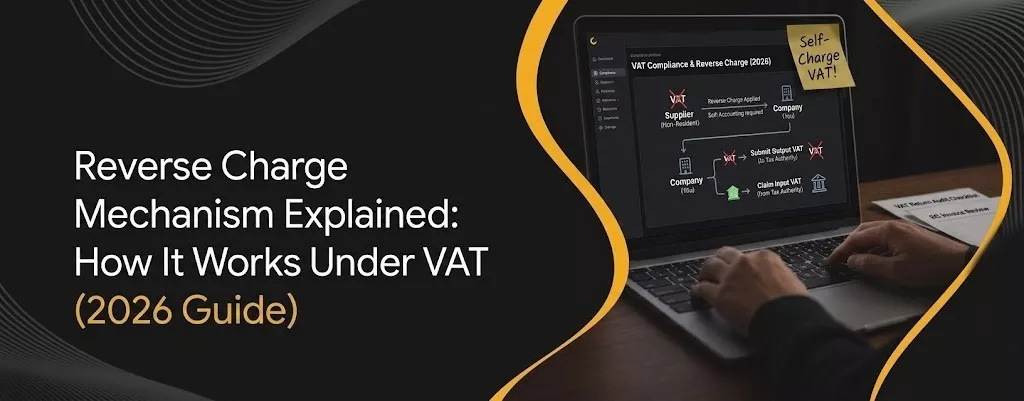
The reverse charge mechanism under the UAE’s Value‑Added Tax (VAT) law transfers the obligation to account for VAT from the supplier to the recipient when goods or services are imported or when certain domestic supplies take place.
Rather than the seller charging VAT and remitting it to the Federal Tax Authority (FTA), the buyer calculates and pays the tax directly.
This guide focuses on how the reverse charge mechanism works under UAE law, why it exists, which transactions it covers, and what you need to do to stay compliant.
What Is the Reverse Charge Mechanism?
Under Article 48 of Federal Decree‑Law No. 8 of 2017 on Value Added Tax, a taxable person who imports concerned goods or services for his business “shall be treated as making a taxable supply to himself and shall be responsible for all applicable tax obligations”. In other words, when the RCM applies the buyer records the transaction as both an output supply (collecting VAT on behalf of the government) and an input supply (claiming input tax credit, if eligible). This mechanism prevents foreign suppliers from having to register for VAT in the UAE and ensures that VAT is collected on cross‑border transactions.
Key elements of the reverse charge mechanism include:
- Shift in responsibility: Instead of the supplier charging VAT, the recipient calculates and pays the VAT due.
- Self‑accounting: The recipient treats the purchase as if they sold the goods or services to themselves, reporting both output and input tax in their VAT return.
- Not a tax exemption: RCM transactions are taxable. However, the cash flow impact is neutral if the recipient can fully recover the input VAT.
- Legal basis: The rules are set out in Article 48 of the VAT law and are supplemented by executive regulations and Cabinet decisions for specific sectors.
Why Was RCM Introduced?
The RCM is common in VAT systems worldwide and is designed to simplify tax compliance for cross‑border supplies. Without it, foreign suppliers would need to register for VAT in every country in which they make supplies.
By shifting the obligation to the recipient, the UAE ensures VAT is accounted for even when the supplier is outside the country or when the goods are part of a chain subject to special rules (such as hydrocarbons or scrap metal). The mechanism also helps to reduce fraud associated with missing‑trader schemes and improve cash flow for businesses involved in specified sectors because they do not have to pay VAT upfront and wait for a refund.
Legal Basis for the Reverse Charge Mechanism
1. Article 48 of Federal Decree‑Law No. 8 of 2017 (VAT Law)
Article 48 is the cornerstone of RCM in the UAE. Key clauses include:
Import of goods and services
- Clause 1 (Imports): If a taxable person imports concerned goods or services for business, they must treat the import as a taxable supply to themselves and account for the VAT due. This applies whether the goods arrive from outside the Gulf Cooperation Council (GCC) or from an implementing GCC state when the final destination is the UAE.
- Clause 2 (Destination in another implementing state): When goods enter the UAE but the final destination is another implementing state, the taxable person must pay the VAT according to a mechanism defined in the executive regulation.
Domestic reverse charge on hydrocarbons
- Clause 3: If a VAT‑registered supplier sells crude or refined oil, unprocessed or processed natural gas or other hydrocarbons to another VAT‑registered recipient, and the recipient intends to resell these goods or use them to produce or distribute energy, the supplier does not charge VAT. Instead, the recipient calculates the VAT and takes responsibility for all related tax obligations.
- Clause 4 (Exceptions): The hydrocarbon reverse charge does not apply if the recipient has not provided written confirmation of resale or registration, if the supply would be zero‑rated (for example exports under Article 45), or if the supply includes goods or services other than the specified hydrocarbons.
- Clauses 5–6 (Liability): If the recipient confirms their registration in writing, the supplier is not liable for VAT unless they should have known the recipient was not registered. If the supplier fails to verify the recipient’s registration, both parties may be jointly liable.
Executive regulations
The Cabinet and the Minister of Finance issue executive regulations detailing when and how the RCM must be applied. These rules cover import procedures, accounting entries, and record‑keeping requirements for self‑assessed VAT, and they give the Cabinet authority to identify other goods or services subject to the domestic reverse charge mechanism.
2. Cabinet Decisions for Specific Goods
Over the past few years, the UAE has expanded the domestic RCM to specific goods in order to combat tax evasion and reduce cash‑flow burdens for businesses. Notable decisions include:
Metal scrap (Cabinet Decision No. 153 of 2025)
From 14 January 2026, supplies of ferrous and non‑ferrous scrap metal between registered businesses will be subject to the reverse charge mechanism. The supplier must not charge VAT on such supplies if the recipient intends to resell or process the scrap. Instead, the recipient accounts for VAT on the value of the scrap. To apply the RCM:
- The recipient must provide a written declaration to the supplier stating that the scrap is intended for resale or processing and confirming their VAT registration.
- The supplier must verify the recipient’s registration using the FTA’s registration lookup tool, retain the written declaration and include a statement on the tax invoice indicating that the reverse charge mechanism applies.
- The decision does not apply if the supply is zero‑rated (for example exports or supplies to a designated zone).
Precious metals and stones (Cabinet Decision No. 127 of 2024)
Effective 15 February 2025, the domestic RCM covers supplies of precious metals (silver, palladium, platinum) and precious stones (manufactured or lab‑grown diamonds, pearls, rubies, sapphires and emeralds) between VAT‑registered businesses for resale or manufacturing. This builds on earlier rules that applied the RCM to gold and diamonds. As with scrap metal, the recipient must provide written declarations and the supplier must verify registration and include a reverse charge note on the invoice. These details are outlined in Cabinet Decision No. 127 and its accompanying FTA public clarification (VATP043).
Electronic devices (Cabinet Decision No. 91 of 2023)
As of 30 October 2023, supplies of electronic devices (such as mobile phones, smart phones, computer devices and tablets) between VAT‑registered businesses for resale or manufacturing are subject to the domestic RCM. The supplier should not charge VAT if the recipient will resell or use the devices in production; instead the recipient accounts for VAT. Written declarations and invoice statements are required. This decision was issued under the authority of Article 48(8) of the VAT law and is supported by FTA public clarification VATP034.
When Does the Reverse Charge Mechanism Apply?
The RCM applies in several scenarios. Use the checklist below to determine whether your transaction falls under these rules:
1. Import of Goods or Services from Non‑Residents
- Cross‑border purchases: When you import goods or receive services from a supplier established outside the UAE, the RCM generally applies. You must declare the VAT on the import and pay it using the FTA’s import declaration or in your VAT return. The law treats such imports as a self‑supply.
- Goods entering the UAE for onward supply: If the goods arrive in the UAE but are destined for another GCC implementing state, the executive regulations require you to pay VAT according to special procedures.
- Services from overseas suppliers: Services purchased from non‑resident suppliers (legal, consulting, SaaS, marketing, etc.) are typically subject to the RCM if the place of supply is in the UAE. You must account for VAT on these services in your VAT return.
2. Domestic Supplies of Hydrocarbons
- Sales of crude or refined oil, natural gas or hydrocarbons: If you are a VAT‑registered supplier selling these goods to another VAT‑registered business that intends to resell or use them to produce or distribute energy, you should not charge VAT. The recipient calculates and pays the VAT.
- Conditions: Before the supply, the recipient must provide written confirmation to the supplier stating that the goods will be resold or used for energy production and confirming their VAT registration. The supplier must verify this information; otherwise both parties may be jointly liable.
3. Domestic Supplies of Specific Goods
- Electronic devices: Supplies of mobile phones, computer devices and tablets for resale or manufacturing are subject to the RCM (Cabinet Decision 91/2023). Written declarations and invoice statements are required.
- Precious metals and stones: Supplies of gold, diamonds, silver, palladium, platinum, pearls and certain precious stones for resale or manufacturing fall under the RCM (Cabinet Decision 25/2018 and 127/2024). The supplier does not charge VAT; the recipient accounts for it and must provide written declarations.
- Scrap metal: Supplies of ferrous and non‑ferrous metal scrap for resale or processing are subject to RCM from 14 January 2026 (Cabinet Decision 153/2025). The recipient must account for VAT and provide declarations.
- Other goods or services: The Cabinet may specify other goods or services in the future. Always check the latest Cabinet decisions and FTA public clarifications.
4. Import by Agents and Tax Groups
- Import by customs agents or freight forwarders: When an agent imports goods on behalf of a VAT‑registered principal, the principal is responsible for accounting for VAT under the RCM. The agent should obtain a written instruction and the principal’s tax registration number.
- Tax groups: Imports by any member of a tax group are treated as imports by the representative member. The representative member must account for VAT on behalf of the group.
How to Account for VAT Under the Reverse Charge Mechanism
Proper accounting is critical for compliance. Follow these steps when the RCM applies:
Step 1: Confirm Applicability
- Identify the type of transaction (import of goods, import of services, domestic supply of specified goods such as hydrocarbons, electronic devices or scrap metal).
- Confirm that both parties are VAT‑registered in the UAE when required (domestic RCM). Use the FTA’s TRN verification tool.
- Obtain a written declaration from the recipient (for domestic RCM) confirming the intention to resell or process and confirming their VAT registration.
Step 2: Issue and Receive Appropriate Documentation
- Self‑invoicing: For imported services, you may need to prepare a self‑invoice showing the VAT you calculated. The invoice should include your TRN and clearly state that VAT has been accounted for under the reverse charge mechanism.
- Supplier invoice: For domestic RCM supplies (electronic devices, precious metals, scrap metal, hydrocarbons), the supplier must issue an invoice that clearly indicates the reverse charge mechanism applies. No VAT is charged on the invoice.
- Customs documentation: For imported goods, ensure that customs declarations are completed accurately. The import VAT may be deferred and reported in Box 7 and Box 9 of the VAT return if the importer has a reverse charge account with the FTA.
Step 3: Calculate Output VAT and Input VAT
- Determine the taxable value of the transaction (for imports, this is the CIF value plus customs duties and any applicable excise duties). Multiply by the standard rate (currently 5 %) to calculate output VAT.
- Record the output VAT in your VAT return as if you charged VAT on a sale. This increases your VAT payable.
- At the same time, if the goods or services will be used to make taxable supplies, record an equivalent amount of input VAT. This offsets the output VAT and results in no cash flow impact. If the goods or services will be used for exempt activities, you may not be able to claim full input tax credit; in such cases, only the recoverable portion should be claimed.
Step 4: Report in the VAT Return
- Imported goods: Enter the value of imported goods subject to RCM in Box 6 of your VAT return and the VAT amount in Box 7 (VAT on import of goods). Then report the recoverable input tax in Box 10 (if recoverable). If you have a deferred import VAT account with the FTA, the VAT payable is automatically populated.
- Imported services: Report the value of imported services in Box 3 (supplies subject to reverse charge), and report the corresponding output VAT in Box 1 and input VAT in Box 9 or Box 10, depending on recoverability.
- Domestic RCM (hydrocarbons, electronic devices, precious metals, scrap metal): Report the value of supplies received in Box 3 and the VAT payable in Box 1. Then record the recoverable input VAT in Box 9 or 10.
Step 5: Keep Adequate Records
- Retain written declarations, invoices, self‑invoices and customs documents. The Cabinet decisions require suppliers to retain written declarations from recipients and evidence of TRN verification.
- Maintain a schedule of all RCM transactions showing the supplier, recipient, nature of goods or services, taxable value, VAT amount and date of supply. This will be important if the FTA audits your returns.
- For hydrocarbon supplies, keep copies of written confirmations and evidence of energy production or resale intentions.
Examples of Reverse Charge Transactions
Example 1: Importing Software Services from a Non‑Resident
ABC LLC (based in Dubai) purchases cloud‑based accounting software from a US‑based provider for AED 10,000. The service is supplied remotely and is used in ABC’s business. Since the supplier is not resident in the UAE, ABC must apply the reverse charge mechanism.
- Taxable value: AED 10,000.
- Output VAT (5 %): AED 500 recorded in Box 1 (supplies subject to RCM).
- Input VAT: AED 500 recorded in Box 9 or Box 10 (recoverable input tax). If ABC uses the software to make fully taxable supplies, the input tax is fully recoverable; if part of their activity is exempt, they must apportion.
- Cash flow: None, as the output VAT is offset by input VAT.
Example 2: Domestic Supply of Hydrocarbons
OilCo, a VAT‑registered supplier in Abu Dhabi, sells crude oil worth AED 1 million to EnergyCo, another VAT‑registered business that will refine the oil and sell fuel. OilCo does not charge VAT on the invoice. EnergyCo applies the reverse charge mechanism:
- Output VAT: AED 50,000 (5 % of AED 1,000,000) reported in Box 1.
- Input VAT: AED 50,000 reported in Box 9/10 and recoverable because EnergyCo uses the oil for taxable supplies.
- Documentation: EnergyCo provides OilCo with written confirmation that the oil is for resale/energy production and that EnergyCo is a registrant. OilCo verifies EnergyCo’s TRN and keeps the declaration.
Example 3: Supply of Metal Scrap (2026 onwards)
ScrapCo supplies AED 100,000 worth of aluminium scrap to RecycleCo, a VAT‑registered recycler. The supply takes place after 14 January 2026. RecycleCo intends to process the scrap into new products.
- Supplier’s responsibility: ScrapCo does not charge VAT on the invoice. It obtains a written declaration from RecycleCo confirming the scrap is for processing and that RecycleCo is VAT‑registered. ScrapCo verifies the TRN and keeps the declaration and verification records.
- Recipient’s responsibility: RecycleCo accounts for AED 5,000 (5 % of AED 100,000) as output VAT in Box 1 and claims the same amount as input VAT in Box 9/10 (assuming the scrap is used to make taxable supplies).
Benefits and Challenges of Using RCM
Benefits
- Simplifies cross‑border transactions: Non‑resident suppliers are not required to register for VAT in the UAE; the recipient handles the VAT instead.
- Improves cash flow for businesses: Domestic RCM on sectors such as hydrocarbons, electronic devices and scrap metal allows suppliers to issue invoices without VAT, reducing immediate cash outflows. Recipients still account for VAT but can usually recover it.
- Enhances VAT compliance: By shifting the responsibility to registrants, the FTA can ensure better oversight of transactions that might otherwise slip through the net.
- Aligns with international best practices: RCM is used in many VAT systems worldwide and is recognized by international businesses.
Challenges
- Record‑keeping and declarations: Domestic RCM requires written declarations and verification of the recipient’s registration. Failing to obtain or keep these can result in joint liability for VAT.
- Complexity of determining applicability: Businesses must analyze each transaction to decide whether RCM applies (import of services, domestic supply of hydrocarbons, etc.).
- Risk of errors: Errors in self‑assessment can lead to penalties and interest. Businesses must ensure they apply the correct VAT rate and claim input tax only where recoverable.
- Frequent updates: Cabinet decisions periodically add new goods or services to the RCM list (electronic devices, precious metals, scrap metal). Businesses must stay up‑to‑date.
Conclusion
The reverse charge mechanism is a fundamental concept of the UAE VAT system, designed to ensure that VAT is collected on imports and certain domestic supplies without placing an unnecessary burden on foreign suppliers. Article 48 of the VAT law makes the buyer responsible for accounting for VAT on imported goods and services and introduces special rules for supplies of hydrocarbons to resellers and energy producers..
If you need assistance implementing the reverse charge mechanism in the UAE, reach out to our VAT specialists. We can help you review contracts, set up accounting systems, and train your team on self‑assessment procedures so that your business remains compliant.
Quick FAQs
What is the reverse charge mechanism in simple terms?
The reverse charge mechanism shifts the responsibility for accounting for VAT from the supplier to the buyer. In the UAE, when a taxable person imports goods or services for business, they are treated as making a supply to themselves and must account for VAT.
Does the reverse charge mean the transaction is tax‑exempt?
No. The transaction is still taxable. Under the RCM the buyer records VAT as output tax and, subject to normal rules, recovers it as input tax, resulting in a neutral cash‑flow if the purchase is for taxable business activities.
When does the reverse charge apply to hydrocarbons?
If a VAT‑registered supplier sells crude or refined oil, natural gas or other hydrocarbons to another VAT‑registered business that intends to resell or use them for energy production, the supplier does not charge VAT; the recipient accounts for VAT. Written confirmations and TRN verification are mandatory.
What are the documentation requirements for the scrap metal reverse charge?
From 14 January 2026, suppliers of metal scrap must obtain written declarations from recipients stating that the scrap is for resale or processing and confirming the recipient’s VAT registration. The supplier must verify the TRN and the invoice must clearly state the reverse charge mechanism applies.
Do I need to issue a self‑invoice for imported services?
Generally, yes. When you receive services from a non‑resident supplier, you should issue a self‑invoice or internal document showing the VAT you calculated under the reverse charge. This ensures you have proper records to support your VAT return.
Can I recover input VAT on reverse charge transactions?
If the goods or services are used to make taxable supplies, you can recover the input VAT in the same return, resulting in no net payment. If the goods or services are used for exempt activities (e.g., financial services), you may not recover the VAT or may need to apportion it.
Are the reverse charge rules the same across the GCC?
Each GCC country applies the reverse charge mechanism within its VAT system, but the scope and procedures may differ. This guide covers only the UAE rules. Check local laws if you trade in other GCC states.
Disclaimer: The information provided in this blog is for general informational purposes only. For professional assistance and advice, please contact experts.
