



Financial reporting is the process of recording, summarising and presenting financial information about a business. In the United Arab Emirates (UAE) it is more than a statutory formality, it is the foundation for transparency and tax compliance.
The UAE Corporate Tax Law is Federal Decree-Law No. 47 of 2022, and it applies to Tax Periods commencing on or after 1 June 2023. For Corporate Tax purposes, IFRS is the accepted accounting standard in the UAE, with IFRS for SMEs available where revenue does not exceed AED 50 million in a Tax Period. The country’s free‑zone entities, mainland companies and offshore structures must all maintain proper financial records to meet Federal Tax Authority (FTA) requirements.
This guide explains what financial reporting means, why it matters, the processes involved and the key requirements for businesses in the UAE.
Note: Financial reporting in the UAE means preparing accurate financial statements in line with accepted accounting standards, mainly IFRS, to support Corporate Tax, VAT, audits, banking, and business decisions. UAE businesses must maintain proper records, prepare financial statements, review tax adjustments, and file Corporate Tax returns within the required deadline.
What is Financial Reporting?
Financial reporting is the preparation of structured financial statements that show a company’s performance and financial position. It includes the statement of profit or loss, statement of financial position, statement of cash flows, statement of changes in equity and accompanying notes. These statements help business owners, investors, lenders and regulators understand how the business is performing.
Financial reporting is governed by accounting standards such as IFRS; the International Accounting Standards Board notes that IFRS Accounting Standards serve as a “global accounting language” and are used in more than 140 jurisdictions worldwide. In practice, financial reports allow stakeholders to evaluate profitability, liquidity, solvency and cash‑flow health and to make informed decisions.
Financial reporting meaning in the UAE
In the UAE, financial reporting is closely linked with taxation. Under the UAE Corporate Tax (CT) Law (Federal Decree‑Law No. 47 of 2022), businesses must determine taxable income based on IFRS‑compliant financial statements.
The Federal Tax Authority’s guide on accounting standards confirms that IFRS is the only accepted accounting standard for corporate tax purposes; IFRS for Small and Medium Enterprises (IFRS for SMEs) may be used when revenue does not exceed AED 50 million in a tax period.
Where Revenue does not exceed AED 3 million in the relevant Tax Period, a Person may prepare Financial Statements using the Cash Basis of Accounting without submitting an application to the FTA. If Revenue exceeds AED 3 million, the business must use the accrual basis unless exceptional circumstances are approved by the FTA.
These rules apply to both mainland and free‑zone companies: free‑zone status does not exempt a business from preparing IFRS‑based accounts or from corporate tax reporting.
Financial reporting process
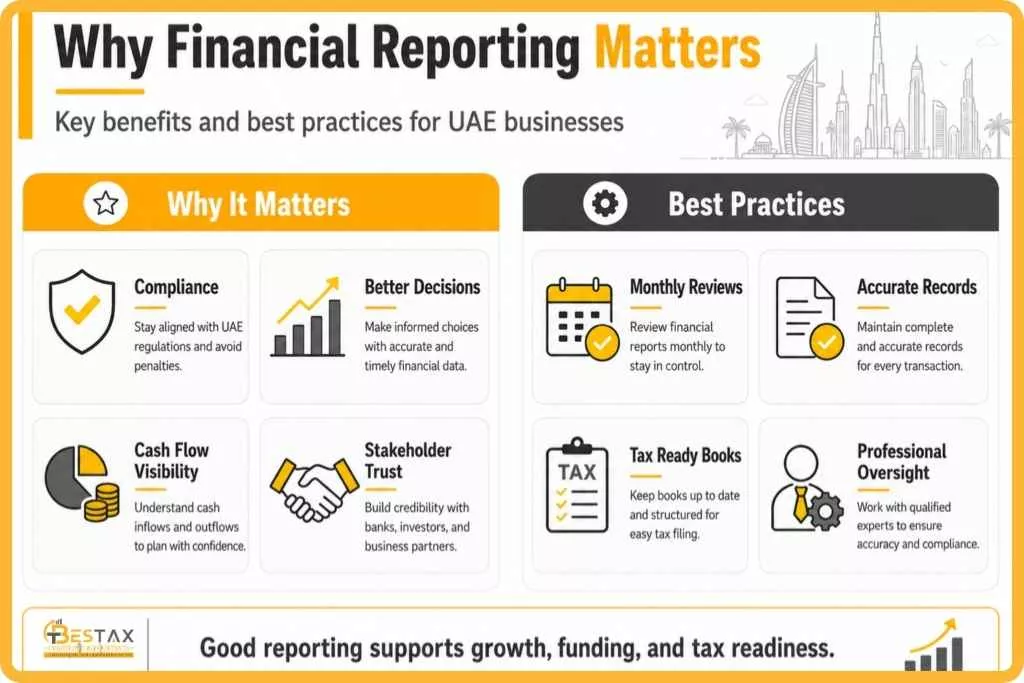
A robust financial reporting process helps ensure that the numbers in a company’s financial statements are accurate and compliant with UAE law. The key steps include:
- Record transactions throughout the year. Businesses must keep records of all sales, purchases, expense receipts, payroll data, contracts and other documents. For UAE Corporate Tax, both Taxable Persons and Exempt Persons must retain relevant records for at least seven (7) years following the end of the Tax Period to which they relate. VAT record-retention rules should be treated separately from Corporate Tax record-retention rules.
- Classify transactions and post entries to ledgers. Each transaction is categorised according to IFRS requirements. Revenue, expense, asset and liability accounts are updated, and the company’s trial balance is prepared.
- Adjust the trial balance. Before preparing the financial statements, adjusting entries are made for accruals, deferrals, depreciation, provisions and tax adjustments. The FTA guide states that provisions for expenses or bad debts recognised in accordance with IFRS or IFRS for SMEs are deductible for corporate tax purposes.
- Prepare financial statements. Using the adjusted balances, the company prepares its statement of profit or loss, statement of financial position, statement of cash flows, statement of changes in equity and explanatory notes. The UAE Corporate Tax Law requires taxable income to start with accounting net profit or loss from these statements.
- Audit the financial statements. Many UAE licensing authorities, free-zone authorities, banks, and mainland company rules may require audited financial statements.
Note: However, for UAE Corporate Tax purposes, the audited-financial-statements requirement comes from Clause (2) of Article 54 of the Corporate Tax Law and is implemented through Ministerial Decision No. 84 of 2025. Ministerial Decision No. 84 of 2025 applies to Tax Periods commencing on or after 1 January 2025 and repeals Ministerial Decision No. 82 of 2023, which continues to apply to Tax Periods that commenced before 1 January 2025.
- File tax returns and other reports. For corporate tax, the taxpayer must file a return with the FTA within nine months after the end of the relevant financial year. VAT‑registered businesses must file VAT returns monthly or quarterly depending on their allocation. Properly prepared financial statements support accurate tax returns and help demonstrate compliance.
Financial reporting requirements in the UAE
Adoption of IFRS and IFRS for SMEs
The FTA’s accounting standards guide makes it clear that IFRS is the default standard for UAE corporate tax. IFRS for SMEs may be used when a business’s revenue does not exceed AED 50 million. This means:
- Mainland and free‑zone companies must prepare annual financial statements in accordance with IFRS (or IFRS for SMEs if eligible).
- Free‑zone companies seeking to qualify for the 0 % corporate tax rate on qualifying income must maintain audited financial statements to prove substance and track income sources.
- Companies with Revenue not exceeding AED 3 million in the relevant Tax Period may prepare Financial Statements using the Cash Basis of Accounting without applying to the FTA. This should not be described as cash basis plus IFRS measurement principles. Cash basis is a separate permitted method for eligible businesses, while businesses above the AED 3 million threshold generally move to accrual-basis financial statements unless exceptional circumstances apply.
Revenue recognition and tax adjustments
The FTA’s guidance emphasises that taxable income begins with accounting net profit. However, book‑to‑tax adjustments are required to reconcile IFRS profit with taxable income. For instance, depreciation rates, provisions, fair‑value gains, related‑party transactions and deferred income may need adjustments.
An FTA guide notes that provisions for expenses and bad debts recorded under IFRS or IFRS for SMEs are deductible for corporate tax purposes, while fines, penalties and similar payments are non‑deductible. Companies must keep detailed records to support these adjustments and maintain transfer pricing documentation for transactions with related parties.
Record retention and auditing
For Corporate Tax, UAE businesses should retain relevant records for at least seven (7) years following the end of the Tax Period to which they relate. This Corporate Tax requirement should be stated separately from VAT record-retention rules. Audited financial statements may also be required by free-zone authorities, mainland licensing rules, banks, or investors.
For Corporate Tax purposes, Ministerial Decision No. 84 of 2025 requires audited financial statements for specified categories, including Taxable Persons that are not Tax Groups and derive Revenue exceeding AED 50 million, Qualifying Free Zone Persons, and Tax Groups required to prepare audited special purpose financial statements.
VAT and excise tax obligations
Financial reporting supports other taxes as well. Businesses with taxable supplies exceeding AED 375,000 must register for VAT; voluntary registration is allowed for supplies or expenses exceeding AED 187,500. Accurate financial statements facilitate timely VAT filings, help determine input tax credits and ensure that zero‑rated or exempt transactions are properly documented. Companies dealing with excise goods must also maintain separate records for excise tax returns.
Financial reporting examples
To help illustrate financial reporting, here are examples of key statements prepared under IFRS:
- Statement of profit or loss and other comprehensive income: summarises revenue, cost of sales, operating expenses and non‑operating gains or losses for the year. It includes components of other comprehensive income, such as revaluation gains or foreign exchange translation.
- Statement of financial position (balance sheet): shows assets (e.g., cash, receivables, property, plant and equipment), liabilities (e.g., trade payables, loans, tax liabilities) and equity (share capital, retained earnings) at the reporting date.
- Statement of cash flows: categorises cash inflows and outflows into operating, investing and financing activities. For example, net cash from operating activities adjusts profit for non‑cash items and changes in working capital.
- Statement of changes in equity: reconciles opening and closing equity, showing profit for the year, dividends, share issues and other movements.
Free‑zone companies may also need to prepare segment reports differentiating between qualifying and non‑qualifying income; these segments must be supported by the underlying accounting records.
Financial reporting checklist
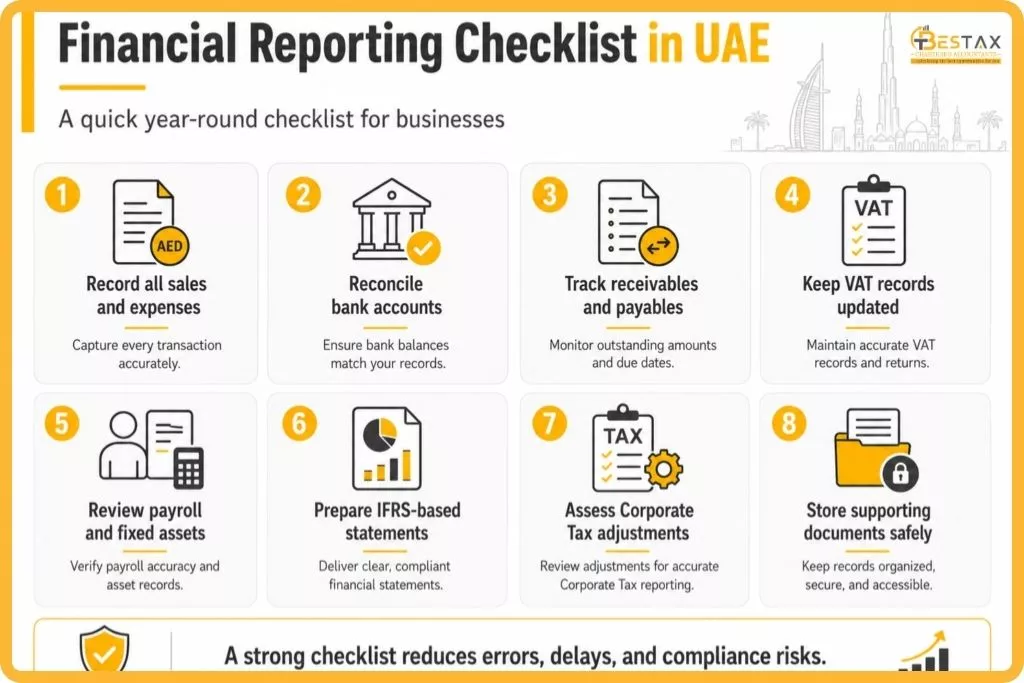
To help ensure compliance with UAE requirements, businesses can use the following checklist:
- Confirm accounting standards: Determine whether your business must use full IFRS or IFRS for SMEs. Check if cash‑basis accounting is permitted based on revenue.
- Set the accounting period: Align the financial year (tax period) with corporate tax and VAT filing deadlines. Most UAE companies use the Gregorian calendar year but can choose another 12‑month period with approval.
- Maintain complete records: Keep invoices, contracts, bank statements, payroll data, inventory reports, and supporting documents. Ensure retention for at least five years or longer for certain sectors.
- Record transactions promptly: Use accounting software that supports IFRS. Classify and reconcile transactions regularly.
- Prepare trial balance and adjustments: Review accruals, provisions, depreciation, amortisation and tax adjustments. Ensure that provisions recorded under IFRS are supported by evidence for deductibility.
- Prepare IFRS financial statements: Use the trial balance to draft the statements and notes. Include comparative information and ensure consistency of accounting policies.
- Conduct an audit (if required): Appoint a registered auditor and provide the necessary documents. Resolve any audit adjustments.
- File tax returns: Submit corporate tax returns within nine months after the end of the financial year. File VAT and excise tax returns on time using data from your financial statements.
- Update for changes: Monitor updates to IFRS (e.g., IFRS 18 – Presentation and Disclosure, effective from 2027) and FTA decisions. New standards may change presentation or measurement and require adjustments.
Importance of financial reporting
Financial reporting is critical for several reasons:
- Legal compliance: UAE corporate tax law requires IFRS‑compliant financial statements as the basis for taxable income. Non‑compliance can lead to penalties and loss of tax reliefs.
- Transparency and trust: High‑quality financial reports provide a true and fair view of a company’s performance. They help attract investors, lenders and partners by demonstrating financial health.
- Decision‑making: Accurate financial reports support strategic planning, budgeting and investment decisions. Business owners can identify profitable products, cost drivers and cash‑flow trends.
- Tax efficiency: Proper financial reporting allows timely recognition of deductible expenses, utilisation of tax losses, and compliance with related‑party rules. The FTA’s guidance highlights the need for correct book‑to‑tax adjustments to avoid penalties.
- Access to banking and visas: Many UAE banks require audited financial statements before opening corporate accounts or extending credit. Free‑zone authorities may link visa quotas to revenue thresholds supported by audited accounts.
Conclusion
The UAE’s corporate tax regime and IFRS-based reporting requirements make financial reporting an important part of running a compliant business. Financial statements are not just year-end documents. They help calculate taxable income, support FTA compliance, track business performance, and give owners a clear view of their financial position.
Companies in the UAE should prepare annual financial statements in line with IFRS, or IFRS for SMEs where eligible. They should also maintain proper records, review book-to-tax adjustments, keep audit-ready documentation, and stay updated with changes in UAE tax and accounting rules.
With the right accounting process, financial reporting can do more than meet compliance requirements. It can help businesses improve decisions, manage cash flow, reduce tax risks, and build stronger trust with banks, investors, and regulators.
Need help preparing accurate financial reports for your UAE business? Bestax Chartered Accountants can support you with bookkeeping, IFRS-based financial statements, VAT, Corporate Tax, audit preparation, and ongoing compliance. Contact Bestax today to keep your business records clear, compliant, and ready for growth.
FAQs About Financial Reporting in UAE
What is financial reporting?
Financial reporting is the process of preparing financial statements that show a company’s income, expenses, assets, liabilities, cash flow, and overall financial position. It helps business owners, tax authorities, banks, and investors understand how the business is performing.
What is the financial reporting meaning for UAE businesses?
In the UAE, financial reporting means preparing accurate accounting records and financial statements in line with accepted accounting standards. These reports support Corporate Tax filing, VAT compliance, audit preparation, bank requirements, and business decision-making.
Why is financial reporting important in the UAE?
The importance of financial reporting has increased after the introduction of UAE Corporate Tax. Businesses need proper financial statements to calculate taxable income, support FTA compliance, maintain audit-ready records, and reduce the risk of incorrect tax filings.
What are the main financial reporting requirements in UAE?
UAE businesses should maintain proper accounting records, prepare annual financial statements, follow IFRS or IFRS for SMEs where eligible, keep supporting documents, review tax adjustments, and meet Corporate Tax and VAT filing requirements where applicable.
What is the financial reporting process?
The financial reporting process usually includes recording transactions, classifying income and expenses, reconciling accounts, preparing a trial balance, making adjustments, preparing financial statements, reviewing tax impact, and completing audit or filing requirements.
Do UAE companies need IFRS financial statements?
Yes, most UAE companies prepare financial statements based on IFRS. Eligible smaller businesses may use IFRS for SMEs, depending on revenue and applicable UAE Corporate Tax guidance. The correct standard should be reviewed before preparing year-end reports.
What are common financial reporting examples?
Common financial reporting examples include a profit and loss statement, balance sheet, cash flow statement, statement of changes in equity, accounts receivable report, accounts payable report, VAT summary, and management reports.
What should be included in a financial reporting checklist?
A financial reporting checklist should include bank reconciliations, sales invoices, purchase bills, payroll records, VAT records, fixed asset details, loan statements, expense receipts, related-party transactions, closing adjustments, and supporting documents for tax filing.
How often should a UAE business prepare financial reports?
A business should review financial reports monthly or quarterly, even if annual financial statements are prepared at year-end. Regular reporting helps monitor cash flow, control expenses, prepare for VAT filings, and avoid year-end accounting issues.
Can Bestax help with financial reporting in UAE?
Yes. Bestax Chartered Accountants can help UAE businesses with bookkeeping, financial statements, IFRS-based reporting, VAT compliance, Corporate Tax registration, tax filing support, audit preparation, and ongoing accounting review.
Disclaimer: The information provided in this blog is for general informational purposes only. For professional assistance and advice, please contact experts.
