



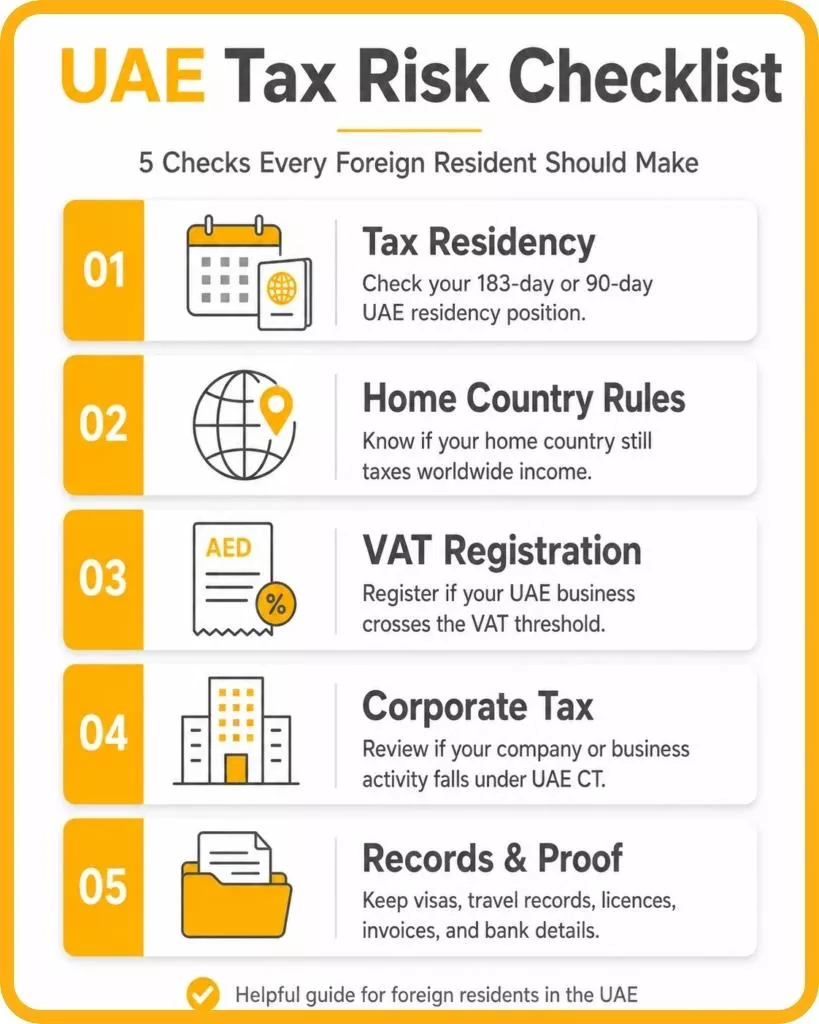
Foreign residents can reduce tax risks in the UAE by understanding their UAE tax residency status, keeping proper income and business records, checking whether Corporate Tax or VAT applies, and reviewing tax obligations in their home country. The UAE does not charge personal income tax on salaries, but foreign residents can still face tax issues if they own a business, earn foreign income, invoice clients, hold assets abroad, or remain tax residents in another country.
That is why expat tax planning is important. It helps you know what must be reported in the UAE, what may still be taxable overseas, and how to avoid double taxation, missed registrations, late filings, or incorrect assumptions about the UAE’s tax-free reputation.
This guide explains the main UAE tax rules for foreign residents, entrepreneurs, freelancers, and business owners, and shows how to stay compliant while protecting your income and business.
4 Key Ways Foreign Residents Can Stay Tax Compliant in the UAE
1. Understand the UAE tax environment
Personal tax and social security
The UAE does not impose personal income tax. Social security contributions apply only to UAE and other Gulf Cooperation Council (GCC) nationals; non‑GCC nationals are not subject to social security. Because there is no personal income tax, foreign residents generally do not file annual income tax returns in the UAE. However, they may still have tax obligations in their home country depending on their residency status and the existence of a double taxation agreement.
Value‑Added Tax (VAT)
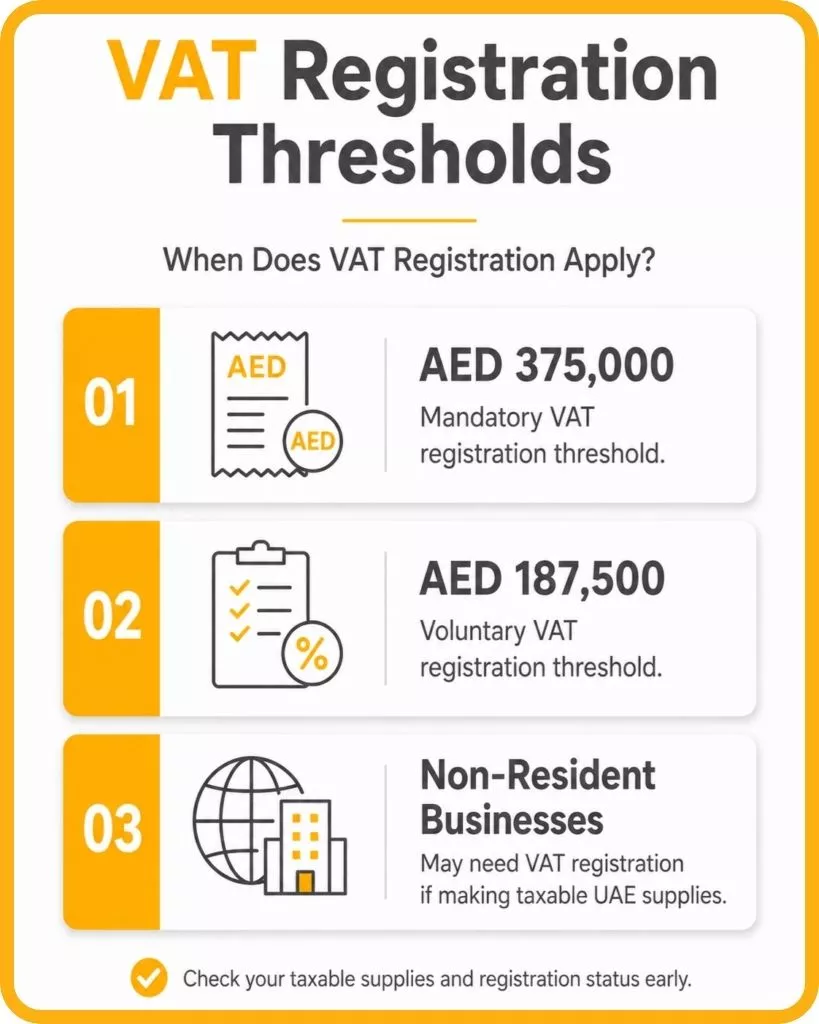
The UAE levies a Value‑Added Tax (VAT) on supplies of most goods and services. Businesses must register for VAT if they exceed the mandatory registration threshold of AED 375,000 in taxable supplies and can opt to register voluntarily if their supplies exceed AED 187,500. Non‑resident businesses that make taxable supplies in the UAE must register for VAT regardless of turnover. Registered businesses must issue tax invoices, keep proper records and file VAT returns. Failure to comply can lead to penalties.
Corporate income tax
Since 2023, the UAE has introduced a federal corporate income tax (CIT). Under the Federal Tax Authority’s tax procedures guide, natural persons are subject to CIT only if they conduct a business or business activity in the UAE and their turnover exceeds AED 1 million in a calendar year.
Wages, salaries, personal investment income and real estate investment income that does not require a licence are excluded from CIT. Juridical persons (companies) established in the UAE or foreign entities that are effectively managed and controlled from the UAE are considered resident for CIT purposes and are taxed on their worldwide income. A foreign company can also become a UAE tax resident if its place of effective management and control is in the UAE.
2. Determine your tax residency status
Tax residency under domestic law
The FTA’s tax procedures guide sets out criteria for tax residency under UAE law. A natural person is considered tax resident if any one of these conditions is met:
- They are physically present in the UAE for 183 days or more in any 12‑month period.
- They are present in the UAE for 90 days or more in a 12‑month period and hold a UAE or GCC residency permit and either have a permanent place of residence in the UAE or carry on an employment or business in the UAE.
- Their usual or primary place of residence and centre of financial and personal interests are in the UAE.
A juridical person (company or other legal entity) is a UAE tax resident if it is incorporated, formed or recognised under UAE law, or if it is effectively managed and controlled in the UAE. Foreign companies can therefore become UAE tax residents through their place of effective management, meaning the location where key management and commercial decisions are made.
Tax residency under double taxation agreements (DTAs)
The UAE has signed DTAs with many countries. These treaties may have their own tests for residency and tie‑breaker rules when a person is resident in both jurisdictions. For juridical persons, DTAs typically require that the entity be liable to tax and incorporate a place of effective management test. For natural persons, the DTA tests often look at where the person has a permanent home, the centre of vital interests, habitual abode or nationality. Where tie‑breaker rules are insufficient, the competent authorities of both countries will agree the individual’s residency.
Why tax residency matters
- Corporate income tax: Resident companies and individuals (with qualifying business income) are taxed on their worldwide income. Non‑residents are taxed only on income sourced from the UAE.
- Home country obligations: Some countries tax their citizens or residents on worldwide income regardless of where they live. Establishing UAE residency through the FTA’s criteria may help reduce double taxation, but you should obtain professional tax residency planning advice.
3. Obtaining a Tax Residency Certificate (TRC)
A Tax Residency Certificate (TRC), issued by the Federal Tax Authority, is official proof of UAE tax residency. It is often required by foreign tax authorities to claim treaty benefits. Under the updated FTA procedures, residents can obtain a TRC for past or current periods but not future periods. The application timelines are:
- Juridical persons: May apply after three months from the start of the relevant tax period.
- Natural persons: Can apply as soon as they meet the residency criteria.
- Government or government‑controlled entities: May apply one day into the year.
The key documentation requirements are :
- Natural person applying under a DTA: Proof of residency (Emirates ID and residence visa or passport with entry and exit report), and a salary certificate or other evidence of income. Bank statements are no longer required.
- Natural person applying under UAE domestic law: In addition to the above, evidence of employment or business or proof of a permanent place of residence, and proof of financial and personal interests in the UAE.
- Juridical person: Corporate documents such as the trade licence, certificate of incorporation, memorandum of association, UAE corporate tax registration number, evidence of authorised signatory, and proof that the company is managed and controlled in the UAE; audited financial statements are not required.
Applying for a TRC ensures that you have formal evidence of your UAE residency when dealing with foreign tax authorities. Keep copies of your application and approval notices for your records.
4. Key compliance steps for foreign residents
Register for VAT (if applicable)
If you operate a business in the UAE and your taxable supplies exceed AED 375,000 per year, you must register for VAT. Registration is also mandatory for non‑resident businesses making taxable supplies in the UAE. VAT‑registered businesses must issue tax invoices, submit returns and pay the tax collected on their supplies.
Consider corporate income tax obligations
Under the UAE Corporate Tax Law, resident juridical persons and non‑resident entities with a permanent establishment in the UAE are subject to CIT on their relevant income. Natural persons conducting business in the UAE are subject to CIT only if their turnover exceeds AED 1 million. Wages, investment income and real estate income remain outside the scope of CIT.
Maintain accurate records and proof of residency
Keep records of days spent in the UAE, travel itineraries, residence visas, employment contracts and business licences. Accurate documentation will help you establish tax residency and support TRC applications. For natural persons, tracking physical presence is essential because the 183‑day and 90‑day thresholds determine whether you are a UAE tax resident.
Understand your home country’s tax rules
Many expats remain tax residents of their home countries or are required to file returns there. Consult a specialist on international tax planning to see how your UAE income is taxed abroad. Some countries tax worldwide income, while others grant exemptions based on residence or treaty rules. A clear expat tax guide that covers home country requirements, foreign tax credits and treaty benefits will help you avoid double taxation.
Conclusion
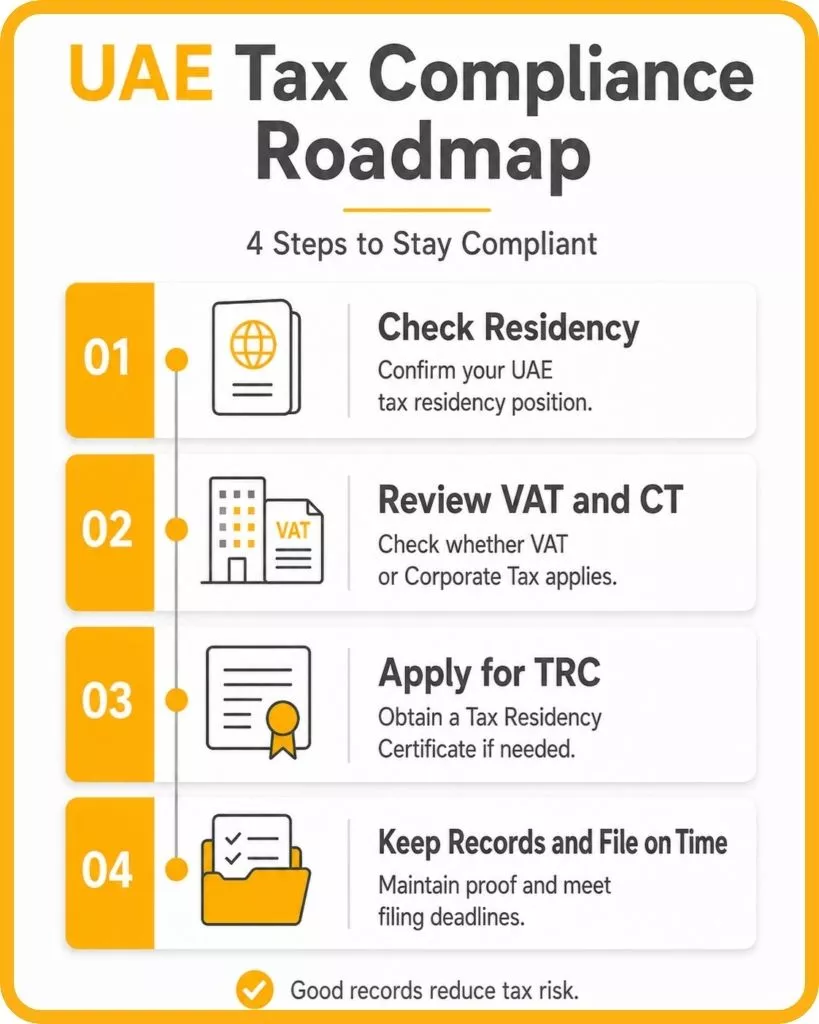
The UAE offers significant tax advantages for expatriates, but you still need to understand the expat tax rules that apply to corporate income tax and VAT. Determine your residency status, obtain a Tax Residency Certificate, register for VAT when required and maintain thorough records. For complex situations involving multiple jurisdictions, seek professional help. Proper tax planning for expats can reduce risks, ensure compliance and maximise the benefits of living and doing business in the UAE.
Quick FAQs
Do expats pay personal income tax in the UAE?
No. The UAE does not charge personal income tax on salaries or wages. However, expats may still have tax duties if they run a business, own a company, earn foreign income, or remain tax resident in another country.
Can an expat become a UAE tax resident?
Yes. An individual may become a UAE tax resident if they meet the UAE residency rules. This can include spending 183 days or more in the UAE, or meeting the 90-day rule with a UAE or GCC residence permit and other conditions.
Why is tax residency important for foreign residents in the UAE?
Tax residency helps decide where your income may be taxed. It can also help you claim benefits under a double taxation agreement and reduce the risk of being taxed twice on the same income.
What is a UAE Tax Residency Certificate?
A UAE Tax Residency Certificate, also called a TRC, is an official document issued by the Federal Tax Authority. It proves that a person or company is a UAE tax resident for a certain period.
Do all expats need a Tax Residency Certificate?
No. Not every expat needs one. A TRC is mainly useful if you need to prove UAE tax residency to a foreign tax authority or claim benefits under a double taxation agreement.
Do freelancers and business owners in the UAE pay Corporate Tax?
They may need to consider Corporate Tax if they conduct business activity in the UAE. Natural persons are generally subject to Corporate Tax only if their business turnover exceeds AED 1 million in a calendar year.
Are salaries subject to UAE Corporate Tax?
No. Salaries and wages are outside the scope of UAE Corporate Tax. Personal investment income and real estate investment income may also be outside the scope if they do not require a business licence.
When does an expat business need to register for VAT in the UAE?
A business must register for VAT if its taxable supplies exceed AED 375,000 per year. Voluntary VAT registration may be available if taxable supplies exceed AED 187,500.
Can a non-resident business be required to register for UAE VAT?
Yes. A non-resident business making taxable supplies in the UAE may need to register for VAT regardless of turnover. This is why foreign business owners should review UAE VAT rules before invoicing UAE clients.
What records should expats keep for tax planning in the UAE?
Expats should keep travel records, entry and exit reports, residence visas, Emirates ID copies, employment contracts, business licences, invoices, bank records, and proof of UAE residence. These documents can support tax residency and compliance.
Can expats still owe tax in their home country?
Yes. Some countries tax residents or citizens on worldwide income. Even if you live in the UAE, your home country may still require tax filings, income reporting, or proof that you are no longer tax resident there.
How can expats reduce tax risks in the UAE?
Expats can reduce tax risks by checking their UAE tax residency status, registering for VAT or Corporate Tax when required, keeping accurate records, applying for a TRC when needed, and reviewing tax rules in their home country.
Disclaimer: The information provided in this blog is for general informational purposes only. For professional assistance and advice, please contact experts.
Author Profile

Sophia Muller
Sophia Müller is a corporate tax consultant with over years of experience advising businesses across Europe and the UAE. She specializes in tax strategy and compliance, helping multinational companies reduce tax risks and follow local regulations.