



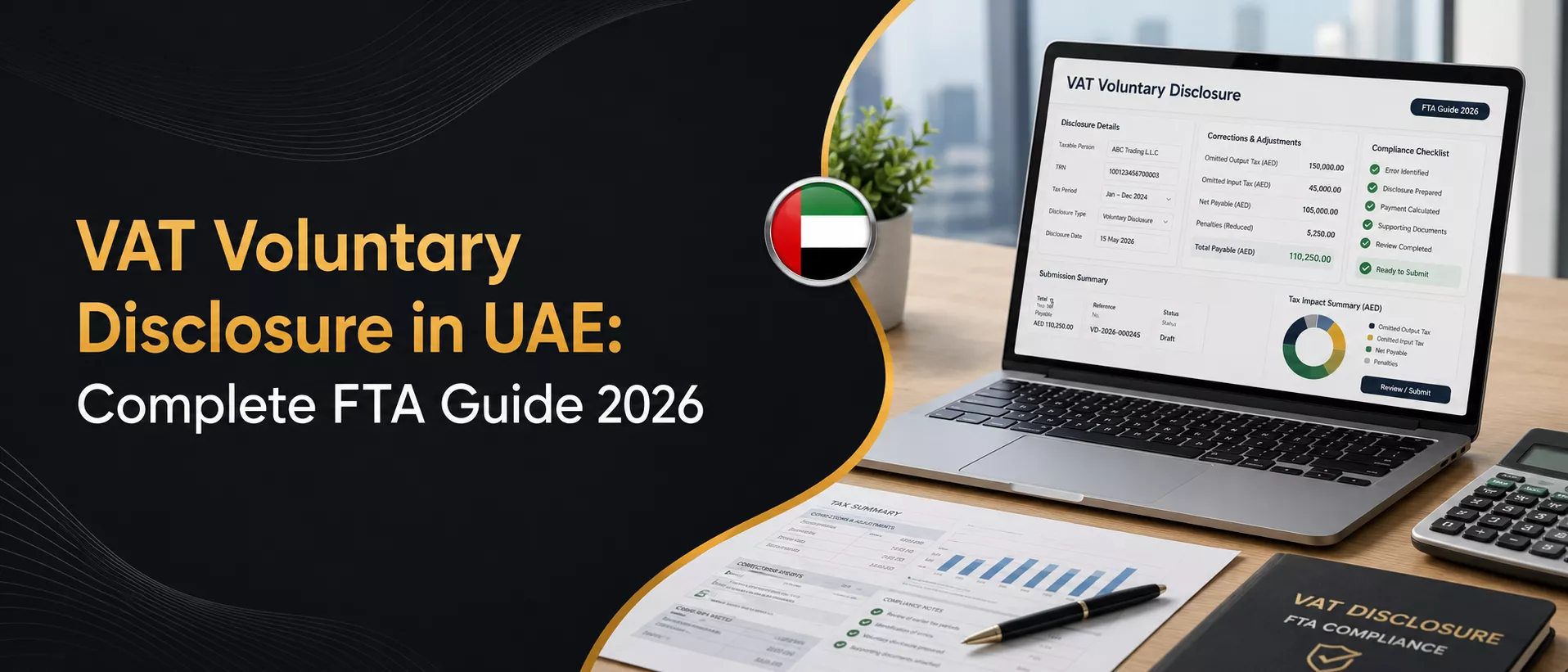
A voluntary disclosure in UAE VAT is the official way to tell the Federal Tax Authority (FTA) that a VAT return, tax assessment, or refund application you already filed contained an error, and to correct it using VAT Form 211. Coming forward before the FTA discovers the mistake keeps your penalties far lower and protects your business from a costly audit.
That one decision, disclosing early versus waiting, now matters more than ever. The rules changed in three steps over 2026. Federal Decree Law No. 17 of 2025 amended the Tax Procedures Law with effect from 1 January 2026. Cabinet Decision No. 17 of 2026 then amended Article 10 of the Executive Regulation (Cabinet Decision No. 74 of 2023) from 1 April 2026, and this is the provision that decides whether your error needs a voluntary disclosure at all. Finally, from 14 April 2026, a reformed penalty framework under Cabinet Decision No. 129 of 2025 changed the way the FTA calculates the penalty for voluntary disclosure in UAE VAT, replacing the old tiered percentages with a simpler monthly charge.
This guide explains, in plain language, what a voluntary disclosure is, when you are required to submit one, how to file VAT Form 211 on the EmaraTax portal, and exactly what it costs under the 2026 rules. You do not need any prior tax knowledge to follow along.
What Is Voluntary Disclosure in UAE VAT?
A voluntary disclosure is a formal notification, made through an official form, that lets a taxable person report and fix an error or omission in a previously submitted VAT return, a tax assessment issued by the FTA, or a VAT refund application. In simple terms, it is how you own up to a VAT mistake and put it right on your own initiative rather than waiting for the authority to catch it.
Every business registered for VAT files periodic returns declaring the tax it collected and the tax it can recover. Mistakes happen even in careful finance teams: a missed invoice, a sale reported under the wrong emirate, an input tax claim that should not have been made, or a simple typing error in a figure. A VAT voluntary disclosure is the mechanism the FTA provides to correct these mistakes cleanly and stay compliant. If your business is still at the registration stage, our VAT registration services team can help you start on the right footing so corrections are rarely needed in the first place.
The key idea to remember is timing. A voluntary disclosure is a proactive step. Once you understand what it is, the rest of this guide is about using it correctly and early.
What Is VAT Form 211?
VAT Form 211 is the official voluntary disclosure form supplied by the FTA inside the EmaraTax portal. When you open it, the form shows the original figures you reported for a given tax period. You then adjust those figures to the correct amounts, explain what went wrong, and attach evidence.
You can submit a voluntary disclosure in UAE VAT against three things: a VAT return you already filed, a VAT refund application you already submitted, or a tax assessment the FTA issued to you. Whichever applies, Form 211 is the route for the correction. One clarification is important for assessments. If you believe an FTA assessment is wrong and you want to formally challenge it, the law also provides a separate tax assessment review and reconsideration process, and applications under that route generally must be filed within 40 business days of being notified of the assessment. A voluntary disclosure corrects errors in the record, while the review and reconsideration route is the formal way to dispute the assessment itself. If you are in this position, take advice on which path fits your case before the 40 business day window closes.
When Do You Need to Submit a Voluntary Disclosure?
Understanding when a disclosure is required is the part most business owners get wrong. The rules sit in Article 10 of the Executive Regulation of the Tax Procedures Law, as amended by Cabinet Decision No. 17 of 2026 with effect from 1 April 2026. Whether you must file depends on the size and nature of the error. Here are the rules that matter.
- You underpaid the tax by more than AED 10,000. If a filed return or refund application understated your payable VAT by more than AED 10,000, a voluntary disclosure is mandatory. You must file it within 20 business days of discovering the error.
- You underpaid the tax by AED 10,000 or less. Smaller underpayments can generally be corrected without filing Form 211, but the timing rule is precise. Under the amended Article 10, the correction must be made in the next VAT return that has not yet fallen due, or in the return for the period in which you discovered the error, whichever is earlier. This route is only available while you remain obligated to submit VAT returns and a return that has not yet fallen due actually exists. If there is no such return, for example because you have deregistered, then a voluntary disclosure is required within 20 business days of discovery.
- You overclaimed a refund. If a refund application overstated the amount you were entitled to receive, a voluntary disclosure is mandatory.
- You overpaid the tax. Where your return calculated the payable tax as higher than the correct amount, the law allows you to submit a voluntary disclosure to recover the difference. This is your right rather than an obligation, but it is usually worth exercising.
- The error does not change the tax due. A reporting error that puts the right total in the wrong box or under the wrong emirate, without changing what you owe, is normally corrected in a future VAT return rather than through Form 211. Be aware, however, that the law empowers the FTA to determine cases in which even a no tax difference error must be corrected through a voluntary disclosure, so this is not an absolute rule. When in doubt, check the current FTA guidance for your specific situation.
The 20 Business Day Deadline
Timing is not optional. Where a voluntary disclosure is required, you must submit it within 20 business days of becoming aware of the error. If several errors relate to the same period, the clock is measured from the date you identified the first one.
Missing this window is a problem for two reasons. First, it exposes you to further penalties. Second, and more importantly, every month that passes before you disclose increases the monthly penalty explained below. In practice, the safest approach is to prepare and file promptly rather than letting an error sit while you gather nerve or paperwork.
The Five Year Limit: You Cannot Disclose Forever
There is also a hard outer boundary that many guides skip. Under the Tax Procedures Law, no voluntary disclosure may be submitted after five years have passed from the end of the relevant tax period. A narrow transitional exception exists for disclosures connected to refund applications: broadly, where the refund application was filed by 31 December 2026, the FTA has not yet decided it, and the disclosure is made within two years of that application.
The practical meaning is simple. Errors in your 2021 and early 2022 periods are aging out of the correction window, while the FTA’s own reach has grown. Federal Decree Law No. 17 of 2025 extended the authority’s assessment powers to as long as 15 years in cases of tax evasion or failure to register. In other words, your window to fix an old error closes at five years, but the FTA’s window to find serious ones does not. That asymmetry is one more argument for reviewing old periods now rather than later.
Penalty for Voluntary Disclosure in UAE VAT (2026 Rules)
This is the section every taxpayer wants, and it is where the 2026 reform matters most. Cabinet Decision No. 129 of 2025 took effect on 14 April 2026 and replaced the older, more complicated penalty tables with a simpler and generally more forgiving structure that rewards early action.
Here is how the penalty for voluntary disclosure in UAE VAT now works.
| Situation | Penalty under the 2026 framework |
|---|---|
| Voluntary disclosure filed before the FTA notifies you of a tax audit | 1 percent per month, or part of a month, of the tax difference, calculated from the day after the original return due date until the date you submit |
| Voluntary disclosure filed after the FTA notifies you of a tax audit | A fixed 15 percent of the tax difference, plus 1 percent per month from the original due date |
| Error that does not change the tax due | No voluntary disclosure penalty in the standard case; the error is corrected in a future VAT return unless the FTA has determined that a disclosure is required |
The logic is deliberate. The cost is tied directly to how long the error stayed uncorrected, and disclosing before an audit notice arrives avoids the fixed 15 percent surcharge entirely. Keep in mind how little warning that notice gives you. Under Article 16 of the Tax Procedures framework, the FTA is required to give at least 10 business days notice before conducting a tax audit. Ten business days is nowhere near enough time to review old periods, quantify an error, and file a disclosure from a standing start. The favourable tier belongs to businesses that act before the letter arrives.
A few related penalties are worth knowing, because a late correction rarely travels alone:
- Late payment of VAT carries a monthly penalty calculated at an annual rate of 14 percent, imposed for every month or part of a month on the unpaid balance. Importantly, for tax arising from a voluntary disclosure, the payment is normally due 20 business days after the disclosure is submitted, and the late payment penalty applies only if the amount remains unpaid after that deadline.
- Submitting an incorrect tax return carries a fixed penalty of AED 500. No penalty applies if you correct the return before its filing deadline, or where a disclosure results in no difference in the tax due.
- Late VAT registration carries a penalty of AED 10,000, and late filing of a return carries AED 1,000 for a first offence and AED 2,000 for a repeat within 24 months. Staying current with VAT return filing is the cheapest way to keep these off your account entirely.
There is also a legal ceiling. Under the Tax Procedures Law, an administrative fine cannot exceed twice the amount of tax on which the fine assessment was issued.
What About Errors From Periods Before April 2026?
The obvious question for anyone holding an older error: if the mistake sits in a 2024 or 2025 period, do the old tiered percentages under Cabinet Decision No. 108 of 2021 apply, or the new 1 percent monthly charge?
The general position is that the penalty framework in force on the date you file governs the disclosure. Cabinet Decision No. 129 of 2025 applies to voluntary disclosures submitted from 14 April 2026 onwards, which on the prevailing professional reading includes disclosures relating to errors from earlier tax periods. For most taxpayers that is good news, because the monthly charge is usually gentler than the old fixed tiers, particularly for errors discovered within the first year or two.
One honest caveat belongs here. The FTA has not published detailed transitional guidance addressing every scenario, so for large legacy errors it is worth confirming the expected penalty treatment before filing rather than assuming a figure. This is exactly the kind of question our VAT consultancy team resolves before a disclosure goes in.
A Simple Example
Imagine a Dubai company discovers it underdeclared AED 50,000 of VAT, and the error sits eight months past the original return due date. Because the underpayment exceeds AED 10,000, a voluntary disclosure is mandatory. This example is illustrative only.
If the company files the voluntary disclosure before receiving any audit notice, the penalty is 1 percent per month on the AED 50,000 tax difference for eight months, which comes to AED 4,000, plus the tax itself. Provided it pays the tax within 20 business days of submitting the disclosure, no late payment penalty is added.
If the same company waits until after the FTA issues an audit notice, it also faces a fixed penalty of 15 percent of the tax difference, an extra AED 7,500, on top of the monthly amount. The message is clear: early disclosure is almost always the cheaper path.
How to Make a Voluntary Disclosure (VAT Form 211) in the UAE
Filing is done entirely online through the FTA EmaraTax portal. Here is how to make a voluntary disclosure using VAT Form 211 in the UAE, step by step.
- Confirm the error. Identify the exact tax period, the nature of the mistake, and the correct figures. Check whether the error actually requires Form 211 under the AED 10,000 threshold rules above. Gather the invoices, credit notes, and records that prove the correct position.
- Prepare an explanation. Draft a clear letter that describes each error, why it happened, and how you calculated the correction. The FTA expects this narrative.
- Log in to EmaraTax. Sign in with your Tax Registration Number (TRN) credentials.
- Open the right period. In the VAT section, find the return, refund, or assessment you need to correct and select Submit Voluntary Disclosure to open Form 211.
- Enter the discovery date. Record the date you identified the error. If there were several errors, use the date of the first one.
- Correct the figures. The form shows your original figures as reported. Update them to the correct current figures. Any box that was already correct stays the same.
- Attach supporting documents. Upload your explanation letter and all evidence that supports the new figures.
- Submit and settle. Submit the form, then pay any tax due within 20 business days of submission, together with the applicable penalty. The FTA reviews the disclosure and may ask for further information by email, so respond promptly.
This is how you submit a voluntary disclosure in UAE VAT correctly. Accuracy at the document stage is what prevents rejection.
Documents You Usually Need
While the exact list depends on your case, most voluntary disclosures require:
A detailed explanation letter covering each error and its cause. The original figures and the corrected calculations side by side. Supporting invoices, credit notes, and accounting records. Any related FTA correspondence, and, where relevant, customs statements or proof of payment.
Keeping organised records throughout the process means you can respond quickly if the FTA requests clarification.
Common Mistakes That Lead to Problems
Businesses run into trouble with voluntary disclosures in a handful of predictable ways. They wait too long and let the monthly penalty build. They file thin submissions without a proper explanation letter, which invites rejection or delay.
They disclose the wrong tax period. They file a full disclosure for a small underpayment that could have been corrected in the next return, or, more dangerously, they assume a large underpayment can wait for the next return when the AED 10,000 threshold makes Form 211 mandatory. They use a voluntary disclosure when their real objective is to dispute an FTA assessment, then miss the 40 business day window for a formal review or reconsideration. And they attempt a complex correction alone, then discover the figures do not reconcile once the FTA reviews them.
Each of these is avoidable with a careful, evidence based approach.
What the 2026 Reform Means for Your Business
Taken together, Federal Decree Law No. 17 of 2025, Cabinet Decision No. 17 of 2026, and Cabinet Decision No. 129 of 2025 reflect a wider shift in the UAE toward a mature, transparency driven tax system that rewards businesses for correcting themselves. The penalty structure is now simpler to calculate, aligns VAT more closely with Corporate Tax and Excise Tax treatment, and makes early disclosure clearly cheaper than waiting for enforcement. If your business also files corporate tax, the same discipline applies there, and our corporate tax return filing team can review both positions together.
The practical takeaway is to review your open VAT positions now. Any period within the record keeping window where you suspect an error is worth checking while the favourable, pre audit penalty tier still applies and before the five year bar closes the door on older periods. Once an audit notice lands, the option to disclose on your own terms, and at the lower cost, is gone.
FTA Enforcement Is Increasing
If you are weighing whether disclosure is worth the effort, the FTA’s own activity data settles the question. The authority carried out approximately 176,000 field inspection visits across all emirates during 2025, an increase of around 89 percent compared with roughly 93,000 visits in 2024. Over the same period, the total value of tax dues and associated administrative penalties identified during those inspections exceeded AED 608 million, up from AED 348 million in 2024.
In a market with that level of oversight, the probability that an uncorrected error is eventually found is rising every year, and the FTA is only required to give 10 business days notice before an audit begins. Voluntary disclosure is the tool that lets you control the outcome before that happens. If a notice has already arrived, our tax audit support team can represent you through the process.
How Bestax Helps You File With Confidence
Getting a voluntary disclosure right is part calculation, part documentation, and part judgement about timing. This is where working with FTA approved tax agents pays for itself. Bestax is a Dubai based firm with more than ten years of experience and offices in the UAE and Canada, and our team handles VAT corrections from start to finish.
Our specialists review your filed returns to pinpoint errors, prepare the corrected figures and the explanation letter the FTA expects, and submit your VAT voluntary disclosure through EmaraTax on your behalf. We also help you stay ahead of problems with ongoing VAT return filing and VAT consultancy, and we represent clients during tax audits when the FTA has questions.
Clients tell us the difference is peace of mind. One long standing client described how our team made their dealings with the FTA seamless, from routine VAT returns and correspondence to settling fines, and even resolved accounts that had been left unresolved before they came to us. That is the outcome a well managed disclosure is meant to deliver.
If you think a past return may contain an error, do not wait for an audit notice to decide for you. Book a free consultation with our VAT team, or contact Bestax today. You can also estimate amounts quickly with our free VAT calculator before you file.
Quick FAQs
What is voluntary disclosure in UAE VAT?
It is the official process for telling the FTA that a VAT return, tax assessment, or refund application you already submitted contained an error, and correcting it using VAT Form 211. You do it before the FTA finds the mistake, which keeps penalties lower.
What is VAT Form 211 used for
VAT Form 211 is the voluntary disclosure form inside the EmaraTax portal. You use it to update the figures you originally reported, explain the error, and attach supporting evidence for the correct amounts.
When do I have to submit a voluntary disclosure in UAE VAT?
A disclosure is mandatory when you underpaid VAT by more than AED 10,000, or when you overclaimed a refund. An underpayment of AED 10,000 or less is corrected in the next return that has not yet fallen due, or the return for the period in which you discovered the error, whichever is earlier, provided you are still required to file returns and such a return exists. If it does not, Form 211 is required within 20 business days. If you overpaid tax, you may file a disclosure to recover the difference.
How do I make a voluntary disclosure using VAT Form 211 in the UAE?
Log in to EmaraTax with your TRN, open the tax period that needs correcting, select Submit Voluntary Disclosure to open Form 211, enter the date you found the error, update the figures, attach your explanation letter and evidence, then submit and pay any amount due within 20 business days of submission.
What is the penalty for voluntary disclosure in UAE VAT in 2026?
If you disclose before the FTA notifies you of an audit, the penalty is 1 percent of the tax difference for every month, or part of a month, from the day after the original due date until you file. If you disclose after an audit notice, you also pay a fixed 15 percent of the tax difference. A disclosure that produces no difference in tax due carries no AED 500 incorrect return penalty.
Is there a deadline to submit a voluntary disclosure in the UAE?
Yes, two of them. Where a disclosure is required, you must file within 20 business days of becoming aware of the error, and if there are several errors the deadline runs from the date you identified the first one. Separately, no voluntary disclosure can be submitted at all once five years have passed from the end of the relevant tax period, subject to a narrow transitional exception for certain refund related disclosures.
Do the new 2026 penalties apply to errors from earlier years?
Generally yes. Cabinet Decision No. 129 of 2025 applies to voluntary disclosures filed from 14 April 2026 onwards, which on the prevailing reading includes disclosures for errors arising in earlier tax periods. The FTA has not published detailed transitional guidance for every scenario, so confirm the treatment of large legacy errors with an adviser before filing.
What happens if I do not file a voluntary disclosure when required?
You risk higher penalties, and if the FTA discovers the error during an audit you lose the lower, pre audit penalty tier. You may also face the fixed 15 percent surcharge and the reputational cost of an error being found rather than disclosed.
When is the tax from a voluntary disclosure due for payment?
The tax arising from a voluntary disclosure is normally due 20 business days after the disclosure is submitted. The late payment penalty, a monthly charge calculated at an annual rate of 14 percent, applies only if the amount remains unpaid after that deadline.
Disclaimer: The information provided in this blog is for general informational purposes only. For professional assistance and advice, please contact experts.
