



Opening an offshore bank account in Dubai is entirely possible for non-residents and foreign-owned companies, but only if you approach it with the right entity structure, documentation, and bank fit.
Dubai’s banking system is internationally regulated, aligned with FATF standards, and requires full transparency on ownership and source of funds.
The FATF (Financial Action Task Force) is the global watchdog that sets standards for fighting money laundering, terrorist financing, and proliferation financing.
Every country undergoes periodic Mutual Evaluations, a deep audit of its anti-money laundering (AML) and counter-terrorist financing (CFT) system.
Important Note: The UAE was removed from the FATF grey list in February 2024 and is now preparing for its next Mutual Evaluation in mid-2026. As a result, banks continue to apply robust risk-based controls to maintain strong correspondent banking relationships and demonstrate effectiveness to international assessors.
This guide walks you through every step, from choosing the right company structure to what to expect on onboarding day.
Why Dubai for an Offshore Bank Account?
Dubai has quietly become one of the most credible jurisdictions for international banking. It’s not a secrecy haven, it’s a compliance-forward financial hub with real infrastructure benefits.
Here’s what makes it stand out:
- Personal investment interest is generally not subject to UAE Corporate Tax, although it may be taxable in your country of tax residence.
- Full currency flexibility, multi-currency accounts in AED, USD, EUR, GBP, and more
- No exchange controls, funds can be transferred in and out without restriction
- SWIFT and SEPA capabilities for global payment corridors
- Removed from the FATF grey list in February 2024, ending the ‘increased monitoring’ designation
- 9% Corporate Tax on profits from financial years starting June 1, 2023, but free zone entities on qualifying income (Qualifying Free Zone Persons) may benefit from a 0% rate under the UAE Corporate Tax Law (Federal Decree-Law No. 47 of 2022)
The UAE Central Bank (CBUAE) regulates all banking institutions and mandates risk-based AML programs aligned with FATF standards, which means your account will come with real oversight and real legitimacy.
What Does “Offshore Bank Account” Actually Mean in Dubai?
In UAE banking practice, “offshore” typically refers to one of two scenarios:
- A non-resident individual seeking a personal account at a UAE bank
- A foreign-owned or non-operating entity, such as a RAK ICC or JAFZA Offshore company, seeking a corporate account
The term does not imply secrecy. UAE banks apply full AML/KYC screening, Common Reporting Standard (CRS) reporting to your home country’s tax authority, and Ultimate Beneficial Owner (UBO) disclosure requirements per the UAE Ministry of Economy’s regulations.
Step 1: Choose Your Entity Structure First
Before approaching any bank, you need to decide what legal vehicle you’ll use. This single decision shapes everything , which banks will consider you, how long onboarding takes, and what your minimum balances will be.
Option A: Free Zone LLC (e.g., DMCC, RAKEZ, IFZA)
Best for businesses with actual trade activity, buying and selling goods/services, paying suppliers, collecting from customers.
- Highest bank acceptance rate
- Eligible for operational multi-currency accounts
- Requires a UAE trade license
- Shareholders may be eligible for UAE residency visas
Option B: ADGM or DIFC SPV
Best for holding assets, shares, or managing investments rather than trading.
- Strong bank acceptance for wealth and asset management
- Narrower transactional account options
- Higher prestige but also higher setup cost
Option C: RAK ICC or JAFZA Offshore
Best for holding structures, inter-company arrangements, or investment vehicles that don’t operate in the UAE.
- Lowest setup cost
- Harder to bank, most UAE banks classify these as higher-risk profiles
- Requires deeper source-of-funds documentation
Important 2025–2026 Update: Most UAE banks no longer accept account applications from foreign offshore entities registered in jurisdictions like BVI or Seychelles. UAE-incorporated structures are strongly preferred.
Need help setting up the right offshore company structure? Bestax’s Offshore Company Setup service guides you from incorporation through bank account opening.
Step 2: Know Which Banks Accept Offshore Profiles
Not every UAE bank will onboard non-residents or offshore entities, and those that do apply their policies case-by-case. Major banks such as Emirates NBD, Mashreq, ADCB, FAB, HSBC UAE, and Standard Chartered UAE all onboard some non-resident and free-zone profiles selectively, usually through premium, wealth, or business-banking tiers. Bear in mind that any minimum balances these banks publish are general retail or business figures and do not necessarily reflect the thresholds applied to offshore or non-resident applicants.
Because eligibility, minimum balances, and timelines change frequently and are rarely published in a standardized way, the most reliable approach is to confirm the specifics directly with each bank before you apply. Use this checklist when you do:
| Factor to verify | What to ask the bank |
|---|---|
| Entity eligibility | Does the bank onboard this exact legal form and jurisdiction? |
| Non-resident eligibility | Is the product available without UAE residency? |
| Minimum balance | Is it an account-level or relationship-level balance? |
| Monthly fees | What fee applies if the balance is not maintained? |
| Supported currencies | Which currencies can be held and transferred? |
| Ownership limits | Are corporate shareholders or multilayer structures accepted? |
| Onboarding method | Digital, branch-based, or hybrid? |
| Expected timeline | What is the current estimate for this specific profile? |
| Restricted activities | Is the applicant’s industry within the bank’s risk appetite? |
Note: Product eligibility, fees, minimum balances, and compliance requirements change frequently. Request the bank’s current Key Facts Statement, tariff guide, and written confirmation of preliminary eligibility before relying on any quoted amount.
Step 3: Prepare Your Documents
This is where most applications fail, not because of the business model, but because the documentation is incomplete, inconsistent, or doesn’t tell a coherent story.
For Non-Resident Individuals:
- Valid passport
- Proof of address (utility bill or bank statement, within 3 months)
- 6–12 months of personal bank statements
- Source of funds evidence (employment contract, dividends, asset sale documents)
- Written explanation of account purpose
- Tax residency certificate (recommended for high-value profiles)
For Free Zone LLCs:
- Trade license + Memorandum and Articles of Association
- Share certificates and board resolution for account opening
- UBO chart tracing to natural persons (all beneficial owners)
- 6 months of business bank statements or shareholder statements
- Supplier contracts, client invoices, or purchase orders
- Business plan and expected transaction volumes
- Proof of UAE office address
For RAK ICC / JAFZA Offshore Companies:
- Certificate of Incumbency
- Memorandum and Articles of Association
- UBO register and control diagram
- Shareholder or group bank statements
- Purpose of the holding vehicle and links to underlying assets
- Share purchase agreements or intercompany loan documents
Step 4: The Onboarding Process: What Actually Happens
Here’s the realistic end-to-end sequence:
- Assessment: Map your transaction flows, choose entity type based on banking appetite
- Entity setup: Register your company (if not done) and obtain all corporate documents
- Document pack assembly: Compile all KYC/EDD documents as listed above
- Pre-call with relationship manager: Confirm the bank’s appetite for your profile before submitting anything
- Formal application submission: Submit the complete pack in one go
- In-person KYC: Travel to Dubai for identity verification (this step cannot be skipped)
- Compliance review: Internal AML screening, UBO verification, sanctions checks (takes 2–8 weeks)
- Account activation: Start with predictable, well-documented transactions
- Go-live maintenance: Keep a folder of supporting documents ready for post-activation queries
Can it be done fully remotely? Pre-screening and document review can happen remotely. But final KYC almost always requires the account signatory to appear in person at a UAE branch. Some banks offer video KYC for UAE residents only, non-residents must visit in person.
Step 5: Understand the Costs: Minimum Balances, Fees & FX
Offshore and non-resident accounts come with higher carrying costs. Budget for these realistically:
Emirates NBD, Mashreq, ADCB
Hidden cost to model: If AED 300,000 must sit idle to avoid fall-below fees, calculate that opportunity cost against your business’s capital needs. For FX-heavy businesses, negotiating relationship pricing (which narrows the FX spread to ~0.45%) can be worth more than the minimum balance difference between tiers.
How UAE Tax Rules Interact With Your Offshore Account
This is an area most guides gloss over. Here’s the practical breakdown:
- Individuals: No UAE personal income tax on bank interest
- Corporate entities: Profits (including interest income) are subject to the 9% Federal Corporate Tax introduced under Federal Decree-Law No. 47 of 2022
- Free zone entities: Can benefit from a 0% rate on qualifying income as a Qualifying Free Zone Person and conduct qualifying activities
- CRS reporting: UAE banks have exchanged information under the OECD Common Reporting Standard since 2018, your home country’s tax authority will be notified of your account balances and income
- UBO obligations: All accounts require disclosure of ultimate beneficial owners, registered with the UAE Ministry of Economy
This means offshore banking in Dubai is not about hiding money, it’s about accessing legitimate infrastructure within a transparent, well-regulated framework.
Need help ensuring your offshore structure is corporate tax compliant? Bestax’s Corporate Tax Consultancy team works specifically with free zone and offshore entity structures.
What No One Else Tells You: Why Applications Actually Fail
Most guides cover the document checklist. Here’s what actually causes rejections and delays:
- No coherent economic rationale. Banks want to understand why you need a UAE account. “Asset protection” isn’t a reason. “We pay Asian suppliers in USD and collect from US marketplace customers” is.
- Opaque UBO structures. Any ownership layer that obscures natural persons triggers enhanced scrutiny. Get your structure chart clean before approaching a bank.
- Thin transactional evidence. If your company is newly registered with no contracts, no invoices, and no banking history, expect delays or rejection. Build a 6-month paper trail first.Signatory unavailability for in-person KYC. The account can be approved in principle, then stall for months because the authorized signatory can’t travel. Plan this trip early.
- Post-activation transaction drift. If your first 3 months of transactions don’t match the story you told during onboarding, expect manual reviews and potential payment freezes.
Pro Tip: Align your first 90 days of transaction activity tightly with your onboarding narrative. Sudden deviations, even legitimate ones, trigger compliance flags.
AML/KYC: What to Expect From UAE Banks in 2025–2026
The UAE was removed from the FATF “increased monitoring” list (grey list) in early 2024, a significant milestone. However, rather than relaxing, UAE banks have maintained and in some areas tightened their risk-based controls to protect correspondent banking relationships.
Expect:
- Enhanced Due Diligence (EDD) for all non-resident and offshore profiles
- Sanctions and adverse media screening against international watchlists
- Periodic KYC refresh, banks will re-verify documents and UBO structures on a scheduled cycle
- Transaction monitoring, AI-driven behavioral profiling now flags anomalies significantly faster than before
The CBUAE’s AML/CFT guidelines and FATF plenary outcomes govern these frameworks. Your compliance posture, clean UBO disclosure, transparent source of funds, consistent transactional behavior, is your best protection against delays.
Need help with AML compliance documentation? Bestax’s AML Services team helps businesses prepare the right frameworks before and after account opening.
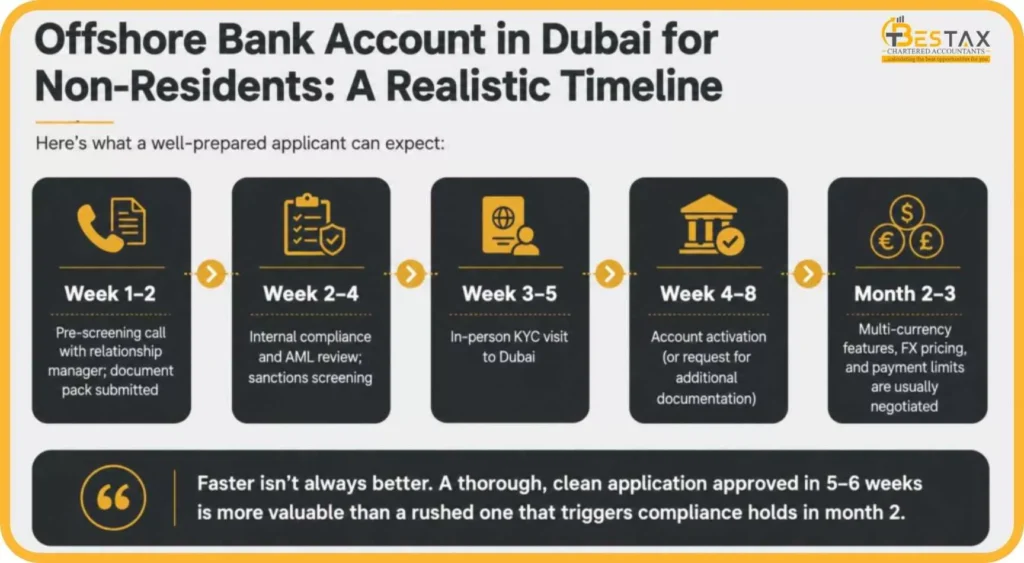
Offshore Bank Account in Dubai for Non-Residents: A Realistic Timeline
Here’s what a well-prepared applicant can expect:
- Week 1 to 2: Pre-screening call with relationship manager; document pack submitted
- Week 2 to 4: Internal compliance and AML review; sanctions screening
- Week 3 to 5: In-person KYC visit to Dubai
- Week 4 to 8: Account activation (or request for additional documentation)
- Month 2 to 3: Multi-currency features, FX pricing, and payment limits are usually negotiated
Faster isn’t always better. A thorough, clean application approved in 5 to 6 weeks is more valuable than a rushed one that triggers compliance holds in month 2.
Bestax: Your Partner for Offshore Company Setup and Banking in Dubai
At Bestax Chartered Accountants, we’ve helped over 1,000 companies successfully launch in the UAE, including offshore and free zone entities requiring bank account support. Our team of 35+ professionals, rated Excellent across 195+ Google Reviews, offers:
- Offshore Company Setup in Dubai (RAK ICC, JAFZA Offshore, DMCC and more)
- Business Setup in Free Zones for entities requiring operational banking
- Corporate Tax Consultancy ensuring your entity structure is tax-efficient and compliant
- AML Compliance Services (KYC documentation preparation and ongoing) compliance support
- UBO Compliance, UAE Ministry of Economy UBO registration and maintenance
“I cannot express enough gratitude to Karim at Bestax… From the initial concept to the grand opening, Karim was an absolute lifesaver, guiding us through every complex step of the process.” Melat Tamiru, client of Bestax Chartered Accountants
Ready to get started? Book a free consultation with Bestax today.
Quick FAQs
Can a non-resident open a personal bank account in Dubai?
Yes, but only through select banks, typically under premium or wealth tiers with minimum balances starting from AED 25,000 for basic non-resident accounts and AED 100,000+ for premium tiers. In-person KYC is required in all cases.
Can I open an offshore company bank account without visiting Dubai?
Pre-screening and document review can happen remotely. However, final KYC requires the authorized signatory to visit a UAE branch in person. This step cannot be bypassed for non-residents.
How long does it take to open a corporate bank account in Dubai?
Most well-prepared applications complete in 2 to 8 weeks depending on the bank, entity type, document completeness, and scheduling of the in-person KYC meeting.
Which is better for banking, an offshore company or a free zone LLC?
A free zone LLC (e.g., DMCC, RAKEZ) is significantly easier to bank with because it has operational activity, a trade license, and can demonstrate business rationale. Offshore companies (RAK ICC, JAFZA Offshore) face higher scrutiny and fewer bank options.
Will UAE banks report my account to my home country tax authority?
Yes. The UAE has participated in the OECD Common Reporting Standard (CRS) since 2018 and automatically exchanges financial account information with participating jurisdictions annually.
What is the minimum balance for a non-resident offshore bank account in Dubai?
Starting from AED 25,000 to AED 500,000 per account or relationship, with fall-below fees of AED 100–300/month if the balance drops below the threshold.
Do I need a UAE company to open an offshore bank account?
Not necessarily. High-net-worth individuals can open personal accounts under premium banking tiers without a UAE company. However, for business accounts, a UAE-incorporated entity (free zone or offshore) is required. Accounts for foreign offshore entities from jurisdictions like BVI or Seychelles are generally no longer accepted by most UAE banks as of 2025.
Can I use my UAE offshore account for cryptocurrency transactions?
Some UAE banks have begun accepting crypto-related accounts. However, all crypto activity is subject to strict compliance standards.
Disclaimer: The information provided in this blog is for general informational purposes only. For professional assistance and advice, please contact experts.
