




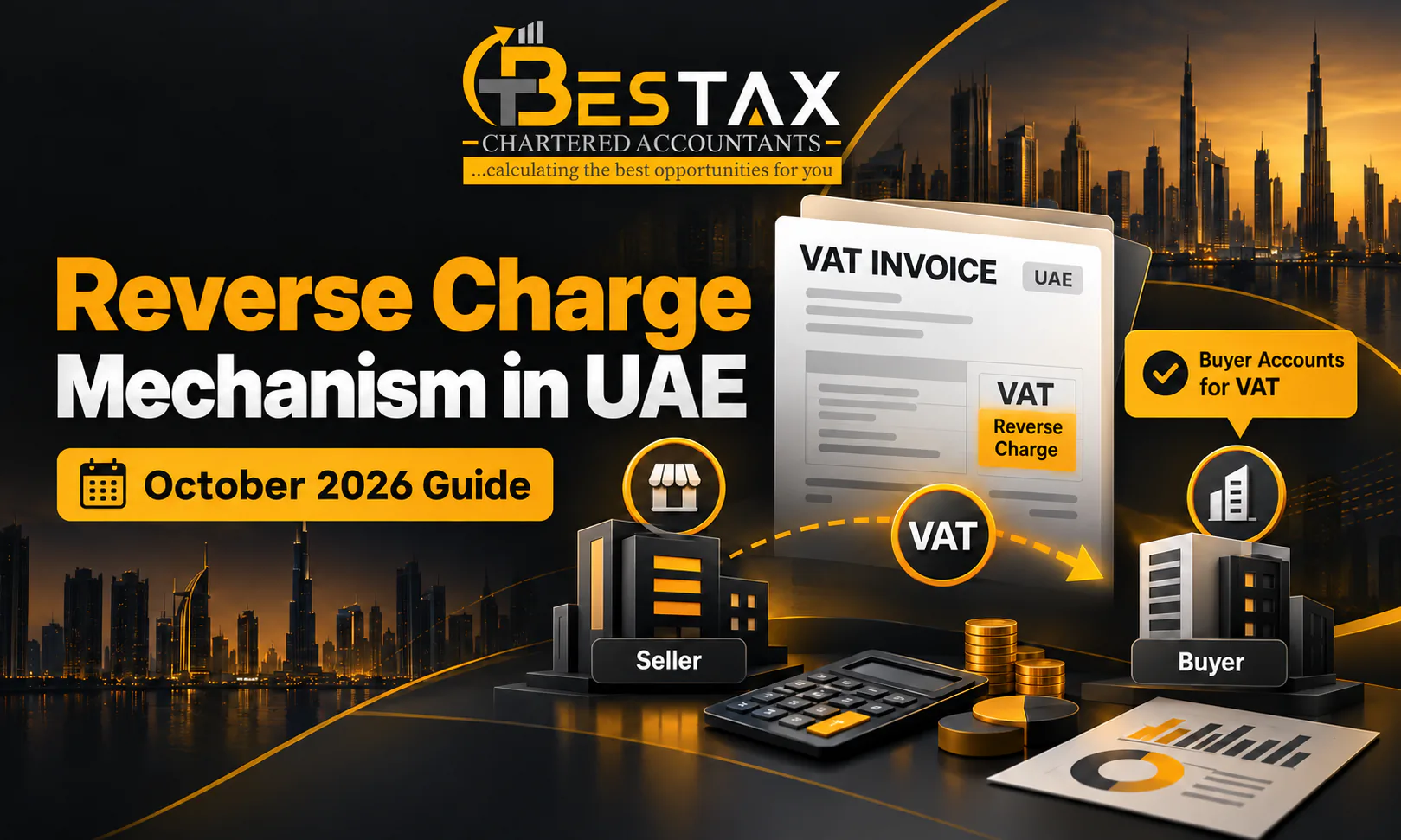
The reverse charge mechanism in the UAE moves the duty to account for VAT from the seller to the buyer, so the buyer reports the output VAT and reclaims it as input VAT in the same return. As of October 2026, it applies to imported goods and services and to four domestic sectors: hydrocarbons, electronic devices, precious metals and stones, and metal scrap, and self invoices are no longer required.
What Is the Reverse Charge Mechanism?
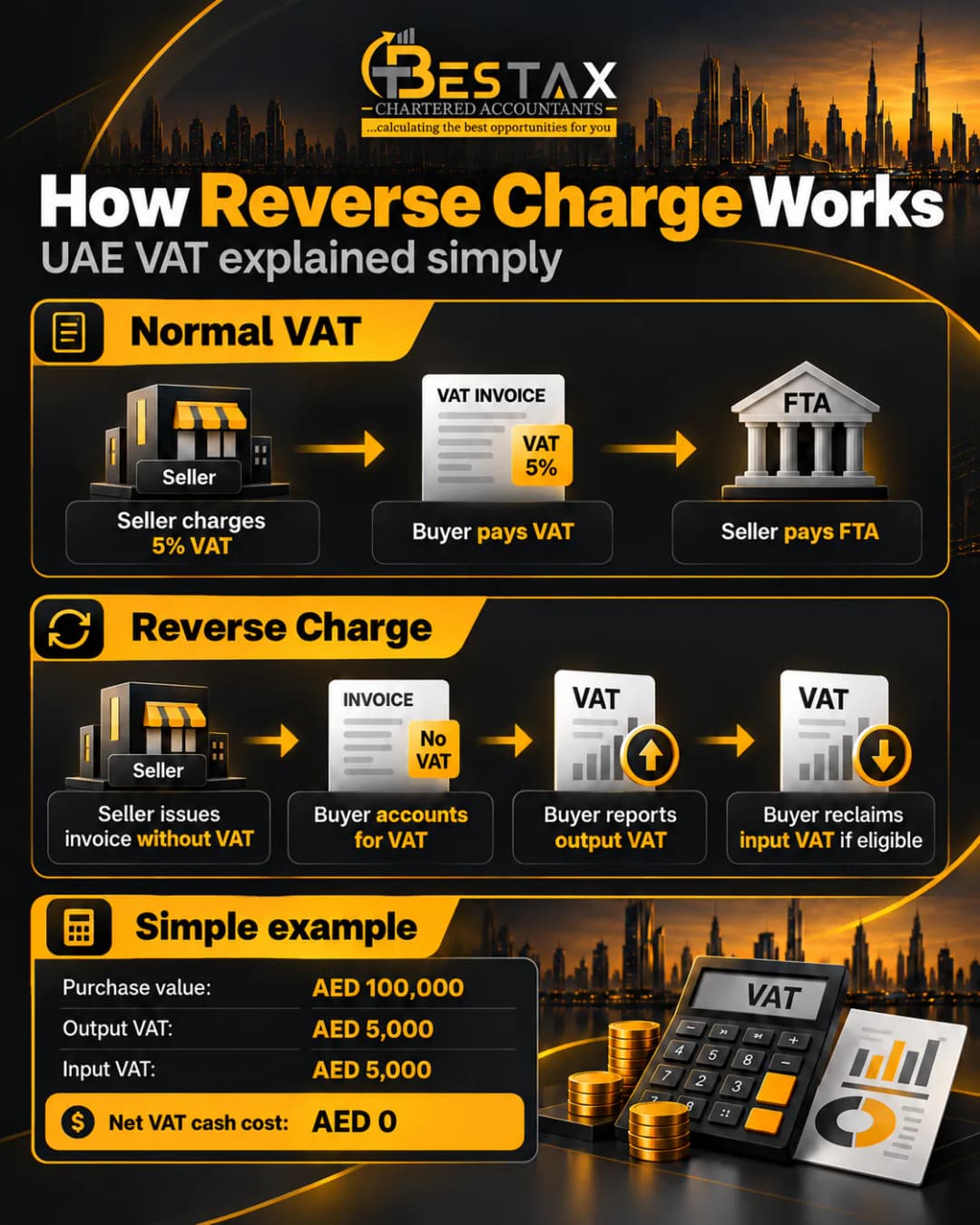
Under normal VAT, the seller adds 5% VAT to the invoice, collects it from the buyer and pays it to the Federal Tax Authority (FTA). Under the reverse charge mechanism (RCM), the seller issues an invoice without VAT, and the buyer calculates the VAT itself.
The buyer then does two things in the same VAT return. It declares the VAT as if it had made the sale (output tax), and it reclaims the same amount as input tax if the purchase is used for taxable business activity. For most fully taxable businesses, the two entries cancel out, so no cash leaves the business.
A simple example: A Dubai trading company buys AED 100,000 of electronic devices for resale from another UAE registrant. The seller charges no VAT. The buyer records AED 5,000 of output VAT and AED 5,000 of recoverable input VAT. Net VAT payable on this purchase: zero.
Why Does the UAE Use Reverse Charge?
The UAE uses RCM for two reasons. First, it lets foreign suppliers sell to UAE businesses without registering for UAE VAT. Second, it closes a common fraud gap in high value, fast moving sectors, where a seller collects VAT and disappears before paying it to the FTA. The Ministry of Finance said the metal scrap rule was introduced to crack down on fraud in that sector and to improve the handling of tax refunds.
RCM is not an exemption. The supply is still taxable at 5%; only the person responsible for reporting it changes.
What Changed for Reverse Charge in 2026?
2026 brought six changes that touch reverse charge, from paperwork relief in January to stricter input tax checks in October. Here they are in date order.
| Date | Change | What it means for reverse charge |
|---|---|---|
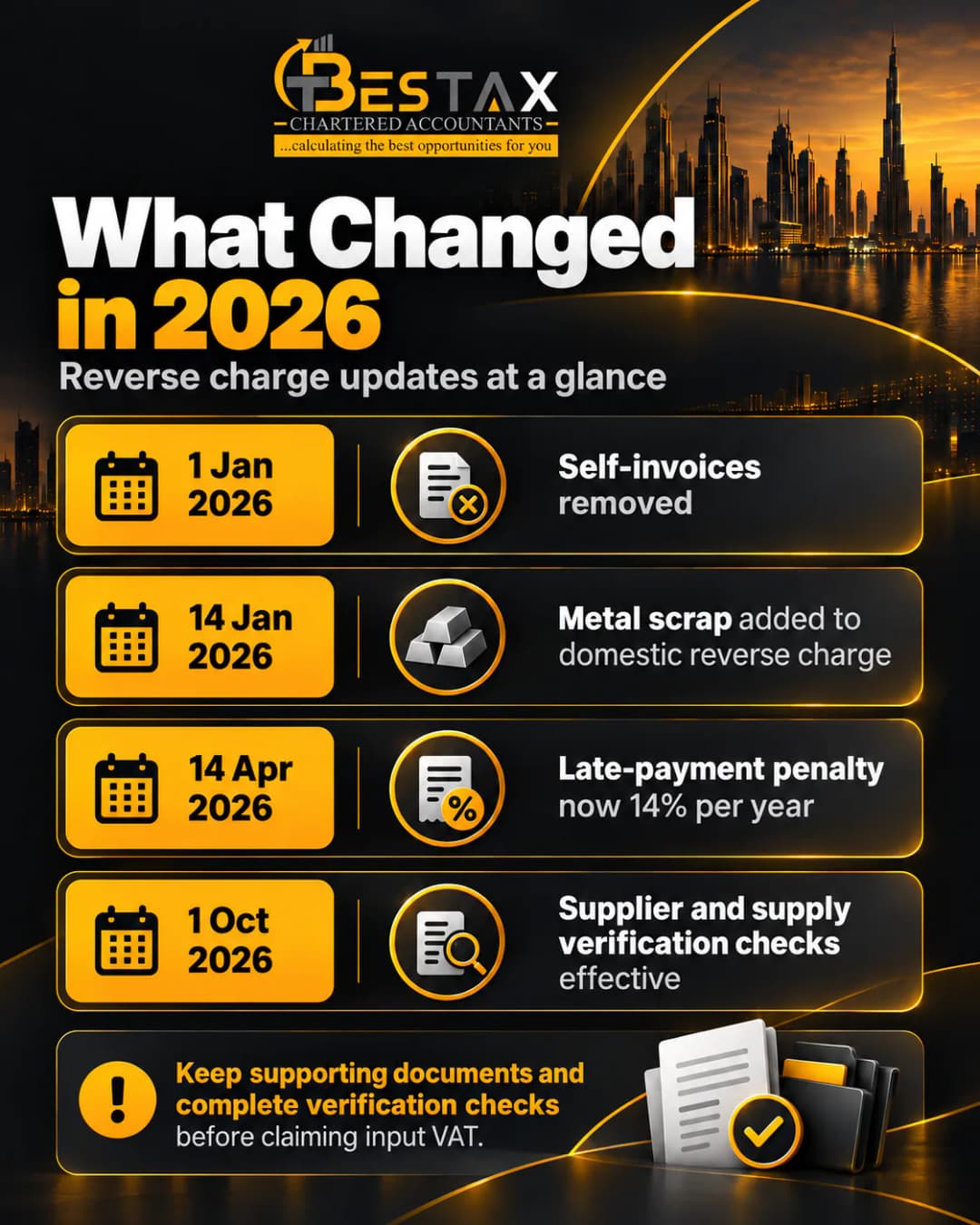
| 1 January 2026 | Federal Decree-Law No. 16 of 2025 amends the VAT Law | Self invoices are no longer required when applying RCM; supporting documents must be kept instead. The FTA can also deny input tax where a supply is linked to tax evasion. A five year limit now applies to reclaiming excess refundable tax. |
| 14 January 2026 | Cabinet Decision No. 153 of 2025 takes effect | Supplies of metal scrap between UAE VAT registrants for resale or processing move to domestic reverse charge. |
| 14 April 2026 | Cabinet Decision No. 129 of 2025 takes effect | Late payment penalties become a flat 14% per year, calculated monthly, replacing the old compounding structure. |
| 1 July 2026 | E-invoicing pilot begins | The national e-invoicing system starts its pilot phase and voluntary adoption. |
| 22 July 2026 | FTA Decision No. 13 of 2026 issued | Sets out the supplier and supply checks businesses must complete before deducting input tax. |
| 1 October 2026 | FTA Decision No. 13 of 2026 takes effect | Input VAT, including VAT reclaimed on reverse charge purchases, can be denied if the checks were not done and the supply chain is linked to evasion. |
Coming next: businesses with annual revenue of AED 50 million or more must appoint an Accredited Service Provider for e-invoicing by 30 October 2026 and go live by 1 January 2027.
Where Does Reverse Charge Apply in October 2026?
Reverse charge applies in two broad situations: cross border purchases (imports) and four domestic sectors between UAE VAT registrants. Article 48 of the VAT Law is the legal base for all of them, and Article 48(8) lets the Cabinet add new goods or services at any time.
| Category | Legal basis | Applies from | Key condition |
|---|---|---|---|
| Imported services | VAT Law, Article 48 | 1 January 2018 | Place of supply is the UAE and the supplier is not UAE resident |
| Imported goods | VAT Law, Article 48 | 1 January 2018 | Goods imported by a registrant for business use |
| Hydrocarbons (crude oil, refined oil, natural gas) | VAT Law, Article 48(3) | 1 January 2018 | Buyer is registered and will resell or use them to produce or distribute energy |
| Electronic devices (mobile phones, smartphones, computers, tablets) | Cabinet Decision No. 91 of 2023 | 30 October 2023 | Buyer is registered and will resell or use them in manufacturing |
| Gold and diamonds | Cabinet Decision No. 25 of 2018, replaced by No. 127 of 2024 | 1 January 2018 | Buyer is registered and will resell or manufacture |
| Silver, platinum, palladium, pearls, rubies, sapphires, emeralds and jewellery made from them | Cabinet Decision No. 127 of 2024 (FTA guide VATP043) | 26 February 2025 | Precious content is worth more than all other components combined |
| Metal scrap (ferrous and non ferrous) | Cabinet Decision No. 153 of 2025 (FTA guide VATP047) | 14 January 2026 | Buyer is registered and will resell or process the scrap |
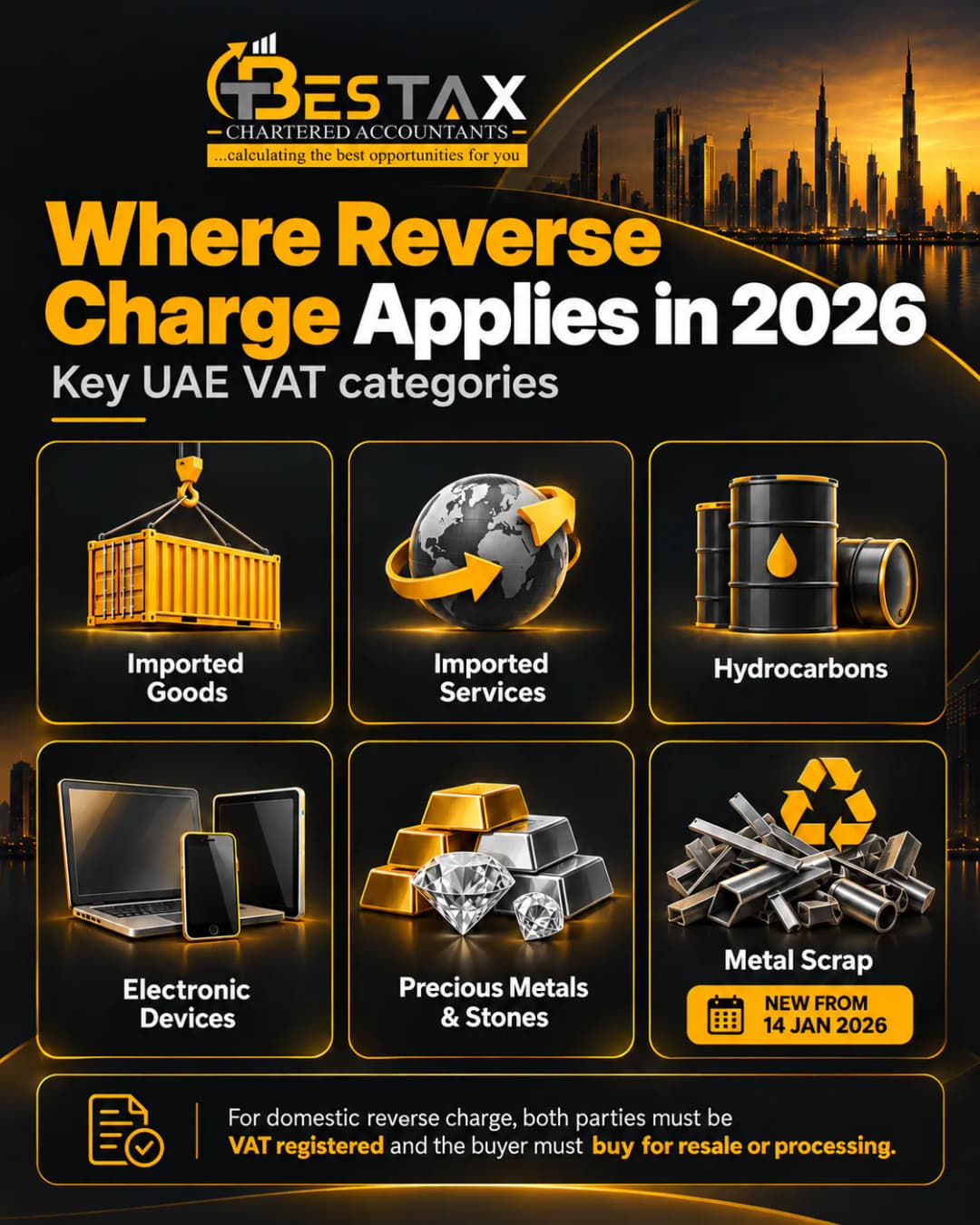
For every domestic category, the same three conditions apply: both parties are VAT registered, the buyer intends to resell or process the goods, and the buyer gives the seller written declarations before the date of supply. If any condition fails, normal VAT applies and the seller charges 5%.
Metal Scrap Reverse Charge: The Newest Rule Explained
Since 14 January 2026, a UAE VAT registrant that sells metal scrap to another registrant who will resell or process it must not charge VAT. The buyer accounts for the VAT instead. The FTA explained how the rule works in its public clarification VATP047.
What Counts as Metal Scrap?
Metal scrap means ferrous or non ferrous metal waste that has commercial value and can be used after processing. Goods made mainly of such metal also qualify. The FTA's own example is a used lead acid battery at the end of its life: it counts as metal scrap when lead makes up most of the product and is the main material recovered, even though it contains some plastic and electrolyte.
Other scrap is outside the rule. Paper, plastic, glass, textiles, organic waste and rubber stay under normal VAT.
When Does the Buyer's Intention Matter?
The rule only applies if the buyer intends to resell or process the scrap.
- Resell means selling it as part of a business that trades in metal scrap, at wholesale or retail level.
- Processing means turning the scrap into material used to make new products, by repairing, recycling or any other method. Converting scrap into building materials or new car parts is processing.
- Own use is not resale. If a business buys scrap to repair its own storage racks, fences or structural supports, the reverse charge does not apply and the seller charges 5% VAT.
What Must the Buyer Do?
Before the date of supply, the buyer gives the seller two written declarations for each supply. They can be combined into one document.
- A declaration that the scrap is bought for resale or processing.
- A declaration that the buyer is VAT registered, with its Tax Registration Number (TRN).
What Must the Seller Do?
Before the date of supply, the seller must:
- Receive and keep the buyer's declarations.
- Verify the buyer's registration using the TRN verification tool on the FTA website.
- Issue a tax invoice that clearly states the supply is subject to the reverse charge mechanism.
What If the Scrap Is Exported?
Exports are excluded. A direct or indirect export of metal scrap that meets the zero rating conditions is reported by the seller as a zero rated supply, not under reverse charge.
What Happens If the Declarations Are Missing?
The consequences fall on both sides. The seller must charge VAT at 5% and report the sale in Box 1 of its VAT return. The buyer cannot reclaim the input VAT it paid on that purchase. In a low margin trade like scrap, losing 5% of input VAT can wipe out the profit on a deal.
How Do You Account for Reverse Charge VAT?
The buyer reports the purchase in Box 3 of the VAT return and reclaims the VAT in Box 10. Follow these five steps for every reverse charge purchase.
- Confirm it qualifies. Check the category (import, hydrocarbons, electronics, precious goods or metal scrap) and, for domestic supplies, that both parties are registered and the goods are for resale or processing.
- Exchange the paperwork before the supply. As the buyer, send your written declarations. As the seller, verify the buyer's TRN on the FTA website and keep the declarations.
- Check the invoice. A domestic reverse charge invoice shows no VAT and states that the reverse charge mechanism applies. You no longer issue a self invoice; keep the supplier's invoice, contract, proof of payment and, for goods, customs documents.
- Calculate the VAT. Multiply the taxable value by 5%.
- Report it in the right boxes. Use the table below.
| Transaction | Where the buyer declares it | Where the buyer reclaims it |
|---|---|---|
| Domestic reverse charge (hydrocarbons, electronics, precious goods, metal scrap) | Box 3 | Box 10 (not Box 9) |
| Imported services | Box 3 | Box 10 |
| Imported goods declared through customs | Box 6 | Box 10 |
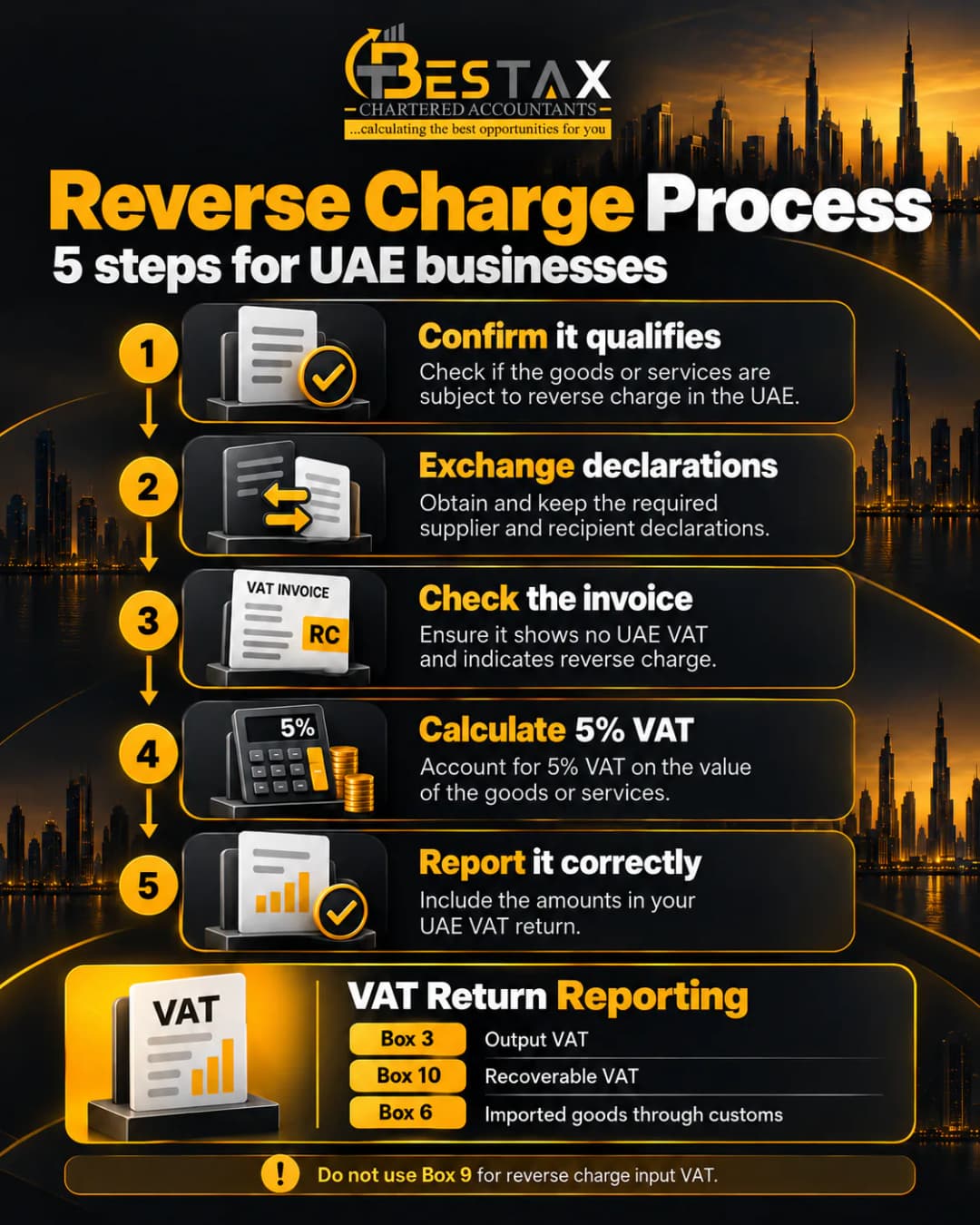
The FTA's VATP047 guide is explicit that Box 9 must not be used to reclaim input tax on reverse charge metal scrap purchases. If your business makes exempt supplies, only the recoverable share goes in Box 10.
Worked Example: A Scrap Metal Purchase in October 2026
Gulf Recycling LLC, a VAT registered recycler in Sharjah, buys AED 200,000 of copper scrap from Desert Metals Trading LLC, also registered, to melt into copper rods.
| Step | Desert Metals (seller) | Gulf Recycling (buyer) |
|---|---|---|
| Before supply | Receives declarations, verifies TRN, keeps records | Sends intent and registration declarations |
| Invoice | AED 200,000, no VAT, marked as reverse charge | Keeps invoice as its supporting document |
| VAT return | Does not report the sale or any VAT | Box 3: AED 200,000 value and AED 10,000 VAT |
| Input tax | Not applicable | Box 10: reclaims AED 10,000 |
| Net VAT cash cost | AED 0 | AED 0 |
If Gulf Recycling had not sent its declarations, Desert Metals would have charged AED 10,000 of VAT, and Gulf Recycling could not have reclaimed it. That is a straight AED 10,000 loss on one invoice.
What Does October 2026 Change for Reverse Charge Buyers?
From 1 October 2026, a valid invoice is no longer enough on its own to protect your input VAT. Three developments now sit on top of the reverse charge rules.
Supplier and Supply Checks Before Reclaiming Input VAT
The 2026 VAT Law amendments let the FTA deny input tax where a supply is part of a chain connected to tax evasion and the buyer knew, or should have known. FTA Decision No. 13 of 2026, issued on 22 July 2026 and effective 1 October 2026, sets out what "should have known" means in practice.
This matters for reverse charge because the buyer is the one reclaiming the VAT. Sectors placed under reverse charge, such as metal scrap, electronics and precious metals, were chosen precisely because they carry fraud risk. Businesses in these sectors should expect their input tax claims to face the closest review.
In practical terms, buyers should now:
- Verify each new supplier before trading and refresh the check periodically.
- Check each supply for commercial sense: price, quantity, delivery and payment route.
- Pay through banking channels and avoid cash for high value purchases.
- Keep a written internal verification policy and the evidence of every check.
A New Penalty Structure
Cabinet Decision No. 129 of 2025 reshaped VAT penalties from 14 April 2026. Unpaid tax, including reverse charge VAT a buyer should have self accounted, now attracts a late payment penalty of 14% per year, calculated monthly. Errors you correct through a voluntary disclosure attract a lower, time based penalty of 1% per month. The lesson is simple: find and fix reverse charge errors early.
E-Invoicing Is Weeks Away
The national e-invoicing system supports reverse charge invoices, so your reverse charge flags must be right in your accounting system. Key dates from the Ministry of Finance:
| Milestone | Date |
|---|---|
| Pilot and voluntary adoption | 1 July 2026 |
| Appoint an Accredited Service Provider (revenue of AED 50 million or more) | 30 October 2026 |
| Go live (revenue of AED 50 million or more) | 1 January 2027 |
| Appoint provider (revenue below AED 50 million) | 31 March 2027 |
| Go live (revenue below AED 50 million) | 1 July 2027 |
| Go live (government entities) | 1 October 2027 |
By May 2026, the Ministry of Finance had approved 32 service providers, with more in final accreditation.
Common Reverse Charge Mistakes to Avoid
Most reverse charge problems we see in UAE businesses come from timing and paperwork, not from the VAT calculation. Use this checklist before every return.
- Declarations are collected before the date of supply, not after the invoice is issued.
- A separate declaration exists for each supply of metal scrap, as VATP047 requires.
- The buyer's TRN was checked on the FTA website and the result was saved.
- Every domestic reverse charge invoice states that the reverse charge mechanism applies.
- The seller has not charged VAT on a supply that qualifies for reverse charge.
- The buyer has not applied reverse charge to scrap bought for its own repairs or maintenance.
- Exports of scrap are reported as zero rated supplies, not as reverse charge.
- Reverse charge VAT is reclaimed in Box 10, not Box 9.
- Self invoice templates have been switched off since 1 January 2026, and supporting documents are filed instead.
- Supplier and supply checks under FTA Decision No. 13 of 2026 are documented before input VAT is claimed.
- Non metal scrap materials (paper, plastic, glass, textiles, rubber) are taxed normally.
Get Your Reverse Charge Right with Bestax
Reverse charge looks simple on paper, but one missing declaration or one wrong box can cost you 5% of a purchase. Bestax Chartered Accountants is an FTA Approved Tax Agency (No. 30008692) based in Business Bay, Dubai, and has supported UAE businesses with VAT, corporate tax, accounting and audit since 2015. Every engagement is led by a senior team, including Haseeb Hamdani, FCCA and FTA Approved Tax Agent.
Our VAT team can help you:
- Review whether your supplies fall under reverse charge, including metal scrap, electronics and precious goods.
- Draft compliant buyer declarations and reverse charge invoice wording.
- Set up supplier and supply verification policies for FTA Decision No. 13 of 2026.
- Switch off self invoicing and map reverse charge correctly to Box 3 and Box 10.
- Fix past errors through a voluntary disclosure before the FTA finds them.
- Prepare your systems for e-invoicing ahead of 1 January 2027.
Book a free consultation with a senior chartered accountant at Bestax or see our VAT services and VAT return filing services.
Frequently Asked Questions
What is the reverse charge mechanism in UAE VAT?
The reverse charge mechanism is a VAT rule where the buyer, not the seller, accounts for the VAT. The seller issues an invoice without VAT, and the buyer reports the 5% VAT in its own return and reclaims it as input tax if eligible.
Who pays VAT under the reverse charge mechanism?
The buyer pays VAT under the reverse charge mechanism. It declares the VAT as output tax and, if the purchase is used for taxable business activity, reclaims the same amount as input tax. For most businesses, the net cash cost is zero.
Is reverse charge mandatory in the UAE?
Yes. Reverse charge is mandatory whenever the legal conditions are met. For domestic sectors such as metal scrap or electronics, it becomes compulsory once both parties are VAT registered, the buyer intends to resell or process the goods, and the declarations are in place.
Which goods are under reverse charge in the UAE in 2026?
In 2026, domestic reverse charge covers hydrocarbons, electronic devices such as phones, computers and tablets, gold, diamonds and other precious metals and stones, and metal scrap. Imported goods and services from non resident suppliers are also under reverse charge.
When did reverse charge on metal scrap start in the UAE?
Reverse charge on metal scrap started on 14 January 2026 under Cabinet Decision No. 153 of 2025. It covers ferrous and non ferrous metal waste sold between UAE VAT registrants for resale or processing.
Do I still need to issue a self invoice for reverse charge?
No. Since 1 January 2026, UAE businesses no longer need to issue self invoices under the reverse charge mechanism. You must still account for the VAT and keep supporting documents, such as the supplier invoice, contract and proof of payment.
Which VAT return box is used for reverse charge?
Reverse charge purchases go in Box 3 of the UAE VAT return, and the recoverable VAT is claimed in Box 10. Imported goods declared through customs go in Box 6. Box 9 should not be used for reverse charge input tax.
Can I recover input VAT on reverse charge purchases?
Yes, if the purchase is used to make taxable supplies. From 1 October 2026, you must also complete the supplier and supply checks in FTA Decision No. 13 of 2026, or the FTA can deny recovery where the supply chain is linked to tax evasion.
What happens if the buyer does not give a reverse charge declaration?
If the buyer does not give the written declarations before the supply, reverse charge does not apply. The seller must charge 5% VAT and report it in Box 1, and the buyer cannot reclaim that input VAT.
What should a reverse charge invoice show in the UAE?
A domestic reverse charge invoice must show no VAT and include a clear statement that the supply is subject to the reverse charge mechanism. It should also carry the usual tax invoice details, including both parties' TRNs.
Does reverse charge apply to scrap metal exports?
No. Reverse charge does not apply when metal scrap is exported directly or indirectly. If the zero rating conditions are met, the seller reports the export as a zero rated supply in its VAT return.
What is the penalty for not paying reverse charge VAT on time?
Since 14 April 2026, unpaid VAT attracts a late payment penalty of 14% per year, calculated monthly. If you find the error yourself and file a voluntary disclosure, the penalty is lower, at 1% per month.
Does reverse charge apply to plastic or paper scrap?
No. The UAE reverse charge on scrap only covers metal. Paper, plastic, glass, textiles, rubber and organic waste stay under normal VAT, so the seller charges 5% VAT as usual.
Disclaimer: The information provided in this blog is for general informational purposes only. For professional assistance and advice, please contact experts.

Khadija Raees holds a Bachelor's degree and brings over five years of experience in creating authoritative content in the areas of tax, accounting, company formation, and VAT in the UAE.
Learn More About Khadija