




From 1 January 2026, the UAE no longer applies one flat percentage to sweetened drinks. The excise amount now depends mainly on total sugar and other sweetener content per 100 ml. Drinks with 8 grams or more are taxed at AED 1.09 per litre, drinks from 5 grams to less than 8 grams are taxed at AED 0.79 per litre, and qualifying drinks below 5 grams are taxed at AED 0 per litre.
What changed under the UAE sugar tax in 2026?
The UAE sugar tax changed on 1 January 2026. Sweetened drinks are now taxed under a tiered volumetric system, which means the tax depends on sugar content and volume instead of one fixed percentage of the excise price.
For businesses, this is more than a pricing update. It changes product classification, laboratory evidence, product registration, tax calculations, stock controls and the commercial value of reformulating a drink. A difference of a few grams of sugar per 100 ml can now move a product from zero excise tax to AED 0.79 or AED 1.09 per litre.
The phrase UAE sugar tax is commonly used, but the legal tax is Excise Tax on sweetened drinks. It is not a separate tax on bags of sugar or every food that contains sugar. It targets beverages that fall within the legal definition of a sweetened drink.
The 2026 UAE excise tax rates for sweetened drinks
| Category | Sugar and other sweeteners per 100 ml | Excise amount | Simple meaning |
|---|---|---|---|
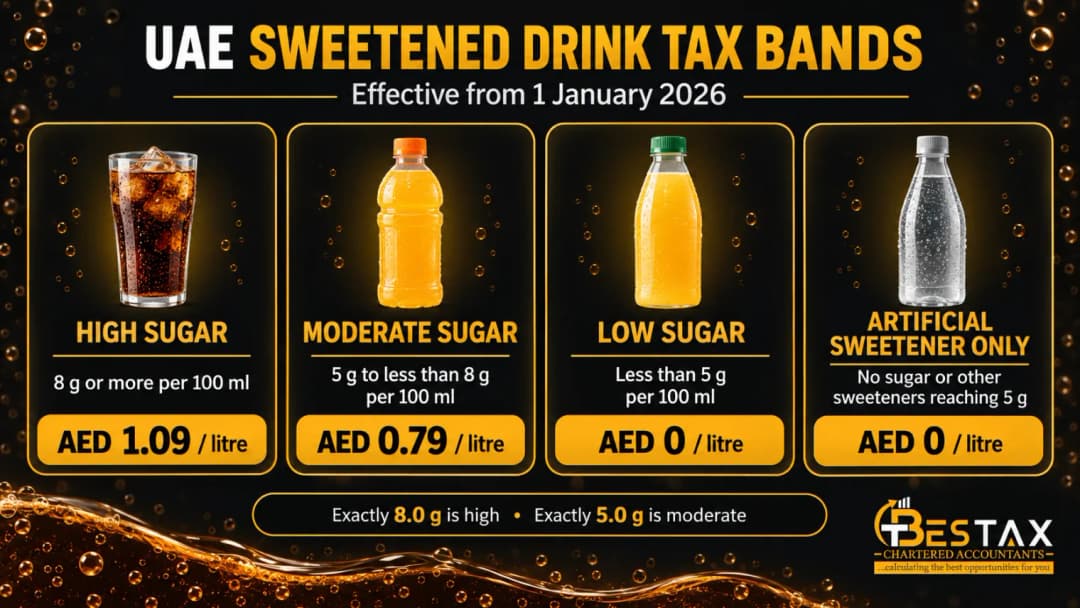
| High sugar | 8 grams or more | AED 1.09 per litre | Highest sweetened drink band |
| Moderate sugar | 5 grams or more and less than 8 grams | AED 0.79 per litre | Middle sweetened drink band |
| Low sugar | Less than 5 grams | AED 0 per litre | Zero excise amount if the drink remains within this category |
| Artificially sweetened | Only artificial sweeteners, or artificial sweeteners with less than 5 grams of sugar or other sweeteners | AED 0 per litre | Artificial sweetener alone does not create a positive excise amount |
The legal thresholds make the boundary points important. A drink at exactly 8.0 grams per 100 ml is in the high sugar category. A drink at exactly 5.0 grams is in the moderate category. A drink below 5.0 grams can fall into the zero amount category, provided the wider definition and evidence requirements are satisfied.
What is a sweetened drink under UAE Excise Tax?
A sweetened drink is broadly a product made for consumption as a drink where a source of sugar, artificial sweetener or another sweetener has been added. The form does not have to be a bottle or can. The definition can cover ready to drink beverages, concentrates, powders, gels, extracts and other products that can be converted into a drink.
What does total sugar mean?
This is where many finance teams make the first mistake. If a drink contains added sugar or another non artificial sweetener, naturally occurring sugar in the beverage is also counted when determining the band. In practical terms, a fruit based drink with added sugar does not test only the added spoonful. Its natural sugar can become part of the total used for classification.
Artificial sweeteners are treated differently. A drink sweetened only with artificial sweeteners can carry an excise amount of AED 0 per litre. However, adding an artificial sweetener does not erase real sugar. If the drink also contains 6 grams of sugar or other sweeteners per 100 ml, it can still fall into the moderate category.
Which drinks are outside the tiered sweetened drink rules?
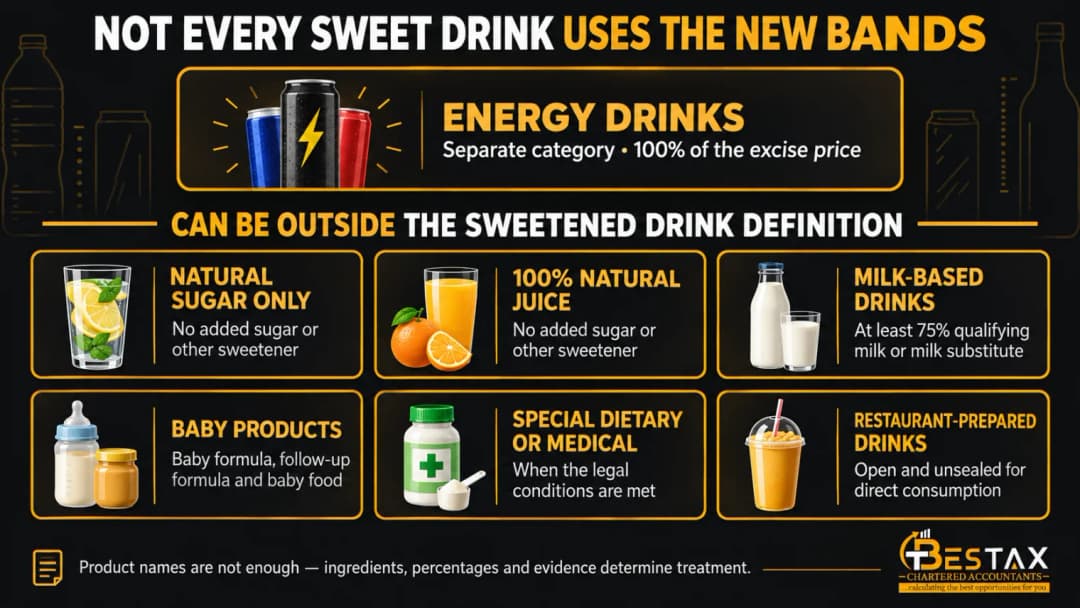
Not every sweet tasting beverage is taxed under the new bands. The legislation and FTA guidance contain important exclusions and separate categories.
- Energy drinks remain subject to Excise Tax at 100 percent of the excise price. They do not move into the sugar bands simply because their sugar content is known.
- Drinks containing only naturally occurring sugar, with no added sugar, artificial sweetener or other sweetener, are outside the sweetened drink definition.
- One hundred percent natural fruit and vegetable juices with no added sugar or other sweeteners are excluded.
- Ready to drink beverages containing at least 75 percent milk can be excluded from the sweetened drink definition.
- Ready to drink beverages containing at least 75 percent qualifying milk substitutes can also be excluded.
- Baby formula, follow up formula and baby food are excluded.
- Qualifying beverages for special dietary needs and medical use are excluded when the relevant conditions are met.
- Sweetened drinks prepared in restaurants or similar establishments and served to consumers in open, unsealed containers for direct consumption are excluded.
These exclusions need to be applied carefully. A product name such as juice, milk drink, wellness drink or zero sugar drink is not enough on its own. The ingredients, product form, percentages, lab evidence and intended use determine the tax treatment.
Carbonated drinks changed category in 2026
Carbonated drinks are no longer a separate Excise Tax category from 1 January 2026. Before 2026, carbonated drinks were generally subject to a 50 percent rate under the old framework. Now a carbonated drink is tested against the sweetened drink definition and the relevant sugar band. This means a low sugar carbonated beverage can have a very different excise result from a high sugar one.
This change matters for pricing models. Under the old percentage approach, a cheaper and a more expensive drink could produce different tax amounts even with the same sugar profile. Under the 2026 volumetric model, the tax on sweetened drinks is driven by litres and sugar content rather than retail price.
How to calculate the new UAE sugar tax
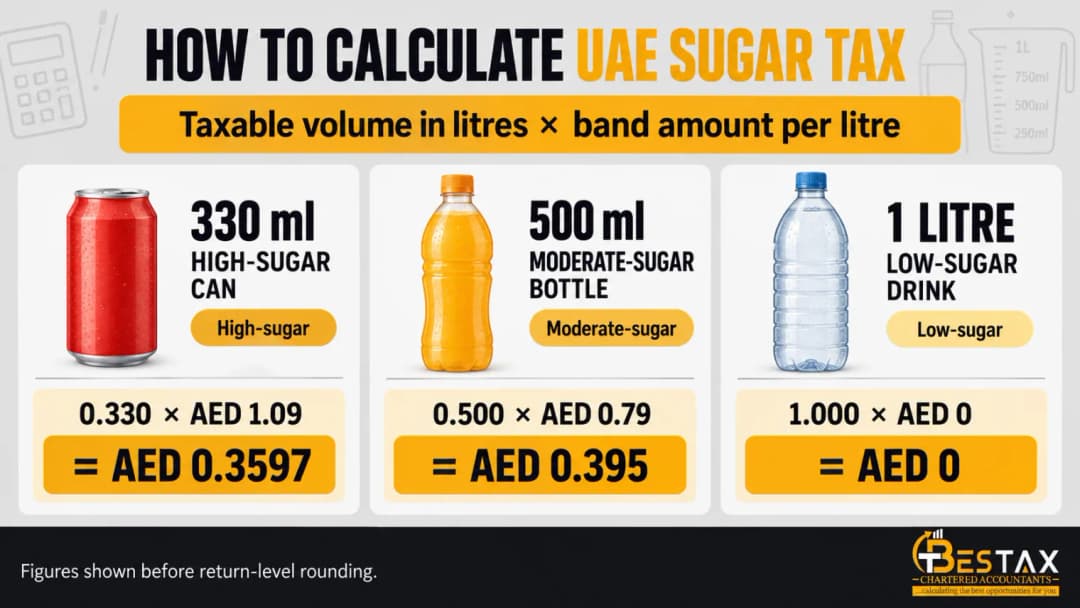
The basic calculation is simple once the correct category has been established. Multiply the taxable volume in litres by the excise amount for that sugar category.
Example 1: A 330 ml high sugar can
Assume a 330 ml drink contains 9 grams of total sugar and other sweeteners per 100 ml. It falls into the high sugar category. The calculation is 0.330 litre multiplied by AED 1.09, giving AED 0.3597 of Excise Tax for the unit before return level rounding.
Example 2: A 500 ml moderate sugar bottle
Assume a 500 ml drink contains 6 grams per 100 ml. It falls into the moderate category. The calculation is 0.500 litre multiplied by AED 0.79, giving AED 0.395 of Excise Tax for the bottle before return level rounding.
Example 3: A one litre low sugar drink
Assume a one litre drink contains 4.5 grams per 100 ml and otherwise meets the low sugar conditions. Its excise amount under the tiered model is AED 0 per litre.
Example 4: A drink with artificial sweetener only
If the drink is sweetened only with qualifying artificial sweeteners and does not have sugar or other sweeteners that move it into a positive band, its excise amount is AED 0 per litre. Zero excise does not remove product registration or evidence requirements where they apply.
How concentrates, powders, gels and extracts are treated
Concentrated products are tested using the final drink that results after dilution. Where reliable producer instructions state the dilution ratio, the calculation follows the final ready to drink form. This prevents a small bottle of concentrate from being taxed as if its concentrated sugar level were the drinking strength.
If proper dilution guidance is not available, or if the guidance is shown to be inaccurate, FTA Decision No. 10 of 2025 provides a mechanism for calculating the relevant sugar and sweetener percentage. Businesses selling syrups, powders and beverage concentrates should make sure the product instructions, laboratory report and FTA registration all tell the same story.
The conformity certificate is now a core compliance document
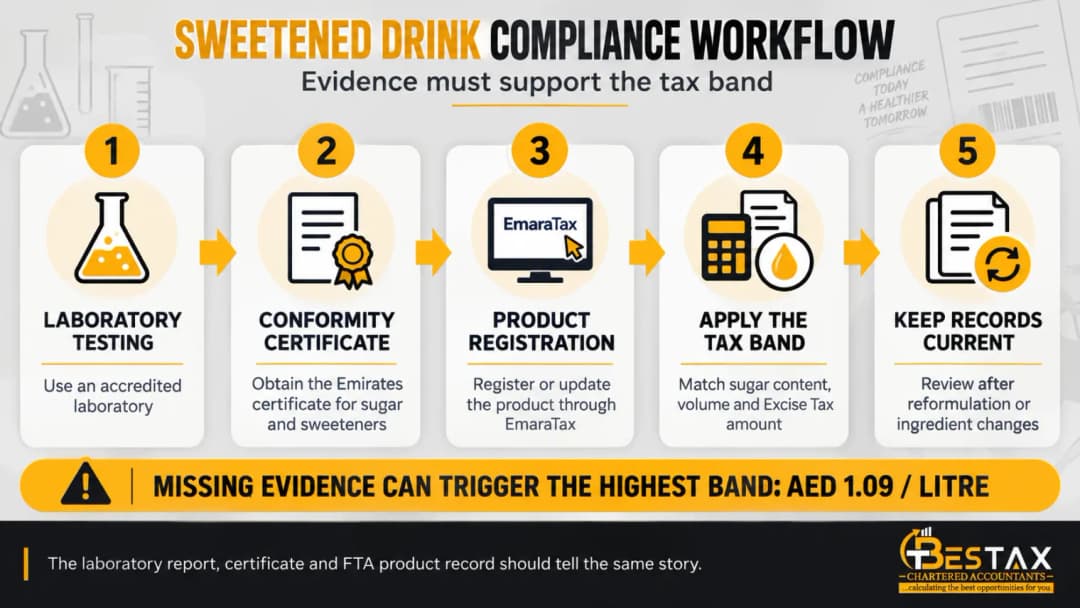
From 1 January 2026, producers, importers and stockpilers of sweetened drinks are required to obtain the Emirates Conformity Certificate for Sugar and Sweeteners Content in Beverages for Excise Tax purposes. This follows laboratory testing through an accredited laboratory and the certificate is then used when registering or updating the product with the FTA through EmaraTax.
The risk of skipping this step is expensive. If the required evidence is not submitted, the FTA can classify the drink in the highest sugar category until acceptable laboratory evidence supports a lower category or non taxable treatment. In other words, missing paperwork can turn a zero amount drink into an AED 1.09 per litre problem.
Who must register for UAE Excise Tax?
Excise Tax registration is relevant to a person carrying out activities that create Excise Tax liability. The FTA identifies the main activities as importing excise goods, producing excise goods for release into UAE consumption, stockpiling excise goods in specified cases, and releasing excise goods from a designated zone.
The FTA service page states that a person liable to register should apply within 30 days from the end of a month in which the person carries out, or intends to carry out, activities that create an Excise Tax liability. The registration service is available through EmaraTax and the FTA states an estimated processing time of 20 business days after a completed application is received.
Product registration is separate from registering the taxable person. The FTA product registration service requires product details, label images and, for sweetened products, the relevant Ministry of Industry and Advanced Technology certificate. Goods are generally registered as single units using the Global Trade Item Number and barcode.
Excise returns, records and transition issues
A registered Excise Tax person generally files an Excise Tax return for each tax period, with the standard return due by the 15th day of the following calendar month. The accounting challenge is not the return form itself. It is making sure the product master, sugar band, volume, inventory movement, import declarations and deductions reconcile before the return is filed.
FTA Decision No. 11 of 2025 created a specific deduction route for excess Excise Tax paid where a drink was initially treated as high sugar and a later laboratory report proved a lower category or no tax. That special rule applied to tax periods beginning on or after 1 January 2026 and ending on or before 30 June 2026, subject to documentary conditions and the goods not having been sold before the right to deduction arose.
By late August 2026, this is now mainly a transition clean up issue. Businesses that used the high sugar default early in the year should review whether they still have unresolved claims, supporting laboratory evidence and unsold inventory records from the relevant periods.
What businesses should change in their accounting systems
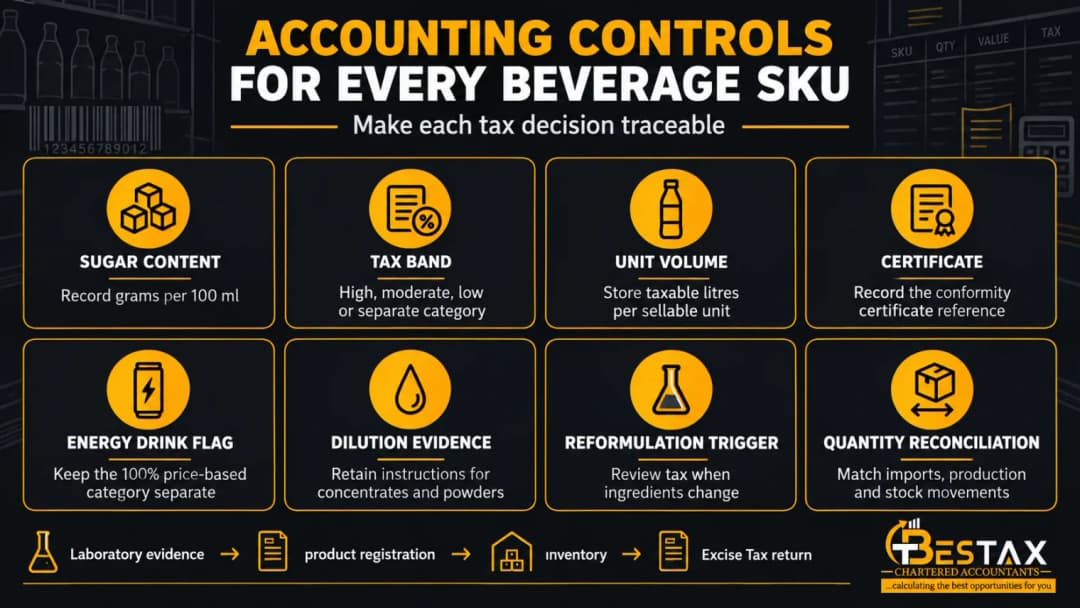
From an accounting perspective, I would not treat the 2026 sugar tax as a one line tax rate update. Each stock keeping unit needs tax attributes that can be audited later. The finance team should be able to trace a product from its laboratory evidence to the FTA registration and then to each return.
- Create a product master field for sugar and other sweeteners per 100 ml.
- Record the tax category and the approved conformity certificate reference for every sweetened drink.
- Store the taxable volume in litres for each sellable unit.
- Separate energy drinks from sweetened drinks because energy drinks remain under the 100 percent price based model.
- Create controls for reformulated products so an ingredient change triggers a fresh tax review and product update.
- For concentrates, retain the dilution instructions and the evidence used to determine the final drink category.
- Reconcile imports, production, stock movements and designated zone releases to the quantities reported to the FTA.
- Review invoices and pricing models so commercial teams understand the excise cost per unit before setting margins.
Common mistakes that can create a large Excise Tax exposure
- Using the nutrition label as the only evidence without the required conformity process.
- Applying AED 0 automatically because a product says zero sugar while ignoring other sweeteners, product formulation or registration evidence.
- Ignoring naturally occurring sugar when added sugar or another sweetener is also present.
- Putting an energy drink into the sweetened drink bands.
- Failing to update the FTA product record after reformulation or a change in ingredients.
- Using the concentrate volume instead of the final diluted drink where the rules require the final form.
- Assuming a restaurant drink exclusion also covers sealed retail bottles prepared for later sale.
- Leaving old default high sugar classifications unresolved after laboratory evidence becomes available.
Why compliance matters more in 2026
The FTA increased market inspection activity in the first half of 2026. It reported about 103,680 inspection visits, which was 21 percent higher than the same period of 2025. The Authority also reported 8.45 million non compliant excise products seized, including 1.87 million packages of other excise goods such as carbonated drinks, energy drinks and sweetened beverages. Tax dues and administrative penalties associated with seized non compliant goods exceeded AED 174 million.
Those figures cover Excise Tax enforcement broadly, not only sweetened drinks. The message for beverage businesses is still clear. Product classification and record quality are operational controls, not just year end tax paperwork.
Practical accountant view: the biggest commercial impact is reformulation
The new system creates a direct tax incentive to reduce sugar. A product that moves from 8 grams to 7.9 grams per 100 ml moves from AED 1.09 to AED 0.79 per litre. A qualifying product that moves below 5 grams can move to AED 0 per litre. For large beverage volumes, those small formulation changes can materially affect landed cost and margin.
However, reformulation should never be planned only by the tax team. Product quality, food regulation, labelling, customer expectations, manufacturing cost and the conformity certificate process all need to move together. The tax saving only works if the actual formula and the registered evidence support the new category.
Need help reviewing your sweetened drink Excise Tax position?
If your business imports, produces or stockpiles sweetened drinks in the UAE, Bestax can help you review registration, product classification, evidence, filings and FTA correspondence. Start with our Excise Tax registration service, get support with Excise Tax return filing and deductions, or speak with an FTA registered tax agent in Dubai. You can also contact Bestax Chartered Accountants for a review of your specific product and filing position.
Frequently asked questions about the UAE sugar tax
What is the UAE sugar tax in 2026?
The UAE sugar tax is the Excise Tax system applied to sweetened drinks. From 1 January 2026, the amount is based mainly on sugar and other sweetener content per 100 ml and the drink volume, instead of one flat percentage for sweetened drinks.
How much is Excise Tax on sweetened drinks in the UAE?
The high sugar category is AED 1.09 per litre for 8 grams or more per 100 ml. The moderate category is AED 0.79 per litre for 5 grams or more but less than 8 grams. The low sugar category is AED 0 per litre when the drink contains less than 5 grams and meets the category rules.
Is a drink with less than 5 grams of sugar per 100 ml tax free?
It can carry an Excise Tax amount of AED 0 per litre under the low sugar category. The business still needs to confirm that the product is correctly classified and that required registration and conformity evidence is in place.
Are zero sugar drinks subject to UAE Excise Tax?
A drink sweetened only with qualifying artificial sweeteners can have an excise amount of AED 0 per litre. The zero amount does not mean the business can ignore product registration or supporting evidence.
Do artificial sweeteners trigger the UAE sugar tax?
Artificial sweeteners alone can fall into the AED 0 per litre category. If the same drink also contains enough sugar or other sweeteners to reach 5 grams or more per 100 ml, the relevant positive sugar band can still apply.
Are energy drinks covered by the new tiered sugar tax?
No. Energy drinks remain a separate Excise Tax category and are subject to a 100 percent rate on the excise price. Their sugar content does not move them into the sweetened drink bands.
Are fruit juices subject to UAE sugar tax?
One hundred percent natural fruit or vegetable juice with no added sugar or other sweeteners is excluded from the sweetened drink definition. If sugar or another sweetener is added, the product needs a fresh classification review and its naturally occurring sugar can also count in the total.
Are milk drinks subject to the new sweetened drink excise tax?
A ready to drink beverage containing at least 75 percent milk can be excluded from the sweetened drink definition. Qualifying milk substitute drinks can also be excluded when the legal conditions are met.
Does naturally occurring sugar count when calculating UAE Excise Tax?
If a drink contains added sugar or another non artificial sweetener, naturally occurring sugar in the drink is counted in the total used for the sugar band. A drink that contains only naturally occurring sugar and no added sweetener can fall outside the sweetened drink definition.
How are beverage concentrates and powders taxed in the UAE?
The sugar level is generally tested using the final drink produced after dilution according to the producer instructions. If those instructions are missing or inaccurate, the FTA calculation mechanism and laboratory evidence become important.
Glossary
- Excise Tax: An indirect tax charged on specific goods identified by UAE law.
- Tiered volumetric model: A method where the tax amount changes according to a product category and the volume sold or released.
- Sweetened drink: A drink product with added sugar, artificial sweetener or another sweetener that falls within the legal definition.
- Taxable Person: A person or business that is registered, or required to register, for Excise Tax.
- Designated zone: A location approved for special Excise Tax treatment where goods can be held under specific controls before release.
- Conformity certificate: The required certificate supporting sugar and sweetener content for sweetened drink Excise Tax classification.
- Stockpiler: A person holding qualifying excise goods in business stock in circumstances where Excise Tax has not already been properly paid, relieved or deferred.
- EmaraTax: The Federal Tax Authority digital platform used for tax registrations, filings and other tax services.

Rina Siti Nabila holds a Bachelor’s degree in Accounting and is a certified tax consultant in the UAE. She has over five years of experience helping businesses manage their taxes and follow UAE tax rules.
Learn More About Rina