



As of 2026, UAE residents may be able to travel to selected destinations visa-free, with visa on arrival, or through a quick online authorisation. However, eligibility depends mainly on your passport nationality. Your valid UAE residence visa can support entry in some countries, but it does not replace your passport or guarantee visa-free access.
Your access depends on two things working together: your passport nationality and your valid UAE residence visa, and when both line up, you can plan a getaway on short notice without an embassy appointment in sight.
Below is a practical 2026 guide to popular destinations, entry types, stay limits, and the documents UAE residents should check before travelling.
Want a printable version? Click here to download the UAE Residents Travel Checklist, including passport rules, residency-based benefits, stay limits and pre-departure documents.
What “Visa-Free” Really Means for UAE Residents
Here’s the single most important thing to understand before you book anything: your UAE residence visa is not itself a travel document, and it does not replace your passport. Your passport nationality remains the primary key to entry, while your UAE residency often acts as a supporting factor that opens additional doors, or smooths the process at the border.
There are, broadly, three ways you’ll enter a country:
- Visa-free, you walk straight to passport control on a valid passport, no prior application needed.
- Visa on arrival (VoA), you fly without paperwork and obtain the visa when you land, usually for a small fee.
- eVisa / electronic travel authorisation (ETA), you apply online before you fly and receive approval by email; technically this is not visa-free, even though it’s quick.
A quick word on the Gulf: GCC nationals can enter the UAE without a visa using either their passport or national ID, and the same freedom of movement applies to Emirati citizens travelling across the GCC. For residents, GCC travel is simplified but still depends on profession and nationality, so always confirm before you go.
For UAE Passport Holders Only: Visa-Free Access in 2026
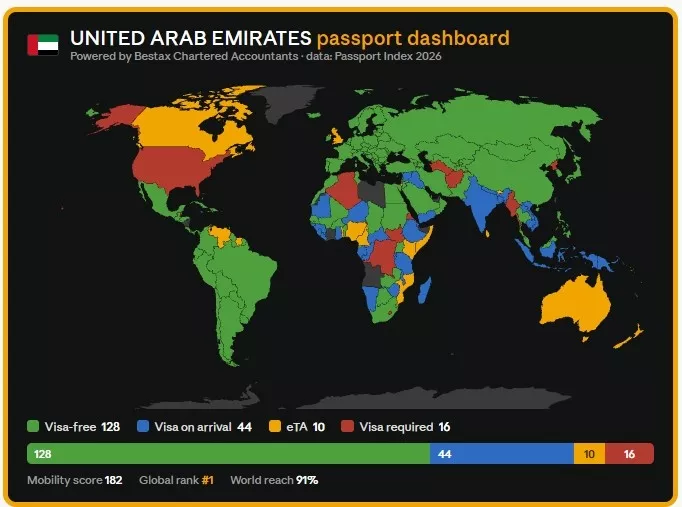
According to Passport Index, the UAE passport is ranked #1 globally in 2026, with a mobility score of 182. This includes 128 destinations with visa-free access, 44 destinations offering visa on arrival or eVisa, and 10 destinations requiring an electronic travel authorisation. These figures apply to UAE passport holders only, not all UAE residents. If you are a UAE resident with an Indian, Pakistani, Filipino, Bangladeshi, Egyptian, or another passport, your travel access will depend mainly on your passport nationality. The sections below separate UAE passport access from residency-based travel benefits so you can check the rules more accurately.
1. Completely Visa-Free Countries (128 Destinations)
These let you enter on a valid passport with no prior visa and no visa-on-arrival step. A representative selection of the most popular:
- Europe: Almost the entire continent is open, including all Schengen states (France, Germany, Italy, Spain, Greece, the Netherlands and more) for up to 90 days, plus the UK-adjacent and Balkan favourites Serbia, Montenegro, Bosnia and Herzegovina, Albania, and North Macedonia.
- Asia & the Caucasus: Armenia (180 days), Georgia (90 days), Azerbaijan, Kazakhstan, Uzbekistan, Kyrgyzstan (60 days), Tajikistan, Mongolia, China (30 days), Hong Kong, Macao, Japan, South Korea, Malaysia, and Brunei.
- Middle East & GCC: Saudi Arabia, Bahrain, Kuwait, Qatar and Oman (GCC entry on passport or ID), plus Jordan, Lebanon, Egypt (180 days), and Iran.
- Africa: Mauritius, Morocco, Tunisia, South Africa, Senegal, Botswana, Uganda, Zambia, The Gambia, and more.
- Americas & Caribbean: Brazil, Argentina, Chile, Colombia, Peru, Ecuador, Mexico (180 days), Costa Rica (180 days), plus Barbados, Bahamas, Grenada, Haiti, Jamaica, Trinidad and Tobago, Dominica, and St. Vincent and the Grenadines.
- Pacific: Fiji (120 days), Vanuatu (120 days), Solomon Islands, Kiribati, Micronesia, Tonga, and Nauru.
The downloadable checklist should be checked against the latest official immigration sources before travel, because visa-free counts and stay limits can change during the year.
2. Visa on Arrival or eVisa (44 Destinations)
These let you fly without prior paperwork and get a visa when you land, or via a fast online application. Popular options include:
- Maldives: Visa on arrival, 30 days.
- Nepal: Visa on arrival or eVisa, generous stay.
- Sri Lanka: eTA or visa on arrival, 30 days (now a free tourist ETA, see below).
- Indonesia: eVisa or visa on arrival, 30 days (Bali remains a favourite).
- India, Cambodia, Laos, Iraq, Bangladesh: eVisa or visa on arrival, 30 days.
- Kenya, Tanzania, Ethiopia, Rwanda, Madagascar and Zimbabwe: entry rules vary by nationality. Some require an eVisa or ETA before travel, while others may offer visa on arrival. Kenya should not be described as simple visa on arrival; travellers generally need an approved eTA before travelling.
3. Electronic Travel Authorisation / Tourist Registration: Apply Online First
These are not the same as visa-free entry. Some destinations require an online authorisation, eVisa, ETA, or tourist registration before travel. Examples include ETIAS for eligible Europe travellers from late 2026, Sri Lanka’s free tourist ETA for eligible nationalities, Kenya’s eTA system, and Seychelles tourist registration. Always apply only through the official government portal.
Disclaimer: Because travel policies update frequently, always check with your specific airline and the destination’s embassy before booking.
How Your Passport Nationality Changes the Picture
Two residents on the very same UAE residence visa can face completely different rules, because the passport in their pocket is different.
An Italian resident may breeze into the UK visa-free, while a resident from another country may need a full visa for the same trip. This is why I always tell clients to confirm their own passport rules first, then layer the UAE residency benefit on top.
A few practical notes that hold true across most destinations in 2026:
- Passport validity: Most countries want at least six months’ validity from your date of entry, with two to four blank pages.
- Emirates ID: Carry your physical, valid Emirates ID. It’s often requested to prove residency, especially for visa-on-arrival eligibility.
- Proof of onward travel and accommodation: Confirmed return tickets and hotel bookings are commonly checked.
- Funds and insurance: Some destinations (Seychelles and the Maldives among them) expect proof of funds or travel insurance.
Visa-Free Countries by Passport Nationality
Your UAE residence visa opens doors, but your passport decides how many. Here’s the reality every UAE resident needs to internalise before booking: a destination that’s visa-free for one expat may require a full embassy visa for the colleague sitting next to them. The lists below give a practical snapshot of popular visa-free, visa-on-arrival and ETA options for some of the UAE’s largest expat communities. (Figures combine visa-free, visa-on-arrival and ETA access, and reflect your home-country passport, not your UAE residency.)
Visa-Free Countries for UAE Residents with an Indian Passport
Indian passport holders have seen steady gains, with the passport climbing into the high-70s to around 80th on the Henley Passport Index across 2026 and access to roughly 55–56 destinations without a prior embassy visa. Indian nationals also tend to benefit most from layering UAE residency on top, since it can unlock simplified entry to places that would otherwise need a visa.
Popular options for Indian passport holders include:
- Visa-free: Barbados, Bhutan, Cook Islands, Fiji, Grenada, Haiti, Jamaica, Kazakhstan, Malaysia, Mauritius, Nepal, Philippines, Rwanda, Senegal, Thailand, Trinidad and Tobago, and several Caribbean islands.
- Visa on arrival: Cambodia, Indonesia, Jordan, Laos, Maldives, Myanmar, Qatar, Sri Lanka (now a free ETA), Tanzania, and others.
- Note: Recent bilateral deals extended longer visa-free windows in Thailand, Sri Lanka and Kazakhstan, and changed or simplified entry processes in Kenya and Rwanda for some travellers, but Kenya still generally requires an eTA before departure.
Visa-Free Countries for UAE Residents with a Pakistani Passport
The Pakistani passport sat around 97th–100th on the Henley Passport Index through 2026, with access to roughly 30 destinations via visa-free, visa-on-arrival or ETA routes. UAE residency is especially valuable here, because it can ease entry or eVisa eligibility for destinations a Pakistani passport alone cannot reach.
- Visa-free: Barbados, Cook Islands, Dominica, Haiti, Micronesia, Montserrat, Rwanda, St. Vincent and the Grenadines, The Gambia, Trinidad and Tobago, Vanuatu.
- Visa on arrival: Cambodia, Cape Verde, Comoros, Madagascar, Maldives, Nepal, Qatar, Samoa, Senegal, Sierra Leone, Timor-Leste, and others.
- ETA before travel: Kenya, Seychelles, Sri Lanka (now free).
Visa-Free Countries for UAE Residents with a Filipino Passport
The Philippine passport ranked around the high-60s to low-70s on the Henley Passport Index in 2026, with combined visa-free, visa-on-arrival and ETA access to roughly 65 destinations. Filipinos enjoy especially smooth travel across Southeast Asia.
- Visa-free: Brazil (90 days), Colombia (90 days), Costa Rica (90 days), Fiji, Hong Kong (14 days), Indonesia, Macao, Malaysia, Morocco (90 days), Peru (180 days), Rwanda, Singapore, and most ASEAN states.
- Visa on arrival: Bolivia, Cape Verde, Djibouti, Ethiopia, Maldives, Mauritius, Oman, Palau, and others.
- ETA before travel: Kenya, Seychelles, Sri Lanka, and (for some) Israel.
Visa-Free Countries for UAE Residents with a Bangladeshi Passport
The Bangladeshi passport ranked around 95th on the Henley Passport Index in 2026, with visa-free or visa-on-arrival access to roughly 36–37 destinations (Henley & Partners, 2026). Nepal is the standout, being the only fully visa-free Asian destination for Bangladeshi nationals.
- Visa-free: Barbados, Bahamas, Bhutan, Dominica, Fiji, Gambia, Grenada, Haiti, Jamaica, Kiribati, Micronesia, Montserrat, Nepal, Rwanda, St. Vincent and the Grenadines, Trinidad and Tobago, Vanuatu.
- Visa on arrival: Cambodia, Cape Verde, Comoros, Madagascar, Maldives, Mozambique, Seychelles, Sierra Leone, Somalia, Timor-Leste.
- ETA before travel: Kenya, Sri Lanka (now free).
Visa-Free Countries for UAE Residents with an Egyptian Passport
The Egyptian passport ranked around 93rd on the Henley Passport Index in 2026, with roughly 50+ destinations reachable without an embassy visa when visa-free, visa-on-arrival and eVisa options are combined.
- Visa-free: Barbados, Dominica, Haiti, Jordan (varies), Malaysia, Micronesia, St. Vincent and the Grenadines, and several Caribbean and Asian states.
- Visa on arrival: Bolivia, Cambodia, Comoros, Jordan, Madagascar, Maldives, Mauritania, Nepal, Seychelles, Somalia, Tanzania, Timor-Leste, Togo (now open to African nationals).
- eVisa / ETA: Kenya, Sri Lanka, and others.
Reminder: These lists are illustrative of popular destinations, not exhaustive, and visa policy shifts frequently. Always confirm your specific passport’s current rule on the destination’s official immigration portal before booking.
What’s New in 2026: Confirmed Policy Changes
Visa rules move fast, and a handful of 2026 changes directly affect UAE residents. Here are the confirmed ones worth knowing:
- Sri Lanka’s free tourist ETA now covers nationals of 40 countries. Effective 25 May 2026, eligible nationals, including UAE, India and Pakistan passport holders, can obtain a tourist ETA free of charge for 30 days. The ETA is still required before arrival and double entry is permitted within the 30-day validity period.
- Kazakhstan remains a popular short-trip option for many travellers from the UAE, but the permitted stay depends on passport nationality and current immigration rules. Check the latest Kazakhstan entry rules before booking.
- Saudi Arabia’s tourist eVisa process continues to be a popular option for eligible UAE residents and travellers from the UAE. Eligibility depends on nationality, residence status and the current Saudi eVisa rules, so applicants should confirm requirements on the official Saudi visa platform before applying.
- Europe’s ETIAS is scheduled to start in the last quarter of 2026. The EU’s new pre-travel authorisation (ETIAS) is scheduled to launch in the last quarter of 2026 for visa-exempt nationalities such as Emiratis. It is not a visa, but it will add a quick online step and a EUR 20 fee before travel. More on this below.
Stay Limits and the “90 Days in 180” Rule Explained
“Visa-free for 90 days” rarely means 90 days whenever you like. Most European-style allowances run on a 90/180 rolling window: you can spend a maximum of 90 days inside any rolling 180-day period, counting every day across multiple trips, not 90 days per visit. So if you spend 60 days in a Schengen-style zone in spring and return two months later, you only have 30 days left in that window.
Other destinations use simpler fixed limits, but they still depend on nationality. For example, some travellers may get up to 90 days in Georgia or Malaysia, the Maldives commonly grants 30 days on arrival, and Sri Lanka’s free ETA gives eligible nationals 30 days with double entry. The numbers vary, so check each one.
Why this matters: overstaying is treated seriously almost everywhere. Consequences range from fines and deportation to multi-year entry bans that can wreck future travel and even visa applications elsewhere. A few practical habits prevent trouble, note your exact entry stamp date, count days conservatively, build in a buffer before your limit, and apply for an extension through the destination’s immigration department before your stay expires rather than after.
How to Apply: eVisa and Visa-on-Arrival, Step by Step
“Visa on arrival” and “eVisa” sound effortless, and mostly they are but each has a process. Here’s how the most popular ones actually work for UAE residents in 2026.
- Azerbaijan / ASAN eVisa: Azerbaijan’s official ASAN Visa system issues a single-entry eVisa that is valid for 90 days and allows a stay of up to 30 days. The state fee is USD 20, plus a USD 9 service fee charged by the official portal. Standard eVisa processing usually takes up to three working days, while urgent applications can be processed within three hours for a higher fee. To apply, visit the official ASAN Visa portal, complete the form with your passport and travel details, pay online, and download the approved eVisa once it is issued.
- Your passport must be valid for at least three months beyond the eVisa expiry date. Some UAE residents with a residence permit valid for more than six months may qualify for visa on arrival, but this depends on current eligibility rules and should be confirmed before travel. If you want the safer option, apply for the ASAN eVisa before flying.
- Sri Lanka (free tourist ETA). Apply online before you fly at the official portal, eta.gov.lk, and only there, since unofficial sites still charge for what is now free for eligible nationalities. Select “Tourist,” enter your passport and travel details, and submit; for the 40 eligible countries (including the UAE, India and Pakistan) there is no fee. Approval typically arrives quickly by email; print or save it to show on arrival. The ETA gives 30 days with double entry, and extensions are available for a fee through Sri Lanka’s Department of Immigration.
- Maldives (free visa on arrival). No advance application. Arrive with a passport valid for your stay, a confirmed return or onward ticket, proof of accommodation, and sufficient funds; a 30-day permit is stamped on arrival for most nationalities.
- Jordan and Nepal (visa on arrival). Both issue visas at the airport, Jordan at its main entry points, Nepal at Tribhuvan International Airport in Kathmandu. Carry a passport-sized photo, the fee in an accepted currency, and your onward-travel and accommodation details to speed things up.
General VoA/eVisa checklist: valid passport (usually six months), a return or onward ticket, accommodation proof, proof of funds, the fee (card or cash depending on the country), and any photos required. Apply for eVisas a few days ahead, and always use the official government domain.
Can UAE Residents Travel to Europe Visa-Free? The Schengen Reality
This is the single biggest misconception I correct for clients, so let’s be clear: for most UAE residents, your residency does not grant visa-free entry to the Schengen Area. Whether you need a Schengen visa depends on your passport, not where you live.
UAE nationals (Emirati passport holders) do enjoy visa-free access to the Schengen countries for short stays. But the large majority of UAE residents, those holding Indian, Pakistani, Filipino, Bangladeshi or Egyptian passports, still need to apply for a Schengen visa through the relevant consulate or visa centre in the UAE, exactly as before.
The good news is that you can apply from the UAE on a valid residence visa, regardless of your nationality, and UAE residency often strengthens your application by showing stable ties and finances.
There’s a 2026 wrinkle to plan for. The EU’s ETIAS pre-travel authorisation is scheduled to launch in the last quarter of 2026. ETIAS is not a visa, it’s a quick online pre-screening (similar to the US ESTA), valid for up to three years, that visa-exempt nationalities like Emiratis will need before Schengen trips. Crucially, if your passport already requires a Schengen visa, ETIAS does not apply to you; you simply keep applying for the visa as normal. Either way, the EU’s official site (europa.eu/etias) is the only place to apply once it goes live, beware of look-alike sites.
If a Schengen visa from the UAE feels daunting, the team at Bestax can help you prepare a strong application and keep your UAE residency in order so nothing stalls your travel plans.
The Golden Visa Advantage
If you travel frequently, the type of UAE residency you hold matters more than people realise. The UAE Golden Visa, a long-term residence permit valid for 5 or 10 years, lets holders stay outside the UAE for longer than the usual six-month window without losing their residency, which is a meaningful advantage for anyone managing a globally mobile lifestyle. It also removes the need for a local sponsor and supports family sponsorship.
At Bestax, we handle end-to-end Golden Visa applications, eligibility checks, documentation and submission through official channels, alongside standard residence visa processing. If your travel plans hinge on keeping your residency rock-solid, that’s worth getting right from the start.
Talk to the Bestax team about your UAE residency or Golden Visa
Frequently Asked Questions
How many countries are visa-free for UAE passport holders?
The UAE passport is ranked #1 in the world in 2026, with access to 182 destinations, 128 completely visa-free, 44 with visa on arrival or eVisa, and 10 with an eTA. For UAE residents on an expatriate passport, the number depends on your own nationality combined with your residence visa.
Which countries are visa-free for UAE residents in 2026?
Popular destinations may include Georgia, Armenia, Azerbaijan, Kazakhstan, Uzbekistan, Malaysia, Mauritius, Seychelles, Montenegro, Serbia, Japan, South Korea, Brazil and European countries, but access depends on your passport nationality. Seychelles requires tourist registration, and Schengen visa-free access applies only if your passport is visa-exempt.
Can I travel abroad using only an Emirates ID?
No. Your Emirates ID proves you live in the UAE, but it is not a travel document outside the country. You always need a valid passport. The Emirates ID is, however, frequently requested at borders to confirm residency for visa-on-arrival eligibility.
Does a UAE residence visa replace a travel visa?
No. It does not automatically grant entry anywhere. It can make you eligible for visa-free or simplified entry in certain countries and is viewed favourably by consulates, but your passport remains the deciding factor.
What is the difference between visa-free, visa on arrival, and eTA?
Visa-free means no application at all, straight to passport control. Visa on arrival means you obtain the visa at a counter on landing, usually for a fee. An eTA or eVisa is applied for online before departure and is not technically visa-free.
How long can UAE residents stay in visa-free countries?
It varies. Many European destinations allow 90 days within any 180-day rolling period; Armenia allows 180 days, Georgia and Malaysia 90, the Maldives 30 on arrival, and Sri Lanka’s free ETA 30 days with double entry. Always confirm the permitted stay and never overstay.
Do I need travel insurance to enter visa-free countries?
It’s not mandatory everywhere, but some destinations, such as Seychelles and the Maldives, expect it, and Georgia may check at the border. Even where it isn’t required, travel insurance is strongly recommended for every trip.
Is ICA or GDRFA approval required before I travel?
No. The mandatory pre-travel ICA/GDRFA approval introduced during the pandemic has been lifted. Just ensure your residence visa and Emirates ID are valid before you fly.
Which documents should UAE residents carry for visa-free travel?
A passport valid at least six months, your physical Emirates ID and valid residence visa, a confirmed return or onward ticket, proof of accommodation, evidence of sufficient funds, and travel insurance. Some countries also require vaccination certificates such as Yellow Fever.
Do UAE residents get visa-free entry to GCC countries?
UAE citizens enjoy visa-free movement across the GCC and can enter on a passport or national ID. UAE residents typically get simplified or on-arrival processes, but eligibility depends on profession and nationality, so verify before booking.
Can Golden Visa holders travel to more countries visa-free?
The Golden Visa is a UAE residency, not a passport, so it doesn’t directly expand visa-free access the way a stronger passport would. Its travel advantage is stability: holders can stay outside the UAE for extended periods without losing residency.
Can UAE residents travel to Europe without a visa?
Only if your passport itself is visa-exempt for Schengen (as the Emirati passport is). Most expatriate residents still need a Schengen visa, which can be applied for from the UAE on a valid residence visa.
Where can I download the full list of visa-free countries for UAE residents?
You can download the complete printable checklist here, covering all 182 destinations by entry type with stay limits, the 2026 policy changes, nationality breakdowns, and a pre-departure document list.
Disclaimer: The information provided in this blog is for general informational purposes only. For professional assistance and advice, please contact experts.
