



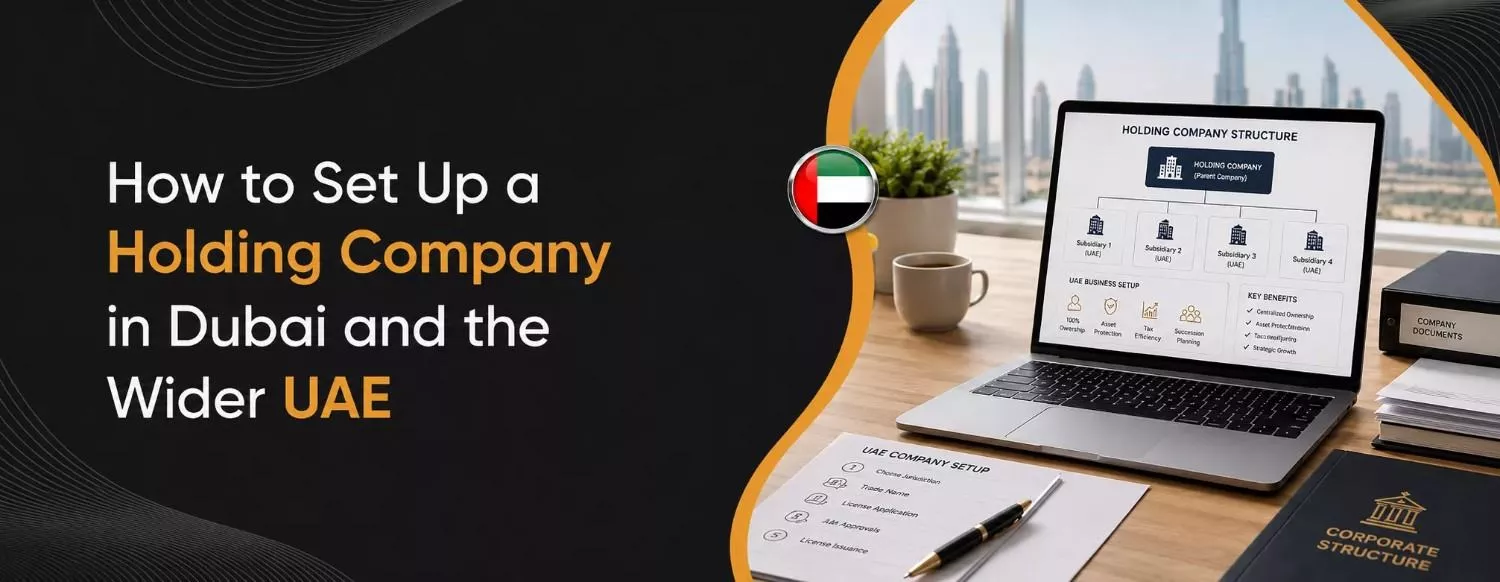
To set up a holding company in Dubai you register a company whose only job is to own and control other companies and assets, then place your shares, property or intellectual property inside it.
You can do this in a free zone, on the mainland, inside a financial centre like the DIFC, or through an offshore vehicle, and most owners complete the licence in a matter of days.
What Is a Holding Company? Meaning and Purpose
A holding company is a business that exists to own things rather than to trade. It does not sell products or deliver services to customers. Instead, it holds shares in other companies, along with assets such as property, trademarks, patents and investments.
So the meaning of a holding company is simple: it is a parent entity that sits on top of your other businesses and owns them. The businesses it owns are called subsidiaries. The holding company controls each subsidiary by owning a majority or all of its shares.
Here is the core idea in one line. A holding company holds ownership; its subsidiaries do the actual work of trading, manufacturing or providing services.
The UAE Ministry of Economy and Tourism formally recognises the holding company as one of the legal forms a business can take, alongside the limited liability company and the public joint stock company. So this is a mainstream, officially supported structure, not a workaround.
As for what such a company is used for, the honest answer is that it is a container. It is where careful owners place valuable things so those things are organised, protected and easy to pass on.
Holding and Subsidiary Company: How the Relationship Works
Once you understand the link between the parent and its subsidiaries, everything else about the structure makes sense.
Think of it as a simple family tree:
- At the top sits the holding company (the parent). It owns the shares.
- Below it sit the subsidiaries (the children). Each one is a separate legal company with its own licence, its own bank account and its own liabilities.
- The parent controls each child by owning more than 50 percent of its shares, and usually 100 percent.
The most important feature is separation. Each subsidiary is legally distinct. If one subsidiary runs into debt or a lawsuit, that problem is generally contained inside that subsidiary and does not automatically reach the parent or the other subsidiaries.
A quick example makes it clear. Imagine you own a restaurant business, a property portfolio and an online store. Instead of holding all three personally, you create one holding company that owns three subsidiaries, one for each activity. If the restaurant is sued, your property and your online store, held in separate subsidiaries, are shielded from that claim.
That is the quiet power of a well built parent and subsidiary arrangement: a legal firewall between your different interests.
Advantages of a Holding Company in the UAE
These benefits are what make the structure so popular with investors, family businesses and international groups operating here. Holding companies in Dubai are set up for a handful of clear, practical reasons, and these are the ones our clients act on most.
- Asset protection. Valuable assets sit in the parent while risk sits in the trading subsidiaries. A problem in one part of your group does not sink the whole thing.
- Cleaner ownership of multiple businesses. One parent owns several companies, so bringing in investors, selling one business or restructuring becomes far simpler. You sell or transfer shares in a subsidiary rather than untangling assets one by one.
- Efficient tax treatment on dividends and gains. Under the UAE participation exemption, dividends and capital gains a parent receives from qualifying shareholdings can be exempt from corporate tax (Federal Tax Authority, 2023). We explain this in full in the tax section below.
- Easier succession and estate planning. Passing a business to the next generation becomes a matter of transferring shares in one entity, which is cleaner than dividing individual assets.
- Central control with local separation. You steer strategy, cash and governance from the top while each business keeps its own identity, staff and licence.
- Confidentiality and consolidation. Group accounts give you one clear view of performance across every business you own, which banks and investors value.
Because these benefits stack on top of the UAE’s wider draw, the country keeps attracting global capital. Foreign direct investment into the UAE reached USD 45.6 billion in 2024, a rise of 48.7 percent on the year before. A large share of that money is organised through exactly the kind of ownership vehicles described here.
Where to Register: Mainland, Free Zone, DIFC and Offshore
Deciding where to register is the first real choice when setting up a holding company in Dubai, because it shapes your ownership, your costs and where your holding company can operate. There are more than 40 free zones in the UAE, plus the mainland and specialist financial centres, so the options can feel overwhelming . Here is how the main routes compare.
| Route | Foreign ownership | Best suited to | Trading inside the UAE |
|---|---|---|---|
| Mainland | 100 percent for most activities | Groups that also want operating businesses with open UAE market access | Yes |
| Free zone | 100 percent | Owning shares and assets, international groups, cost efficiency | Inside the zone and abroad; mainland access needs approvals |
| DIFC | 100 percent | Financial groups, family offices, international structures | Within DIFC and internationally |
| Offshore | 100 percent | Pure holding of shares, property and IP with no UAE trading | No |
A few plain warnings from experience:
- A free zone holding company gives you full foreign ownership and a simple, low cost licence. It is the most common choice for owning shares and assets.
- An offshore holding company is the leanest option for holding assets with no local trading, but its banking choices are narrower and it still must meet UAE substance and ownership rules.
- The mainland suits you when the group also runs businesses that sell directly across the UAE market.
We cover each route in depth on our offshore company setup and business setup pages.
DIFC Holding Company: The Premium Option
The Dubai International Financial Centre, known as the DIFC, is a financial free zone with its own independent legal system based on English common law, its own courts and its own companies registrar. For many international investors, this is the gold standard.
Why owners choose the DIFC:
- A globally respected common law framework that international banks, funds and partners understand instantly.
- 100 percent foreign ownership with no local shareholder required.
- Purpose built vehicles such as special purpose companies and prescribed companies that are designed for holding shares, assets and family wealth.
- A prestigious address that lends credibility to family offices and cross border groups.
The trade off is cost. A holding company DIFC structure generally carries higher setup and running costs than a standard free zone, so it suits larger or more sophisticated groups rather than a first time entrepreneur holding a single small business. Weigh the holding company DIFC option against a standard free zone before you commit, and the right answer for your group usually becomes clear. You can learn more directly from the authority at difc.ae.
Choosing Your Holding Company Structure in Dubai
Once you have picked a jurisdiction, you choose the legal wrapper. Getting the holding company structure in Dubai right matters, because it decides your liability, your ownership flexibility and how banks see you.
The most common wrapper is a limited liability company. An LLC holding company structure means your personal liability is limited to what you put into the company, and the parent simply holds shares in its subsidiaries. This is the workhorse setup for most groups because it is flexible, well understood and accepted everywhere.
The main structures used for holding companies are:
- Limited Liability Company (LLC) or free zone equivalent (FZ LLC, FZE, FZCO). The default. Liability is capped, ownership is flexible, and it can hold shares in as many subsidiaries as you like.
- Special Purpose Company or Prescribed Company (in DIFC and similar centres). Lightweight vehicles built specifically to hold assets or shares, often used inside a larger group.
- Offshore company. Used purely to hold shares, property and intellectual property where no UAE trading takes place.
A sound structure also plans for the future from the start. We ask four questions before anything is filed: who owns it, who is liable, what will it own, and how will profits flow out. Converting a structure later costs far more than choosing correctly now, which is why the parent is usually mapped against your tax position before the name is even reserved.
Calculate Your Setup Cost (via our UAE business setup cost calculator)
How to Set Up a Holding Company in Dubai: Step by Step
This is the part everyone wants: the actual process. Below is exactly how to set up a holding company in Dubai, in plain steps. The UAE has made this fast. A company can be licensed in about four days through a Department of Economic Development, and in as little as 15 minutes through the federal Basher online platform, compared with around 10 days on average in high income countries .
Here is the path we run for holding company formation in Dubai:
- Define the purpose. Decide what the holding company will own: shares in subsidiaries, property, intellectual property or investments. This shapes every later choice.
- Choose the jurisdiction. Mainland, a free zone, the DIFC or offshore, using the comparison above.
- Select the legal structure. Usually an LLC or its free zone equivalent, matched to your tax and banking needs.
- Reserve the trade name. The name must be unique and follow UAE naming rules. Pre approval is often possible within 24 hours.
- Get initial approval. This is the government’s no objection to your business being formed. It is not yet permission to operate.
- Prepare and sign the documents. The Memorandum of Association sets out ownership and governance. Corporate shareholders need attested parent company documents.
- Secure a registered address. Mainland companies need a tenancy contract registered on Ejari; free zones offer flexi desk and office options inside the zone.
- Receive the licence. Once approvals and fees clear, the trade licence is issued and your holding company legally exists.
- Activate the company. Open a corporate bank account, register for corporate tax, and add visas if needed.
That is the full journey of setting up a holding company in Dubai. Steps overlap in practice, so the calendar is usually shorter than the list looks. The one step that takes longest for everyone is opening the corporate bank account, which is why we prepare your compliance file properly the first time.
Holding Company Registration in Dubai: Documents and Costs
Most delays are document delays, so bring the right paperwork and the process runs clean. For holding company registration in Dubai you will typically need:
If the shareholders are individuals:
- Passport copies, valid for at least six months
- Passport size photographs
- Proof of address for each shareholder
- A short business plan explaining what the holding company will own
- UAE visa or entry stamp copy, if you are in the country
If a shareholder is a company:
- Attested certificate of incorporation of the parent
- The parent’s Memorandum and Articles of Association
- A board resolution approving the new holding company
- Certificate of good standing
- Passport copies of directors and ultimate beneficial owners
What it costs and how long it takes
Through Bestax, an offshore holding company starts from AED 5,500 and a free zone company from AED 6,000, while a mainland setup starts from AED 14,000. The final figure depends on your route, visas and any special approvals, so we quote the complete number in writing before you commit.
On timing, trade name pre approval can arrive within 24 hours, and most licences are issued within 3 to 10 business days once your documents are complete. The completed registration is only the beginning; the real value comes from setting up the tax and compliance side correctly, which is covered next.
How UAE Corporate Tax Treats a Dubai Holding Company
This is where an accountant earns their fee, so read this section closely. Since June 2023 the UAE has a federal corporate tax, and it changes how you should think about any holding company based here.
The headline rates are straightforward:
- 0 percent on taxable income up to AED 375,000.
- 9 percent on taxable income above AED 375,000.
- 0 percent on qualifying income for a qualifying free zone company that meets strict conditions.
These rates come from Federal Decree Law No. 47 of 2022 (Ministry of Finance, 2022) and are administered by the Federal Tax Authority .
The participation exemption: the reason holding companies love the UAE
Here is the rule that makes the UAE so attractive for holding structures. Under the participation exemption in Article 23 of the corporate tax law, dividends and capital gains that a parent receives from a qualifying shareholding can be completely exempt from the 9 percent tax.
In plain English, if your holding company owns a qualifying stake in a subsidiary, the profits that subsidiary sends up to the parent as dividends, and the gain if you later sell that subsidiary, can be tax free.
To qualify as a participating interest, the main conditions are:
- The parent holds at least 5 percent of the subsidiary, or an ownership stake that cost more than AED 4 million.
- The stake is held, or intended to be held, for at least 12 months.
- The subsidiary is subject to tax at a rate of at least 9 percent in its home country.
- Not more than half of the subsidiary’s assets are the kind that would not qualify if held directly.
Dividends a UAE company receives from another UAE company are generally exempt as well. The detailed rules were updated by Ministerial Decision No. 302 of 2024, which applies to tax periods starting on or after 1 January 2025.
This is why holding structures thrive here. Structured properly, money moves up from your operating businesses to your parent with little or no tax friction.
Tax grouping and VAT
Two more points every owner should know:
- Tax grouping. A UAE parent that owns at least 95 percent of its UAE resident subsidiaries can form a single tax group and file one combined return, offsetting profits and losses across the group. Qualifying free zone companies cannot join a tax group.
- VAT. A pure holding company that only holds shares often has no VAT to charge. But VAT registration becomes mandatory once taxable supplies pass AED 375,000 in a 12 month period, with voluntary registration available from AED 187,500 .
Our corporate tax registration and tax consultant teams handle all of this, so your group stays compliant and tax efficient.
Ongoing Compliance: What a Holding Company Must Do Every Year
Setting up is one thing; staying compliant is what protects the benefits. Even a holding company that does not trade has real obligations.
- Corporate tax registration. Every UAE company must register for corporate tax, including holding companies expecting to pay nothing. Late registration carries an AED 10,000 penalty.
- Accounting records. UAE law requires proper books from your first transaction, kept for at least 7 years.
- Audited financial statements. Many free zone and group structures must prepare audited accounts each year, and audited statements are a condition of the free zone 0 percent rate.
- Ultimate Beneficial Owner (UBO) filings. You must disclose the real human owners behind the company.
None of these are difficult when handled from the start. They become expensive only when ignored. Our bookkeeping and accounting teams keep the records that every one of these obligations depends on.
Common Mistakes to Avoid

These are the errors we fix most often when new clients bring us a structure someone else set up.
- Choosing the jurisdiction before the tax plan. The zone and structure you pick decide your corporate tax outcome. Deciding on price alone is the most expensive mistake of all.
- Assuming a holding company owes no tax. It still must register for corporate tax, keep records and file, even when the answer is zero.
- Missing the participation exemption conditions. The exemption is generous but conditional. Get the ownership percentage, holding period or subject to tax test wrong and the relief can be lost.
- Treating intercompany dealings casually. Loans, management fees and charges between your parent and subsidiaries must be priced at market value and documented, or the tax authority can adjust them.
- Ignoring substance and UBO rules. A company that exists only on paper, with no records or real activity, is exactly what modern rules are designed to catch.
Avoiding all five comes down to the same thing: build the structure with an accountant who also handles the tax, not a licence seller who disappears after issuing the trade licence.
Why Set Up Your Holding Company with Bestax
Holding companies in Dubai reward careful structuring, and that is precisely what a chartered accountancy firm is built to give you. Here is what working with Bestax means.
- Accountants first. Your structure is designed around your tax outcome and banking reality, not around whichever zone pays the best commission.
- One written quote. Government fees and our fee, listed in full before you pay anything. The number you approve is the number you pay.
- FTA registered and verifiable. We are an FTA registered tax agency with published credentials: Tax Agency Approval Number 30008692 and Tax Agent Number 20052643.
- One team after setup. Company formation, accounting, VAT, corporate tax and audit under one roof, so you never have to explain your business twice to a new provider.
What a client says:
Zoran Bojovic, 5 stars, April 2026: “My company Uktra Dex Trading is with Bestax Chartered Accountants for bookkeeping and they arranged also all for opening of my company in Dubai.”
Frequently Asked Questions
What is a holding company in simple words?
In plain terms, the holding company meaning is a business that owns other businesses and assets rather than trading itself. It holds the shares of its subsidiaries and controls them, while the subsidiaries do the actual work of selling products or services. Think of it as a parent that owns a group of children companies.
What is the difference between a holding and subsidiary company?
The holding company is the parent that owns the shares. The subsidiary is the company being owned and controlled. One holding company can own many subsidiaries, and each subsidiary stays a separate legal entity with its own licence and its own liabilities.
How do I set up a holding company in Dubai?
You define what it will own, choose a jurisdiction such as a free zone or the DIFC, pick a legal structure like an LLC, reserve a trade name, get initial approval, sign the documents, secure a registered address, and receive your licence. A specialist like Bestax can complete most of the process for you, often within days.
How much does holding company setup in Dubai cost?
Through Bestax, an offshore holding company starts from AED 5,500 and a free zone company from AED 6,000, while a mainland structure starts from AED 14,000. The final cost depends on your chosen route, the number of visas and any special approvals, which is why we give you one written quote before you commit.
Do holding companies pay tax in the UAE?
A holding company must register for corporate tax, but it often pays little or none. Dividends and capital gains from qualifying shareholdings can be exempt under the participation exemption, and income up to AED 375,000 is taxed at 0 percent. Above that threshold the rate is 9 percent.
What are the main advantages of a holding company?
The main advantages are asset protection, cleaner ownership of several businesses, efficient tax treatment on dividends and gains, easier succession planning, and central control over a group. In short, it organises and protects everything you own in one clean structure.
Can a foreigner own 100 percent of a Dubai holding company?
Yes. Free zone, DIFC and offshore holding companies allow full foreign ownership, and most mainland activities now permit 100 percent foreign ownership as well. You do not need a local partner for a standard holding structure.
What is a DIFC holding company and who is it for?
It is a company set up inside the Dubai International Financial Centre, a financial free zone that runs on English common law with its own courts and registrar. It suits financial groups, family offices and international structures that value a globally recognised legal framework, and it typically costs more than a standard free zone.
How long does holding company formation in Dubai take?
Trade name pre approval can come within 24 hours, and most licences are issued within 3 to 10 business days once documents are complete. Government platforms have made this fast, with some UAE company licences issued in about four days, and in minutes through the Basher online platform.
What is the best structure for a holding company in Dubai?
For most owners, an LLC holding company structure or its free zone equivalent is the best choice because liability is limited and ownership is flexible. Larger or international groups often prefer a DIFC vehicle. The right answer depends on what you own and how profits should flow, which is exactly what we map out in a free consultation.
Does a holding company need to file audited accounts?
Often yes. Many free zone and group structures must prepare audited financial statements each year, and audited accounts are a condition of the free zone 0 percent corporate tax rate. Every company must also keep proper accounting records for at least 7 years.
Can a holding company and its subsidiaries be taxed as one group?
Yes, in many cases. A UAE parent that owns at least 95 percent of its UAE resident subsidiaries can form a tax group and file a single combined corporate tax return, offsetting profits and losses across the group. Qualifying free zone companies cannot be part of a tax group.
Disclaimer: The information provided in this blog is for general informational purposes only. For professional assistance and advice, please contact experts.
