



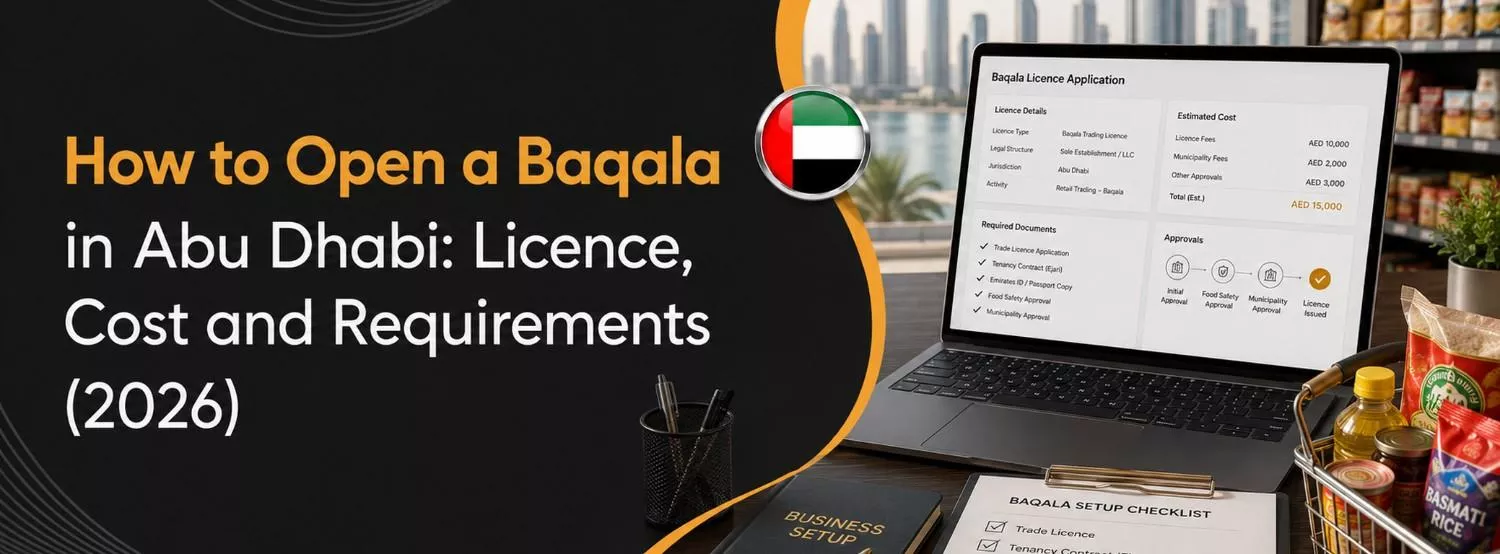
To open a Baqala in Abu Dhabi you need a commercial trade licence from the Abu Dhabi Department of Economic Development (ADDED), plus food-safety approval from the Abu Dhabi Agriculture and Food Safety Authority (ADAFSA) and a store fit-out that meets the mandatory Project Baqala standards. Get those three things right and the rest of the build is mostly admin.
This guide walks you through the Baqala Abu Dhabi setup process for 2026, the licence, the realistic cost, the documents, the food-safety rules, and the practical advice that keeps a new grocery store alive past its first year.
Quick checklist to open your baqala
- Confirm activity classification and legal structure with ADDED.
- Reserve a trade name that includes “Baqala” per Project Baqala branding.
- Lease and register a compliant, high-footfall location (5,000 mm spacing rule).
- Fit out to Project Baqala specs (non-wood fixtures, signage, pest control).
- Pass ADAFSA / HACCP food-safety approval; obtain food-handler certificates.
- Install a certified POS for physical invoices; price-tag every item.
- Assess VAT registration against the AED 375,000 threshold.
- Stock up, keep 6–9 months of working capital, and launch.
What does “Baqala” mean?
“Baqala” (بقالة) is the Arabic word for a small neighbourhood grocery store, the corner shop that sells bread, milk, eggs, snacks, beverages, basic toiletries and household essentials. The word is rooted in older Arabic usage tied to selling provisions and produce, which is why a baqala grocery has always been associated with everyday staples rather than a full supermarket shop.
In Abu Dhabi, though, “baqala” is not just a casual term. It is a regulated retail category. Since the launch of Project Baqala in 2013, every qualifying small grocery store in the emirate operates under a unified brand, layout and food-safety framework set by the food-safety regulator. So when people search for the baqala meaning in an Abu Dhabi context, the honest answer is: a small grocery store and a government-standardised retail format with specific rules attached.
Why open a baqala in Abu Dhabi?
The appeal of an Abu Dhabi baqala is simple: it sells things people need every single day, it sits inside the community it serves, and it earns from repeat, walking-distance demand rather than one-off shoppers. Demand is steady because groceries are non-seasonal, and the format is lighter to run than a restaurant or supermarket, with a smaller footprint, smaller team, simpler inventory.
It is also a relatively standardised path to launch. Because ADAFSA’s Project Baqala framework sets clear, uniform rules for store design and operation, a compliant operator competes on a more level playing field than in an unregulated market. That predictability is genuinely useful for a first-time owner.
That said, “steady demand” is not the same as “guaranteed profit.” The economics live or die on location and cash-flow planning, which we’ll come back to in the expert section below.
Step-by-Step Process to Open a Baqala in Abu Dhabi
Step 1: Choose your business activity and legal structure
Your first real decision is the licence itself. A baqala is licensed as a retail grocery/foodstuff trading activity under an economic licence issued by ADDED. ADDED issues several licence types, and most baqala operators fall under the Standard Licence, which permits practising a business in the Emirate of Abu Dhabi and accommodates all legal forms of business through traditional establishment procedures.
You will also need to settle your legal structure, typically a sole establishment or a Limited Liability Company (LLC). Ownership rules and equity requirements shift over time and depend on the exact activity classification, so this is an area to confirm against current ADDED rules (or with a licensed consultant) rather than assume from an older guide.
A baqala in Abu Dhabi is licensed by ADDED as a retail grocery activity, usually under a Standard Licence, in a sole establishment or LLC structure.
Step 2: Reserve your trade name (the “Baqala” branding rule)
Here’s a rule that trips people up. Under the Baqala signage rules, the storefront sign must display the Baqala brand/classification prominently, while the business name appears separately in Arabic and English according to the approved signboard layout. The manual describes the business name as the trade name excluding trade classifications such as grocery, foodstuff, supermarket or store, so the signage format should be checked before reserving and designing the name.
This unified branding is mandatory across outlets in the programme, and deviating from the approved naming and signage format creates a compliance problem during inspection.
So “Green Valley Baqala” works; a fully personalised brand that drops the “Baqala” identifier does not. Reserve your trade name with ADDED with this rule already baked in, so your signage, licence and trademark all match from day one.
Step 3: Secure a compliant location
This is the decision that matters most, and it has both a regulatory side and a commercial side.
On the regulatory side, ADAFSA’s rules include a minimum distance requirement between grocery outlets, the premises must satisfy the Baqala location rules, including the 5,000mm door-to-door spacing requirement from other retail establishments or activities that may create food-safety risks, such as barber shops, auto repair shops, industrial plants and carpentry shops. Your premises also has to pass municipality location approval and meet layout, ventilation and storage expectations before it can be signed off.
On the commercial side, location is the single biggest driver of success, and the single most common reason baqalas fail. More on that from our expert below.
Step 4: Fit out the store to Project Baqala specifications
Once the lease is registered, you build to spec. The fit-out is inspected against specific physical standards, and building blind almost always means refitting later. The key requirements under Project Baqala include:
- Non-wood fixtures. All internal shelving and counters must be made of non-wood materials (metal or food-grade polymer). Wooden shelving is prohibited.
- Standardised design and signage. Store colours, signage and layout must follow the approved Project Baqala specifications.
- Pest control. A certified pest-control system and service agreement is mandatory.
- Food-safety-ready layout. Proper refrigeration, separation of raw and ready-to-eat products, accessible handwashing, and clean, maintainable surfaces.
Skipping any of these doesn’t just risk a fine, it can hold up your licence, because a failed inspection has to be remediated before final sign-off.
Step 5: Pass ADAFSA food-safety approval (HACCP)
Because a baqala handles food, it must comply with the Hazard Analysis and Critical Control Point (HACCP) food-safety system. ADAFSA inspectors assess food storage, temperature control, product handling and hygiene against HACCP principles, andfood handlers must be trained, demonstrate food-safety and hygiene knowledge, and obtain the official food-safety training certification required for their role.
Budget for those certificates during your pre-opening period, and treat compliance as an ongoing duty, not a one-time gate, a food-safety stop-order can shut a store overnight.
Step 6: Install a compliant invoicing (POS) system and price tags
Two operational rules are easy to overlook and routinely inspected. Each checkout must have an electric cash register or POS setup capable of producing printed customer receipts with the required transaction details. Product and service prices must also be displayed clearly and accurately, including unit prices where products are sold by weight, volume or measure. Price tagging is not optional.
Step 7: Register for VAT (only if you cross the threshold)
This is where official tax rules matter, and where a lot of misinformation circulates. Under the Federal Tax Authority, VAT registration is mandatory once your taxable supplies and imports exceed AED 375,000 over the previous 12 months (or are expected to in the next 30 days). You may register voluntarily if you exceed AED 187,500. The standard VAT rate in the UAE is 5%.
For many single-location baqalas, turnover sits below the mandatory threshold in year one, but you must track your rolling 12-month turnover continuously, because crossing the line triggers a 30-day registration window. Getting this assessment right early avoids penalties later.
How much does it cost to open a baqala in Abu Dhabi?
There is no single fixed price, your total depends heavily on location (rent is usually the biggest line), store size, fit-out finish and opening stock. Rather than repeat unofficial figures, the honest framing is this: your cost is the sum of the licence and government fees, your registered lease, a Project-Baqala-compliant fit-out, refrigeration and shelving, opening inventory, your POS system, food-handler certificates, and several months of working capital.
The one number that is official and worth planning around is the VAT threshold (AED 375,000 mandatory; AED 187,500 voluntary) from the FTA, because it determines whether you’re collecting and remitting 5% VAT from launch or not. For a location-specific cost estimate built on current Abu Dhabi rents and fees, speak to a setup specialist before you sign a lease.
Expert insight: the two mistakes that sink new baqalas
We put two questions to a UAE tax and compliance specialist, Haseeb Hamdani, an FTA-approved tax agent, about what really separates a baqala that survives from one that doesn’t.
On the biggest mistake people make:
“Choosing location on low rent instead of footfall. A baqala lives entirely on captive, repeat, walking-distance demand. The cheap unit on a quiet street, with no labour accommodation, no dense residential cluster, and three competitors already within 300 metres, is cheap for a reason.”
In other words, the rent saving is an illusion if the foot traffic isn’t there. A baqala is a convenience business; it has to be where people already walk.
His advice for someone with capital but no retail experience:
“Solve cash flow before fit-out. The classic killer: people spend everything on renovation and opening stock, then can’t cover rent, often demanded in one or two cheques upfront here, the breakeven runway, and the gap while you earn supplier credit terms. Budget so that after you’ve opened and stocked, you can still survive six to nine months of losing money. If you can’t, you’ve already over-leveraged.”
And on the part most owners underestimate:
“Get the licensing and food-safety side handled by someone who does it daily. Activity classification, municipality and ADAFSA approvals, signage, and the ownership-structure realities all matter, and the rules shift. Don’t let the operational excitement make you sloppy on compliance, because a food-safety stop-order kills a baqala faster than weak sales.”
That last point is the through-line of this whole guide: the build is exciting, but compliance is what keeps the doors open.
Ready to open your baqala the right way?
Opening a Baqala in Abu Dhabi is very doable, but the licence classification, ADAFSA food-safety approvals, signage rules and VAT assessment are exactly where avoidable delays and penalties happen. If you’d rather get it right the first time, the team at Bestax handles Abu Dhabi business setup, licensing and tax compliance end to end.
Talk to Bestax about your baqala setup today
Quick (FAQs)
1. What is a baqala in Abu Dhabi?
A baqala is a small neighbourhood grocery store that sells everyday essentials like bread, milk, snacks and household items. In Abu Dhabi it is a regulated retail format under the Project Baqala framework administered by the food-safety authority, ADAFSA.
2. What does the word “baqala” mean?
“Baqala” is the Arabic word (بقالة) for a small grocery or provisions store. The baqala meaning ties back to selling everyday produce and staples, which is exactly what these neighbourhood shops do.
3. Do I need a licence to open a baqala in Abu Dhabi?
Yes. You need a commercial economic licence from the Abu Dhabi Department of Economic Development (ADDED) for the retail grocery activity, most commonly under a Standard Licence. You also need food-safety approval from ADAFSA.
4. Which government authorities approve a baqala in Abu Dhabi?
Three main bodies are involved: ADDED for the trade licence, the Abu Dhabi Municipality for location and signage approvals, and ADAFSA for food-safety and Project Baqala compliance.
5. Why must my store name include the word “Baqala”
Project Baqala requires unified branding, so the store name must show “Baqala” prominently with your unique name in a smaller font. Using a non-compliant personal brand can fail inspection.
6. How close can my baqala be to another grocery store?
ADAFSA’s rules require a minimum distance of 5,000 millimetres (5 metres) from another existing grocery activity, in line with the food-hygiene premises regulation.
7. What food-safety rules does a baqala have to follow?
A baqala must comply with the HACCP food-safety system, covering correct refrigeration, separation of raw and ready-to-eat products, handwashing access and documented hygiene procedures, and food-handling staff must hold valid health certificates.
8. Can shelves and counters be made of wood?
No. Under Project Baqala, all internal shelving and counters must be non-wood materials such as metal or food-grade polymer. Wooden fixtures are prohibited.
9. Do I need a POS system and price tags to open?
Yes. Every sale must be accompanied by a physical invoice, so a certified POS system is required before opening, and every product must display a clear, visible price tag.
10. Does a baqala have to register for VAT?
Only if it crosses the threshold. VAT registration becomes mandatory once taxable supplies exceed AED 375,000 in a rolling 12-month period, with voluntary registration available above AED 187,500. The standard VAT rate is 5%.
Disclaimer: The information provided in this blog is for general informational purposes only. For professional assistance and advice, please contact experts.
