

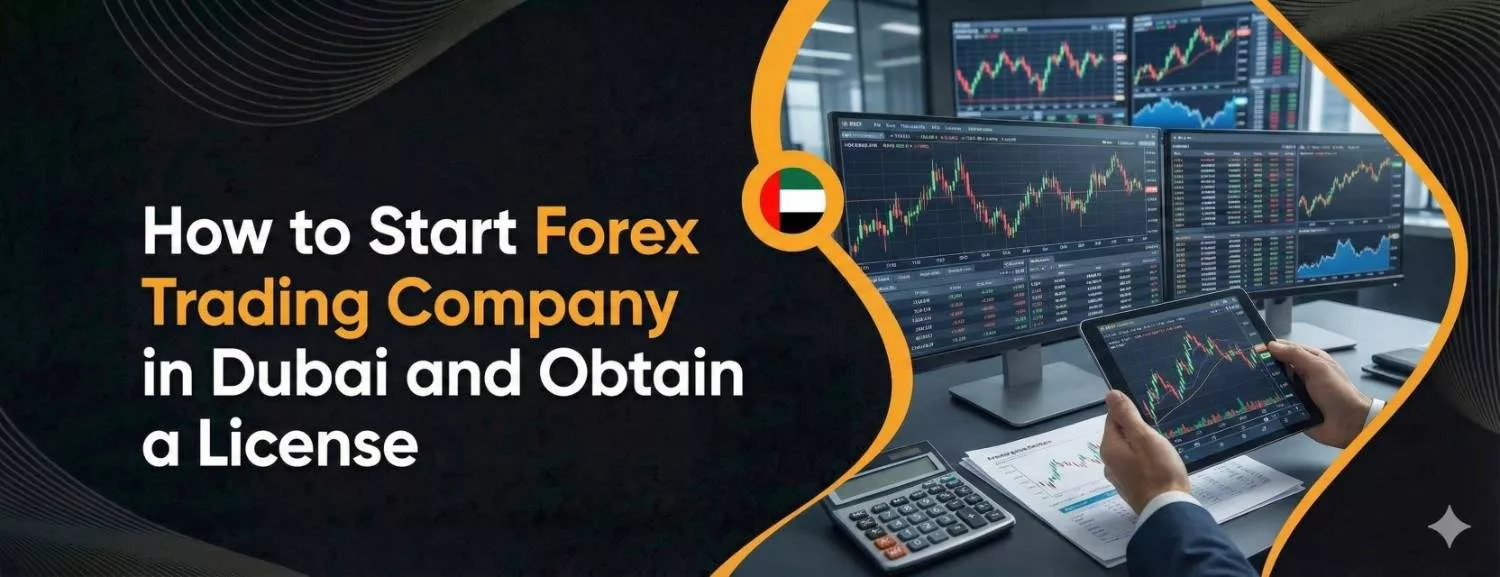
Launching a forex trading company in the UAE can be rewarding. The foreign‑exchange market sees more than $5 trillion traded daily, and Dubai’s liberal regulatory environment and strong economy make it an attractive base for currency trading firms. However, forex trading is a regulated activity in the United Arab Emirates (UAE).
Anyone offering brokerage or trading services must obtain the correct licence and comply with rules laid down by the Securities and Commodities Authority (SCA), Dubai Financial Services Authority (DFSA) and other regulators.
This guide explains the legal framework, licence types, capital requirements, set‑up steps and ongoing obligations so you can confidently plan your forex business in Dubai or elsewhere in the UAE.
Is Forex Trading Legal in the UAE?
Forex trading is legal in the UAE when it is performed through properly regulated brokers. The Securities and Commodities Authority (SCA) regulates non-banking forex brokerage activities, while the Central Bank oversees banks and exchange houses. Two financial free zones, the Dubai International Financial Centre (DIFC) in Dubai and Abu Dhabi Global Market (ADGM) in Abu Dhabi, offer separate regulatory regimes. Within the DIFC, the Dubai Financial Services Authority (DFSA) supervises forex brokers.
UAE law clearly prohibits unlicensed forex trading. Article 6 of Dubai Law 13 (2011) and Article 328 of Federal Law 2 (2015) require any natural or legal person offering forex or other online trading services to obtain a licence. Companies must establish a legal entity in the UAE (mainland or free zone) and acquire the appropriate permit from the SCA, DFSA, ADGM or other designated regulators.
Understanding UAE Forex Licence Categories
SCA licence categories and capital requirements
The UAE Securities and Commodities Authority issues five licence categories. Category 5 is currently the most popular for forex brokers. Key categories include:
| Licence Category | Activities Permitted | Indicative Capital Requirement* |
|---|---|---|
| Category 1: Securities Trading | Buying and selling securities like stocks and bonds within UAE markets | Typically AED 5 million or more (depending on risk profile) |
| Category 2: Investment Management | Portfolio management, operating investment funds and offering wealth‑building strategies | Often AED 1–3 million |
| Category 3: Custody, Clearing & Registration | Clearing, settlement and custody services for securities transactions | Usually AED 2–5 million |
| Category 4: Credit Rating | Independent credit assessments of corporations and financial instruments | Varies |
| Category 5: Advisory & Arrangement | Financial advisory and arrangement services, often used by forex brokers and prop‑trading firms | AED 500,000 minimum paid‑up capital |
Regulators may require additional capital buffers based on risk. Category 5 licence holders must have a local office and staff and maintain compliance manuals, KYC/AML policies and financial projections.
DIFC (DFSA) licence categories
Inside the Dubai International Financial Centre, the DFSA issues Category 3A and Category 4 licences for forex‑related activities:
- Category 3A – Brokerage licence: Permits dealing in investments as principal (matched principal basis) and as agent. It allows trading in forex, commodities, and derivatives. Applicants must incorporate a DIFC company, maintain a minimum capital of USD 500,000, and prepare risk capital and expenditure‑based capital calculations. Licensing typically takes 8 to 12 months.
- Category 4 – Advisory/arranging licence: Allows firms to arrange deals, advise on financial products, operate an alternative trading system or provide fund administration. Minimum capital is USD 10 000, and approval is generally granted in 4 to 6 months. Category 4 licensees cannot hold client funds.
DMCC (Dubai Multi Commodities Centre) licence
In the DMCC free zone, forex trading is licensed as “Trading Proprietary account on regulated exchanges” for companies trading with their own funds. Firms can trade foreign exchange, OTC derivatives and exchange‑traded derivatives. The capital requirement is AED 50 000 (about USD 13 600). There is no dedicated regulator inside DMCC; however, companies trading Dubai Gold & Commodities Exchange (DGCX) contracts must obtain SCA approval.
Mainland licences
Outside free zones, a mainland company obtains its licence through the Department of Economic Development and subsequently gets SCA approval. Mainland forex brokers must partner with a UAE national owning at least 51 % of the company’s shares. Activities allowed include brokering foreign shares, bonds and commodities, currency remittance and securities promotion.
Step‑By‑Step Guide to Starting a Forex Trading Company in the UAE
1: Conduct market research and craft a business plan
Before applying for a licence, study global forex trends, target markets, platform costs and the competitive landscape. Research helps you assess the risks and opportunities ahead of time. Industry guidance emphasises that market analysis and understanding the pros and cons of FX trading are essential first steps.
Pro tip: Engage with professional advisors familiar with the GCC financial sector to gauge demand and regulatory developments. Use this research to create a detailed business plan outlining your business model (proprietary trading vs. client brokerage), revenue projections and compliance strategy.
2: Decide your business model
UAE regulators distinguish between proprietary trading (using your own capital) and brokerage services (handling client funds):
- Proprietary trading: Requires a DMCC proprietary trading licence or SCA Category 5 advisory licence. You trade your own funds and cannot manage clients’ money.
- Brokerage services: Requires a DFSA Category 3A licence (DIFC) or SCA Category 2/5, depending on scope. You act as an agent or principal on behalf of clients and must meet higher capital requirements.
Clarify your business model early because it determines the licence type, capital requirement and compliance obligations.
3: Choose your jurisdiction
Dubai International Financial Centre (DIFC)
DIFC offers 100 % foreign ownership, an English‑common‑law legal system, and tax exemptions. It is ideal for firms that need to manage client funds or access sophisticated financial services. However, the USD 500 000 capital requirement and lengthy approval process make it more expensive.
Dubai Multi Commodities Centre (DMCC)
DMCC suits start‑ups and prop‑trading firms that trade their own money. It provides world‑class infrastructure, low share‑capital requirement (AED 50 000) and 100 % foreign ownership. The absence of a dedicated on‑site regulator means fewer compliance hurdles, but firms cannot manage client funds and must obtain SCA approval for DGCX contracts.
Mainland UAE
A mainland licence is required to access the UAE retail market. Foreign investors must partner with a UAE national holding at least 51 % of shares. In addition to DED and SCA approvals, mainland firms must follow Central Bank regulations. Mainland companies can conduct broader currency‑related services like remittance and securities promotion.
Abu Dhabi Global Market (ADGM)
ADGM operates its own regulator, the Financial Services Regulatory Authority (FSRA). Its framework mirrors DIFC but is located in Abu Dhabi. Capital requirements and licence types are comparable to DFSA standards.
4: Incorporate your company and secure office space
Once you select a jurisdiction, incorporate an entity (LLC or company limited by shares). Free‑zone authorities or the DED will issue your trade licence. Many free zones require you to lease physical office space; some allow Flexi‑desk packages. DIFC requires you to lease approved office space within the financial centre.
Open a corporate bank account to deposit share capital and handle client funds. Bank account opening often involves KYC checks and verifying the regulatory authorisation of your business.
5: Prepare your application documentation
Regulators expect detailed submissions. At a minimum, gather:
- Corporate documents: Memorandum of Association, incorporation documents and share‑holder information.
- Business plan and financial projections: Outline services offered, target markets, revenue models and risk management.
- Governance manuals: Compliance, internal controls, risk management and corporate governance frameworks.
- KYC/AML policies: Procedures for verifying clients, monitoring transactions and reporting suspicious activity.
- Fit‑and‑proper details: CVs and background checks for shareholders, directors and key personnel.
- Proof of capital: Bank statements showing the minimum paid‑up capital (AED 500 000 or USD 500 000, depending on licence).
6: Submit the licence application and respond to regulator queries
For SCA licences, applications are filed through the SCA portal with supporting documents and fee payment. DFSA and FSRA applications are made through their electronic portals. Regulators may raise additional queries or request clarifications respond promptly to avoid delays.
7: Receive the licence and fulfil post‑approval conditions
After a successful review, the regulator issues your licence. You may need to satisfy post‑approval conditions such as appointing compliance officers, installing reporting software and undergoing on‑site inspections. DFSA Category 3A licencees must secure a “client assets” endorsement to hold client funds.
8: Hire qualified staff and build your infrastructure
UAE regulators expect licensed firms to maintain a local office and professional staff. Recruit experienced traders, compliance officers, risk managers and customer support personnel. Implement secure trading platforms and back‑office systems.
9: Ongoing compliance and reporting
Licensing is only the beginning. The SCA requires licensed brokers to maintain:
- Adequate capital (AED 1 to 5 million depending on operations).
- Physical office presence within the UAE.
- Robust AML/KYC framework.
- Quarterly and annual financial reporting to the SCA.
- Transparent advertising practices subject to regulator approval.
DFSA and FSRA licencees must also file periodic prudential returns and undergo risk‑based audits. Non‑compliance can result in heavy fines or revocation of the licence.
How Much Does a Forex Trading Licence Cost?
Licensing costs vary depending on the jurisdiction and activities. Typical figures include:
- Licence application and government fees: Expect to pay around AED 32 000 (approximately) for the basic licence fee in Dubai.
- Share‑capital deposit: For DMCC proprietary trading licences, a minimum share capital of around AED 50 000 must be deposited in a UAE bank. The DIFC Brokerage Licence requires a minimum capital of USD 500 000. SCA Category 5 licences require AED 500 000 paid‑up capital, while Category 1 to 4 licences typically range from AED 1 million to AED 5 million.
- Office rent and visas: Costs depend on location and office size; flexi‑desk packages start from around AED 15 000 per year, while full offices cost more. Visa fees vary depending on the number of employees (each visa may add a few thousand dirhams).
- Professional fees: Legal, compliance and business‑setup consultants charge according to scope.
Opening a Forex Trading Account in Dubai
After obtaining your company licence, you (or your clients) can open individual trading accounts with regulated brokers. Choosing a broker is critical:
- Check regulation: Ensure the broker is authorised by a reputable agency such as the SCA or DFSA.
- Understand brokerage models: Decide whether to use an Electronic Communication Network (ECN) broker, which pools quotes from multiple market makers, or a market‑maker broker that takes the other side of your trades.
- Start with a demo: Most brokers offer demo accounts. Demo trading helps you evaluate spreads, execution speed and platform features before depositing real funds.
- Consider leverage and margin: High leverage can amplify profits and losses; ensure you understand margin requirements.
- Choose a trading platform: Many brokers in the UAE support MetaTrader 4, MetaTrader 5 or proprietary platforms. Look for features like advanced charting, automated trading options and mobile apps.
Recommended regulated platforms (2026)
A 2026 review identified several top brokers serving UAE traders. Each combines global regulatory oversight with local services:
- XM Global: DFSA‑regulated with SCA Category 5 authorisation, low minimum funding (USD 5) and hundreds of instruments.
- ActivTrades: FCA‑supervised broker offering institutional‑grade execution, insurance up to USD 1 million per account and various platforms.
- BlackBull Markets: ECN powerhouse providing over 26 000 instruments and institutional‑quality infrastructure.
- PU Prime: Award‑winning platform with social trading features and direct access to UAE equities.
- Vantage: Multi‑jurisdictional broker with robust technology and pro tools.
While these platforms accept retail traders, your licensed company may integrate with one or more of them as liquidity providers or white‑label partners.
The following platforms are mentioned for informational purposes only and do not constitute financial or investment advice.
Benefits of Running a Forex Trading Company in the UAE
- Favourable tax environment: The UAE currently has no personal income tax and offers generous tax exemptions in free zones. This allows companies to retain more profits.
- 100 % foreign ownership in free zones: DIFC and DMCC permit full foreign ownership.
- Strong infrastructure: Dubai’s world‑class telecommunications, legal system and global connectivity make it ideal for financial services.
- Regulatory credibility: Operating under SCA or DFSA regulation builds trust with clients and investors.
- Booming economy and demand: Dubai’s growing expatriate population and remittance needs create continuous demand for currency services.
Risks and Challenges
- Capital‑intensive: High capital requirements (AED 500 000 to several million) and licence fees can be prohibitive for small start‑ups.
- Regulatory complexity: Multiple regulators (SCA, DFSA, FSRA) mean complex compliance and reporting obligations.
- Market volatility: Currency markets can be highly volatile. A poorly managed brokerage may suffer losses if clients trade aggressively without adequate risk controls.
- Operational costs: Office rent, staff salaries and technology infrastructure add to ongoing expenses beyond the initial licence cost.
- Reputation risks: Non‑compliance with AML/KYC rules can result in heavy penalties or licence revocation.
Final Thoughts
Obtaining a forex trading licence in the UAE is a complex but rewarding journey. If you’re serious about starting a forex trading company in the UAE, consider consulting with experienced corporate service providers like Bestax and legal advisors who can tailor the licensing process to your business model. A well‑structured business plan and early engagement with regulators will significantly increase your chances of approval.
Frequently Asked Questions (FAQs)
Is forex trading legal in Dubai
Yes, forex trading is legal as long as it is conducted through brokers licensed by the SCA, DFSA or FSRA. Unlicensed trading is prohibited and subject to penalties.
What licence do I need for a forex brokerage
If you plan to handle client funds and provide brokerage services, you’ll need a DFSA Category 3A licence (DIFC) or an SCA Category 2/5 licence. For proprietary trading with your own funds, a DMCC proprietary trading licence or SCA Category 5 licence suffices.
How much does a forex trading licence cost?
Expect government fees around AED 32 000. However, the major cost is the minimum capital requirement: AED 50 000 in DMCC, AED 500 000 in SCA Category 5, USD 500 000 in DFSA Category 3A and up to AED 5 million for SCA Categories 1‑3.
Can foreigners own 100 % of a forex company in the UAE?
Yes. Free zones such as DIFC, DMCC and ADGM allow 100 % foreign ownership. Mainland licences require a local partner holding at least 51 %.
How long does the licensing process take?
The DFSA Category 3A process may take 8–12 months, while Category 4 usually requires 4–6 months. SCA approvals vary but generally range from several months to a year, depending on the completeness of documentation and regulatory scrutiny.
Do I need a physical office?
Yes. SCA‑licensed brokers must maintain a physical office and local staff. DIFC requires approved office space within the centre. DMCC offers flexi‑desk and office options, but you need a local presence to open corporate bank accounts and maintain regulatory compliance.
How do I open a forex trading account in Dubai?
Choose a broker regulated by the SCA or DFSA, verify your identity, deposit funds and start with a demo account to familiarise yourself with the platform. Understand the broker’s model (ECN vs. market maker) and leverage options.
Which is the best forex trading platform in the UAE?
Top platforms in 2026 include XM Global, ActivTrades, BlackBull Markets, PU Prime and Vantage. Each offers strong regulatory oversight, advanced technology, and local support. Your choice depends on your trading style, capital and product range.
Disclaimer: The information provided in this blog is for general informational purposes only. For professional assistance and advice, please contact experts.
