




When travellers plan a dream trip to the United Arab Emirates, it’s easy to focus on iconic skyscrapers, record‑breaking malls and endless sunshine. Yet there’s one practical detail every visitor needs to understand: the Dubai Tourist Tax, also known as the Tourism Dirham fee. The tax was introduced in 2014 as a way to help fund the infrastructure that keeps Dubai running smoothly for more than 16 million visitors a year.
When you check out of your hotel, you’ll see a small fee on your bill for each night of your stay. In this guide you’ll learn exactly how much this fee is, how it’s calculated, whether you can get a refund, and how Dubai’s policy compares with those in other Emirates and global destinations. Armed with this knowledge, you can budget accurately and avoid surprises.
What Is the Dubai Tourist Tax?
The Dubai Tourist Tax is a nightly fee charged to visitors staying in hotels, hotel apartments and holiday homes within the emirate. It’s also called the Tourism Dirham fee. Unlike VAT or service charges, which are calculated as percentages of your room rate, the tourist tax is a flat amount per room per night.
The city introduced the fee in 2014 to help finance tourism infrastructure such as roads, public transport, safety services and visitor facilities. Because millions of tourists use these services, the authorities decided that a modest fee would spread the cost fairly across visitors instead of pushing it entirely onto residents or businesses.
Think of the tax as a contribution to Dubai’s seamless visitor experience: the glittering airport, clean streets, pristine beaches and efficient public transport would be impossible without significant investment. The Dubai Department of Economy and Tourism has confirmed that the Tourism Dirham fee remains unchanged for 2025/2026, meaning you can plan your budget around a stable rate.

Why does Dubai charge this fee?
Dubai isn’t the only city to impose a tourist tax. Paris and Rome levy nightly taxes between €1 and €7, while New York adds US$3.50 plus an accommodation tax of nearly 15 %. These fees allow cities to maintain tourism infrastructure, regulate short‑term rentals and encourage sustainable tourism. Without them, high visitor numbers could overwhelm local services. Dubai’s rates are comparatively moderate, especially considering the high level of service you receive.
How Much Is the Tourism Dirham Fee?
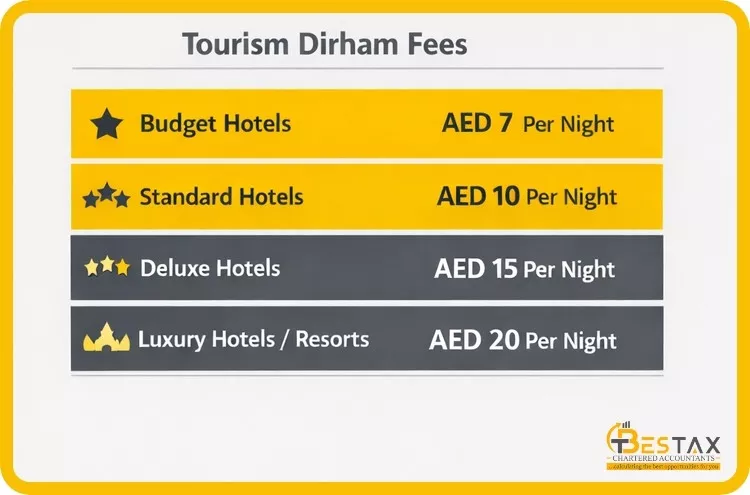
Dubai calculates the tourist tax according to the category of the property you stay in. The higher the hotel’s rating, the higher the fee. According to the UAE tax rules for 2025/2026 and business advisory sources, the rates are as follows:
| Accommodation type | Tourism Dirham fee (per room per night) |
|---|---|
| 5‑star hotels & resorts | AED 20 |
| 4‑star hotels | AED 15 |
| 3‑star hotels | AED 10 |
| Budget hotels, 1–2‑star hotels and hotel apartments | AED 7 |
| Holiday homes (registered short‑term rentals) | Fee depends on property classification, usually AED 7–20 per night |
The fee is charged per room rather than per person. That means a family of four pays the same Tourism Dirham as a single traveller occupying the same room. The tax is capped at 30 consecutive nights; if you are staying longer, you only pay for the first 30 nights and nothing for the remainder. Apartment rentals that are not registered as holiday homes are technically not required to collect the fee, although landlords may still be subject to sanctions if they operate unlicensed short‑term rentals.
Hidden costs: other taxes and charges
It’s easy to confuse the Tourism Dirham fee with other charges on your bill. Dubai hotels typically charge:
- VAT (Value Added Tax) at 5 % on most services.
- A municipality fee (around 7 %) and a service charge (around 10 %) regulated by the hotel’s licence.
- City taxes or tourism fees (6 to 10 %) and sometimes a 10 % room rate tax in restaurants and resorts.
These percentages are calculated on your room rate and will appear separately from the flat Tourism Dirham fee. When comparing hotel prices online, check whether the tourism fee is included. Booking platforms such as Booking.com and Expedia sometimes exclude it from the nightly rate and collect it at check‑out, so your final bill may be slightly higher than the total price displayed at booking.
Who Pays the Dubai Tourist Tax?
The Dubai tourist tax is applied uniformly to most visitors staying in licensed accommodation. Here’s a breakdown of how the policy works:
- Per room, not per guest: Families and groups pay one fee per room. Children stay for free in terms of the Tourism Dirham fee.
- First 30 nights only: Visitors staying longer than a month are exempt from paying beyond the 30‑night cap. This is particularly important for business travellers or those temporarily relocating to Dubai.
- Registered holiday homes and Airbnbs: Short‑term rentals must register with the Department of Economy and Tourism and collect the fee. Unregistered rentals are technically outside the system, but hosts risk fines and loss of licence.
- No exemptions by nationality: The tax applies to all non‑resident visitors regardless of citizenship. Only UAE residents and Gulf Cooperation Council nationals staying in their primary residence (not in hotels) avoid paying the tax.
Who collects the fee?
Hotels, hotel apartments and licensed holiday homes collect the Tourism Dirham fee. They are responsible for reporting collections to the Dubai Department of Economy and Tourism (DET). The DET has increased enforcement on holiday homes and platforms like Airbnb to ensure compliance. Failure to collect and report the fee can result in fines or suspension of a property’s licence.
Dubai Tourist Tax Cost in Practice
Because the Tourism Dirham fee is a flat charge, calculating your cost is simple: multiply the nightly rate by the number of nights (capped at 30). Here are some real‑world examples to illustrate how much you might pay:
- Family holiday in a 4‑star hotel: A week‑long stay (7 nights) in a four‑star hotel will cost AED 105 in Tourism Dirham (7 nights × AED 15 per night) about USD 29. Spread across a family, this is only a few dollars per person.
- Budget traveller in a hotel apartment: Ten nights in a budget hotel or hotel apartment require a total of AED 70 (10 nights × AED 7 per night), roughly USD 19. This makes it one of the more affordable tourist taxes globally.
- Luxury escape in a 5‑star resort: A three‑night stay in a five‑star hotel will add AED 60 (3 × AED 20). For a two‑week luxury vacation (14 nights), you’ll pay AED 280, which remains modest compared with the overall cost of a high‑end stay.
Remember to include other fees (VAT, service charge, municipality fee) when budgeting. For a quick estimate, add roughly 22 % to your room rate to cover these percentage‑based charges and then add the flat Tourism Dirham from the table above.
How Dubai’s Tourist Tax Compares to Other Emirates and Countries
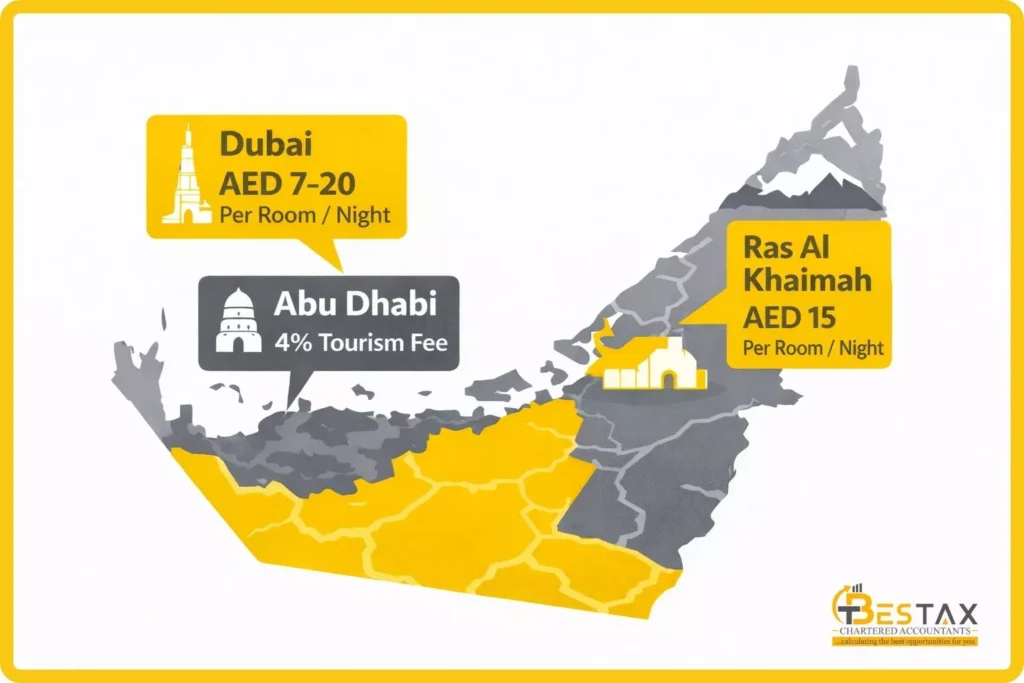
Dubai isn’t the only Emirate with a tourism fee, but its structure is unique. Here’s how it compares:
- Abu Dhabi: There’s no Tourism Dirham fee per night; instead, guests pay a 4 % tourism fee on the accommodation bill and AED 15 per room per night. This percentage‑based model can increase the total cost when staying in luxury properties.
- Ras Al Khaimah: Hotels charge a AED 15 tourism fee per room per night.
- Sharjah: Some sources note a 10 % tourism fee on the room rate. Always check your hotel confirmation because the structure may vary by property class.
- Other global cities: Paris adds €1–€5 per night, Rome charges up to €7, and New York adds US$3.50 plus a 14.75 % accommodation tax. Compared with these, Dubai’s maximum fee of around USD 5 per night is relatively modest. (estimated cost for actual cost breakdown, visit the hotel websites)
Understanding these variations helps you compare accommodation costs when travelling throughout the UAE or deciding whether to split your trip between cities.
Is the Dubai Tourist Tax Refundable?
Visitors often confuse the Tourism Dirham fee with the VAT refund for tourists. They are separate systems. The Dubai tourist tax is non‑refundable because it funds public services and is not classified as a refundable tax. However, you can claim a refund on the 5 % VAT paid on eligible retail purchases when you leave the UAE. Here’s how the VAT refund works:

Who can claim a VAT refund?
- Non‑resident tourists aged 18 or older.
- Airline or ship crew members on layovers.
- You must spend at least AED 250 in a single transaction at a retailer participating in the Tax Refund for Tourists Scheme.
What purchases qualify?
- Goods purchased from retailers registered in the scheme.
- Products that are unused and will leave the UAE with you.
What doesn’t qualify?
- Services (hotel stays, tours, or restaurant meals).
- Used or consumed items.
- Vehicles, boats and aircraft.
How much will you get back?
The Federal Tax Authority applies two fees on VAT refunds: a 13 % administrative fee of the refund amount plus a fixed fee of AED 4.80 per claim.
How to claim your VAT refund
- Present your passport at the point of purchase so the retailer can issue a digital tax‑free invoice.
- Receive a tax‑free tag or sticker from the retailer, linked to your passport. Ensure the merchant uploads your invoice; if verification fails, resolve it before leaving the UAE.
- At the airport, seaport or land border, go to a VAT refund validation desk or self‑service kiosk. Show your passport, tax invoice and boarding pass. Keep the goods unopened so the officer can check them if needed.
- Collect your refund in cash or credit card. Cash refunds are immediate, while card refunds may take up to nine days.
How is this different from the Tourism Dirham?
While both schemes involve taxes and visitors, the key differences are:
- The Tourism Dirham fee is a nightly accommodation tax that goes directly to Dubai’s government and is non‑refundable.
- The VAT refund scheme returns part of the sales tax you paid on eligible goods, minus administrative fees. It doesn’t apply to accommodation or restaurant services.
Knowing the distinction prevents frustration at check‑out and ensures you claim the refunds you’re entitled to.
How to Check Whether Your Booking Includes the Tourism Fee
When booking accommodation, it can be tricky to understand whether the Tourism Dirham fee is included. Here are practical steps:
- Read the pricing breakdown on booking platforms. Sites like Booking.com or Expedia often show taxes and fees separately. The Tourism Dirham may be marked as “taxes to be paid at the property.” If it’s not listed, contact the hotel to confirm.
- Book directly with the hotel. Direct bookings often show the full breakdown, and hotels may be more transparent about the Tourism Dirham fee and other charges.
- Ask at check‑in. If the tax hasn’t been added to your quoted price, you’ll need to pay at check‑out. Keeping some dirhams or a card available will make the process smoother.
Pro tips
- Budget for around AED 100 to 200 extra depending on your stay length and hotel category. This small buffer ensures you’re not caught off guard.
- If you are staying for more than a month, clarify the 30‑night cap so you aren’t charged erroneously beyond 30 nights.
- Check licensing if you book an apartment through Airbnb. Only registered holiday homes are allowed to charge the fee; unlicensed hosts may be operating illegally.
Seasonal Travel Advice and Budgeting Tips
Dubai’s climate is subtropical desert, so the cost of your trip including the tourist tax will feel quite different depending on when you visit. Since the Tourism Dirham fee is a fixed amount per night, staying longer in off‑season months can make high‑end hotels more affordable.
Best months to visit
- November to March: These are the most popular months due to pleasant daytime temperatures (around 20–25 °C) and outdoor events. Hotel rates are higher, so the Tourism Dirham fee is a small portion of your overall bill.
- April and October: Shoulder seasons when temperatures rise but remain comfortable. You may find lower room rates, making these months a good compromise between weather and cost.
- May to September: Hot and humid. Accommodation prices drop significantly, meaning you can stay in a higher‑category hotel while paying the same tourism fee. Indoor attractions like malls and museums offer respite from the heat.
Budgeting tips
- Pick the right hotel category. If you’re comfortable staying in a 3‑star hotel, you’ll pay AED 10 per night instead of AED 20, saving AED 210 on a two‑week holiday.
- Stay outside tourist hotspots. Accommodation in areas like Deira or Al Barsha may be cheaper than Downtown or the Palm, and the Tourism Dirham fee remains the same across the city.
- Combine room nights. Some travellers split their stay between a few days at a luxury resort and a few days at a budget hotel to experience both ends of the spectrum while controlling costs.
- Look for packages that include taxes and fees; some tour operators bundle the Tourism Dirham into the room rate, so you pay everything up front.
- Plan for the VAT refund if you enjoy shopping, particularly electronics, jewellery or high‑end fashion. Keep receipts and use the refund kiosks at the airport for immediate cash back.
Conclusion
Understanding the Dubai Tourist Tax is a small but important part of planning your trip. The fee, ranging from AED 7 to 20 per room per night, helps maintain the infrastructure that makes Dubai one of the world’s most seamless destinations.
Unlike VAT, the tourism fee is non‑refundable, so factor it into your budget and enjoy your stay knowing you’re contributing to the city’s continued excellence. Whether you’re visiting for a weekend or a month, a little advance planning will ensure you’re not surprised at check‑out.
Frequently Asked Questions
How much is the tourist tax in Dubai
The Tourism Dirham fee ranges from AED 7 to AED 20 per room per night, depending on the hotel category. Budget hotels and apartments charge AED 7, three‑star hotels AED 10, four‑star hotels AED 15, and five‑star hotels AED 20.
Does the tax apply per person or per room?
It applies per room. Families or groups staying in the same room pay a single nightly fee.
Is the Dubai tourist tax included in the hotel price
Not always. Some booking platforms and hotels include it; others collect the fee at check‑out. Always check your booking confirmation.
Do children have to pay the tax?
No. Since the fee is charged per room rather than per guest, there is no additional charge for children.
I’m staying longer than 30 days, do I still pay?
The tax is capped at 30 consecutive nights. If you stay longer, the remaining nights are tax‑free. Make sure the property’s billing system recognises this cap.
Are there any exemptions?
Visitors staying in unregistered private apartments technically don’t pay the fee, though hosts may be liable for penalties if they rent without a licence. Residents and GCC nationals staying in their own homes don’t pay the tax. Otherwise, all tourists pay regardless of nationality.
Can I get a Dubai tourist tax refund?
No. The Tourism Dirham fee is non‑refundable. Only the VAT on eligible goods can be reclaimed.
Is Dubai’s tourist tax expensive?
No. Compared with other global cities, Dubai’s maximum tax of about USD 5 per night is moderate. Because it’s a flat fee, the cost becomes proportionally smaller the more you spend on accommodation.
Disclaimer: The information provided in this blog is for general informational purposes only. For professional assistance and advice, please contact experts.
