



Digital banking in the UAE means managing financial services 24/7 through a mobile app or web portal without visiting a branch or handling paper forms. In simple terms, it lets individuals and businesses open accounts, transfer money, pay bills, track spending, and access banking support faster and more securely from almost anywhere. The Central Bank of the UAE’s Open Finance framework allows licensed participants to access customer data and initiate transactions with the customer’s express consent.
On 10 April 2026, Al Etihad Payments announced that Aani had exceeded 12.5 million users, with transfers completing in 3 seconds.” That shift matters because the UAE is not just following the digital banking trend.
It is actively building the system behind it. Instant payment rails, open finance rules, and newer banking laws are making digital banking easier to use and harder to ignore. For a resident, that can mean opening an account in minutes.
For a business, it can mean quicker collections, real-time visibility, and less dependence on branch visits. In other words, digital banking in the UAE is no longer a side option. It is becoming the standard way people and companies manage money.
What is Digital Banking?
Definition
Digital banking automates all traditional banking activities through online and mobile channels. In simple terms, digital banks replace physical paperwork and teller interactions with intuitive apps and online dashboards, allowing users to manage money anywhere and anytime.
Digital vs. Online Banking
While the terms are often used interchangeably, there is an important distinction:
- Online banking: primarily refers to accessing bank accounts via a browser to view balances and make payments. It still relies on traditional banking infrastructure.
- Digital banking: incorporates all online and mobile banking functions and adds advanced tools like virtual assistants, automated budgeting, instant payments, and in‑app loan applications. Some banks operate entirely online without physical branches.
In 2026, most UAE banks offer digital channels; however, digital‑only banks (neobanks) provide a fundamentally different experience with no need for branch visits and minimal paperwork.
How Digital Banking Works
Digital banks invest heavily in secure software and infrastructure.
Features typically include:
- Mobile apps and web platforms: account opening, transfers, bill payments and statement downloads.
- Digital wallets and instant payment platforms: enabling contactless payments and peer‑to‑peer transfers.
- AI‑powered tools: budgeting, spending insights and personalised recommendations.
- Virtual assistants/chatbots: for quick support without waiting on hold.
- Biometric authentication and two‑factor authentication (2FA): fingerprint or facial recognition and OTPs to secure accounts.
Benefits of Digital Banking
Digital banking benefits both individuals and businesses by saving time and money while increasing financial control. Information from ADCB and other UAE banks highlights the following advantages:
For Individuals
- Convenience and 24/7 access: You can access your accounts at any time, whether you’re at home or traveling. ADCB emphasises that digital banking allows users to manage their finances effortlessly from home or on the go.
- Speed: Transactions – from bill payments to money transfers – are processed almost instantly.
- Enhanced security: UAE banks use biometric login and 2FA to safeguard customer data. The Liv digital bank notes that advanced security measures such as biometrics and two‑factor authentication help protect against cyber threats.
- Lower fees: Digital‑only banks operate without expensive branch networks, resulting in lower maintenance fees, minimal minimum balance requirements and free domestic ATM withdrawals.
- Financial tools: Many digital banks provide budgeting features, expenditure trackers and goal‑setting options.
- Paperless statements: Digital platforms reduce paper waste and make statements accessible online.
For Businesses and Entrepreneurs
- Integrated financial services: Digital banks often combine business accounts with invoicing, expense management and analytics. Liv notes that integrated financial services can include built‑in budgeting tools and even investment platforms.
- Reduced operating costs: Without branch overheads, digital banks can offer competitive interest rates and lower transaction fees, improving cash flow.
- Streamlined account opening: Businesses can open accounts online in minutes, avoiding long queues and paperwork.
- Better cash‑flow visibility: Real‑time transaction alerts and dashboards help businesses monitor their finances and manage liquidity.
- Access to modern payment tools: Virtual cards, Apple Pay/Google Pay, payment token services and contactless solutions make it easier to accept customer payments.
Regulatory Framework and Digital Bank Licensing in the UAE
Central Bank Regulations and Open Finance
The UAE’s digital banking landscape is shaped by progressive regulations. In September 2025 the Central Bank of the UAE (CBUAE) introduced the Federal Decree‑Law No. 6 of 2025, which expanded the scope of regulated activities to include providing open finance services and payment services using virtual assets.
In April 2024, the CBUAE issued two key regulations:
- Open Finance Regulation: This framework requires CBUAE‑licensed financial institutions to obtain licences before offering open finance services. Under this arrangement, providers can access customer data and initiate transactions on customer accounts.
- Sandbox Conditions Regulation: This allows fintech firms to test innovative financial products under CBUAE supervision without a full licence.
Additionally, the CBUAE’s Payment Token Services Regulation (June 2024) created a framework for licensing and supervising digital payment services, covering the issuance, conversion and custody of payment tokens.
Digital Bank Licensing Requirements
The CBUAE has engineered a tiered licensing system with high capital and governance standards for neobanks. According to Nour Attorneys, applicants must meet stringent capital requirements, governance standards and operational mandates. Key elements include:
- Capital adequacy: Neobanks must meet minimum capital thresholds to absorb operational losses and maintain liquidity. Failure to maintain sufficient capital buffers could lead to liquidity crises during shocks such as cyberattacks or sudden withdrawals.
- Robust governance: Applicants must demonstrate a strong board with expertise in technology and risk management; independent boards and comprehensive internal controls are essential.
- Compliance with AML/CTF: The framework mandates strict adherence to Anti‑Money‑Laundering and Counter‑Terrorist Financing regulations. Advanced supervisory tools monitor real‑time compliance.
- Tiered categories: Licences may be issued for full digital banks, specialised digital banks (e.g., SME‑focused) or digital‑only payment service providers.
- Inter‑agency coordination: The CBUAE collaborates with the Securities and Commodities Authority and the Telecommunications Regulatory Authority to ensure digital banks align with broader regulatory objectives.
Step‑by‑Step Licensing Process
Launching a digital bank is a multi‑stage process.
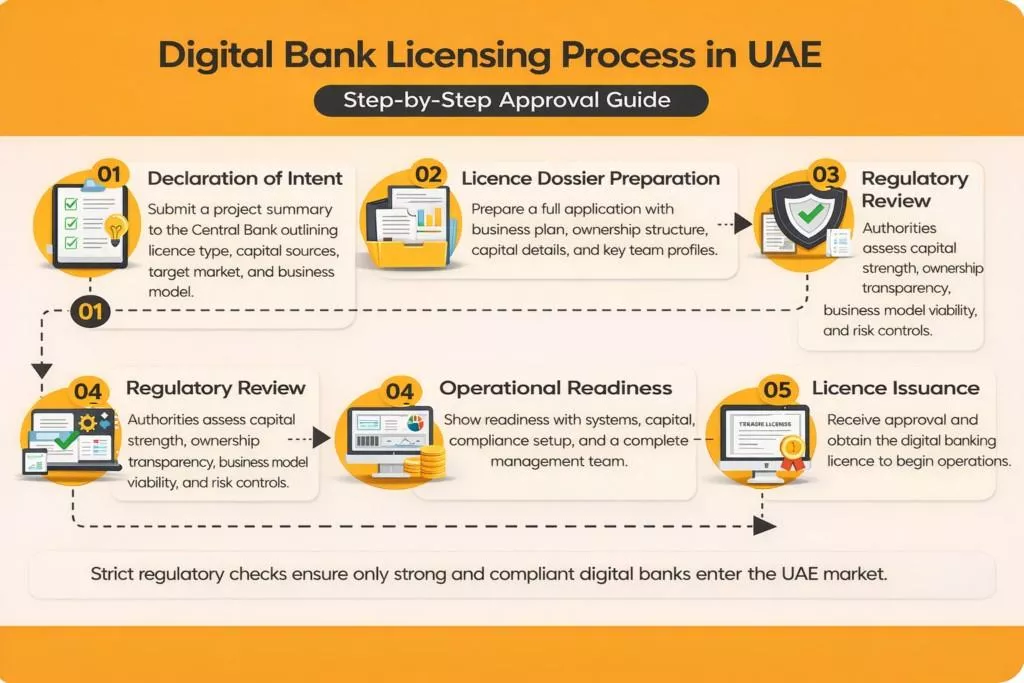
The general steps include:
- Declaration of intent: Submit a project summary to the CBUAE detailing the proposed licence type, capital sources, target clientele and revenue model.
- Build the licence dossier: Prepare a comprehensive application package with corporate structure diagrams, capital confirmation, detailed business plan, risk policies and CVs of key team members.
- Regulatory due diligence: The licensing division scrutinises the application to verify capital sufficiency, ownership transparency, business model viability and risk controls.
- Operational readiness review: Applicants must prove operational readiness by demonstrating paid‑in capital, IT systems for KYC and risk monitoring, a fully staffed management team and compliance mechanisms.
- Licence issuance: Upon satisfying all requirements, the CBUAE issues the digital banking licence, allowing the entity to commence operations.
These stages emphasise the UAE’s stringent oversight, ensuring only resilient and compliant neobanks enter the market.
How to Open a Digital Bank Account in the UAE
Whether you’re a UAE resident, expatriate or non‑resident, opening a digital bank account is straightforward. A step‑by‑step guide from Reyson outlines the general process:
- Choose the right digital bank: Compare options such as Liv by Emirates NBD, Mashreq Neo, Wio, Zand or YAP. Consider fees, minimum balances, app usability, customer support and whether the bank offers personal or business accounts.
- Check eligibility: Most banks require a UAE national ID (Emirates ID) for residents; expatriates may need a passport and a visa copy. A valid UAE mobile number is usually required. Some banks may request proof of income or salary certificates.
For Non-residents, read this detailed guide on How to Open a Bank Account in UAE for Non-Residents (2026 Guide)
- Download the official mobile app: Install the chosen bank’s app from the Apple App Store or Google Play Store.
- Register and verify your identity: Enter personal details, upload your Emirates ID or passport, and complete biometric verification (selfie or facial scan) as prompted.
- Submit the application: Select the desired account type (current, savings or salary), choose any additional services (like debit or virtual cards) and set up login credentials.
- Start banking digitally: Once approved, you’ll receive a virtual debit card instantly within the app and can request a physical card delivered to your address.
For non‑residents or businesses, additional documentation may be required (e.g., corporate documents and proof of business address). Many digital banks provide dedicated business onboarding teams to facilitate the process.
Top Digital Banks and Digital‑Only Accounts
Below are some of the leading digital and virtual banks in 2026, including their standout features and suitability for different users:
| Digital Bank | Key Features (2026) | Suitable For |
|---|---|---|
| Liv by Emirates NBD | Liv is one of the first lifestyle digital banks designed for tech‑savvy millennials. It allows instant account opening via the app, budgeting and expense tracking tools and integration with Apple Pay and Samsung Pay. Liv offers a strong digital experience, but customers should check current fee conditions, as maintaining the account without charges may depend on salary transfer, spending, credit-card usage, or maintaining an average balance. | Individuals seeking a flexible everyday account, students and expatriates. |
| Mashreq Neo | A full‑service digital bank offering savings accounts, international money transfers, bill payments and real‑time transaction alerts. Account opening is 100 % paperless and the bank provides investment options. | Individuals and small businesses requiring comprehensive banking and investment services. |
| YAP | YAP currently states that the regulated banking services on its platform are powered by Ruya Community Islamic Bank LLC. Features include in‑app financial analytics, virtual cards for secure online payments and no hidden fees. | Freelancers and gig economy workers seeking transparency and spending insights. |
| Zand | The UAE’s first fully independent digital bank offering both retail and corporate banking services. It provides seamless onboarding, competitive savings rates and business banking solutions. | SMEs and startups needing a digital‑first corporate account with low fees. |
| Wio Bank | Backed by First Abu Dhabi Bank, Etisalat and ADQ. Wio emphasises mobile‑first banking with innovative expense management, smart invoicing and payment features. | Entrepreneurs and SMEs requiring integrated invoicing and accounting tools. |
| Al Maryah Community Bank (Mbank) | A digital bank headquartered in Abu Dhabi that offers free account opening in minutes and multicurrency options. Mbank has become popular among expatriates for cross‑border payments and SME services. | Non‑resident individuals and SMEs seeking multi‑currency accounts. |
Digital Banking Requirements for Individuals and Businesses
Requirements for Individual Account Holders
To open a personal digital bank account, you generally need:
- Emirates ID or passport (for non‑residents).
- Valid UAE mobile number to receive verification codes.
- Proof of residency or visa page for expatriates.
- Salary certificate or proof of income (varies by bank).
Most banks do not require a minimum salary for basic accounts, but premium accounts may have higher thresholds.
Requirements for Businesses and Start‑Ups
Business digital bank accounts typically require:
- Trade licence and company registration documents.
- Shareholder and director IDs/passports.
- Proof of business address.
- Company memorandum and articles of association.
- UAE residency visas for signatories.
Some digital banks (e.g., Wio and Zand) specialise in SME banking and may have simplified onboarding for startups. Always check if a bank offers business accounts before applying.
Ready to Open Your Account?
Ready to embrace the convenience and efficiency of digital banking in the UAE? Whether you’re opening a personal account or exploring a neobank licence for your business, take the next step today and talk too an expert at Bestax of Online Banking Assistance.
Quick (FAQs)
1. Is digital banking safe in the UAE?
Yes. UAE digital banks use advanced security measures, including encryption, biometrics and two‑factor authentication. Regulators enforce strict cybersecurity and AML/CTF requirements, ensuring that digital banks maintain robust protection against fraud and hacking.
2. Do digital banks offer interest on savings?
Many digital banks, such as Mashreq Neo and Zand, offer competitive interest rates on savings accounts because they save on branch overheads. Always compare rates and terms before opening an account.
3. Can non‑residents open digital bank accounts in the UAE?
Some digital banks allow non‑residents to open accounts, particularly for business or multicurrency accounts. Requirements typically include a passport, visa copy (if available) and proof of address in your home country. Check with the bank for specific eligibility criteria.
4. What is the minimum capital required to start a digital bank in the UAE?
The CBUAE sets minimum capital thresholds for digital bank licences to ensure financial resilience. Licensing requirements depend on the institution category. Official UAE rules show much higher capital thresholds than ‘AED 100 million’ for a full bank, so applicants should assess the exact category and applicable rulebook requirements before relying on headline figures.
5. How do digital banks generate revenue without charging high fees?
Digital banks reduce costs by eliminating physical branches and automating back‑office operations. They earn revenue through interest on loans, savings products, subscription‑style account packages, merchant fees on payments and wealth‑management services. Lower overhead costs allow them to pass savings to customers through low or zero fees.
6. What happens if a digital bank fails?
Licensed digital banks are subject to the same regulatory oversight as traditional banks and must maintain capital adequacy and risk management frameworks. In the unlikely event of a failure, depositors in UAE banks are protected by the Deposit Guarantee Scheme (DGS), which ensures that deposits up to a certain threshold are reimbursed. Always verify that your bank participates in the DGS.
7. Are virtual bank accounts and digital wallets the same?
A virtual bank account is a full bank account opened entirely online, while digital wallets such as Apple Pay or Google Pay act as payment methods linked to bank cards or accounts. Digital wallets provide a convenient way to make contactless payments but do not replace a bank account.
Disclaimer: The information provided in this blog is for general informational purposes only. For professional assistance and advice, please contact experts.
