




Flights paused at Dubai and Abu Dhabi. Shipments rerouted around the Strait of Hormuz. Hotels are watching months of bookings vanish in days. Traders staring at a phone that no longer rings. If 30 to 40 percent of your Q2 revenue has already walked out the door, you are not alone and you are not without options.
Every news site has explained the CBUAE Resilience Package from the bank’s side. Almost nobody has written it for the owner who still has to make payroll this Friday. The Central Bank of the UAE approved a five-pillar support package on 17 March 2026 but the real question is how that relief actually reaches your P&L, your receivables, and your loan file.
This is not a news recap. It is a recovery roadmap. If you want a finance partner for the walk, Bestax’s CFO Services in UAE guides war-hit companies through exactly this kind of turnaround.
The CBUAE Resilience Package: The Short Version
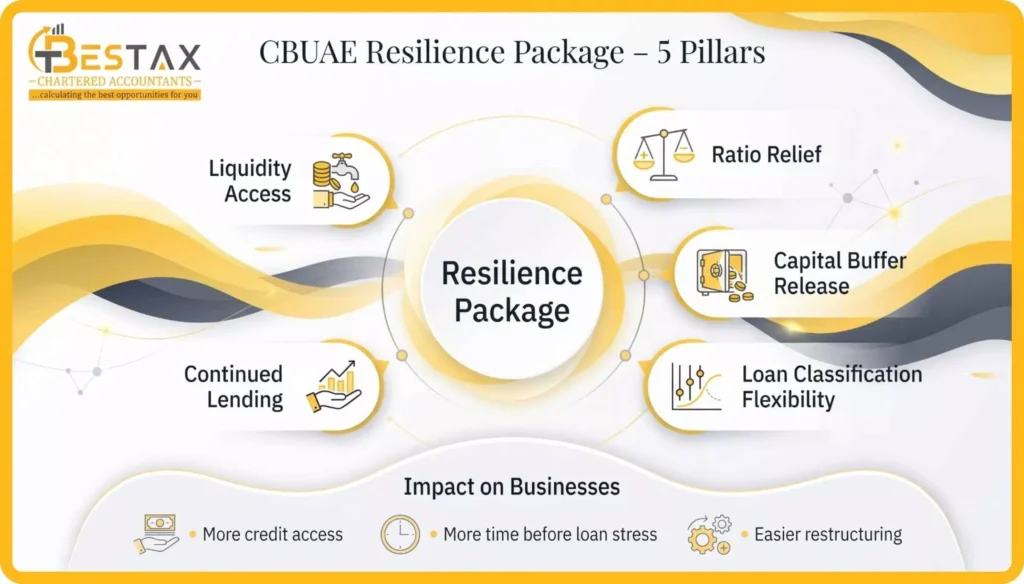
The package rests on five pillars: liquidity access (banks can tap up to 30 percent of cash reserve balances), ratio relief (temporary ease on liquidity and stable funding rules), capital buffer release (both the Countercyclical and Capital Conservation Buffers are unlocked), loan classification flexibility (banks can delay staging distressed loans), and continued lending (a clear push to keep credit flowing).
The measures are backed by CBUAE reserves above AED 1 trillion, and UAE banks hold close to AED 920 billion in combined liquidity and eligible assets at the central bank, including reserve balances above AED 400 billion. Gulf News: That matters for your business in three ways more credit headroom at your bank, more time before a weak quarter gets labelled “problem loan,” and more room to restructure existing facilities. For the full announcement, see Gulf News’s report on the CBUAE board approval.
Who Counts as a War-Affected UAE Business
“War-affected” is not one label. There are five exposure types, and most companies sit in two or three at once.
- Direct exposure: logistics, freight, shipping, and maritime services dealing with Hormuz disruption and longer transit times.
- Demand-shock exposure: aviation, hospitality, tourism, retail, and F&B are watching cancelled bookings and softer spend.
- Supply-chain exposure: importers, traders, and manufacturers whose regional suppliers or customers are in affected territories.
- Insurance-cost exposure: companies hit with sudden war-risk premium hikes on cargo, property, or liability cover. These jumps can quietly erase a full quarter of margin.
- Currency and receivables exposure: exporters with invoices in jurisdictions where payment has slowed, or bank transfers are delayed.
If even one revenue line or cost line above matches your business, this package was written with you in mind. Most UAE SMEs in construction, real estate, trading, and services fall into at least one bucket, often without noticing until month-end.
Quick Self-Check: Are You Eligible for Relief
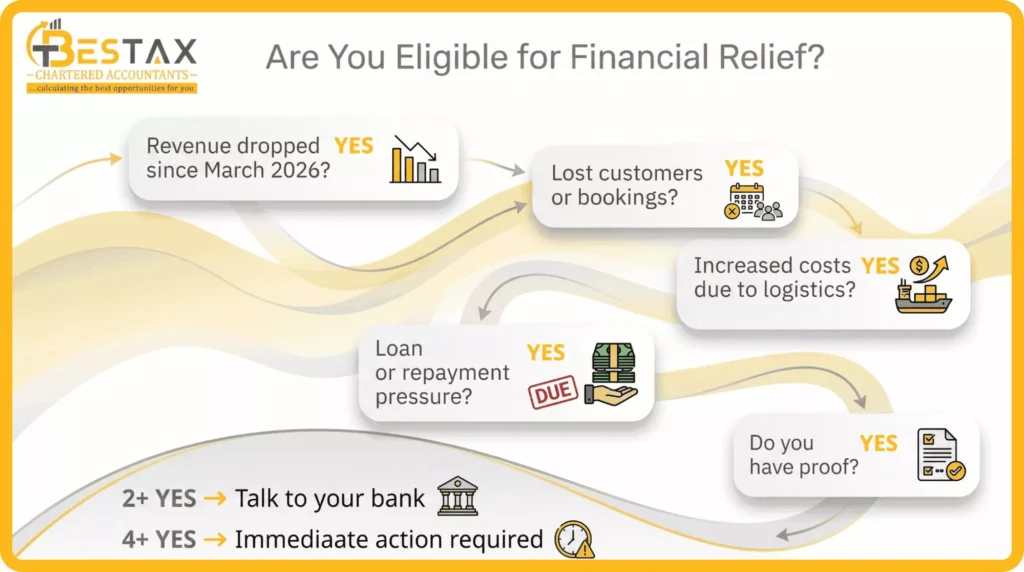
Before you call your bank, answer these five questions honestly. No guessing.
- Has your revenue dropped measurably since March 2026 because of the regional conflict?
- Have you lost customers, orders, or bookings tied to affected geographies?
- Are your supply or freight costs materially higher because of rerouted logistics or new insurance premiums?
- Are you struggling with an existing loan covenant, repayment, or facility limit?
- Do you have documented evidence, invoices, emails, supplier notices, not just a gut feeling?
Two or more “yes” answers mean you should start the conversation with your bank now. Four or more means you should have started last week. Banks assess each case on its own merits, so this self-check prepares you; it does not guarantee approval. Walking in with the answers already on paper is what separates borrowers who get relief from those who get silence.
How to Approach Your Bank the Right Way
Your relationship manager will decide how flexible to be in the first 30 minutes of the meeting. Lead with facts, not emotion. Quantify the revenue drop, name the specific orders lost, and show the month-by-month cash picture before and after the conflict started.
This is the sequence most owners get wrong, ask for loan classification postponement before asking for new credit. Classification relief costs the bank almost nothing; new credit costs it capital. Propose a specific restructuring window too, such as a six-month interest-only period or a short covenant holiday, rather than leaving the bank to guess. Get every agreed point confirmed in writing, in the same email thread.
Walk in with a folder, not a story. Bring a 12-month rolling cash flow (pre-crisis and post-crisis), invoice-level evidence of cancelled or delayed orders, supplier disruption letters, updated management accounts, an aged receivables report, insurance correspondence on premium changes, and a revised 6-to-12-month forecast.
One warning, do not draw down undrawn facilities the week before asking for classification relief. That single move signals distress to the credit team and shrinks the bank’s room to help you.
What IFRS 9 Relief Means for Your Books
IFRS 9 is the accounting rule that forces banks to classify loans as Stage 1 (healthy), Stage 2 (higher credit risk), or Stage 3 (distressed). Moving up a stage triggers heavier provisioning, tighter pricing, and often stricter covenants on your next review. The CBUAE package lets banks postpone that staging for war-affected borrowers, giving your balance sheet breathing room while you recover.
But IFRS 9 cuts both ways. The same expected-credit-loss logic applies to your own receivables. If a customer owes you AED 2 million and that customer sits in a war-hit supply chain, you need to assess the expected loss, disclose any material impact, and flag going-concern issues in your next accounts. Say nothing, and you risk an audit qualification that will haunt your next loan application.
If you are not sure how to frame the disclosure or the impairment assessment inside your own financials, this is exactly what CFO Services in the UAE is built for.
Tax and VAT Treatment for War-Hit Companies
This is the section most blogs skip. Tax relief is not automatic; you have to claim it.
- Corporate Tax. Losses from cancelled contracts, abandoned inventory, and impaired receivables are potentially deductible under UAE CT rules, as long as the paperwork is clean. Loss carry-forward becomes a serious lever for your FY2026 return, every unclaimed loss now is a tax shield lost later. Transfer pricing is the quiet risk: if your related-party supply chain has been rerouted or repriced, the benchmarks in your local file must be updated before year-end.
- VAT. Bad-debt VAT relief can be reclaimed on receivables that become uncollectible, subject to FTA conditions. Cancelled orders, refunded deposits, and insurance settlements each have their own VAT treatment, and any adjustment must go through a proper credit note, not an internal journal.
- Substance and ESR. If your operations have paused, moved, or consolidated, the economic substance position may need a fresh look before filing.
- AML. Rerouted supply chains mean new counterparties, new jurisdictions, and new beneficial owners. Enhanced due diligence is not optional, even when time is short.
Tax relief will not arrive on autopilot. You have to claim it, document it, and disclose it correctly.
AED or USD Liquidity Line: Which Suits You
The package offers term liquidity in both dirhams and dollars, and your bank will usually offer whichever is easier for them, not what suits your balance sheet.
Choose USD if your revenue or payables are already dollar-denominated, or if you have USD-invoiced exports that give you a natural hedge. Choose AED if your revenue and costs are both dirham-based, a USD line on an AED revenue stream adds an FX layer on top of an already tight cash position. The question to ask your relationship manager is simple: what is the effective all-in cost difference between the two, and who bears the hedging cost if we mismatch? If the bank cannot answer in numbers, push back until they do.
Costly Mistakes to Avoid During the Relief
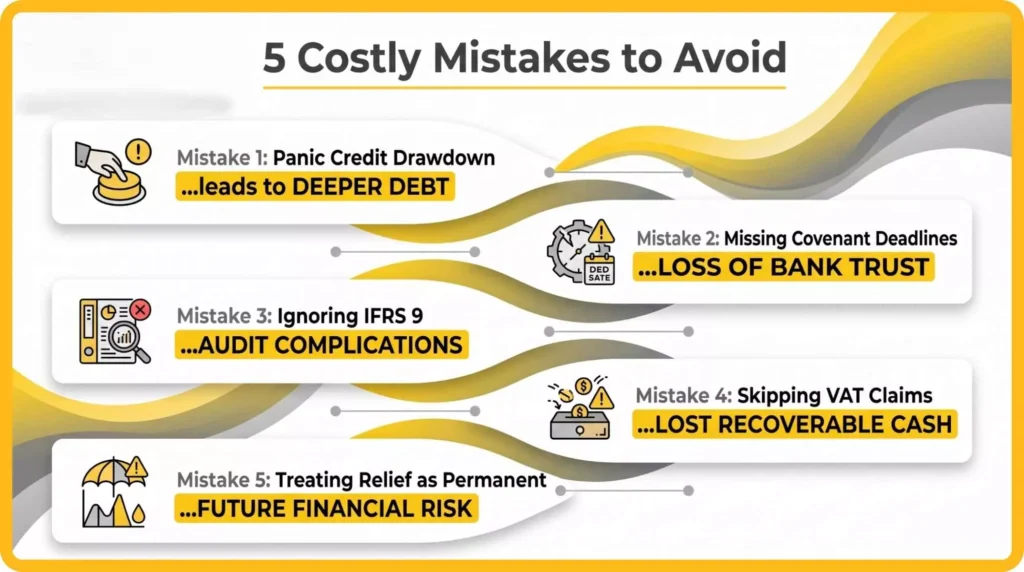
Five mistakes show up again and again and each one costs real money. Drawing down panic credit is the first: using your new facility to fund losses instead of stabilizing cash flow buys three months of false calm and a larger repayment when the package ends. Missing covenant notification deadlines is the second, silence is worse than bad news with any credit committee. Ignoring IFRS 9 disclosure in your own accounts is the third, because what saves the bank can sink you if your auditor qualifies the opinion. Skipping bad-debt VAT claims is the fourth, that is, cash you already paid, and leaving it with the FTA is the same as binning a cheque. Treating the relief as permanent is the fifth, and the most dangerous. Banks will normalize, and borrowers who did not prepare will get reclassified first. Relief rewards businesses that move carefully, not the ones that move fastest.
Planning for When the Relief Window Closes
The CBUAE has been clear that these measures are temporary and calibrated. When buffers are reinstated and classification flexibility ends, banks will re-stage their loan books quickly, and pricing, covenants, and provisioning will tighten on everyone who is not ready.
Companies that use the next nine to twelve months to rebuild come out of the cycle stronger than they went in. Companies that just push the pain forward face a second, harder crisis on exit. Build a simple exit test for your own file: can the business service its debt at pre-crisis covenant levels within nine to twelve months? If the honest answer is no, restructure now not later. Document every assumption in writing, because your auditor and your next lender will both ask for it.
Your Next Step
The Resilience Package is a window, not a rescue. Businesses that approach it with clean numbers, documented impact, clear bank conversations, and the right tax and accounting treatment will exit 2026 stronger than they entered. Businesses that drift through it will meet a harder 2027.
If you want a finance team beside you for the bank meeting, the IFRS 9 disclosure, and the tax treatment, Bestax Chartered Accountants works with UAE companies on exactly this kind of recovery. Book a conversation before your next covenant date.
Quick FAQs
Is my SME eligible for the CBUAE Resilience Package directly?
The package is administered through your bank, not directly with the CBUAE. You apply for its benefits through your lender. The central bank sets the framework; your bank decides how it reaches your account.
Will requesting loan classification postponement hurt my credit record?
Under the package’s framework, affected borrowers are treated with flexibility. Documentation and timely communication protect your standing, silence does not. Talking early keeps your file clean.
Can Free Zone and Mainland companies access the same relief?
Yes. The package flows through licensed UAE banks, so eligibility is driven by your banking relationship, not your licence type or zone.
Does the package cover Islamic finance customers?
Yes. CBUAE measures apply across conventional and Shariah-compliant lenders, though the instruments and terms differ in structure.
How long will the relief last?
The measures are temporary, and the CBUAE has signalled it will communicate normalization in advance. Plan for a 9-to-12-month horizon.
Disclaimer: The information provided in this blog is for general informational purposes only. For professional assistance and advice, please contact experts.
