




Accounting principles form the foundation of modern finance. They are not esoteric theories reserved for accountants; they are rules and concepts that govern how a business records its financial transactions, interprets its performance and communicates its story to investors, regulators and stakeholders.
Whether you operate a start‑up in Dubai’s bustling free zones or manage an established company in Abu Dhabi, understanding accounting principles is crucial for compliance, transparency and strategic decision‑making. This guide explains the core basic accounting principles for you and why they should matter to you.
What Are Accounting Principles and Why Do They Matter?
Definition and purpose
Accounting principles are standardized rules and guidelines that shape how financial information is recorded and reported. According to accounting literature, these principles exist to ensure uniformity, comparability, and adaptability across businesses so that investors and regulators can trust the numbers they see.
They also deter fraud by requiring consistent procedures and full disclosure. For instance, the economic entity assumption keeps business records separate from owners’ personal transactions, while the monetary unit assumption requires transactions to be measured in a stable currency to maintain comparability.
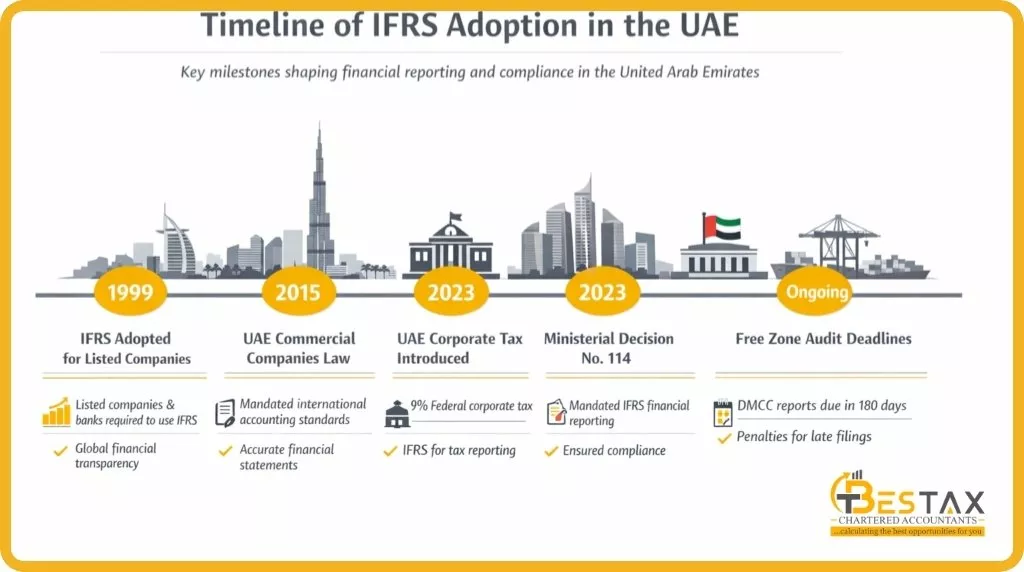
In the UAE, adopting accounting principles is not optional. The Federal Decree‑Law on Commercial Companies mandates that companies apply international accounting standards and practices in preparing their periodic and annual accounts. Ministerial Decision No. 114 of 2023 reinforces this obligation by requiring companies to prepare financial statements in accordance with International Financial Reporting Standards (IFRS). Compliance is critical not only for legal reasons but also because IFRS‑compliant statements serve as the basis for corporate tax calculations, particularly for entities with revenue above AED 3 million.
How accounting principles support the UAE economy
The UAE’s economy thrives on transparency and investor confidence. When businesses follow coherent accounting principles and concepts, stakeholders can compare financial statements across different sectors and make informed decisions. The adoption of IFRS since 1999 has made UAE companies more attractive to foreign investors, improved financial transparency and strengthened governance. Non‑compliance, on the other hand, can lead to fines, legal penalties and loss of investor trust.
The Building Blocks: Fundamental and Basic Accounting Principles
Over the years, educators and regulators have distilled accounting guidelines into various lists: 3 accounting principles, 5 accounting principles, 14 principles of accounting and the 10 core principles of GAAP. These lists overlap because they all originate from a common set of concepts. Below we explore each of the fundamental principles, so you can understand how they interact.
Economic entity, monetary unit and time period: the 3 basic accounting principles
Many textbooks start with three bedrock principles:
- Economic entity (business entity) principle: Business transactions must be recorded separately from the personal affairs of the owner. This applies even in sole proprietorships: personal assets like a car or a house are excluded from the business’s books. Maintaining this separation protects personal liability and clarifies the business’s performance.
- Monetary unit principle: All transactions must be expressed in a single stable currency; for instance, the dirham in the UAE or the U.S. dollar. According to accounting texts, it assumes that the currency’s purchasing power remains relatively stable, meaning inflation is ignored for measurement purposes. Without this assumption, comparing figures across periods would be impossible.
- Time period assumption: Also called the periodicity principle, this concept divides the life of a business into artificial time periods, monthly, quarterly or annually, for reporting. This allows businesses to prepare interim financial statements and requires adjusting entries for expenses like depreciation. UAE companies must align their financial year with the requirements of the Commercial Companies Law (12‑month periods after the first fiscal year).
These three principles form the starting point for every accounting system and correspond to the simplified list of 3 accounting principles used in basic courses.
The 5 main accounting principles
Expanding on the basic triad, many experts summarise five accounting principles that are essential for general practice:
- Cost principle: Assets should initially be recorded at their historical cost (original purchase price), not current market value. In the UAE, this principle is particularly relevant for property and equipment because it prevents inflation‑driven revaluations unless IFRS requires fair value measurement.
- Revenue recognition principle: Revenue should be recorded when it is earned (goods delivered or services performed), regardless of when payment is received. This principle is central to IFRS 15, which uses a five‑step model to ensure revenue is not recognized prematurely.
- Matching principle: Expenses must be recorded in the same period as the revenue they helped generate. For example, depreciation expense should be recognized over the useful life of an asset to match the revenue it produces.
- Full disclosure principle: Financial statements must include notes and schedules that provide all information necessary for a reasonable understanding of the company’s financial situation. In the UAE, this includes disclosing significant accounting policies, contingent liabilities and related‑party transactions.
- Objectivity principle: Accounting information should be based on verifiable evidence, not personal opinion. This principle ensures reliability and impartiality.
These five concepts align closely with IFRS requirements and are often summarised together as the main accounting principles.
The 14 principles of accounting (comprehensive list)
To provide a holistic view, many instructors refer to the 14 principles of accounting, a comprehensive framework that encompasses both fundamental assumptions and broad guidelines:
| No. | Principle | Explanation |
|---|---|---|
| 1 | Economic entity | Separate the business from the owner; do not mix personal transactions. |
| 2 | Monetary unit | Record transactions using a stable currency and ignore inflation. |
| 3 | Going concern (continuity) | Assume the business will continue operating for the foreseeable future. If liquidation becomes likely, disclose this to users and change the measurement basis. |
| 4 | Time period | Divide operations into periods (months, quarters, years); adjust entries for accruals and depreciation. |
| 5 | Cost principle (historical cost) | Record assets at their original cost and update only for depreciation. |
| 6 | Full disclosure | Provide notes explaining significant policies, commitments and contingencies. |
| 7 | Revenue recognition | Recognize revenue when earned and realizable; under IFRS 15 this involves identifying the contract and performance obligations. |
| 8 | Matching principle | Match expenses to the revenue they help generate. |
| 9 | Accrual (periodicity) | Record transactions when they occur, not when cash is received; record receivables and payables. |
| 10 | Materiality | Only information that could influence users’ decisions must be disclosed; trivial items may be aggregated. |
| 11 | Conservatism (prudence) | Be cautious: anticipate losses and liabilities, and only recognise revenue when it is reasonably certain. |
| 12 | Consistency and comparability | Apply the same accounting methods across periods and across entities. If changes occur, disclose them. |
| 13 | Objectivity (reliability) | Ensure that information is based on unbiased evidence. |
| 14 | Duality (double entry) | Every transaction affects at least two accounts, debit and credit, to preserve the accounting equation. |
When you see references to fundamental accounting principles, they typically encompass this list. Some lists condense materiality and conservatism into the broader concept of prudence.
Others treat accrual and matching as part of the revenue recognition principle. The key takeaway is that every one of these guidelines exists to ensure that financial statements reflect economic reality fairly and consistently.
IFRS Adoption and Regulatory Requirements in the UAE
Legal mandates
The UAE Commercial Companies Law requires companies to apply international accounting standards when preparing their financial statements. Ministerial Decision No. 114 of 2023 reiterates that IFRS is the baseline for financial reporting, making compliance obligatory across most sectors. Free zones such as the Dubai Multi Commodities Centre (DMCC) and Jebel Ali Free Zone (JAFZA) impose additional requirements, including submission of audited financial statements within 180 days of the financial year end. Failure to comply can result in monthly penalties of around AED 5,000 and non‑renewal of licenses. Businesses must also keep financial records for at least five years.
Link to corporate tax and AML
With the introduction of the UAE’s federal corporate tax regime, IFRS compliance has taken on new importance. IFRS‑compliant statements form the basis for calculating taxable income, and the Federal Tax Authority relies on these records.
Companies with revenue above AED 3 million face additional scrutiny and must ensure their financial systems are robust. Moreover, anti‑money laundering laws and economic substance regulations require clear audit trails and transparent reporting.
Benefits of IFRS compliance
Adopting IFRS has significantly improved the UAE’s investment climate. Studies show that after IFRS adoption, over 90 percent of surveyed UAE companies reported enhanced transparency and better investor confidence. Investors appreciate that IFRS brings comparability across borders and reduces ambiguity in transactions.
IFRS also demands detailed disclosures, such as the five‑step revenue recognition model, fair value measurements and regular impairment tests, which help companies avoid over‑valuing assets or booking income prematurely.
For example, real estate developers must test property values for impairment regularly under IAS 36, ensuring their balance sheets reflect realistic values.
Accounting Principles of Cost Accounting and the Matching Principle
Cost accounting in the UAE context
Cost accounting focuses on measuring, recording and analysing the costs associated with producing goods or services. Under IFRS and GAAP, the cost principle still applies, assets are recorded at historical cost, which provides reliability.
However, IFRS permits fair value remeasurement in specific circumstances. For manufacturing firms in Dubai or Abu Dhabi, accurate cost records are essential for determining pricing strategies, evaluating profitability and complying with tax authorities. When applying cost accounting principles, businesses should:
- Identify direct costs (materials, labour) and allocate indirect costs (overheads) using systematic methods.
- Use standard costing or activity‑based costing to improve precision and detect variances.
- Reconcile cost records with financial accounting statements to ensure consistency.
- Regularly review depreciation and impairment calculations in line with IFRS.
The matching principle in practice
The matching principle of accounting requires that expenses be reported in the same period as the revenues they help generate. This ensures that income statements present an accurate measure of profitability.
For example, suppose a company sells annual maintenance contracts in February; the revenue should be recognised over the contract period (e.g., twelve months), and expenses such as wages and materials should be allocated across the same months.
Matching also requires amortising prepaid expenses and recognising accrued liabilities. In the UAE, where service contracts and annual rentals are common, correctly applying the matching principle helps businesses avoid overstating earnings in one period and understating them in another.
Best Practices and Pro Tips for UAE Businesses
Sticking to accounting principles involves more than just reading regulations. Below are practical recommendations for UAE companies:
1. Establish strong internal controls. Implement segregation of duties, approval processes and regular reconciliations to prevent fraud and ensure objectivity.
2. Invest in IFRS‑trained professionals. The complexity of IFRS, especially in areas like revenue recognition, financial instruments and leases, means that well‑trained accountants and auditors are indispensable. Since UAE auditors must follow stringent guidelines, having staff who understand IFRS reduces the risk of non‑compliance.
3. Use integrated accounting software. Modern enterprise resource planning (ERP) systems can automate double‑entry bookkeeping, ensure compliance with the duality principle and generate IFRS‑compliant reports. Look for software that accommodates multi‑currency transactions, given the UAE’s exposure to foreign currencies.
4. Review contracts carefully. For companies involved in construction, real estate or long‑term service agreements, IFRS 15 requires identifying performance obligations and allocating transaction prices. A legal review can help ensure that contract terms align with accounting requirements.
5. Maintain thorough documentation. Keep invoices, agreements and supporting records for at least five years to satisfy legal and tax obligations. Documentation supports the objectivity and full disclosure principles.
6. Plan for taxes and free zone audits. Understand the interplay between IFRS statements and corporate tax filings. Free zones like DMCC may impose specific audit requirements and deadlines. Budget for audit fees and penalties if deadlines are missed.
Conclusion
Accounting principles are not mere academic concepts; they are the legal and ethical backbone of every organisation. In the UAE, the enforcement of IFRS, the growing importance of corporate tax, and rigorous free-zone audits mean that businesses must stay vigilant.
Ready to strengthen your accounting practices? Contact our team of UAE‑based accounting professionals at Bestax for advice and assistance in setting up compliant accounting systems.
Frequently Asked Questions
What are generally accepted accounting principles?
Generally Accepted Accounting Principles (GAAP) are a set of accounting rules and standards used in the United States to prepare financial statements.
Why are accounting principles important?
Accounting principles underpin transparent and comparable financial reporting. They help investors, lenders and regulators gauge a company’s true performance and financial position. In the UAE, adherence to IFRS is required by law, and non‑compliance can lead to fines and loss of investor trust.
How do the 3, 5 and 14 principles differ?
The 3 basic accounting principles (economic entity, monetary unit and time period) form the foundation of double‑entry accounting. The 5 accounting principles expand this list to include the cost principle, revenue recognition, matching, full disclosure and objectivity. The 14 principles of accounting encompass a more comprehensive set, combining assumptions (e.g., going concern), measurement bases (historical cost), ethical guidelines (prudence) and procedural rules (dual entry).
How does IFRS 15 affect revenue recognition?
IFRS 15 prevents companies from recognizing revenue too early and ensures that revenue reflects the transfer of control to the customer.
Are small businesses in the UAE exempt from IFRS
No. While certain simplified reporting frameworks exist, the UAE Commercial Companies Law and Ministerial Decision 114 require most companies to prepare IFRS‑compliant financial statements. However, entities with revenues below AED 3 million may have less stringent audit requirements, though using IFRS still enhances credibility and facilitates banking relationships.
What happens if I don’t follow accounting principles?
Failing to adhere to IFRS in the UAE can result in penalties, legal trouble and loss of investor confidence. Free zones may refuse to renew licenses, and the Federal Tax Authority may impose tax adjustments. Non‑compliance also weakens internal control and increases the risk of fraud.
Disclaimer: The information provided in this blog is for general informational purposes only. For professional assistance and advice, please contact experts.
