



A lot of owners do the “obvious” thing first. They cancel the trade licence, stop operations, and move on. Then an email lands in the inbox that says the closure file is still open. Suddenly, you are back in paperwork mode when you thought you were done.
This is where the liquidation report UAE becomes the document that decides whether your company can close cleanly, or stay stuck in follow-ups and extra costs.
In this guide, you will understand what the liquidation report is, why authorities ask for it, when it is required, and what proof usually gets the file approved without repeat requests. By the end, you will know if you need one and what to prepare before you submit.
A liquidation report is the final written record of the closure process. It shows the business has stopped, obligations are settled, and the company can be removed from active records.
What Is a Liquidation Report in the UAE?
A liquidation report is the final written record prepared during liquidation. It shows that the company has stopped business, settled obligations, and closed its financial position for the purpose of company closure. Think of it as the “closing file” that connects every closure step into one clear story.
Who prepares it depends on your setup and the authority’s rules. In most cases, an appointed liquidator or an authorized professional prepares and signs the report, because the report is meant to stand up to review.
It is also important to know what it is not. It is not a trade licence cancellation by itself. It is not a bank closure letter. It is not one single form you upload and forget. It is the document pack that ties together the liquidation process in UAE, with dates, proof, and a final summary that matches what the authority expects.
Why Is a Liquidation Report Required to Close a Company?
The main reason is simple: authorities need proof. They need to see that the business is not leaving unpaid dues, unresolved staff matters, or open liabilities behind. A company can stop operations today, but a closure file ends only when the records show it ended properly.
This is why the liquidation report UAE matters as a closure requirement. It becomes the “final account” narrative that supports deregistration and closure in official records, especially when the authority asks, “Show us what happened, and prove it.”
There is also a practical business reason. Without a solid report, your closure can turn into a back-and-forth cycle. You submit something, get a request for more proof, resubmit, then get another request because a date or name does not match. That is where delays and extra costs appear, even after the business has stopped.
When Is a Liquidation Report in the UAE Required?
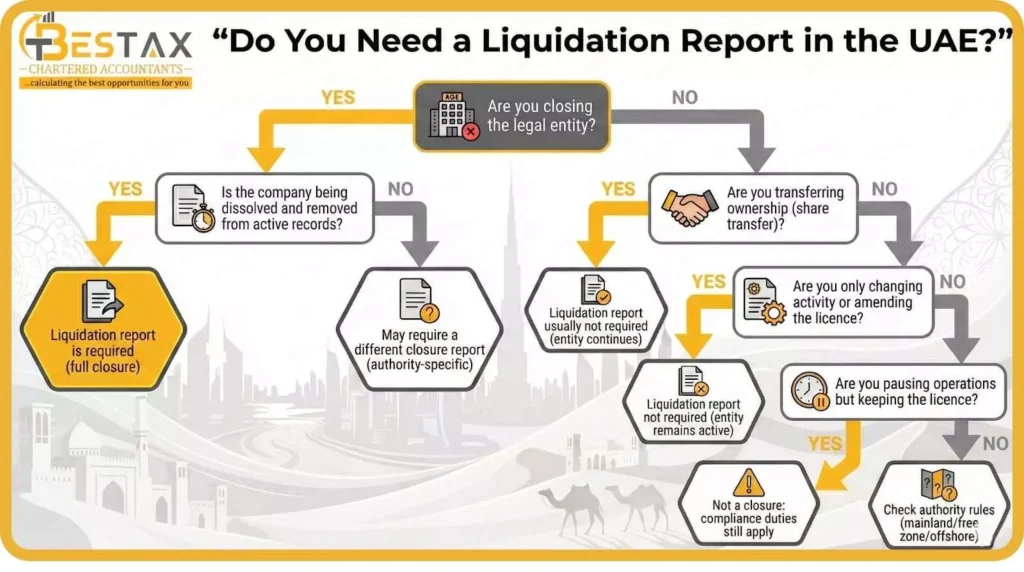
In most cases, it is required for full closures where the legal entity is ending. Here is a simple way to decide:
- Required in most full closures
- Voluntary liquidation and dissolution of the company
- Any closure where the legal entity is being ended and removed from active records
- Often not required (or required in a different form)
- Selling the business through a share transfer where the entity continues under new ownership
- Changing activity or amending the licence while the entity stays active
Now, the key clarity point that many guides skip: paused vs closed. If you pause operations, the entity still exists and still carries compliance duties. If you close, you are ending the entity, and you usually need a liquidation report UAE to prove the final position.
Types of Liquidation That Change the Report Requirements
Not every closure looks the same, and the report changes based on the situation.
- Voluntary liquidation is owner-driven. You decide to close, appoint a liquidator where required, settle matters, and close out the file.
- Compulsory or court-led liquidation is process-led. The steps and timelines may be shaped by court procedures and claims, so the report often becomes more detailed around settlements and disputes.
- Solvent vs insolvent is another turning point. In a solvent closure, the report often focuses on how assets were realized and whether anything is distributed after paying debts. In an insolvent scenario, the focus shifts toward claims, priorities, and proof of settlement steps.
If you are unsure which category you fall into, treat that as a planning risk. The wrong liquidation route can delay the closure and force you to redo documents.
The Liquidation Report Blueprint
Most articles say “get a liquidation report UAE” but never show what a strong one contains. Here is a practical, approval-ready blueprint that reduces questions and speeds reviews:
- Cover page: company details, licence number, shareholders, liquidator appointment reference
- Scope and date logic: cessation date, liquidation start date, reporting end date, and why these dates were used
- Assets realized: what assets were sold or disposed of, when it happened, and how the proceeds were handled
- Liability settlement schedule: creditors, employees, government dues, and proof of references
- Bank and cash position: account closures, final balances, and supporting confirmations
- Final accounts summary: a clear closing snapshot and short notes that explain any big movements
- Distribution statement: if there is any surplus, show how it was distributed and supported
- Declarations and attachments list: what is included, what was verified, and what remains nil
One legal detail matters here: creditors must be notified, and the law sets a minimum notice requirement. The notice is published in two local daily newspapers (one in Arabic) and must give creditors at least 30 days to present claims.
The “Under Liquidation” Status Trap
During a company liquidation in UAE, the company may still exist legally for the limited purpose of completing liquidation tasks. This is why you sometimes see “Under Liquidation” used with the company name and in formal communications.
This matters in real life because banks, landlords, and other parties may ask for documents that match the company’s current status. If your report says one thing, your letters say another, and your notice shows a third version, you invite rejection or delay.
Your fix is boring but powerful: keep the company name, licence number, and key dates consistent across the report, notices, bank letters, and any authority forms. Consistency is what approvals are built on.
Step-by-Step Process to Complete a Liquidation Report in the UAE
A clean report comes from a clean sequence. Here is the flow most authorities expect, described in a simple, do-this-next way.
Step 1:
Pass the shareholder or board resolution confirming liquidation and the liquidator’s appointment (where required). Official guidance for mainland closures starts here: notarized minutes confirming liquidation and appointing a liquidator.
Step 2:
Confirm the scope and the closure dates, because your cessation date drives the rest of the file.
Step 3:
Plan the notice and claims window, then issue notices as required and keep proof of publication and delivery.
Step 4:
Settle employees, visas, suppliers, and government-related dues, and keep evidence for each settlement.
Step 5:
Close bank accounts, complete final reconciliations, and prepare the final accounts summary to be included in the report.
Step 6:
Submit the report pack to the authority and respond to any queries using the same evidence pack, not new documents with new dates.
Step 7:
After approval, you can usually proceed with the final licence cancellation and obtain the closure confirmation. Depending on the jurisdiction, you may also receive a liquidation certificate as the final proof that the closure has been completed.
Unique Section That Makes the Report Defendable
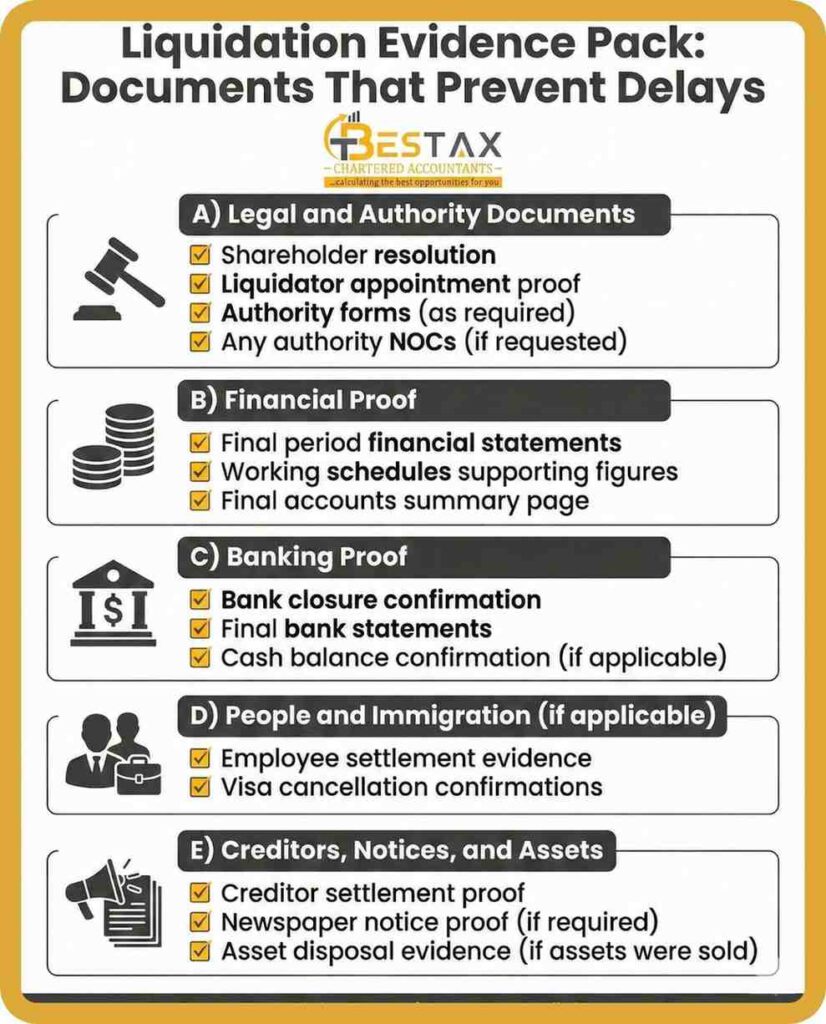
This is the part that saves you from repeat requests. Build this pack first, then write the report around it:
- Shareholder resolution and liquidator appointment proof
- Final period financial statements and working schedules
- Bank closure proof and final bank statements
- Employee settlement evidence and visa cancellation confirmations (where applicable)
- Creditor settlement evidence and supplier clearances (where applicable)
- Proof of notices and any required publications
- Asset disposal evidence (if assets were sold)
- Any authority-specific no-objection letters requested during closure
If something is missing here, the report becomes weak, no matter how well it is written.
Mainland vs Free Zone vs Offshore
The report concept stays the same, but the approval checkpoints change.
On the mainland, authorities often focus on the resolution, the liquidator’s role, settlements, and a clear final accounts view. They want to know the entity is ending cleanly.
In a free zone, you often deal with authority templates, internal closure steps, and specific format expectations. That is why another can reject the same report that works for one authority.
Offshore closures can rely more on registered agent processes and registrar requirements, plus proof that operations and accounts are closed.
A simple way to avoid guessing is to build an “authority checklist” before you submit. List what your authority asks for, map each item to a document in your evidence pack, then submit only when every box has proof.
Common Rejection Reasons and How to Avoid Them
Most rejections are not about big mistakes. They come from small mismatches that look risky to reviewers.
One common problem is mismatched cessation dates across documents. Another is missing settlement proof for employees or creditors. Bank accounts that are still active also trigger delays, because they suggest the company might still be operating.
A report can also be rejected if it lacks a clear final account summary or if notices and attachments are missing. Even simple identity issues cause problems, like different spellings, different licence numbers, or a company name that changes between documents.
Your best defence is one rule: one set of dates, one set of names, one evidence pack, and one story.
Timeline Planning for 2026 Closures
Closures take longer when you submit before the file is ready. The fastest closures usually follow one pattern: build proof first, then submit once.
Also, do not forget the tax side of closure planning. If you are registered for Corporate Tax, the FTA guidance warns that failing to submit a tax deregistration application within three months of cessation, dissolution, or liquidation can trigger penalties of AED 1,000, plus AED 1,000 monthly up to AED 10,000.
This is why many owners treat closure like a project with weekly milestones. It keeps dates, filings, and approvals aligned, and it reduces last-minute surprises.
Conclusion
A liquidation report is not just another document. It is the closure proof that ties together settlements, final accounts, and authority approval. If you want fewer delays, use the blueprint, build the evidence pack first, and keep your dates and names consistent across every file.
If you want a second set of eyes before you submit, Bestax Chartered Accountants can review your closure pack and report structure so your submission reads clean, complete, and consistent, without turning the process into a long email chain.
Quick FAQs
What is a liquidation report, and who issues it?
It is the final written record of the liquidation and closure steps. It is usually prepared by an appointed liquidator or authorized professional and submitted to the relevant authority for closure approval.
Do all companies need a liquidator to close?
Not always. Some setups require a liquidator appointment, while others may allow a simplified closure. The requirement depends on your jurisdiction, legal form, and authority rules.
What documents are usually needed to support the report?
You typically need the resolution, liquidator appointment proof, final accounts, bank closure proof, settlement proof for staff and creditors, notice proofs, and any authority-specific clearances.
Why do some closures take longer even after business stops?
Delays usually come from missing proof, date mismatches, unpaid dues, or submissions made before all accounts and settlements are closed.
Can I close my licence without a liquidation report?
In many full closures, cancelling the licence alone is not enough. If the legal entity is ending, a liquidation report or an equivalent closure report pack is often required to close the file properly.
Disclaimer: The information provided in this blog is for general informational purposes only. For professional assistance and advice, please contact experts.
