




Starting a business in the United Arab Emirates is exciting, but it comes with legal obligations. One of the first documents you will encounter is the memorandum of association.
This guide explains what a memorandum of association (MoA) means for UAE companies in 2026, why it matters and how recent amendments impact new businesses.
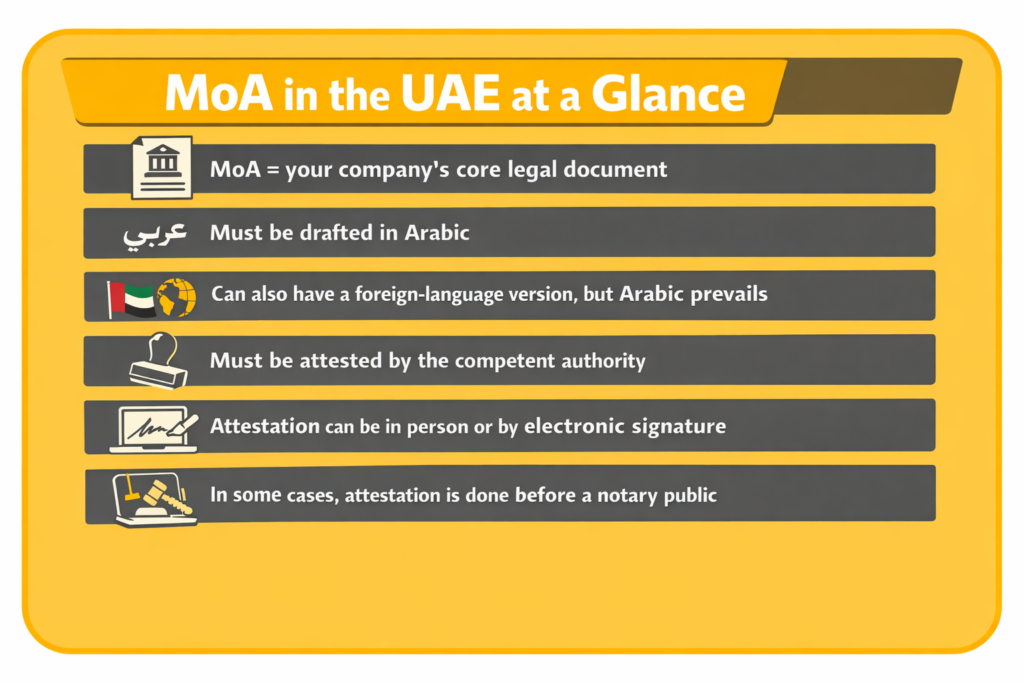
What is a Memorandum of Association (MoA)?
A memorandum of association is a constitutional document that creates the legal identity of a company and defines its relationship with the outside world. Under Article 14 of Federal Decree‑Law No. 32 of 2021 on Commercial Companies, the MoA must be drafted in Arabic and attested by the competent authority; if a foreign‑language version is provided, the Arabic version prevails. The law allows attestation either in person or by electronic signature, and in exceptional cases the document may be notarised before a notary public.
In practical terms, the MoA records essential details of your company, its name, purpose, legal form, capital structure, ownership, responsibilities and rules for operating. Once notarised and registered, the MoA gives your company legal existence and becomes binding on the company and third parties.
MoA vs Articles of Association (AoA)
A second key document in UAE corporate law is the articles of association (AoA).
The difference between an MOA and articles of association depends on the type of company you are forming.
For an LLC, the company is incorporated through the MoA. In practice, the MoA covers both the core constitutional details and the internal operating rules. That means the same document usually sets out the company name, purpose, capital, ownership, management powers, profit distribution, meeting rules, transfer rules, and dispute provisions. A separate AoA is not normally required for an LLC under the main incorporation framework.
For private joint-stock companies and public joint-stock companies, the position is different. These company forms generally require both a memorandum of association and articles of association, with each document serving its own formal role in the incorporation and governance structure.
So, if you are writing for founders choosing an LLC, it is more accurate to say this: in an LLC, the MOA is the main governing document. It is not just an external-facing record. It also handles much of the company’s internal governance.
| Company Type | MoA | Separate AoA |
|---|---|---|
| LLC / One Person LLC | Main incorporation and governance document | Not usually required as a separate document |
| Private Joint-Stock Company | Required | Required |
| Public Joint-Stock Company | Required within the statutory framework | Required |
Legal Framework for MoAs: 2021 Law & 2025 Amendments
Drafting and Attesting the MoA (Article 14)
Federal Decree‑Law No. 32 of 2021 is the primary legislation for mainland companies. Article 14 stipulates that the MoA and any amendments must:
- Be drafted in Arabic and attested by the competent authority; a foreign‑language version may accompany the Arabic text, but the Arabic text prevails.
- Be attested physically or electronically as determined by the competent authority; the law also allows attestation before a notary public in cases specified by the authority.
- Include optional clauses. Partners in LLCs and shareholders in PrJSCs may insert drag‑along and tag‑along provisions (allowing majority owners to compel minority owners to sell or enabling minority owners to join a sale). They may also include rules on how the shares of deceased partners are handled, including pre‑emptive rights for surviving partners or the company itself.
Registration with the Competent Authority (Article 15)
An MoA is only effective once registered. Article 15 states that the MoA and any amendments become effective after registration in the commercial register. Failure to register means the MoA has no legal effect against third parties. Companies must notify the competent authority and registrar within 15 business days of changes in registered details such as name, address, share capital, number of shareholders or legal form. Managers or directors are jointly liable for damages arising from failure to register or update the MoA.
Invocation by Third Parties (Article 16)
Article 16 provides that third parties may prove the existence of the MoA and invoke its validity or invalidity. If a company is declared invalid at the request of a third party, the company is deemed void from inception in relation to that third party, and persons acting on behalf of the invalid company become jointly liable for obligations arising from the MoA. Even in cases of invalidity, the MoA’s terms govern liquidation and settlement among shareholders.
2025 Amendments: Drag‑Along & Tag‑Along Rights, Share Classes and More
In October 2025, Federal Decree‑Law No. 20 of 2025 amended the Commercial Companies Law to make the UAE more investor‑friendly. A Ministry of Economy brief summarising the amendments highlights several key reforms:
- Drag‑along and tag‑along rights recognised: The 2025 amendments include provisions allowing majority partners or shareholders to compel minority holders to sell their shares during a sale while giving minority holders the right to join the sale on the same terms. These provisions support flexible structuring, protect rights and make ownership transfers smoother.
- Reduced lock‑up period: For private joint‑stock companies, the lock‑up period for disposing of shares is reduced from two years to one year, with possible ministerial exemptions. Private placements or listings may be exempted from any lock‑up.
- Harmonisation with free‑zone laws: The amendments align the Commercial Companies Law with free‑zone and financial‑free‑zone regulations, enabling easier transfer of companies between regimes and harmonising licensing procedures.
- Valuation of in‑kind contributions: New standards require in‑kind contributions (e.g., real estate, equipment or intellectual property) to be valued according to standards issued by the Ministry of Economy and Tourism in coordination with the competent authority. This encourages transparency when adding non‑cash assets to capital.
- Corporate mobility: Although not explicitly highlighted in the brief, Article 15 BIS of the 2021 law already permits companies to transfer their registration between emirates or from a free zone to the mainland (and vice versa) while retaining legal personality. The 2025 amendments enhance these mechanisms, streamlining relocations and conversions.
These reforms mean that 2026 is the first full year in which drag‑along/tag‑along rights and multi‑class share structures can be embedded directly into an MoA, giving founders and investors more sophisticated tools.
Why Does Your Business Need an MoA?
The MoA is more than just paperwork; it is the foundation of your company. Here is why it matters:
- Legal requirement: For mainland LLCs and PrJSCs, an MoA is mandatory. Some free‑zone authorities also require an MoA, especially when there is more than one shareholder or a complex structure.
- Defines the company’s scope: The MoA states what activities your company is legally permitted to undertake. Operating outside these activities may invalidate transactions and expose the business to penalties.
- Provides certainty to partners and investors: Share ownership, capital contributions, profit distribution and liability are defined in the MoA. Investors feel safer when rights and obligations are spelled out.
- Regulatory compliance: Licensing authorities (such as Dubai’s Department of Economy & Tourism or Abu Dhabi Department of Economic Development) rely on the MoA to approve trade licences. The document helps ensure your company aligns with UAE regulations and foreign ownership rules.
- Facilitates banking and contracts: Banks and counterparties often require an attested MoA before opening accounts or signing contracts. It functions as your company’s constitution.
- Protects during disputes: Should disagreements arise, courts will refer to the MoA. Article 16 clarifies that third parties may invoke the MoA’s validity, and in cases of invalidity the MoA governs liquidation.
Key Clauses and Sections of a UAE MoA (2026)
While the exact content may vary depending on the company type or free‑zone requirements, a typical UAE MoA includes the following sections:
- Company Name and Legal Form: States the official name, legal form (LLC, PrJSC, general partnership, etc.) and registered office address.
- Purpose and Activities: Defines the main and ancillary business activities; you must align these with the activity codes permitted by the competent authority.
- Duration: Many MoAs state that the company exists for an unlimited period unless dissolved earlier by law or unanimous partner decision.
- Capital and Shareholding: Specifies authorised share capital, number and value of shares, ownership percentages and whether different classes of shares exist. After the 2025 amendments, LLCs and PrJSCs may have multiple classes of shares with different voting or economic rights (e.g., class A and class B shares).
- Partners/Shareholders: Lists the names, nationalities, addresses and capital contributions of the partners or shareholders. It may specify whether an Emirati partner is acting as a local service agent (no shareholding) or local partner (shareholding).
- Management and Governance: Sets out who manages the company (e.g., one manager or board of directors), their powers, appointment and removal procedures, and remuneration.
- Profits and Losses: Outlines how profits and losses are distributed among partners based on shareholding; it may restrict distribution or permit reinvestment.
- Restrictions on Transfer and Pledge: Describes how shares or stakes can be transferred. After 2025, drag‑along and tag‑along clauses may appear here (see Article 14(4)).
- Succession and Deceased Partner Clause: Provides a mechanism to handle the shares of a deceased partner, including pre‑emptive rights and valuation rules.
- Liquidation and Dissolution: Describes how the company will be wound up, how assets and liabilities are distributed and the role of a liquidator. Article 16 ensures that even if the company is declared invalid, the MoA governs liquidation.
- Dispute Resolution: States the applicable law (UAE law) and often requires disputes to be resolved in UAE courts. Some MoAs also provide for arbitration.
- Other Provisions: May include confidentiality obligations, non‑competition covenants, exclusivity arrangements or undertakings required by regulators.
Pro Tip: When drafting the MoA, think ahead. Include exit strategies, valuation methods for in‑kind contributions and share classes that match your funding needs. Ensure the MoA aligns with shareholder agreements and any free‑zone or mainland regulations.
MoA Requirements by Company Type and Location
Different company structures and locations in the UAE have specific MoA requirements. Here is a breakdown:
Limited Liability Company (LLC)
A Limited Liability Company, or LLC, is one of the most common business structures in the UAE. It can be formed by one person or by multiple partners. Under the Commercial Companies Law, an LLC may be established by a single natural or legal person as a Limited Liability One Person Company. In that case, the owner’s liability is limited to the capital stated in the company’s memorandum of association.
Where there is more than one owner, the LLC structure can still be used in the usual multi-partner form. This matters because many founders now set up single-owner mainland companies and assume they need at least two shareholders. That is no longer the right reading for LLCs as a category in the UAE.
For practical planning, this means a founder can launch an LLC alone, then later admit new partners if the business grows, investment comes in, or ownership is restructured.
Private Joint‑Stock Company (PrJSC)
- A private joint-stock company, or PrJSC, must have capital that is sufficient to achieve its objects.
- The law does not set a fixed statutory minimum capital amount for all PrJSCs. Instead, the capital is determined based on the company’s purpose, structure, and regulatory context, and it is subject to approval where required by the competent authority or the relevant securities regulator.
- The MoA must be attested and registered with the competent authority and the Securities & Commodities Authority (SCA) if the company issues securities.
- The 2025 amendment reducing the lock‑up period from two years to one year for share transfers applies here.
Public Joint‑Stock Company (PJSC)
- A PJSC’s constitutional document is usually called the articles of association rather than an MoA; however, when converting from an LLC or PrJSC, a memorandum may still be used.
- Due to their public nature, PJSCs follow additional rules from the SCA and Dubai Financial Market (DFM) or Abu Dhabi Securities Exchange (ADX).
Professional Companies
Not every professional company in the UAE is governed by the same resolution. This point needs to be handled carefully.
Cabinet Resolution No. 10 of 2025 specifically applies to law firms and legal consultancy firms. It regulates the organisational framework for advocacy and legal consultancy professional companies, including licensing, registration, partnership conditions, and the rulesfor working with international legal firms.
That resolution does not apply across all professions. It does not automatically govern doctors, engineers, architects, or general consultants. Those businesses may be formed under other provisions of UAE company law or under sector-specific rules issued by the relevant regulator..
Free‑Zone Companies
- Many free‑zone authorities provide standard templates that function as both MoA and AoA. Some zones, such as Dubai Multi Commodities Centre (DMCC) or Abu Dhabi Global Market (ADGM), issue articles of association only; others require an MoA when there are multiple shareholders or if the company is an LLC.
- Free‑zone MoAs may be signed electronically through the authority’s portal. After the 2025 harmonisation, transferring a company between a free zone and the mainland is easier.
Pro Tip: Each emirate and free zone has its own forms and procedures. Always check the latest templates on the official websites of the relevant economic department or free‑zone authority.
How to Draft and Attest a MoA: Step‑by‑Step Guide
- Choose the legal form and activities. Determine whether your business will be a mainland LLC, PrJSC, a professional company or a free‑zone company. Select permitted activities from the official list of the competent authority.
- Prepare a draft. Use the standard template provided by the authority as a starting point. Add custom clauses for share classes, drag‑along/tag‑along rights, succession or other arrangements. Ensure the MoA is in Arabic; you may attach an English translation but the Arabic text prevails.
- Appoint partners and decide shareholding. Confirm the names, ID/passport details, nationalities and share percentages. Specify cash and in‑kind contributions, including valuation for non‑cash assets as per the new standards.
- Obtain approvals (if required). Certain activities (media, education, healthcare, financial services) require approvals from regulatory bodies before the MoA can be attested.
- Submit for attestation. Log into the relevant authority’s e‑services portal (Dubai, the “Invest in Dubai” portal; Abu Dhabi, ADDED’s e‑services; other emirates, their DED portals). Upload the draft MoA, scanned passports and Emirates IDs. Choose whether to sign in person or via electronic signature. The competent authority or notary public will verify identities and witness signatures.
- Pay the fees. Attestation fees vary by emirate and company type. Expect additional notary fees if you choose a private notary.
- Register the MoA. Once attested, the authority will register the MoA in the commercial register. Registration makes the document legally enforceable.
- Obtain a trade licence. After registration, submit the MoA along with other documents (lease contract, shareholder resolutions, approvals) to obtain the trade licence.
- Update when changes occur. Should you change your company name, address, share capital, shareholders or legal form, update and re‑register the MoA within 15 business days. Failure to do so may attract penalties and personal liability for managers.
Pro Tip: Use the electronic signature option where available. Many free zones and emirate‑level authorities now accept digital signing, saving you time and the cost of notarisation.
Costs and Timelines
Exact costs differ between emirates and depend on capital, number of shareholders and whether you require a private notary. To give a broad idea:
- Attestation fees: Notary attestation typically ranges from a few hundred to several thousand dirhams, depending on company type. Some free zones include MoA drafting and attestation in their licence packages.
- Registration fees: Economic departments charge for commercial registration, often based on share capital or number of activities.
- Timeframe: Drafting and attestation can be completed in 2–4 working days for straightforward structures, but complex share arrangements may require more time for approval.
Always check fee schedules on official websites or consult a registered service provider.
MoA Requirements by Emirate and Free Zone
Dubai (Department of Economy & Tourism)
Dubai requires an MoA for mainland LLCs, PrJSCs and most professional companies. The document must be uploaded via the Invest in Dubai portal. Electronic signature (UAEPass) is accepted. Free zones such as DMCC and Jebel Ali Free Zone (JAFZA) provide their own constitutional documents; if you plan to transfer to the mainland later, draft your MoA with flexibility in mind.
Abu Dhabi (Abu Dhabi Department of Economic Development – ADDED)
ADDED requires an MoA for LLCs and PrJSCs. It offers a bilingual template and, like Dubai, allows electronic attestation. In Abu Dhabi Global Market (ADGM), companies adopt “articles of association” rather than a memorandum.
Sharjah, Ajman, Ras Al Khaimah, and Fujairah
Each emirate’s economic department provides its own forms. For example, Sharjah Economic Development Department (SEDD) offers Arabic and English templates; Ras Al Khaimah Economic Zone (RAKEZ) uses MoAs for multiple shareholders. Always use the official template and ensure compliance with Emirate‑specific rules.
Free Zones
- ADGM and DIFC (Financial Free Zones): Companies are formed under English common law frameworks and adopt articles of association instead of a memorandum.
- Other Free Zones (e.g., DMCC, JAFZA, RAKEZ, SAIF Zone): Provide standard MoA/AoA templates. Some zones (e.g., DMCC) allow single‑shareholder companies with no MoA. Always consult the respective authority.
Conclusion
The memorandum of association is the backbone of any mainland or multi‑shareholder free‑zone company in the UAE. It defines your company’s legal identity, sets the limits of its activities, and protects the rights of partners and investors.
The 2025 amendments bring powerful new tools, drag‑along and tag‑along rights, multiple share classes, and harmonisation with free‑zone laws, making 2026 the perfect time to structure your business flexibly.
Drafting an MoA requires careful consideration of legal obligations and business goals. If you’re planning to incorporate a company in the UAE, consult with a licensed business setup consultant to ensure your MoA is comprehensive and compliant.
Quick FAQs
What does a memorandum of association include?
An MoA contains the company’s name, legal form, purpose and activities, head office, capital structure, ownership stakes, management arrangements, profit and loss distribution, provisions for transferring shares and clauses on dissolution or exit. Optional clauses may include drag‑along/tag‑along rights and rules for handling the shares of deceased partners.
Do free‑zone companies need an MoA?
It depends on the free zone. Some zones provide a combined MoA/AoA template for multi‑shareholder companies; others use only articles of association. Always follow the template issued by the relevant authority. If you plan to transfer the company to the mainland later, drafting an MoA that mirrors mainland requirements is advisable.
How are drag‑along and tag‑along rights implemented?
Following the 2025 amendments, LLCs and PrJSCs may include drag‑along/tag‑along rights directly in their MoA. Drag‑along rights allow majority shareholders to compel minority shareholders to sell their shares during a sale, while tag‑along rights give minority shareholders the right to join the sale on the same terms. Including these rights in the MoA gives them statutory recognition and makes enforcement easier.
Can I add or remove partners after the MoA is registered?
Yes, but you must amend the MoA, have the amendment attested, and register it with the competent authority. Notify the authority and registrar within 15 business days of any changes.
Is the MoA valid without registration?
No. Article 15 clearly states that the MoA and any amendments have legal effect only after registration with the competent authority.
Disclaimer: The information provided in this blog is for general informational purposes only. For professional assistance and advice, please contact experts.
