



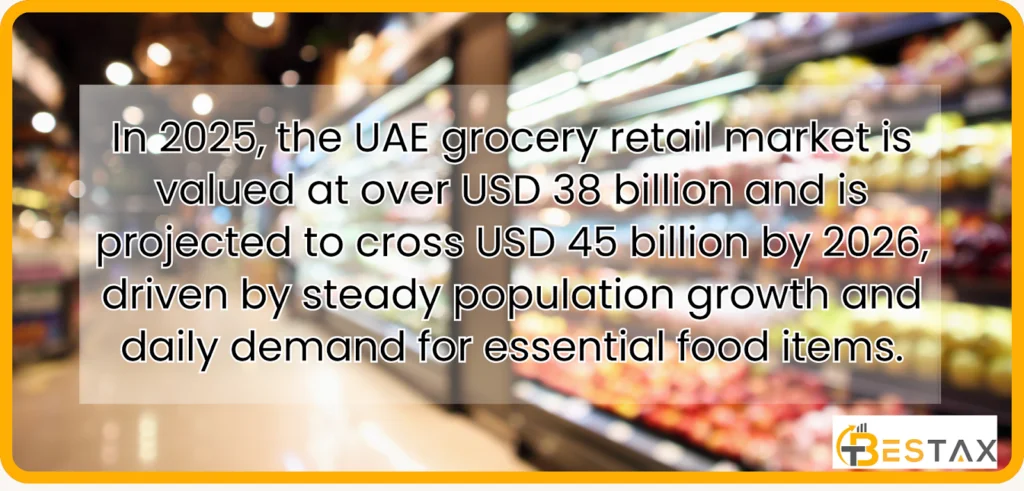
Opening a grocery store in Dubai is not a lifestyle business. It is a volume-driven, cash-flow asset. According to Statista, the UAE grocery retail market exceeds USD 38 billion in 2025 and is projected to grow steadily through 2026, with food and essentials contributing over one-third of total retail spending. Unlike discretionary retail, grocery demand remains stable across economic cycles, supported by population growth, high expatriate density, and year-round consumption.
For investors, the appeal is predictability. Grocery stores benefit from frequent purchase behaviour, fast inventory turnover, and recurring footfall, especially in dense residential areas of Dubai. With the right location, licensing structure, and supply chain, a grocery store in Dubai offers defensible margins, steady monthly revenue, and long-term scalability in one of the Middle East’s most resilient retail segments.
Why Dubai’s Grocery Market Is Thriving
Dubai’s grocery sector benefits from several structural advantages:
- High demand from a growing population. Dubai’s population continues to expand with expatriates and tourists. Demand for grocery stores is constant, and new residential communities ensure a growing customer base.
- Ease of doing business. The UAE government has simplified company registration and offers more than 20 free zones. City’s top‑notch infrastructure and business‑friendly climate make it an attractive place for entrepreneurs.
- Global supply chain access. Located between Asia, Europe, and Africa, Dubai’s ports and logistics hubs (Jebel Ali Port, Al Maktoum International Airport) make it easy to import a wide range of products.
Market Research: Understanding Dubai’s Diverse Consumers
Before committing capital, conduct detailed research on consumer preferences, competition, and location. Dubai’s population includes Emirati families, South Asian and Middle Eastern expatriates, and Western professionals. Demand varies by neighbourhood, organic produce and imported speciality items sell well in upscale areas such as Marina or Downtown, while discount grocers thrive in more residential districts such as Deira and Karama.
Key questions to answer during market research:
- Who is your target customer? Identify whether you’ll serve daily shoppers, expatriate communities, tourists or corporate clients.
- What niche do you want to occupy? Options include neighbourhood convenience stores, organic or specialty supermarkets, discount grocers or bulk‑buy discounters. Clarify your product mix early to choose the correct business activity when you apply for your licence.
- Where is the best location? Look for premises with high foot traffic, accessible parking and proximity to residential or business hubs. Areas such as Dubai Mainland for direct customer access; Jebel Ali Free Zone and DMCC are better for wholesale or import/export groceries due to their logistics network.
Legal Framework and Licensing for Grocery Stores
Choosing the Right Legal Structure
Grocery stores in Dubai typically operate as either a Limited Liability Company(LLC) on the mainland or as a Free Zone company. Mainland businesses allow you to sell directly to residents anywhere in Dubai. Free Zone companies (e.g., DMCC, Meydan Free Zone or Jebel Ali Free Zone) offer 100 % foreign ownership, simplified regulations and customs exemptions, but they restrict sales to within the free zone or require a distributor to sell on the mainland. Your choice will affect the licensing process and capital requirements.
Registering Your Trade Name and Getting Initial Approval
All businesses in Dubai need to register a trade name with the Department of Economic Development (DED). The name must follow DED guidelines, it cannot include profanity, religious references or another firm’s name. Reserve several name options in case your first choice is unavailable.
Once you decide on a legal structure and have a business plan, apply for initial approval from the DED. This stage confirms that the government has no objection to your proposed grocery store. You will submit passport copies, initial approval forms, your business plan and other supporting documents. Without initial approval, you cannot proceed with the licensing process.
Lease Contracts and Ejari Registration
Before applying for a grocery licence, you must secure a suitable commercial space and sign a tenancy contract. Dubai’s Real Estate Regulatory Agency (RERA) administers Ejari, the official rental registration system. Every lease must be registered through Ejari.
Without a valid Ejari certificate you cannot activate utilities such as DEWA (Dubai Electricity & Water Authority) or renew a trade licence. To register Ejari you need a signed tenancy agreement, a copy of the tenant’s Emirates ID, copies of passports and visas, the title deed, and the business trade licence. Registration costs around AED 220 for online submissions.
Applying for Your Grocery Licence
After obtaining initial approval and registering your lease, apply for a commercial licence for grocery activities. The process involves submitting your approved trade name certificate, Ejari registration, tenancy contract, Memorandum of Association and approvals from the DED and Dubai Municipality.
A commercial licence permits you to sell food items classed as groceries but does not allow the sale of pharmaceuticals, herbal medicines, cosmetics or medical devices. Licences are normally valid for one year and must be renewed before expiry. The eTrader (home‑based) licence requires a fee of AED 1,070 for licence and innovation fees plus AED 300 for Dubai Chamber membership. Full grocery licences for brick‑and‑mortar stores cost more: business setup fees between AED 10,000 and AED 50,000, depending on location, store size and business type.
The costs are based on conditions, and for the estimated license cost, check out this business setup cost calculator for free
Cost Breakdown and Budgeting
Set‑up costs vary widely based on location, store size and product range. Typical expenses include:
| Cost Component | Estimate (AED) | Notes |
|---|---|---|
| Business setup & licensing | 10,000–50,000 | Includes registration fees, trade licence and initial approvals. Package fees may vary based on free zone or mainland authority. |
| Rent | 100,000–500,000 per year | Prime locations cost more; budget for 6–12 months rent up front. |
| Interior fit‑out | 50,000–200,000 | Shelving, refrigeration, cash registers, signage and design. |
| Inventory | 100,000–500,000 | Initial stock depends on product range; consider perishables and storage. |
| Operational expenses | Variable | Staff salaries, utilities (electricity, water, waste disposal), point‑of‑sale and inventory software, packaging and marketing. |
Required Documents
Gather the following documents before submitting your application:
- A comprehensive business plan outlining market research, products, pricing, marketing and financial projections.
- Trade name certificate and initial approval from DED.
- Lease agreement for the premises and the Ejari certificate.
- Passport and visa copies of all shareholders.
- Memorandum of Association (for LLC) or service agent contract (for sole establishments).
- Approval from Dubai Municipality and Food Control Department for food safety compliance.
- Health and safety and fire safety approvals.
- VAT registration and tax registration number if your annual taxable supplies exceed the mandatory threshold.
- Trademark registration from the Ministry of Economy if you intend to brand your own products.
VAT Registration and Tax Considerations
Grocery stores must register for VAT and charge 5 % VAT on taxable supplies once their turnover exceeds the threshold set by the Federal Tax Authority. Businesses need to obtain a VAT registration number and use a compliant invoicing system.
Although Dubai introduced a federal corporate tax on profits over AED 375,000 (effective June 2023), small grocery stores below this threshold still enjoy zero corporate tax and no customs duties on imported food products. Always consult a qualified tax advisor for up‑to‑date guidance.
Food Safety Training and Certification
The Dubai Municipality’s Food Safety Department mandates formal training for all food handling staff, supervisors, and managers. According to the municipality’s Requirements for Integrated Training Management System, all food employees must be trained in Basic Food Safety before starting work, and persons in charge must take PIC (Person in Charge) training to ensure they can implement food safety standards. Training must be renewed if inspections reveal gaps or if new staff are hired. Many authorised training providers offer courses in multiple languages, and completion certificates are required during inspections.
Permits for Advertising, Signage, and Intellectual Property
Dubai strictly regulates outdoor advertising. Changing or amending your licence (e.g., adding new products or activities) also requires approval from the municipality and the DED. Selling goods with fake trademarks is prohibited and may result in fines. Registering your own brand with the Ministry of Economy protects your intellectual property rights.
Where to Open: Choosing the Right Location in Dubai
Selecting the right location can make or break your grocery store. Key options include:
- Dubai Mainland – Best for stores targeting residents because it allows unlimited trading across the UAE. Mainland locations provide direct access to customers and businesses. Popular neighbourhoods include Deira (traditional markets), Al Quoz (warehouses), Sheikh Zayed Road (business district) and residential communities like Al Barsha, Jumeirah and Mirdif.
- Dubai Multi Commodities Centre (DMCC) – Ideal for businesses dealing with food commodities and imports. Located in Jumeirah Lakes Towers (JLT), DMCC offers access to a network of suppliers.
- Jebel Ali Free Zone (JAFZA) – Perfect for wholesalers or import/export grocery businesses thanks to its proximity to Jebel Ali Port and major airports.
- Meydan Free Zone / Dubai Silicon Oasis / Dubai Industrial City – Cost‑effective options for start‑ups or tech‑savvy urban audiences. These zones offer packages with lower rent and flexible licences.
When choosing a site, assess foot traffic, parking, competition, proximity to residential areas and rental rates. Prime malls and high‑end neighbourhoods command higher rents but yield greater sales volume, while community centres offer stable demand at lower cost.
For online groceries, warehouse space near major highways like Sheikh Zayed Road and E311 (Emirates Road) reduces delivery times.
Step‑by‑Step Process to Open a Grocery Store in Dubai
Step 1: Business Planning and Company Structure
Decide what type of grocery you will operate (convenience store, specialty organic shop, discount grocer, wholesale supplier). Plan your initial investments, reserve funds, business location and company structure. Prepare a comprehensive business plan covering market research, marketing strategies, suppliers, pricing and financial projections. Choose between a mainland LLC and a free zone entity based on your target market and expansion plans.
Step 2: Choose Your Business Activity
Select the appropriate activity code from the DED’s list. There are more than 2,000 registered commercial activities; picking the right one ensures that you don’t run afoul of Dubai’s regulations. A grocery licence allows you to sell food items classed as groceries but not pharmaceuticals, herbal medicines or cosmetics. Operating outside your approved activities can lead to fines.
Step 3: Reserve Your Trade Name and Obtain Initial Approval
Submit several trade name options to the DED and pay the trade name reservation fee. Avoid offensive or religious words and ensure the name appears on your signage and licence. Once your business plan and documents are accepted, obtain initial approval from the DED to proceed with licensing.
Step 4: Finalise Your Location and Register the Lease
Identify a suitable shop and negotiate a tenancy contract. Register the lease through Ejari; without this certificate, you cannot apply for a trade licence or connect utilities. Save copies of the tenancy contract, title deed,d and landlord’s NOC for your application.
Step 5: Prepare the Memorandum of Association and Submit Documents
Draft the Memorandum of Association (MOA) with details of shareholders, capital and management structure. For single‑owner establishments, prepare a Local Service Agent agreement if required. Collect all supporting documents: passports, visas, trade name certificate, initial approval, Ejari certificate and NOCs.
Step 6: Obtain Final Approvals and Pay Licence Fees
Submit your application to the DED or free zone authority. Pay the applicable licence fee, which typically ranges between AED 10,000 and AED 50,000 for full grocery licences. Once approved, receive your commercial licence and register for a VAT account and corporate bank account.
Step 7: Fit Out Your Store and Install Systems
Design the interior layout, order shelves, refrigerators, POS systems and signage. Budget between AED 50,000 and AED 200,000 for fit‑out. Ensure your design meets Dubai Municipality’s safety, hygiene and accessibility requirements. Obtain approval for signage and advertising from the DED.
Step 8: Hire and Train Your Staff
Recruit cashiers, stock managers, delivery drivers and supervisors. Every staff member who handles food must complete Basic Food Safety training before starting work and managers must take PIC training. Maintain training records and renew certificates when necessary.
Step 9: Open a Corporate Bank Account and Apply for Visas
You will need a corporate bank account to process payments and handle payroll. Collect your trade licence, passport copies and MOA to open an account. Simultaneously apply for investor and employee visas through the General Directorate of Residency and Foreigners Affairs. Visas are linked to your trade licence and require a security deposit; some free zones include visa quotas in their packages.
Step 10: Launch Operations and Market Your Store
Once your store is ready and staff are trained, stock your inventory and establish relationships with suppliers. Plan a marketing campaign using local advertising (with DED approval), social media promotions and loyalty programmes. Consider integrating e‑commerce or delivery services to cater to tech‑savvy customers and those preferring online grocery shopping. Continue monitoring financial performance, customer feedback, and regulatory updates.
Benefits and Opportunities of Running a Grocery Store in Dubai
- Booming economy and high purchasing power. Dubai’s booming economy and diverse population create consistent demand for groceries.
- Streamlined business setup. The government’s simplified procedures, lack of income tax, and multiple free zones make it easy to open a grocery store.
- Free zone advantages. Some free zones offer packages with 100 % foreign ownership, lower overheads, and strategic logistics support.
- Technology and e‑commerce. Integrating online ordering, delivery, and click‑and‑collect services can expand your reach to Dubai’s growing digital consumer base.
- Event and Expo exposure. Dubai regularly hosts major events and trade expos where grocery businesses can showcase their products and build brand recognition.
Conclusion
Opening a grocery store in Dubai is a strategic decision that goes beyond licensing. The success of your store depends on where you open, how you structure the business, and how well you navigate regulatory approvals from day one. This is where working with a qualified CPA makes a measurable difference. Bestax supports entrepreneurs and investors through the entire company formation process, from advising on the best location for your grocery store based on footfall, zoning, and compliance, to handling trade licensing, Ejari registration, VAT setup, and banking.
Quick FAQs
How much does it cost to open a grocery store in Dubai?
Start‑up costs vary from AED 12,000 to AED 50,000 for licensing and initial set‑up, but total investment (including rent, fit‑out and inventory) can range from AED 300,000 to AED 1 million depending on size and location.
How long does it take to obtain a grocery licence?
Under ideal circumstances, obtaining a licence can take two to three weeks. Delays occur if documentation is incomplete or additional approvals are required.
Can a foreigner own 100 % of a grocery store?
Yes, foreigners can own 100 % of a business in many free zones. Consult a business setup advisor for the latest rules.
What products can I sell under a grocery licence?
You can sell food and beverage items classed as groceries, including fresh produce, packaged foods, beverages, snacks and household staples. You cannot sell pharmaceuticals, herbal medicines, cosmetics or medical devices without obtaining additional licences.
Is VAT registration mandatory?
Yes. Businesses exceeding the Federal Tax Authority’s turnover threshold must register for VAT and charge 5 % VAT on taxable supplies. Retailers must issue tax invoices and file returns periodically.
Disclaimer: The information provided in this blog is for general informational purposes only. For professional assistance and advice, please contact experts.
