




In June 2023 the UAE corporate tax regime applied a 0 % rate on taxable profits up to AED 375,000 and 9 % on profits above that threshold. The Federal Tax Authority (FTA) administers the tax, and registration is compulsory for all taxable persons whether you run a mainland company, operate from a free zone, or are a natural person earning business income. Failing to register by the prescribed deadline can lead to penalties of AED 10,000, so understanding the process and getting it right the first time is important.
This guide draws together current rules, deadlines and best practices from official UAE government resources and professional corporate tax consultants. By the end, you will know exactly who needs to register, what documents you need, how to complete the EmaraTax application, and how to stay compliant after you obtain your Corporate Tax Registration Number (TRN).
What Is Corporate Tax and Why Does It Matter?

Corporate tax is a direct tax on the net profits of businesses operating in the UAE. Under the Federal Decree‑Law No. 47 of 2022, it applies to both resident and certain non‑resident entities. Key features include:
- 0 % tax on profits up to AED 375,000 and 9 % tax on profits above AED 375,000.
- Applies to mainland companies, free zone entities, foreign legal entities with a permanent establishment, and natural persons (freelancers or sole proprietors) if their annual business income exceeds AED 1 million.
- Even if a business qualifies for a 0 % rate (for example, as a Qualifying Free Zone Person), registration is still mandatory.
- The FTA has stated that failure to register by your deadline results in an AED 10,000 fine, regardless of whether you owe tax.
The tax brings the UAE in line with international standards and helps fund public services. It also demonstrates transparency to foreign investors and aligns with global Base Erosion and Profit Shifting (BEPS) requirements.
Why Your Business Must Register
Registering for corporate tax is not optional if you are a taxable person. Besides avoiding fines, registration is important because:
- Legally recognises your business with the tax authority: Without a TRN, you cannot file tax returns or claim deductions.
- Provides access to government portals and services: Many transactions, such as renewing licences or applying for visas, will require proof of tax registration.
- Protects your reputation: Being compliant shows partners and banks that your business is professionally managed.
- Allows you to benefit from tax reliefs: For example, small businesses with revenue under AED 3 million can apply for the Small Business Relief scheme but only after registering.
Who Needs to Register for Corporate Tax?
The FTA requires all taxable persons to register. You fall into this category if any of the following apply:
Mainland and Free Zone Companies
- Mainland companies: Any legal entity with a valid trade licence must register, regardless of its expected tax liability.
- Free zone entities: Free zone businesses must register even if they plan to benefit from the 0 % rate. Free zone status affects only the rate, not the registration requirement.
- Branches: UAE branches of domestic companies do not register separately; they are covered by the head‑office registration.
Natural Persons (Freelancers or Sole Proprietors)
Natural persons engaged in business activities must register if their gross annual income exceeds AED 1 million. Below this threshold, registration is optional but may be beneficial for expense tracking or future compliance.
Foreign Legal Entities
Foreign entities must register if they conduct trade or business in the UAE on a regular basis or if they have a permanent establishment in the country. Foreign-owned companies follow the same tax rate structure as domestic entities which is 9 % on profits above AED 375,000.
Exempt Entities and Exceptions
Certain entities are exempt from ongoing corporate tax but must still register before seeking exemption. These include government and some government‑controlled entities, qualifying public benefit entities, qualifying investment funds, and companies engaged in natural resource extraction. Individual salaries, dividends from qualifying shareholdings, and interest from bank deposits are also exempt from corporate tax.
Documents Required for Corporate Tax Registration
Gathering the right documents ahead of time will prevent delays and rejections. Requirements differ for natural persons and legal entities.
Natural Persons (Individual Applicants)
According to the FTA and several advisory guides, individual applicants should prepare:
- Trade licence (if applicable).
- Emirates ID or passport of the applicant.
Legal Entities (Companies and Other Juridical Persons)
The documentation list is more extensive for companies and may include:
- Valid trade licence(s) and any branch licences.
- Memorandum of Association (MoA) or partnership agreement.
- Commercial registration certificate or equivalent document.
- Emirates ID and passport of any owner holding more than 25 % ownership.
- Proof of authorisation for the signatory (Power of Attorney, board resolution, etc.).
- Company contact details: official email, phone number and business address.
- Bank account information (IBAN and a stamped bank letter).
- Recent financial statements or estimated figures.
- Nature of business activities, a detailed description matching your trade licence.
PDF only, max 15 MB per file, and list the required documents (MoA/partnership agreement, trade licence incl. branches, IDs of owners >25% & authorised signatories, proof of authorisation, etc.) as per the FTA service card
Register for Corporate Tax via EmaraTax
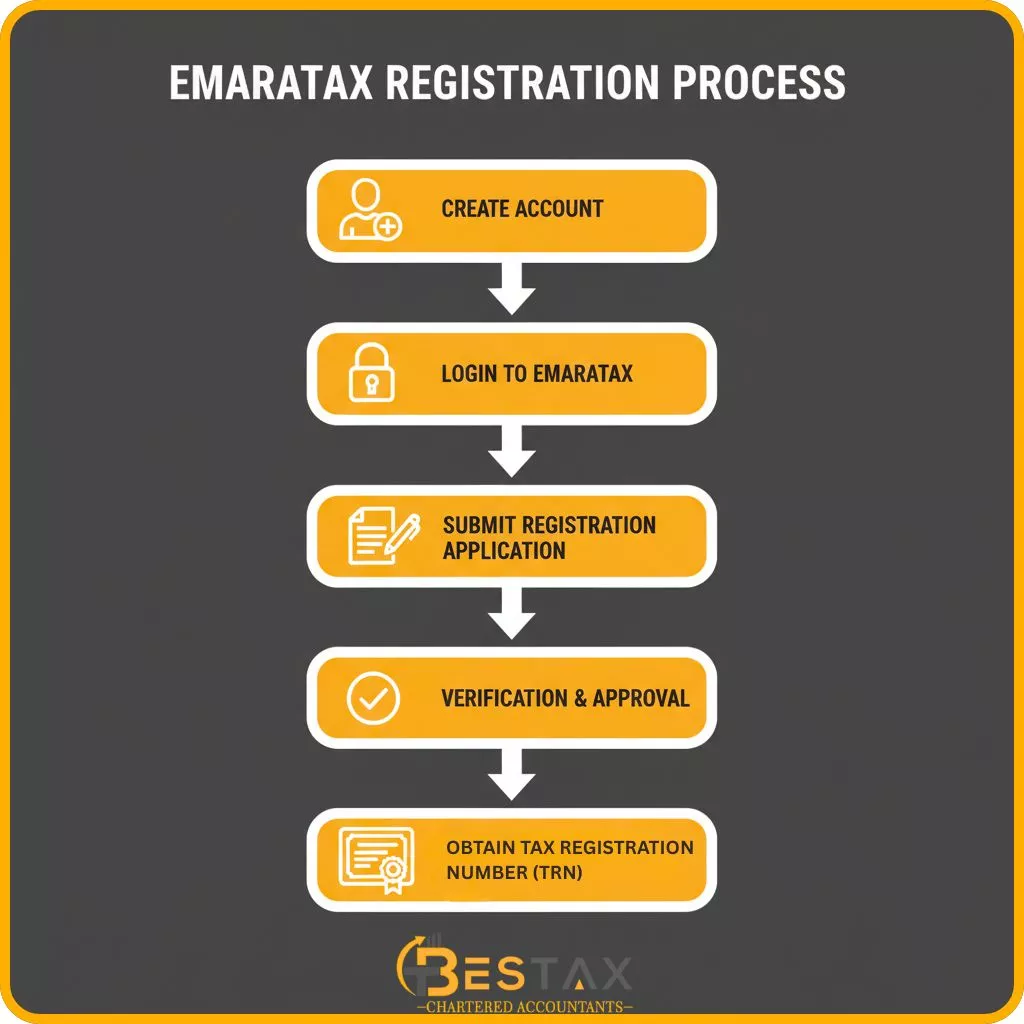
Registering through the FTA’s EmaraTax portal is straightforward if you follow each step carefully. The steps below combine official instructions with practical tips from industry guides.
- Create or log in to your EmaraTax account: Use your UAE Pass for seamless login, or register manually using your email and phone number.
- Add or select your taxable person profile: If you already have a VAT profile, add a new taxable person for corporate tax; otherwise, create one.
- Select “Corporate Tax” under the tax type: On your dashboard, locate the Corporate Tax tile and click Register.
- Review the instructions and tick the confirmation box: Carefully read the guidelines and check the box to confirm your understanding.
- Provide entity details: Select your entity type (e.g., LLC, free zone company, foreign company). Enter your legal name (English and Arabic), trade licence number, incorporation date and legal form.
- Enter identification and licence details: Upload scanned copies of your trade licence(s) and supply all required licence data.
- Add business activities: Click Add Business Activity, select the correct activity codes and descriptions, and ensure they align exactly with your trade licence.
- Add owner details: Provide information for each owner with at least 25 % ownership, including their Emirates ID or passport and ownership percentage.
- Provide branch details (if applicable): If your business operates branches, indicate Yes, then enter each branch’s licence number, location, activities, and owners. Remember, registration is under the head‑office name, so branches aren’t registered separately.
- Enter contact information: Add your official business address, email and phone number. Do not use a shared office or your accountant’s address.
- Add authorised signatory: Provide the details of the person legally authorised to represent the business (Emirates ID or passport) and upload proof of authorisation. You can add multiple authorised signatories if needed.
- Review and declaration: Double‑check all information for accuracy. Tick the declaration box to confirm that your details are complete and accurate.
- Submit your application: After submission, a reference number is generated. Save it for tracking and future correspondence.
- Monitor the application: The FTA typically processes corporate tax applications within 20 business days. During this period, check your EmaraTax dashboard and email regularly for any requests for additional information.
- Receive your TRN: Upon approval, you’ll receive a Corporate Tax Registration Number. Keep this number safe as it must appear on all corporate tax returns, invoices and official correspondence.
How Long Does Registration Take?
The standard processing time is 20 business days once a completed application is received. However, if the FTA requests additional documents, the review period may extend; applicants must respond within 60 calendar days or the application may be rejected. Plan accordingly and avoid leaving registration to the last minute.
Common Mistakes to Avoid
Even small errors can lead to delays or penalties. Industry guides highlight several pitfalls:
- Inconsistent or outdated licence information: Ensure that the trade licence number, entity name and issuing authority exactly match your application.
- Skipping required documents: Failure to upload mandatory documents (trade licence, MoA, Emirates ID, etc.) is a top reason for rejection.
- Wrong business activity codes: Align your declared activities with those listed on your trade licence.
- Missing the FTA deadline: Late registration triggers a AED 10,000 penalty.
- Using a shared or incorrect address: The FTA requires your actual business address.
- Forgetting Arabic translation requirements: Certain documents, like Powers of Attorney, may need official Arabic versions.
- Improper authorisation: Only an authorised signatory can submit the application; ensure supporting documents (board resolutions, etc.) are in place.
Pro tip: Take advantage of EmaraTax’s “Save as Draft” feature so you don’t lose data if your session times out.
Compliance After Registration
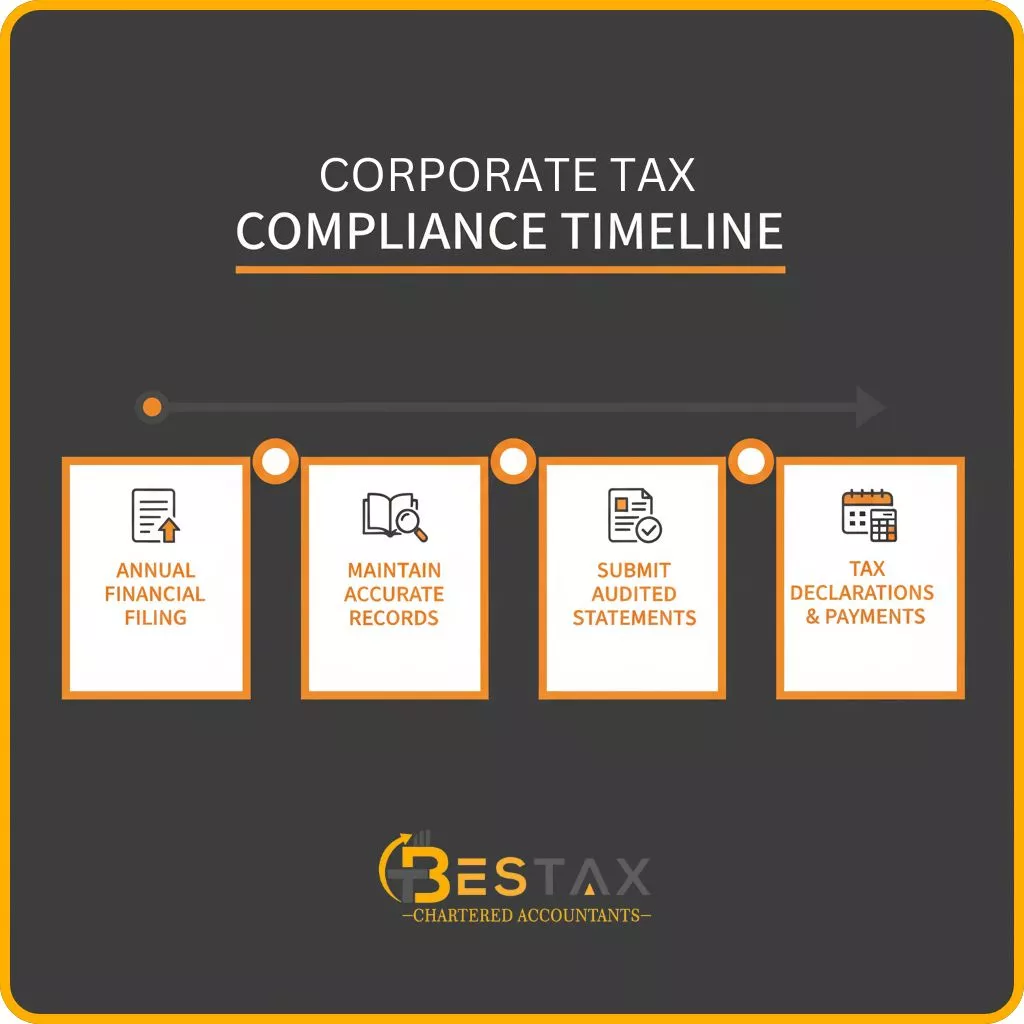
Registration is just the start. To avoid fines and audits, businesses must adhere to ongoing obligations:
- File your first corporate tax return within nine months of your financial year-end. For example, if your financial year ends on 31 December 2024, your return is due by 30 September 2025.
- Maintain accurate financial records for at least seven years. This includes invoices, receipts, contracts, and ledgers. Qualifying Free Zone Persons and entities with revenue above AED 50 million must have audited financial statements.
- Pay tax by the due date. Corporate tax is generally payable after the end of your financial year; the FTA will specify payment methods via EmaraTax.
- Monitor your business activities regularly. Changes in revenue, ownership or activities may affect your tax status or available reliefs.
- Stay informed about regulatory updates. The UAE tax landscape continues to evolve. Subscribe to FTA bulletins and consult certified tax professionals when in doubt.
Special Scenarios and Additional Considerations
Small Business Relief
The UAE offers Small Business Relief to support start‑ups and small enterprises. Businesses with revenue below AED 3 million per tax period may elect to be treated as having no taxable income, resulting in a 0 % tax rate; however, they must still register for corporate tax and file returns. This relief is available until December 31 2026 unless extended by law.
Free Zone Entities
Free zone companies qualify for a 0 % corporate tax rate on income derived from activities within the free zone and transactions with other free zone entities. Income generated from mainland customers is taxed at 9 %. To benefit from the 0 % rate, you must meet the Qualifying Free Zone Person conditions, such as maintaining adequate substance in the UAE and deriving qualifying income. Registration is still mandatory.
Natural Persons Earning Less Than AED 1 Million
If you operate as a freelancer or sole proprietor and your annual business income is below AED 1 million, registration is voluntary. Voluntary registration can be beneficial if you anticipate crossing the threshold soon or wish to formalise your business for tendering or banking purposes.
Non‑Resident Persons
Non‑resident companies and individuals must register if they have a Permanent Establishment (PE) or earn UAE‑sourced income not subject to withholding tax. Consult a tax advisor to determine if your activities constitute a PE.
Deregistration
Businesses that cease operations or become exempt should deregister. The process involves:
- Submitting a deregistration request via EmaraTax.
- Providing supporting documents (e.g., proof of liquidation or exemption).
- Settling outstanding tax liabilities.
- Awaiting FTA approval while maintaining records for at least seven years.
Failure to deregister properly may result in penalties or an audit.
Need Help Filing Your Corporate Tax Return?
Running a business is hard enough; keeping up with corporate tax deadlines should not be another headache. At Bestax, our corporate tax consultants handle everything from UAE corporate-tax registration to annual return filing, so you stay compliant and penalty-free.
Here’s what we help you with:
- Preparing and filing your corporate tax return through the EmaraTax portal
- Our FTA-approved agents ensure compliance with the latest UAE regulations
- Managing adjustments, credits, and exemptions
- Guiding you through audits or FTA clarifications
Talk to a Corporate-Tax Expert Today
Frequently Asked Questions
What is a Corporate Tax Registration Number (TRN)?
A TRN is a 15‑digit identifier issued by the FTA to businesses that register under the corporate tax regime. It links your company to all tax-related activities, including filings, payments and audits.
Is corporate tax registration separate from VAT registration?
Yes. VAT and corporate tax have different thresholds and procedures. You must register for corporate tax even if you already have a VAT TRN.
Do sole establishments need to register?
Yes. Sole establishments with annual turnover exceeding AED 1 million must register and file returns.
Do UAE and foreign branches need separate registrations?
UAE branches of domestic companies do not register separately; the parent company covers them. Foreign branches may need to register if they constitute a permanent establishment or earn UAE‑sourced income.
What documents should I prepare in Arabic?
While EmaraTax accepts English documents, key legal documents (e.g., Powers of Attorney or Memoranda of Association) may require an official Arabic translation.
Can I register voluntarily if I’m below the threshold?
Yes. Natural persons earning less than AED 1 million and small legal entities may register voluntarily. Voluntary registration can enhance business credibility and prepare you for future growth.
How long does the FTA take to process my application?
Typically 20 business days, but it may take longer if additional information is requested.
Disclaimer: The information provided in this blog is for general informational purposes only. For professional assistance and advice, please contact experts.
