


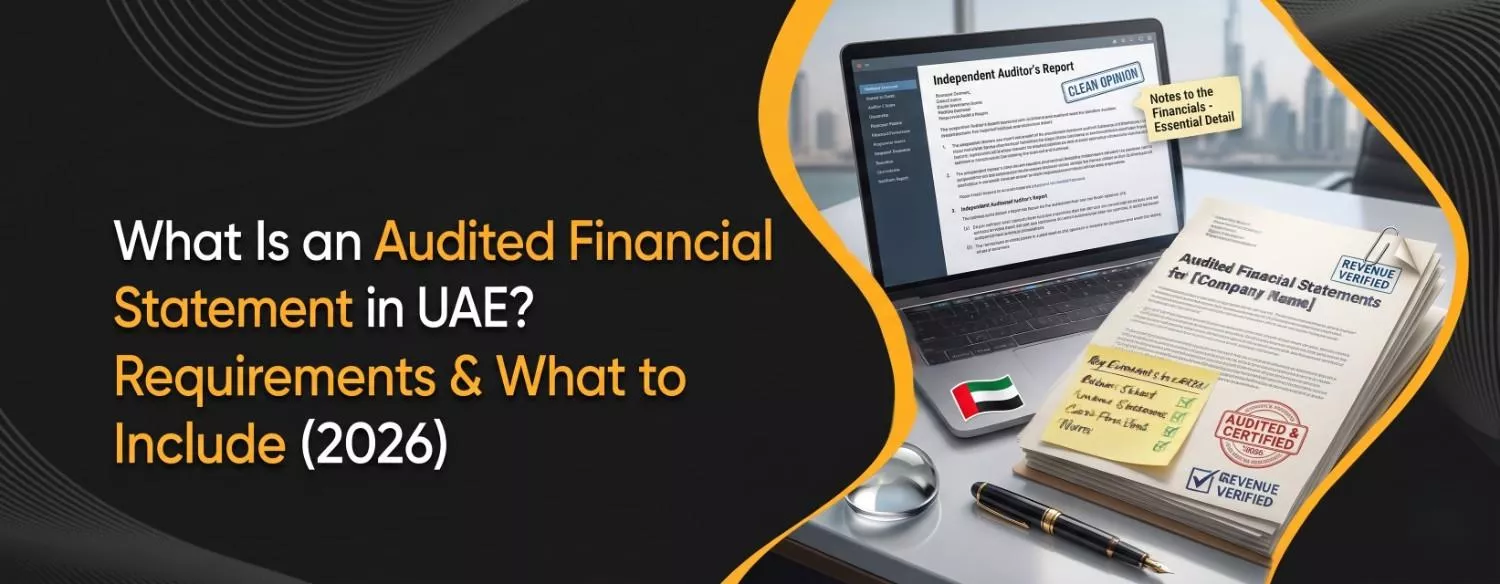
An audited financial statement in the UAE is a company’s financial statement that is independently verified by a licensed auditor to ensure that it is accurate and prepared according to the accounting standards required.
This is not only a good practice, but a compliance requirement for many businesses in 2026, particularly in the context of the UAE corporate tax regime and Ministerial Decision No. 84 of 2025. This guide will discuss who should use it, what it should contain, and how to remain compliant.
Why Audited Financial Statements Are Mandatory in the UAE
Regulatory backdrop
Federal corporate tax was introduced in the UAE by Federal Decree‑Law No. 47 of 2022. In order to facilitate tax transparency, MoF has issued Ministerial Decision No. 84 of 2025 on Audited Financial Statements.
Article 2 of the decision states that taxable persons not part of a tax group must prepare and maintain audited financial statements if their annual revenue exceeds AED 50 million and that Qualifying Free Zone Persons (QFZPs) must maintain audited financial statements regardless of revenue. It also requires tax groups to prepare audited special‑purpose financial statements following FTA rules.
If the non-resident entity has a permanent establishment or nexus in the UAE, then only the revenues generated from such permanent establishment or nexus is considered towards the AED 50 million threshold.
Who must prepare audited financial statements?
- Taxable persons with revenue > AED 50 million: Any business or natural person generating more than AED 50 million in a tax period must have audited statements. For non‑residents, only revenue attributable to the UAE permanent establishment or nexus counts.
- Qualifying Free Zone Persons (QFZPs): Free‑zone entities that meet qualifying criteria (including economic substance and de‑minimis requirements) must maintain audited financial statements regardless of revenue. The audit ensures they continue to qualify for the 0 % corporate tax rate.
- Tax groups: Groups of companies taxed as a single unit must prepare audited special‑purpose financial statements. The FTA’s Decision No. 7 of 2025 requires aggregated financial statements that combine the parent company and its subsidiaries’ standalone financial statements, eliminate intra‑group transactions, and comply with IFRS.
- Designated‑zone distributors: QFZPs distributing goods from a designated zone must follow any additional procedures prescribed by the FTA.
Who is exempt?
Under the corporate tax law and MoF guidance, certain entities are not required to prepare audited financial statements:
- Under the corporate tax law and MoF guidance, certain entities are not required to prepare audited financial statements:
- Businesses with revenue below AED 50 million, and small taxable persons, are exempt.
- Non‑qualifying free‑zone persons, free‑zone companies that do not meet the QFZP conditions (and are subject to the 9 % corporate tax) can avoid audits.
- Non‑qualifying free‑zone persons, free‑zone companies that do not meet the QFZP conditions (and are subject to the 9 % corporate tax) can avoid audits.
- Non‑resident persons without a UAE permanent establishment or nexus, revenue not connected to the UAE is excluded.
Understanding whether your business falls into a mandatory or exempt category is the first step toward compliance.
Accounting Standards and Frameworks in 2026
IFRS and IFRS for SMEs
The UAE’s Commercial Companies Law and regulatory authorities require mainland companies to prepare financial statements under International Financial Reporting Standards (IFRS). The IFRS framework is mandatory for all mainland limited liability companies (LLC), public joint‑stock companies (PJSC) and other entities. Some free zones, such as the Dubai International Financial Centre (DIFC) and Abu Dhabi Global Market (ADGM), also require full IFRS, while others allow IFRS for SMEs. IFRS ensures comparability and transparency in financial reporting, and auditors will test compliance during the audit.
For small businesses, the MoF allows different accounting bases depending on revenue:
- Cash basis (revenue ≤ AED 3 million) – micro‑businesses may use cash accounting, recording transactions when cash is received or paid.
- IFRS for SMEs (revenue ≤ AED 50 million) – a simplified version of IFRS with reduced disclosure requirements.
- Full IFRS (default) – required for businesses exceeding the AED 50 million threshold or opting out of simplified frameworks.
Small Business Relief
Small companies with revenue ≤ AED 3 million may elect for Small Business Relief (SBR) until 31 December 2026, allowing them to pay 0 % corporate tax. However, they must still maintain proper records and meet conditions to prove eligibility. Although an audit is not mandatory, good bookkeeping is vital to support future audits when the relief expires.
Components of an Audited Financial Statement
Primary statements
An audited financial statement normally includes the following primary components:
- Statement of Financial Position (Balance Sheet) shows the company’s assets, liabilities and equity at the reporting date. For tax groups, the FTA requires a line‑by‑line aggregation of each member’s standalone statements.
- Statement of Profit or Loss (Income Statement) reports revenue, expenses and profit or loss for the period. In aggregated financial statements, intra‑group transactions and unrealised gains/losses must be eliminated.
- Statement of Other Comprehensive Income presents items not recognised in profit or loss (e.g., revaluation gains or losses). This statement is part of the aggregated package.
- Statement of Changes in Equity tracks movements in share capital, retained earnings and reserves during the year.
- Statement of Cash Flows although not explicitly listed in the FTA’s decision for tax groups, cash‑flow information is typically part of an IFRS‑compliant set of statements. Businesses should include it unless guidance states otherwise.
Notes to the financial statements
Detailed notes are essential. They describe the basis of preparation, significant accounting policies, key estimates and judgements, and provide breakdowns of balances. The FTA requires disclosures on the aggregation framework for tax groups, material policies, and explanatory notes supporting figures.
Auditor’s report and opinion
An independent auditor’s report accompanies the financial statements. It expresses an opinion on whether the statements give a true and fair view in accordance with IFRS and the UAE’s regulatory framework. Audit opinions can be unqualified (clean), qualified, adverse or a disclaimer. A clean opinion indicates the statements are materially correct; a qualified opinion highlights a specific issue; an adverse opinion means the statements are materially misstated; and a disclaimer signals the auditor could not obtain sufficient evidence.
Special‑purpose financial statements for tax groups
Tax groups must prepare aggregated financial statements in accordance with FTA Decision No. 7 of 2025. Key principles include:
- Aggregation: the parent and each subsidiary’s standalone financial statements are combined line‑by‑line, eliminating intra‑group transactions.
- Uniform accounting policies: all group members must use consistent accounting policies and prepare statements under IFRS or IFRS for SMEs.
- Pre‑tax profit aggregation: profits or losses are aggregated before tax.
- Presentation in AED: the aggregated statements must be presented in UAE dirhams.
- Disclosure of framework and policies: notes must explain the aggregation method, policies and significant judgements.
The Financial Statement Audit Process
A financial statement audit is a systematic examination carried out by an independent auditor. Its purpose is to determine whether the statements present a fair and materially correct representation of a company’s financial position. Audits are performed according to International Standards on Auditing (ISA) or Generally Accepted Auditing Standards (GAAS), depending on jurisdiction. The process typically follows three broad phases:
1. Planning and risk assessment
- Engagement letter: the auditor issues an engagement letter outlining scope, objectives and timing. An initial meeting helps the auditor understand the business and identify high‑risk areas.
- Risk assessment: auditors gain an understanding of the company, industry and internal controls. They assess areas susceptible to errors or fraud and design an audit plan accordingly.
- Audit planning: includes assigning the audit team, ensuring independence, and establishing a timeline.
2. Internal control testing
Auditors evaluate the design and effectiveness of internal controls, processes that reduce the risk of errors or fraud. Preventive controls include segregation of duties and authorization procedures; detective controls involve reconciliations and physical counts. Weak controls lead to more substantive testing.
3. Substantive testing and fieldwork
During fieldwork, auditors gather evidence to verify account balances and transactions. They review books, bank reconciliations, invoices and contracts, and may use sampling techniques. In the context of the UAE, FTA‑approved auditors also check compliance with VAT returns, corporate tax filings and economic substance requirements. The auditor also ensures that IFRS, IFRS for SMEs or the cash‑basis framework have been applied correctly.
Reporting
Upon completion, the auditor issues a report describing the scope of the audit, the accounting framework used and the opinion. A clean (unqualified) opinion signals that the statements are free from material misstatement, while other opinions highlight issues.
Financial Statement Audit Checklist for UAE Businesses
Creating a comprehensive financial statement audit checklist will prepare your company for an efficient audit. Below is a summary of key items based on UAE audit guidelines and best practices:
- Organize financial records
- Updated trial balance and general ledger
- Bank reconciliations match cash balances to bank statements
- Fixed asset register with depreciation records
- Accounts receivable and payable
- Aging reports for outstanding invoices
- Debt review to identify bad debts
- Supplier statements and reconciliations
- Accruals for expenses incurred but not yet paid
- Inventory and stock take (for trading or manufacturing businesses)
- Physical count at year‑end
- Valuation at the lower of cost or net realizable value
- Identification of obsolete or damaged stock
- Tax compliance
- Reconciliation of VAT returns with accounting records
- Preparation for the 9 % corporate tax calculation
- Transfer pricing documentation for related‑party transactions
- Employee benefits and payroll
- Compliance with the Wages Protection System (WPS)
- Provision for end‑of‑service gratuity and leave salary
- Legal and licensing documents
- Valid trade licence
- Memorandum of Association (MOA) or Articles of Association
- Tenancy contract or Ejari registration
- Internal control documentation
- Policies on segregation of duties and authorization
- Evidence of detective controls (reconciliations, inventory counts)
A well‑prepared checklist not only makes the audit smoother but also improves the quality of financial reporting.
Benefits of Auditing Financial Statements
Audited financial statements deliver more than compliance. They provide strategic and operational benefits, including:
- Accurate tax filings: audits confirm that financial statements are free from material errors or fraud, ensuring reliable figures for corporate tax returns.
- Investor and lender confidence: audited reports enhance transparency and governance, building trust with investors, banks and regulators.
- Preservation of tax incentives: proper audits demonstrate eligibility for incentives such as QFZP status and Small Business Relief.
- International alignment: using IFRS or IFRS for SMEs aligns your reporting with global practices.
- Operational insights: auditors often identify inefficiencies, control weaknesses and risks, providing recommendations for improvement.
These advantages make audits a value‑adding exercise, not just a regulatory burden.
Audited vs Reviewed Financial Statements
Companies sometimes confuse audited financial statements with reviewed financial statements. Understanding the difference helps determine the appropriate level of assurance.
- Level of assurance – a review engagement provides limited assurance, in which the accountant performs analytical procedures and inquiries to determine whether the financial statements require material modifications. An audit provides reasonable assurance through an in‑depth examination of financial records and internal controls.
- Scope and procedures – reviews involve analytical review and inquiry only. Audits involve confirmation of balances, verification of transactions, assessment of internal controls and detailed testing.
- Cost and time – reviews are generally less time‑consuming and less expensive; audits require more extensive procedures.
- Regulatory requirement – in the UAE, audits are mandated for specified entities under corporate tax law, whereas reviews may suffice for smaller companies or for purposes such as bank financing.
Businesses should consult with professional accountants to determine whether a review is acceptable or an audit is required.
Audit of Consolidated Financial Statements and Tax Groups
Aggregated financial statements versus consolidated statements
Traditional consolidated financial statements prepared under IFRS 10 combine a parent and its subsidiaries, eliminating intra‑group transactions and recognizing acquisition‑related adjustments such as goodwill. Under FTA Decision No. 7 of 2025, aggregated financial statements for tax groups follow different rules:
- No consolidation accounting: aggregated statements do not apply IFRS 3 (Business Combinations) or IFRS 10 (Consolidated Financial Statements). Goodwill, bargain purchases and fair‑value adjustments are excluded.
- Line‑by‑line aggregation: stand‑alone statements are aggregated without adjustments beyond intra‑group elimination.
- Investment measurement: investments in non‑tax‑group entities are carried at cost less impairment, even if they were previously measured using equity or fair‑value methods.
- Uniform policies and AED presentation: all members must use consistent accounting policies and present the statements in AED.
These rules aim to provide a simplified yet consistent framework for calculating the taxable income of a tax group while avoiding complex consolidation adjustments.
What to Include in Your Audited Financial Statement (UAE‑specific Checklist)
Beyond the primary statements and notes, UAE audits should include the following:
- Management’s report: a narrative by management describing the business, principal risks and uncertainties, and future plans.
- Corporate tax reconciliation: schedules reconciling accounting profit to taxable income, including adjustments for non‑deductible expenses and exempt income.
- Economic Substance Regulation (ESR) compliance: a declaration confirming that relevant activities meet ESR requirements (for companies engaged in specific activities such as distribution, service centres and finance).
- Transfer pricing documentation: evidence supporting that related‑party transactions follow the arm’s‑length principle; required for companies with cross‑border dealings.
- Auditor’s independence declaration: statement confirming the auditor’s independence, as required under auditing standards and local regulations.
- Comparative figures and restatements: prior‑year comparatives and explanations of any restatements arising from changes in accounting policies or errors.
Including these elements ensures a complete and informative audited package that meets regulatory expectations and investor needs.
Common Challenges During Audits and How to Overcome Them
Auditing financial statements can reveal weaknesses in an organization’s accounting practices. Common challenges include:
- Disorganized records: incomplete ledgers, missing bank reconciliations and outdated fixed asset registers make it difficult to verify balances. Solution: Adopt robust bookkeeping practices and cloud accounting systems; perform regular reconciliations.
- Incorrect application of IFRS: misclassifying transactions or omitting disclosures leads to qualified opinions. Solution: Invest in staff training or hire professionals experienced in IFRS and IFRS for SMEs; consult official IFRS guidance.
- Unsupported accounting estimates: estimates for impairment, depreciation or provisions require evidence. Solution: Document assumptions and provide supporting calculations; engage specialists when necessary.
- Missing disclosures: failure to disclose loans, related‑party transactions or contingencies can result in non‑compliance. Solution: Use disclosure checklists and compare against IFRS requirements.
- Uncertainty about audit requirements: businesses may not know whether they need an audit, leading to delays. Solution: Seek advice from professional auditors and refer to MoF guidelines (Ministerial Decision No. 84 of 2025).
Proactively addressing these challenges helps achieve a smooth audit and reduces the risk of penalties.
Work with Bestax: Your Partner for Audit Success
Preparing for an audit can be demanding, but partnering with the right firm makes the process seamless. Bestax offers comprehensive audit services across Dubai, Sharjah and Abu Dhabi. Their FTA‑approved auditors conduct detailed reviews of your systems and processes, providing practical insights that improve efficiency, strengthen controls and enhance transparency. With over 10 years of experience, 35+ professionals, and more than 1,000 clients, Bestax delivers a 100% satisfaction rate.
Ready to get audit‑ready? Book a free appointment with Bestax’s experts and enjoy professional support that ensures your financial statements comply with UAE regulations and IFRS while enhancing your business operations.
Frequently Asked Questions (FAQs)
What is an audited financial statement?
An audited financial statement is a set of financial reports examined by an independent auditor to determine whether they present a fair and materially correct representation of a business’s financial position in accordance with applicable accounting standards.
Who needs to have audited financial statements in the UAE?
Businesses whose annual revenue exceeds AED 50 million, Qualifying Free Zone Persons, and tax groups must maintain audited financial statements. Small businesses below the revenue threshold, non‑QFZPs and individual members of tax groups are generally exempt.
What accounting standards apply to UAE financial statements?
Mainland companies must comply with full IFRS. Businesses with revenue up to AED 50 million may use IFRS for SMEs, while micro‑businesses with revenue ≤ AED 3 million can use the cash basis.
What is the difference between audited and reviewed financial statements?
Audits provide reasonable assurance through in‑depth examination of financial records and internal controls; reviews provide limited assurance through analytical procedures and inquiries. Audits are generally more comprehensive and are required for entities specified under the UAE corporate tax law.
Do small businesses with revenue below AED 3 million need an audit?
No. Entities with revenue below AED 3 million may elect for Small Business Relief until 31 December 2026. However, they must maintain proper records and may still benefit from voluntary reviews or audits to enhance credibility.
How do aggregated financial statements differ from consolidated financial statements?
Aggregated financial statements, required for tax groups, line‑by‑line aggregate the standalone statements of each member and eliminate intra‑group transactions, but they do not apply consolidation adjustments such as goodwill or fair‑value adjustments. Consolidated statements prepared under IFRS 10 include such adjustments.
When should I start preparing for my 2026 audit?
Start as early as possible, ideally at the beginning of the tax period. Organize records, maintain internal controls and consult with an FTA‑approved auditor to avoid last‑minute challenges.
Disclaimer: The information provided in this blog is for general informational purposes only. For professional assistance and advice, please contact experts.
