


Electronic invoicing (e‑invoicing) is no longer an optional technology; it has become a cornerstone of the UAE’s digital economy. The benefits of e invoicing go far beyond convenience. By 2027, all businesses must issue structured e‑invoices through accredited service providers.
According to the Ministry of Finance, countries that have adopted e‑invoicing have seen invoice‑processing costs drop by about 66 percent and payments are delivered in near real‑time. For small businesses in Dubai, Abu Dhabi, Sharjah and other emirates, understanding and embracing this shift now can deliver huge competitive advantages.
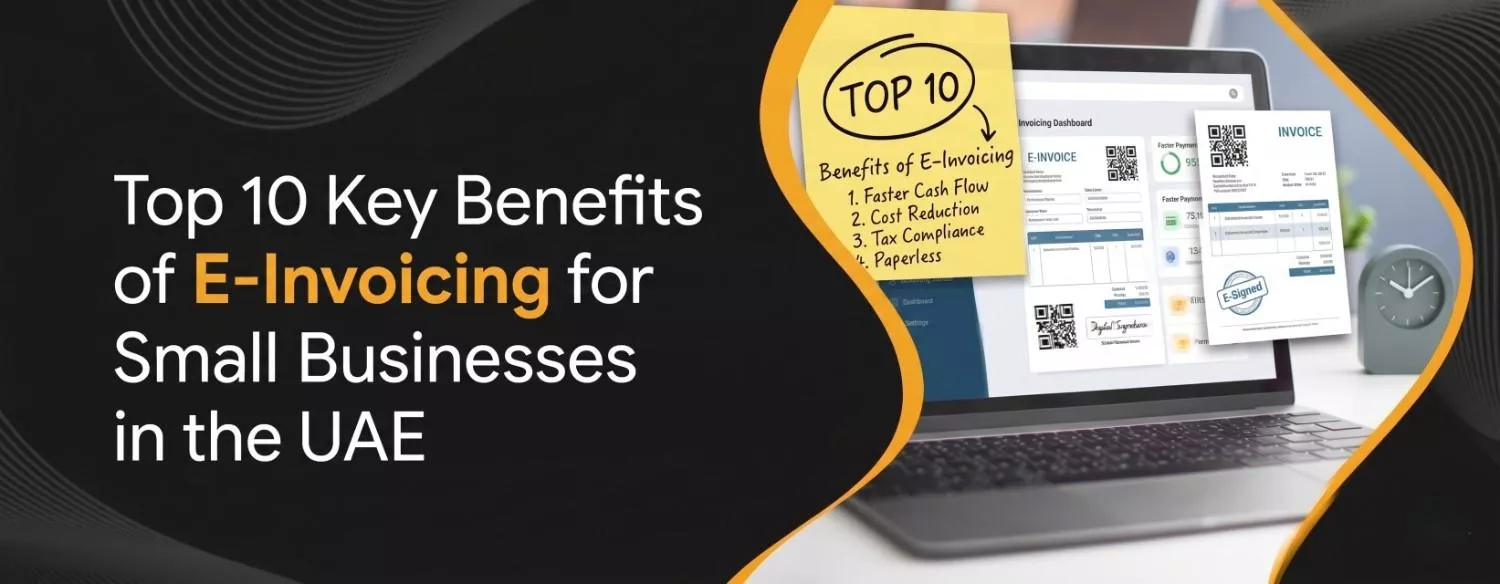
This comprehensive guide explains what is e invoicing, the regulatory context, and the top 10 benefits for small businesses in the UAE.
What Is E‑Invoicing?
E‑invoicing is the process of creating, sending and receiving invoices in a machine‑readable digital format. Instead of generating a PDF or paper invoice, an e‑invoice uses structured data (commonly XML or UBL/Peppol) that can be validated automatically by software. The process typically involves:
- Invoice creation: You generate the invoice in an e‑invoicing platform or integrated accounting system.
- Standardisation: The invoice is converted into the UAE‑approved format (PINT‑AE) and digitally signed.
- Transmission: Your accredited service provider (ASP) validates and forwards the invoice to the buyer’s ASP and reports the tax data to the FTA.
- Storage and reporting: Both parties store the invoice electronically for audit purposes and the FTA’s system pre‑populates VAT return fields.
E‑Invoice Meaning and UAE Regulation
The UAE government is rolling out e‑invoicing in phases. Large taxpayers (revenue ≥ AED 50 million) must begin issuing e‑invoices by 1 January 2027, while small‑ and medium‑sized enterprises (revenue < AED 50 million) must comply by 1 July 2027. Public sector (B2G) invoices will be mandatory by 1 October 2027. The pilot phase begins on 1 July 2026, so forward‑thinking SMEs should implement systems early.
Under the PINT‑AE standard, every e‑invoice must include mandatory fields like seller and buyer details, VAT registration numbers and a digital signature. Accredited service providers validate the data, ensure compliance with the FTA’s technical requirements and report it in real time. This decentralised continuous transaction control model facilitates near real‑time tax reporting and enhances transparency.
Top 10 Benefits of E‑Invoicing for Small Businesses in the UAE
The following sections outline the primary benefits of e‑invoicing for small businesses. Each benefit includes practical tips relevant to entrepreneurs in Dubai, Sharjah, Abu Dhabi, Ajman and other emirates, ensuring a geo‑specific perspective.
1. Reduced Processing Costs and Administrative Burden
E‑invoicing eliminates paper, printing, mailing and manual data entry. The Ministry of Finance states that successful e‑invoicing initiatives can cut invoice‑processing costs by up to 66 percent. Local accounting firms estimate that automation reduces processing time by over 90 percent. For SMEs operating with lean teams, these savings are substantial.
2. Improved Cash Flow and Faster Payments
Standardised electronic invoices are validated and delivered almost instantly. The Ministry of Finance highlights that automated validations and controls reduce errors and deliver invoices in near real‑time, enabling faster payments and better working‑capital management.
For SMEs facing tight cash‑flow cycles, faster invoice delivery means payments can be triggered as soon as validation occurs. Automated reminders and real‑time status updates reduce days sales outstanding (DSO) and provide predictable cash flow.
3. Increased Accuracy and Lower Error Rates
Manual data entry in traditional invoicing often leads to human errors, incorrect VAT calculations or missing information. E‑invoicing systems automatically validate data and ensure compliance with VAT requirements. Structured XML formats, digital signatures and automated checks strengthen accuracy and fraud prevention. Reducing errors lowers the risk of disputes, invoice rejections and VAT penalties.
4. Simplified VAT Compliance and Audit Readiness
E‑invoicing simplifies VAT reporting and compliance. The FTA receives tax data in real time via accredited service providers, allowing the system to pre‑populate VAT return fields and expedite refunds. Digital invoices provide a clear audit trail, making it easier for SMEs to respond to audits and reduce the risk of penalties.
E‑invoicing ensures standardised VAT‑compliant invoices, automates tax calculations and maintains accurate digital records. This level of compliance is particularly crucial for small businesses without dedicated finance teams.
5. Better Financial Visibility and Data‑Driven Decisions
Because e‑invoices are machine‑readable, they contain richer data that can be analysed in real time. The Ministry of Finance notes that e‑invoicing provides financial visibility and richer information for decision making. Small businesses can track receivables, monitor cash‑flow bottlenecks and identify late‑paying customers more easily.
Advanced analytics tools can use invoice data to highlight purchasing trends, sales patterns and profitability by customer or product. Experts observes that structured e‑invoices enable companies to analyse customer behaviour, supplier performance and VAT liabilities, shifting finance teams toward strategic decision‑making rather than reactive reporting.
6. Enhanced Data Security and Fraud Prevention
Security is a major concern for small businesses. E‑invoices incorporate digital signatures, encryption and time‑stamped audit trails. UAE framework requires digitally signed invoices, encrypted transmission and UAE‑based data storage. These controls help verify invoice authenticity, prevent tampering and maintain confidentiality. Automated validations also detect anomalies and reduce fraudulent activities.
7. Scalability and Integration with Business Systems
As small businesses grow, the volume of invoices increases. E‑invoicing systems are scalable; they can handle thousands of invoices without the additional overhead of manual processes. Many platforms integrate seamlessly with enterprise resource planning (ERP), point‑of‑sale (POS) and accounting systems. Businesses can map ERP fields to the PINT‑AE data dictionary and connect to FTA‑aligned APIs.
8. Environmental Sustainability
Paperless invoicing supports the UAE’s Net Zero 2050 strategy. OrchidaTax calculates that a company issuing 10,000 invoices per month can save 120,000 sheets of paper, roughly 14 trees and more than 1 tonne of CO₂ annually. Beyond reducing paper waste, digital invoices require less energy for printing and storage.
9. Improved Customer Experience and Professionalism
Customers value convenience. E‑invoicing delivers invoices instantly and allows customers to pay via online methods or mobile apps. Digital invoices are easy for customers to store, track and pay. Automated reminders minimise the need for uncomfortable payment chases, improving relationships.
10. Strategic Advantage and Future Readiness
Early adoption of e‑invoicing offers a competitive edge. OrchidaTax notes that proactive businesses benefit from stronger competitive positioning, cross‑border readiness and higher trust from global partners. The PINT‑AE standard is aligned with international frameworks like Peppol, enabling seamless cross‑border transactions. This is critical for SMEs in trade hubs like Dubai and Abu Dhabi that deal with overseas suppliers or customers.
Moreover, the Ministry of Finance emphasises that e‑invoicing provides financial visibility and richer information, enabling proactive decision‑making. Future upgrades may include AI‑powered analytics, blockchain‑based security and global network interoperability. SMEs that adopt e‑invoicing early will be better positioned to leverage these advancements.
Addressing Challenges in E‑Invoicing Adoption
Transitioning from manual invoicing to e‑invoicing can present obstacles. There are several challenges: initial setup costs, change management, data security concerns and integration with legacy systems. While these may deter some SMEs, they can be managed with careful planning:
- Budget for Implementation: Upfront expenses for software, training and integration are investments that pay off quickly through cost savings and efficiency gains. Many ASPs offer flexible pricing for small businesses.
- Employee Training: Provide comprehensive training sessions so staff understand the new workflows. Change management is smoother when users see the benefits.
- Robust Cybersecurity Measures: Adopt encryption, firewalls and access controls to address security concerns. Choose an ASP with strong security credentials.
- Upgrade Legacy Systems: If your accounting software is outdated, work with an IT consultant or accounting service provider to ensure seamless integration.
- Seek Professional Advice: Partner with local accounting firms or tax consultants who specialise in e‑invoicing to guide you through compliance and technical requirements.
Actionable Steps to Implement E‑Invoicing in Your SME
To maximise the benefits of e‑invoicing, follow these practical steps:
- Choose an Accredited Service Provider: Select a provider that meets FTA guidelines and offers API integrations with your accounting or ERP systems.
- Assess Current Systems: Evaluate how your existing software handles invoicing. Identify any upgrades or customisations needed for compatibility.
- Design Invoice Templates: Create templates that comply with the PINT‑AE standard and include your branding. Check that fields like VAT registration number, Tax Invoice wording and TRN number are correctly placed.
- Train Your Team: Conduct internal workshops to familiarise staff with new processes. Provide user manuals and a help desk for ongoing support.
- Run a Pilot Program: Test the system with a subset of customers during the voluntary pilot phase starting 1 July 2026. Gather feedback and refine processes before the mandate.
- Monitor and Optimise: Use dashboards to track key metrics, invoice validation time, DSO, error rates. Continuously improve by addressing bottlenecks.
- Prepare for Future Enhancements: Stay informed about upcoming FTA updates, AI integration, and cross‑border network expansions.
Conclusion
Don’t wait until the last minute to comply with the UAE’s mandate. Start preparing now, choose a trusted e‑invoicing provider, train your team and run a pilot program ahead of the July 2026 voluntary phase. If you need expert guidance, reach out to local accounting and tax specialists who can help your business embrace digital invoicing and tap into its numerous benefits.
Have questions or need assistance implementing e‑invoicing? Contact our consultants today for a free assessment. We’ll help you transition smoothly and ensure you reap the full benefits of this game‑changing technology.
Quick FAQs
Is e‑invoicing mandatory for all businesses in the UAE?
Yes. The UAE is rolling out mandatory e‑invoicing in phases: the pilot begins on 1 July 2026, large taxpayers must comply by 1 January 2027 and SMEs by 1 July 2027.
What is the difference between e‑invoicing and sending a PDF invoice?
A PDF is unstructured and cannot be automatically validated or processed. An e‑invoice uses a structured digital format (XML/UBL) that is machine‑readable, allowing accredited service providers to validate data, transmit it to the buyer’s system and report it to the FTA.
Will e‑invoicing save me money?
Yes. Countries that have implemented e‑invoicing report up to 66 percent reduction in invoice‑processing costs. Small businesses also save on printing, mailing and manual labour.
How does e‑invoicing improve cash flow?
Real‑time validations and electronic delivery mean invoices reach buyers almost instantly, triggering faster payment cycles. Automated reminders reduce late payments.
Is e‑invoicing secure?
Yes. The UAE system requires digital signatures, encryption and secure storage. Only accredited service providers can transmit invoices to ensure authenticity and compliance.
What software do I need for e‑invoicing?
You will need an e‑invoicing platform that complies with the PINT‑AE standard and integrates with your accounting or ERP system. Many providers offer cloud‑based solutions with scalable pricing.
How do I handle cross‑border invoices?
The UAE system aligns with international standards like Peppol, allowing you to exchange e‑invoices with overseas partners. Ensure your provider supports cross‑border formats and validations.
Disclaimer: The information provided in this blog is for general informational purposes only. For professional assistance and advice, please contact experts.
