



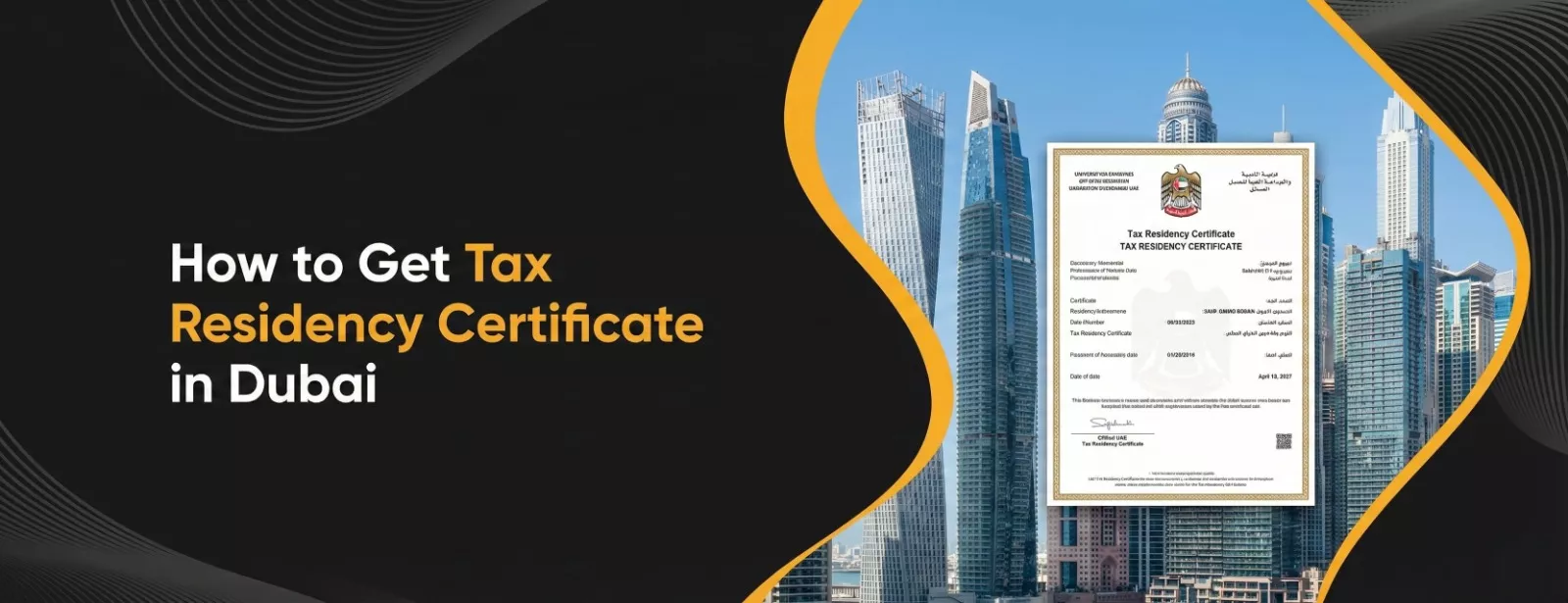
Dubai’s cosmopolitan economy attracts entrepreneurs, expatriates and investors from around the world. A Tax Residency Certificate (TRC) is the document that unlocks the UAE’s network of double‑taxation treaties and proves to foreign authorities that you’re fiscally resident in the Emirates.
Without it, overseas tax offices may charge withholding taxes on your dividends or interest, and banks may question your compliance. This step‑by‑step guide explains what a TRC is, who needs one, the latest residency rules, and how to apply through the Federal Tax Authority’s EmaraTax portal.
What Is a Tax Residency Certificate?
A Tax Residency Certificate, sometimes called a tax domicile certificate, is an official document issued by the UAE Ministry of Finance/ Federal Tax Authority (FTA). It confirms that an individual or company is a tax resident of the UAE, allowing the holder to benefit from the country’s double‑taxation avoidance agreements.
For businesses, both free‑zone and mainland entities can apply, provided they have a physical presence and economic activity in the UAE. The certificate is usually valid for one year and must be renewed each year to remain effective.
Tax Residency Certificate vs. Tax Domicile Certificate
The terms are often used interchangeably. A tax domicile certificate is simply another name for the TRC. Both confirm that the holder’s income is subject to UAE taxation and can therefore benefit from treaty relief. Offshore companies (entities with no physical presence in the UAE) are not eligible for a TRC and may receive a Tax Exemption Certificate instead.
Why You Need a TRC: Benefits for Individuals and Businesses
Avoid Double Taxation and Claim Treaty Benefits
The UAE has signed more than 130 double‑taxation avoidance agreements. With a valid TRC you can claim reduced or zero withholding taxes on dividends, interest, royalties or capital gains and even reclaim taxes paid abroad if you became a UAE tax resident partway through a year. Without a TRC, your home country (or another jurisdiction) could attempt to tax the same income.
Ensure Global Compliance and Protect Your Reputation
Banks and foreign tax authorities increasingly require proof of tax residency to comply with the Common Reporting Standard. A TRC satisfies these requests and shows you are subject to UAE oversight.
For companies, holding a TRC demonstrates a genuine economic presence in the UAE and builds credibility with lenders and international partners. It also supports regulatory filings such as audits or cross‑border transactions.
Personal and Business Planning Advantages
- Individuals: With a TRC you can gain tax savings on foreign pensions and investments, provide evidence for immigration or tax‑exit processes, and open offshore bank accounts more easily. Estate planning also becomes simpler because your assets are clearly tied to the UAE’s tax regime.
- Companies: A TRC allows you to structure cross‑border contracts more favourably and claim treaty relief on profits and royalties. It signals a global trust factor, making your business more attractive to overseas investors.
Fairness and Protection for All Taxpayers
Beyond the financial benefits, the certificate ensures fairness and clarity for everyone. It standardizes how the UAE recognizes tax residency, ensuring transparent practices. This fosters a stable business environment and protects taxpayers from arbitrary assessments abroad.
UAE Tax Residency Rules: The 183‑Day and 90‑Day Criteria
Until recently, residency for tax purposes was based mainly on how many days you spent in the country. Cabinet Decision No. 85 of 2022 introduced more flexible criteria:
- 183‑day rule: You are a tax resident if you spend at least 183 days in the UAE during a calendar year.
- Place of habitual residence: Even if you spend fewer than 183 days, you can qualify if your permanent home and centre of personal and financial interests are in the UAE. This means maintaining a regular dwelling that you occupy on an ongoing basis and showing that your family and finances are centred here.
- 90‑day rule: If you are not considered a tax resident elsewhere and spend at least 90 days in the UAE during the year, you may still be deemed a tax resident. This rule recognizes frequent travellers or individuals with strong ties to the country.
If you use the 90‑day route, ensure you are not simultaneously a tax resident elsewhere, and prepare evidence showing your permanent home and financial interests are anchored in the UAE.
Eligibility Criteria
Natural Persons (Individuals)
To apply for a Tax Residency Certificate, individuals must:
- Meet residency requirements: Be physically present in the UAE for 183 days or more during the relevant 12‑month period, or satisfy the 90‑day rule described above. Keep a record of your days in the country to demonstrate compliance.
- Hold valid documents: You need a UAE residence visa, a passport, and an Emirates ID.
- Have a permanent residence: Provide a certified tenancy contract (EJARI in Dubai) or property title deed covering the application year. This must match your name and show actual use.
- Prove income and financial ties: Provide salary certificates, trade licences, or proof of investments to show economic activity. Six months of UAE bank statements are required, along with an entry/exit report from the Federal Authority for Identity and Citizenship.
- Age requirement: Applicants must be at least 18 years old.
Legal Persons (Companies)
Businesses must meet the following criteria:
- Operational history: The company must have been established in the UAE for at least one year.
- Economic substance: It should conduct real economic activity and hold a valid trade licence. Offshore companies without a physical office are not eligible for a TRC.
- Audited financial statements: Provide a certified audit report covering the requested year and the previous year if applying for the current year.
- Registered address: Submit a lease agreement or proof of office ownership registered with the relevant municipality or free zone authority.
- Bank statements: Present six months of UAE bank statements stamped by the bank.
- Authorized representatives: Supply copies of shareholders’ and managers’ passports, visas and Emirates IDs. Include a power of attorney if someone else files on your behalf.
Government Entities
Government bodies applying for a TRC must provide a trade licence or government decree and a formal request letter.
Special Cases: Investors and Housewives
Investors may qualify by proving at least 180 days of residency, showing investment documents (share certificates), bank statements, and an Emirates ID. Housewives sponsored by spouses must provide marriage certificates and proof of joint residence.
Documents Required
Below is a concise checklist. For ease of reference, keep electronic scans and hard copies ready.
| Applicant Type | Mandatory documents | Additional documents |
|---|---|---|
| Individuals | Passport and UAE residence visa; Emirates ID; Six months of UAE bank statements; Tenancy contract or title deed; Entry/exit report | Salary certificate or trade licence (proof of income); Marriage certificate if dependent |
| Companies | Valid trade licence; Memorandum of Association/Articles of Incorporation; Audited financial report; Office lease contract; Six months of stamped bank statements | Passports, visas and Emirates IDs of shareholders and managers; Power of attorney (if applicant not on licence) |
| Investors | Passport and residence visa; Emirates ID; Proof of investment (share certificates); Six months of bank statements | Tenancy contract; Financial statements of the invested company |
| Government entities | Trade licence or decree; Request letter |
How to Apply for a UAE Tax Residency Certificate (Step‑By‑Step)
The Federal Tax Authority processes TRC applications through its EmaraTax portal. The process is slightly different for individuals and companies, but the core steps are similar.
1. Create or Log in to Your EmaraTax Account
Register or sign in at the FTA’s EmaraTax platform. If you previously used the old TRC portal, link your existing account by verifying your email. You can also log in via UAE PASS for convenience.
2. Select the Certificate Type and Application Year
After logging in, go to Other Services and choose Tax Residency Certificate. Decide whether you need the certificate for domestic purposes or tax treaty purposes. Then select the application type (Natural Person, Legal Person, or Government Entity) and choose the year you are applying for.
You can apply for the previous year or the current year once the residency criteria are met. Applications for future years will be rejected.
3. Complete the Application Form
Fill in your personal or company details, upload all required documents, and ensure they are clear and valid. For registered taxpayers, enter your Tax Registration Number (TRN); if you are not registered, select “TRN Not Available”. Specify the country in which you intend to use the certificate and the financial year start date.
4. Pay the Submission Fee
A non‑refundable AED 50 (approx. USD 13.60) submission fee is due upon completing the application. Payment can be made by credit/debit card, Google Pay or Samsung Pay.
5. Wait for FTA Review
The FTA reviews your application, typically within 5–7 working days. Complex cases or incomplete submissions may take 2–4 weeks. Respond promptly to any clarifications to avoid delays.
6. Pay the Issuance Fee
Once approved, you must pay the certificate fee. The FTA charges:
- AED 500 for tax‑registered applicants (i.e., those with a TRN).
- AED 1,000 for non‑registered individuals.
- AED 1,750 for non‑registered legal persons.
Fees are identical for domestic and treaty certificates. A hard copy can be requested for an extra AED 250.
7. Download or Receive Your Certificate
After payment confirmation, the certificate will be available for download. Ensure you save a digital copy and, if requested, wait for the courier delivery of the hard copy.
8. Renewal and Next Steps
Because the TRC covers only the selected financial year, you must submit a fresh application each year. Gather updated bank statements, lease agreements and financial reports, then repeat the process. Plan ahead so you have at least a few weeks before the certificate is needed for foreign filings.
Application Flow Summary (Individual or Company)
- Preparation: Determine your eligibility (183‑ or 90‑day rule; one‑year operating history for companies). Gather all documents.
- Registration: Create or log in to your EmaraTax account. Link existing TRC portal credentials if necessary.
- Selection: Choose “Tax Residency Certificate,” application type (Natural Person, Legal Person, Government Entity), and the year.
- Submission: Enter details, upload documents, and pay the AED 50 submission fee.
- Review: Monitor your application status and respond to FTA clarifications.
- Issuance: Pay the appropriate certificate fee. Download digital certificate; optionally request a hard copy.
Fees at a Glance
Validity and Renewal
- A Tax Residency Certificate is valid for one year.
- It covers only the financial year chosen in your application; there is no automatic renewal.
- You may apply for the previous year (retrospective) or the current year if you already meet the residency criteria.
- For each new year, you must submit a fresh application with updated documents, including bank statements, renewed leases and current financial statements.
How Long Does It Take?
The total timeline depends on your preparation and the FTA’s workload:
Tax Residency Certificate vs. Commercial Activity Certificate
While the TRC confirms tax residency and allows treaty benefits, the Commercial Activity Certificate verifies the nature of business activities conducted in the UAE. It may be required to support certain TRC applications or to establish a company’s operational presence. Many free zones issue their own commercial activity certificates, but the FTA can also issue one through the EmaraTax portal.
Common Mistakes and Pro Tips

- Incomplete document scans: Ensure documents are clear, legible and certified where necessary.
- Mismatched details: Double‑check that names, passport numbers and dates match across the passport, visa, bank statements, and tenancy contract.
- Applying too early: Companies must operate for at least one year and have audited financials.
- Ignoring the 90‑day rule conditions: You must not be tax resident elsewhere and must prove that your permanent home and main interests are in the UAE.
- Not tracking days: Keep an entry/exit log or request an ICP report to verify your presence.
- Failing to meet economic substance: Free‑zone companies without physical offices or staff are not eligible for a TRC.
- Losing validity: Remember that the TRC applies only to the selected year and cannot be transferred or used for future years.
Conclusion
Getting your Tax Residency Certificate in Dubai does not have to feel confusing. When you follow the steps, prepare the right documents, and meet the residency rules, the process becomes smooth and predictable. The certificate then works as your proof of tax residency, protects you from double taxation, and helps you deal confidently with banks, foreign tax authorities, and international partners.
If you want help with the paperwork, the FTA portal, or understanding which rule applies to you, Bestax is here to support you. Our team handles corporate tax, VAT, accounting, and compliance every day, so you get clear advice and a fast, accurate TRC application. You focus on your plans in the UAE, and we take care of the tax side.
To start your TRC application or ask a quick question, reach out to Bestax anytime. We will guide you step by step and make sure everything is done the right way.
Frequently Asked Questions
What is a Tax Residency Certificate?
It is a document issued by the UAE Ministry of Finance/FTA confirming that an individual or company is considered tax resident in the UAE.
Who issues the TRC?
The Federal Tax Authority issues TRCs through its EmaraTax portal.
Can non‑residents apply?
No. The UAE does not issue TRCs to non‑residents.
What is the processing time?
Typically 5–7 working days; complex cases may take 2–4 weeks.
Is there a difference between TRCs for individuals and companies?
The concept is the same, but companies must provide audited financial statements and proof of economic substance.
How long is the certificate valid?
One year, covering the calendar or fiscal year applied for.
Is a TRC transferable?
No. Each certificate is country‑specific and cannot be transferred to another jurisdiction.
Can freelancers apply?
Yes, provided they hold a valid UAE residence visa, maintain a local bank account and meet the 183‑ or 90‑day rule with supporting income documents.
Is there an age limit?
Applicants must be at least 18 years old.
What if my application is rejected?
The FTA will notify you of the reason, and you may reapply with corrected documents.
Disclaimer: The information provided in this blog is for general informational purposes only. For professional assistance and advice, please contact experts.
