



Dubai’s thriving business environment offers entrepreneurs the flexibility to start and end ventures easily. But stopping operations does not automatically cancel a trade licence, a mistake many owners make. Even if a company has been dormant for months, it still exists on paper until formally deregistered. Failing to cancel means the business continues to accrue fines, visa obligations, tax dues, and legal liabilities.
This guide explains how to cancel a trade license in Dubai legally and efficiently. It covers steps, documents, costs and timelines, and provides tips to avoid penalties and close your company with peace of mind.

Understanding Trade Licences in Dubai
A trade licence is a document issued by Dubai’s Department of Economy & Tourism (DET) that authorises a business to operate a specific commercial, professional or industrial activity. Licences are tied to the company’s legal structure (sole establishment, civil company, LLC, etc.) and require regular renewal. When a business ceases operations, the licence must be cancelled, not simply allowed to expire. Keeping an expired licence triggers fines and prevents owners from starting new ventures or clearing immigration records.
Types of cancellation
Different legal structures follow different cancellation procedures:
- Cancellation without liquidation (sole establishments/civil companies): No liquidator is required; owners cancel visas, settle liabilities, and obtain clearances before the DET issues a cancellation certificate.
- Standard liquidation (LLCs and companies with share capital): A licensed liquidator must be appointed, shareholders pass a notarised resolution, a liquidation notice is published in two Arabic newspapers for 45 days, and preliminary and final liquidation reports are submitted.
- Branch closure: Branches of local or foreign companies need an attested parent-company resolution approving the closure and must show that all liabilities, visas, and contracts have been settled.
- Special cancellation for licences expired over two years: Companies with long‑expired licences follow a shortened 15‑day notice period and must provide a partner liability undertaking and evidence of inactivity. The Emirati partner accepts liability for any unknown debts.
Difference between cancellation and liquidation
Cancellation removes the business licence from the DET register once clearances are obtained. Liquidation is part of cancellation only when the company has share capital (e.g., LLC or PJSC). It involves appointing a liquidator, settling debts and distributing remaining assets. Sole establishments and civil companies do not require formal liquidation but must still cancel their licences and settle liabilities.
Reasons to cancel a trade licence
- Permanent business closure due to strategic restructuring or relocation.
- Company liquidation: When owners decide to wind up an LLC or share-capital company.
- Branch closure: Parent company no longer wants to operate a Dubai branch.
- Non‑operational or dormant entities: Inactive companies must still cancel to avoid penalties.
- Expired licences over two years: Special procedure for long‑expired licences; leaving them unattended leads to fines and legal issues.
Preconditions: Clearances and Obligations
The DET only issues a cancellation certificate after verifying that all financial, legal and administrative obligations have been settled. Business owners should complete these prerequisites before starting the cancellation process:
- Labour and immigration clearances: Cancel all employee visas and labour cards through MOHRE and the General Directorate of Residency and Foreigners Affairs (GDRFA). Failure to cancel visas before the licence can result in fines.
- Utility and tenancy closure: Obtain final settlement from DEWA (water/electricity), telecom providers and landlords; ensure the Ejari tenancy contract is cancelled. Neglecting tenancy closure can delay cancellation and increase costs.
- Financial obligations: Close corporate bank accounts, pay outstanding debts and complete VAT or corporate tax deregistration. Final tax returns must be filed before the DET will approve cancellation.
- Liquidation requirements (for LLCs/companies with share capital): Pass a notarised shareholder resolution approving liquidation, appoint a licensed liquidator and prepare preliminary and final liquidation reports. An Arabic newspaper notice must run for 45 days.
- Parent company resolution (for branches): Provide an attested resolution from the parent company authorising branch closure.
- Partner liability undertaking (for licences expired >2 years): Emirati partner must accept responsibility for outstanding liabilities and supply documentation proving inactivity.
How to Cancel a Trade Licence in Dubai
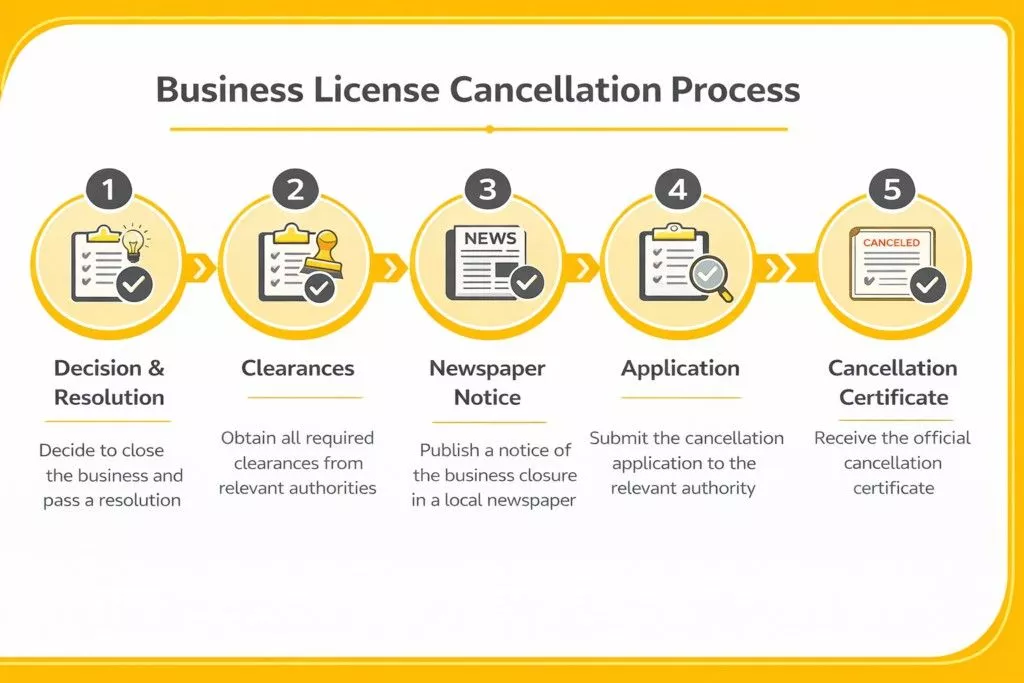
Follow these steps to legally cancel your trade licence. Steps may vary slightly depending on your company’s legal structure, but the core process remains the same.
1. Draft and notarise a board or shareholder resolution
For companies with share capital, the first step is to pass a board or shareholder resolution authorising the liquidation and appointment of a liquidator. This resolution must be notarised by a notary public and, for branches, must be attested by the relevant authorities in the parent company’s country (A notary verifies the signer’s identity, ensures the document is genuine, and applies a formal signature and seal). Sole establishments and civil companies do not need a liquidator but should still draft a letter stating the intention to cancel the licence.
Pro tip: Use a template approved by Dubai courts and include the company’s trade licence number, shareholders’ names, liquidator details and a statement of no outstanding liabilities.
2. Obtain required clearances and cancel visas
Before submitting the cancellation request:
- Cancel all employee visas and labour cards through MOHRE and GDRFA. The experts emphasise that failing to cancel visas can lead to fines and delays.
- Settle employee end‑of‑service benefits and salaries. All dues must be paid before MOHRE will issue clearance.
- Close tenancy agreements and utilities. Provide final DEWA and telecom clearance letters and cancel your Ejari contract.
- Close bank accounts and settle outstanding debts. Prepare final balance sheets and clear all taxes.
Pro tip: Start collecting clearance letters early. Obtaining tax, labour and tenancy clearances can take weeks, so plan ahead.
3. Publish a liquidation notice (for companies requiring liquidation)
If your business is an LLC, PJSC or any company with share capital, you must publish a liquidation announcement in two Arabic newspapers for 45 days. This gives creditors time to lodge claims. Companies with licences that have expired for more than two years only need a 15‑day notice.
Why is a liquidation notice important?
A liquidation notice is important because it serves as a formal public announcement that the company is being dissolved. It ensures transparency and gives creditors, suppliers, and any other stakeholders a defined period to come forward with claims or outstanding dues. This step helps protect all parties involved and ensures that liabilities are properly settled before the company is officially closed.
4. Prepare and submit the cancellation application
After completing clearances and, if necessary, the liquidation notice period, submit a trade licence cancellation application to the DET or relevant free‑zone authority. For mainland companies, you can use the DET’s e‑services portal, service centres or authorised agents. Ensure you attach:
- Notarised board/shareholder resolution (if applicable).
- Preliminary and final liquidation reports (for companies with liquidators).
- Copies of newspaper notices and proof of publication.
- Clearance certificates from MOHRE, GDRFA, DEWA, telecom provider and landlord.
- Passport and visa copies of shareholders.
- Trade licence copy, establishment card and Emirates ID (if applicable).
For sole establishments and civil companies, the application can be submitted directly after obtaining MOHRE and GDRFA clearances.
5. Pay trade licence cancellation fees
Once your application is submitted and verified, you must pay the official DET fees. According to the DET’s fee schedule:
- Licence cancellation fee: AED 1,020.
- Company dissolution fee: AED 2,520 for companies undergoing liquidation.
- Knowledge and innovation fee: AED 20 per transaction.
- Additional costs: Arabic newspaper notices (varies), labour/visa cancellation fees, notary fees for resolutions and liquidator professional fees.
Note: Costs can differ slightly depending on company size, legal structure and service provider.
6. Receive the trade licence cancellation certificate
After all fees are paid and documents verified, the DET or free‑zone authority will issue a trade licence cancellation certificate, confirming that your company has been deregistered and removed from the commercial register. If you have completed liquidation, shareholders and managers are released from future liabilities.
Why is the Trade License Cancellation Certificate Important?
A Trade License Cancellation Certificate is important because it serves as official proof that your business has been legally closed with the relevant authorities. Without this certificate, the company may still be considered active, which can lead to ongoing penalties, fines, or renewal fees.
Documents Required
Prepare the following documents to streamline the cancellation process:
| Document | Purpose | Notes |
|---|---|---|
| Passport copies of shareholders | Identify owners | Include visa pages and Emirates ID, if applicable |
| Trade licence copy | Evidence of registration | Evidence of a liquidation notice |
| Notarised board/shareholder resolution | Authorise liquidation and cancellation | Required for LLCs and companies with share capital |
| Liquidator’s appointment letter and reports | Confirm liquidation progress | Only for entities requiring liquidation |
| Clearance certificates | Proof that liabilities are settled | MOHRE, GDRFA, DEWA, telecom, landlord, and Federal Tax Authority |
| Newspaper publication copies | Evidence of liquidation notice | Only for companies with share capital or expired licences |
| Partner liability undertaking (if needed) | Accept liability for outstanding debts | Required for licences expired >2 years |
| Power of Attorney | Authorise representative | Needed if shareholders are abroad; must be notarised and attested |
Costs & Fees Breakdown
Understanding the cost structure helps you budget and avoid surprises.
- DET fees: AED 1,020 licence cancellation fee + AED 2,520 dissolution fee (for companies requiring liquidation) + AED 20 knowledge & innovation fee.
- Newspaper announcement: Publication costs vary by newspaper; typically between AED 500–800 per notice, and two notices are required for standard liquidation.
- Visa and labour card cancellation: MOHRE and GDRFA fees depend on the number of employees. Expect AED 100–200 per cancellation.
- Notary and attestation fees: Notarising the resolution and attesting documents can cost AED 300–700.
- Liquidator fees: Professional liquidator services range from AED 3,000 to 10,000, depending on company size and complexity. In some cases, in‑house chartered accountants can act as liquidators at a lower cost.
- Service centre or PRO fees: If you use a service provider to handle the process, expect additional service fees (often between AED 1,000–3,000). The DBS cost breakdown (AED 3,520) includes some of these service charges.
Pro tip: Obtaining quotes from multiple service centres ensures you pay transparent and regulated fees. Look for centres authorised by the DET (e.g., EGSH) that offer government‑regulated pricing.
How Long Does It Take?
The timeline varies depending on the company’s legal structure and whether liquidation is required. Sole establishments and civil companies usually complete cancellation within 40 to 60 days. LLCs and companies requiring liquidation may take 60 to 90 days due to the mandatory 45‑day newspaper notice and the time needed to prepare liquidation reports.
Branch closures fall in between, depending on how quickly clearances are obtained. Starting the process at least three months before the licence renewal date helps you avoid late‑renewal fines.
What Happens if You Don’t Cancel?
- Accumulating fines: The DET charges penalties for each day the licence remains expired and for failing to renew or cancel.
- Blocked visa services: Uncancelled licences prevent you from sponsoring new visas or starting new businesses.
- Legal and financial liabilities: Shareholders remain liable for outstanding debts, employee entitlements and tax obligations.
- Difficulty exiting the UAE: Immigration records may show an active business, complicating departures or new visa applications.
Freezing a Trade Licence
If you plan to pause operations temporarily rather than close permanently, you can freeze your trade licence for up to three years by paying a licence freezing fee. To freeze the licence:
- Submit a letter to the DET requesting suspension and outlining reasons.
- Provide a letter from MOHRE confirming that all employees under the licence are inactive.
- Attach a report from the DED inspection department verifying business inactivity.
Freezing the licence preserves your company’s name and registration without incurring renewal penalties. However, after three years, the DET may require cancellation or reactivation.
Pro Tips for a Smooth Cancellation
- Start early: Begin collecting clearance letters and drafting resolutions at least three months before your licence expires.
- Settle all liabilities: Ensure there are no outstanding debts, fines or employee claims; these will delay approval.
- Use authorised service centres: Centres integrated with the DET (e.g., EGSH) offer regulated fees and can complete processes in a single visit.
- Keep documentation organised: Prepare a file with all documents (resolutions, clearances, notices, receipts). Missing documents are the most common cause of delays.
- Communicate with stakeholders: Inform employees, landlords and partners early to obtain their cooperation for clearances and signatures.
- Consider professional assistance: PROs and business consultants understand DET requirements, saving time and reducing errors.
Conclusion
Cancelling a trade licence in Dubai is not just a formality; it is a legal obligation that protects you from fines, visa issues, and unforeseen liabilities. By understanding your company’s legal structure, settling all obligations and following the prescribed steps, you can obtain your cancellation certificate smoothly. Planning ahead, keeping documents organised and leveraging authorised service centres or professional consultants will save you time and money. With proper guidance, you can end your business chapter confidently and focus on your next venture.
If you are considering closing your Dubai business or need help navigating the cancellation process, Bestax can assist. Reach out today for a confidential consultation.
Quick (FAQs)
Can I cancel a trade licence online?
Yes. For mainland companies, the Dubai DET portal allows you to submit cancellation requests electronically. However, you still need to upload notarised resolutions, clearances and newspaper notices. Some documents may require in‑person verification.
Do I need a liquidator for all cancellations
No. Only companies with share capital (e.g., LLCs, PJSCs) require a licensed liquidator. Sole establishments, civil companies and branches do not, but they must still obtain clearances.
How do I handle visas when cancelling?
All employee visas and labour cards must be cancelled through MOHRE and GDRFA before the DET will approve cancellation. Failure to cancel visas leads to fines and delays.
Is a newspaper announcement always required?
No. Newspaper announcements are required only for companies undergoing liquidation. Sole establishments and civil companies are exempt. Licences expired for more than two years follow a shorter 15‑day notice period.
Can I appoint someone else to complete the process?
Yes. If shareholders are outside the UAE, they can issue a notarised and attested Power of Attorney authorising a representative to sign documents and submit the cancellation request.
What happens to deposits and guarantees after cancellation?
Once the trade licence is cancelled and liquidation completed, deposits held by government departments, banks or landlords are released. Ensure you have the cancellation certificate to claim refunds.
How long does the process take?
Depending on your company’s structure, cancellation can take 40–90 days. Delays usually occur when documents are missing or clearances are incomplete.
Disclaimer: The information provided in this blog is for general informational purposes only. For professional assistance and advice, please contact experts.
