




Important notice: Bestax is not a law firm and does not provide travel ban checking, removal or legal representation services. This guide is for general information only. For current fees, procedures or advice about your specific case, contact the relevant UAE authority or a licensed UAE lawyer.
A UAE travel ban generally stops a person from leaving the country while a legal or judicial restriction is active. It is different from an entry or immigration ban, which stops a person entering the UAE, and from a labour ban, which blocks new work permits. You can check Dubai cases through Dubai Police with UAE PASS, Abu Dhabi cases through the Estafser service, and federal cases through the Ministry of Justice.
Planning to travel from the UAE? A quick travel ban check before you book your flight can show whether you have a travel restriction, pending case, financial case, immigration issue or court matter that may stop you at the airport.
This guide explains how to check a travel ban in the UAE through official channels such as Dubai Police, the Abu Dhabi Judicial Department's Estafser service, Ministry of Justice services and GDRFA Dubai. It also covers the 2026 updates that let some Dubai residents clear eligible bans online.
What Is a Travel Ban in the UAE?
A UAE travel ban generally prevents a person from leaving the country while a legal or judicial restriction remains active. It is usually ordered by a court, the public prosecution or another competent authority, and enforced at airports and border crossings.
An entry or immigration ban is a separate restriction. It may prevent a person from entering or re-entering the UAE. The responsible authority and the way you check depend on the type of restriction.
A travel ban can be linked to a criminal case, financial case, civil execution case, family dispute or official court order. It is also not the same as a labour ban. A labour ban affects your ability to get a new work permit, while a travel ban affects your ability to leave the UAE. That is why you should check with the correct authority for your situation.
Common Reasons for a Travel Ban in the UAE
A UAE travel ban may be imposed for different legal, financial or administrative reasons. Common reasons include:
- Pending criminal cases or ongoing investigations by the police or public prosecution
- Financial cases or unpaid court-ordered debts
- Civil execution cases
- Rental disputes that have reached the court or execution stage
- Family law disputes, such as custody or guardianship matters
- Certain bounced cheque cases (see below)
Bounced cheques: a bounced cheque does not automatically create a criminal case or travel ban. Since January 2022, cheques returned solely for insufficient funds have generally been handled through civil enforcement. Criminal penalties may still apply in cases involving fraud or other prohibited conduct. A travel ban may be requested or imposed through the relevant legal proceedings, depending on the circumstances.
Overstaying and immigration violations: overstaying a visa generally creates an immigration violation and fines, not an automatic judicial travel ban. You can check your UAE overstay fine online through ICP or GDRFA. Serious immigration matters, such as deportation orders or absconding cases, may lead to separate immigration or entry restrictions.
Government fines: unpaid fines do not automatically create a travel ban. Whether a restriction applies depends on the relevant law, an enforcement order or the competent authority.
Not every unpaid bill or dispute creates a travel ban. In most cases, a legal case, court order, execution file or official authority action is involved. If you are unsure, check through official channels before travelling.
Types of Bans and Restrictions in the UAE
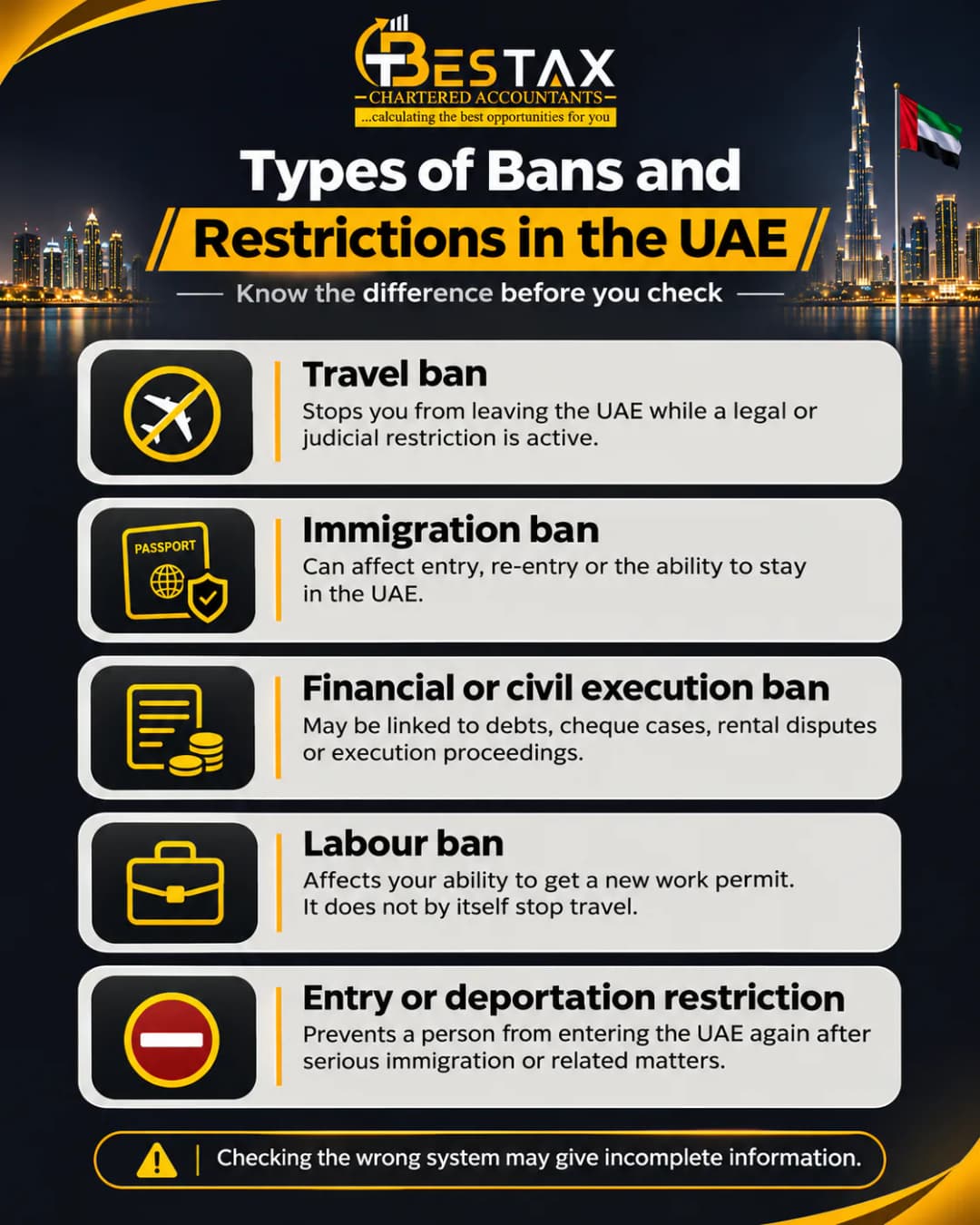
People often use the terms travel ban, visa ban, immigration ban and labour ban as if they mean the same thing. These UAE restrictions are related, but they are not the same.
1. Travel Ban
A travel ban generally stops a person from leaving the UAE until the issue behind it is resolved. It may be linked to a criminal case, financial case, court order, civil execution file or family dispute.
2. Immigration Ban
An immigration ban can affect a person's ability to enter, re-enter or stay in the UAE. It may follow serious immigration violations, deportation orders, criminal matters or other official restrictions.
3. Financial Case or Civil Execution Ban
This type of restriction may be connected to unpaid debts, certain cheque cases, credit card cases, rental disputes or other financial claims that have reached the legal or execution stage. Dubai Police provides an online service for circulars and travel bans related to financial cases.
4. Labour Ban or Work Permit Ban
A labour ban usually affects a person's ability to get a new work permit in the UAE for a certain period. It does not by itself stop a person from entering or leaving the country. Labour matters are handled through the Ministry of Human Resources and Emiratisation (MOHRE).
5. Entry Ban or Deportation-Related Restriction
Some restrictions prevent a person from entering the UAE again. These cases are usually serious and may involve deportation, immigration violations, criminal matters or security restrictions.
Before taking action, identify what type of ban or restriction you are dealing with. Checking the wrong system may give you incomplete information.
How to Check a Travel Ban in the UAE Online
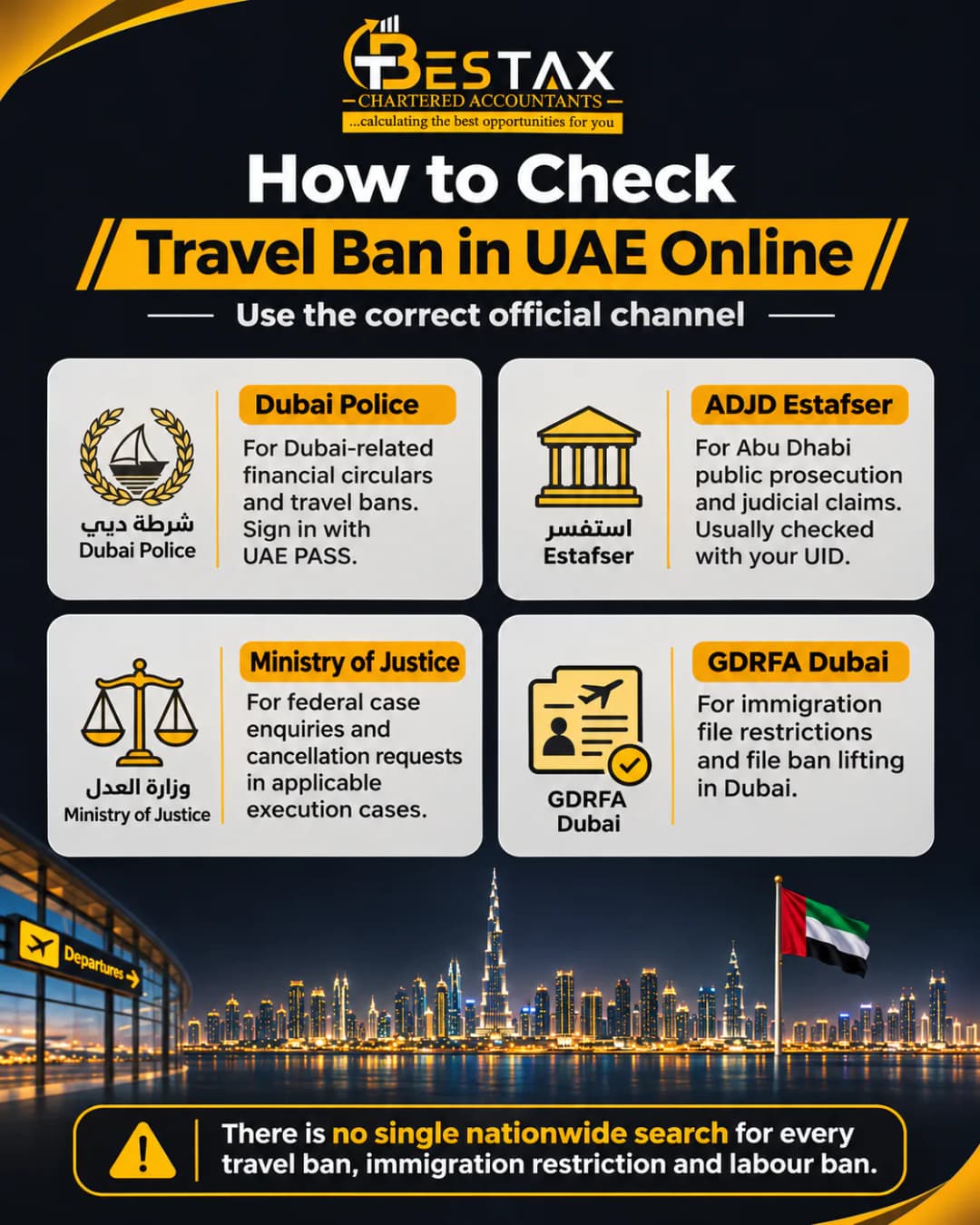
There is no single check that shows every travel ban, labour ban, court case, immigration restriction and police case across the UAE. The right method depends on the emirate, the authority and the type of case.
The main official channels are:
- Dubai Police online services, for Dubai-related financial case circulars and travel bans
- Abu Dhabi Judicial Department (ADJD) Estafser, for Abu Dhabi public prosecution and judicial claims
- Ministry of Justice services, for federal case enquiries and travel ban cancellation requests in applicable execution cases (not a nationwide status check)
- GDRFA Dubai, for certain immigration file restrictions
- Police stations, courts, public prosecution offices, immigration offices or licensed lawyers
If your travel is urgent or you suspect a serious legal matter, do not rely on one online search. Contact the relevant authority or a licensed UAE lawyer before travelling.
Check a Travel Ban in Dubai Through Dubai Police
If your possible travel ban is connected to Dubai, start with the Dubai Police website or Smart App.
Steps to Check Through Dubai Police
- Visit the official Dubai Police website or open the Dubai Police Smart App.
- Open the Circulars and Travel Bans service.
- Sign in using UAE PASS where prompted, and provide any additional identification requested.
- Review the financial case circulars and travel ban information shown.
If a restriction appears, follow the instructions shown by Dubai Police or visit a police station with your Emirates ID, passport copy and any requested documents. For enquiries, you can also call Dubai Police on 901.
The service does not provide a nationwide check of every judicial or immigration restriction. It may not show bans issued by other emirates, federal courts, immigration authorities or labour authorities.
2026 Update: Pay and Clear Eligible Dubai Travel Bans Online
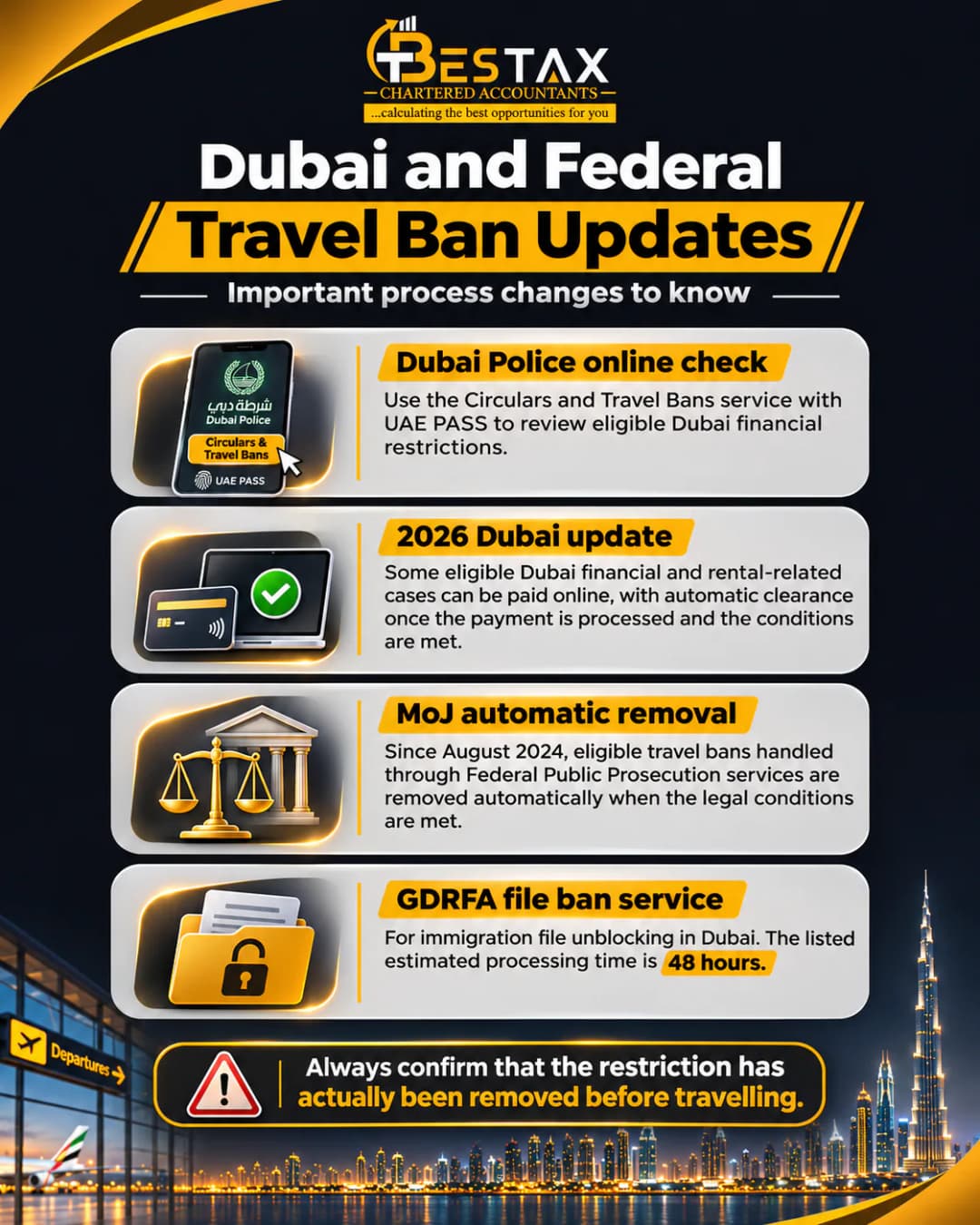
In January 2026, Dubai Police upgraded its Circulars and Travel Bans service to help eligible users check restrictions and settle certain financial claims online. Using UAE PASS on the website or Smart App, users can, depending on the case:
- Check registered financial circulars and travel restrictions
- Identify the authority responsible for the restriction
- Review eligible outstanding financial claims
- Pay covered amounts electronically
- Receive automatic travel ban clearance once the payment is processed and the relevant conditions are met
The first phase covers cases issued by Dubai's Rental Dispute Settlement Centre. Dubai Police said that, for these cases, the ban is lifted within seconds once the electronic payment is complete. On 17 March 2026, the Rental Disputes Center also announced an integrated digital system with Dubai Police to improve rental-related payments, information exchange and judicial procedures.
Important: this service does not cover every travel ban in Dubai or elsewhere in the UAE. Other cases may still need court approval, a separate application or contact with the issuing authority. Always confirm that the restriction has been removed before travelling.
Check a Travel Ban in Abu Dhabi With Estafser
For Abu Dhabi-related cases, use the Estafser service from the Abu Dhabi Judicial Department. It helps you check whether there are public prosecution or judicial claims linked to your record in Abu Dhabi.
Steps to Check Through Estafser
- Visit the official Abu Dhabi Judicial Department website or app.
- Open the Estafser e-service.
- Enter the required details, such as your UID (unified number).
- Submit the request.
- Review the result or follow the instructions provided.
Estafser is useful for Abu Dhabi judicial and public prosecution matters, but it is not a complete check of every possible ban. If the result shows a case, claim or restriction, contact the relevant Abu Dhabi authority or a licensed UAE lawyer.
Ministry of Justice: Automatic Removal and Cancellation Requests
The Ministry of Justice (MoJ) has two separate processes. Know which one applies before you act.
Automatic Removal (Since August 2024)
Since August 2024, eligible travel bans handled through Federal Public Prosecution services are removed automatically once the required legal conditions are met. No separate cancellation application is needed. The MoJ cut this procedure from nine steps to zero and removed the document requirement.
Travel Ban Cancellation Request (Execution Cases)
The MoJ also provides a cancellation request service for certain travel ban orders issued in federal execution proceedings. Applicants must have legal standing, an existing travel ban order and the relevant open execution file.
Who can apply is worth confirming first. Earlier MoJ guidance said the person subject to the ban or their lawyer could use the service, while the current service description refers to the party in whose favour the order was issued. Check the live MoJ service page, or ask the court or a licensed UAE lawyer, before you apply. Eligible applicants:
- Sign in through UAE PASS.
- Submit the cancellation request.
- Provide supporting documents where required.
- Pay any applicable fee.
- Wait for the request to be handled through the relevant judicial process.
The fee and processing time depend on the case and are shown on the MoJ service page when you apply. These requirements apply only to the manual request, not to automatic removal. The reason behind the ban, such as a payment, settlement or court decision, must usually be resolved first.
If you do not understand the case or the reason for the ban, speak to the relevant court, public prosecution office or a licensed UAE lawyer before submitting anything.
GDRFA File Ban or Immigration File Restriction
Some issues do not appear in a standard travel ban search and need an immigration file check instead. They may be linked to an immigration, sponsor or residency file. In Dubai, GDRFA offers a Lifting the ban on a file for individuals service.
GDRFA Dubai lists two required documents:
- The sponsored person's unified number or Emirates ID
- A receipt from the Finance Department showing payment of the fees owed by the sponsor
Where the file ban comes from a criminal or civil case, GDRFA's terms also ask for a letter from the official authorities, such as the courts or public prosecution, confirming that the case has ended. GDRFA does not list a separate fee for lifting the ban, but collection commissions apply, and Amer centres add AED 100 per application.
GDRFA gives an expected completion time of 48 hours for this service. This applies to immigration file unblocking only. It is not a promise that a judicial travel ban will be removed in 48 hours.
For visa, residency, sponsor file or Dubai entry and exit matters, contact GDRFA Dubai, an Amer centre or another authorised immigration channel. If the restriction sits on a company or employee file, our PRO services in the UAE team can handle the GDRFA and ICP paperwork once any legal case behind it is closed.
Can You Check a UAE Travel Ban by Passport Number?
Most online travel ban checks use UAE PASS, an Emirates ID or a UID rather than a passport number. Dubai Police uses UAE PASS sign-in, while Abu Dhabi's Estafser commonly uses your UID.
If you only have your passport number, the safest way to verify a travel ban in the UAE is to contact the relevant police station, immigration authority, court, GDRFA, ICP, public prosecution office or a licensed UAE lawyer to confirm your status.
If you are outside the UAE and cannot access the online systems, contact the authority directly or ask a licensed UAE lawyer to check through proper legal channels.
What to Do If a Travel Ban Appears
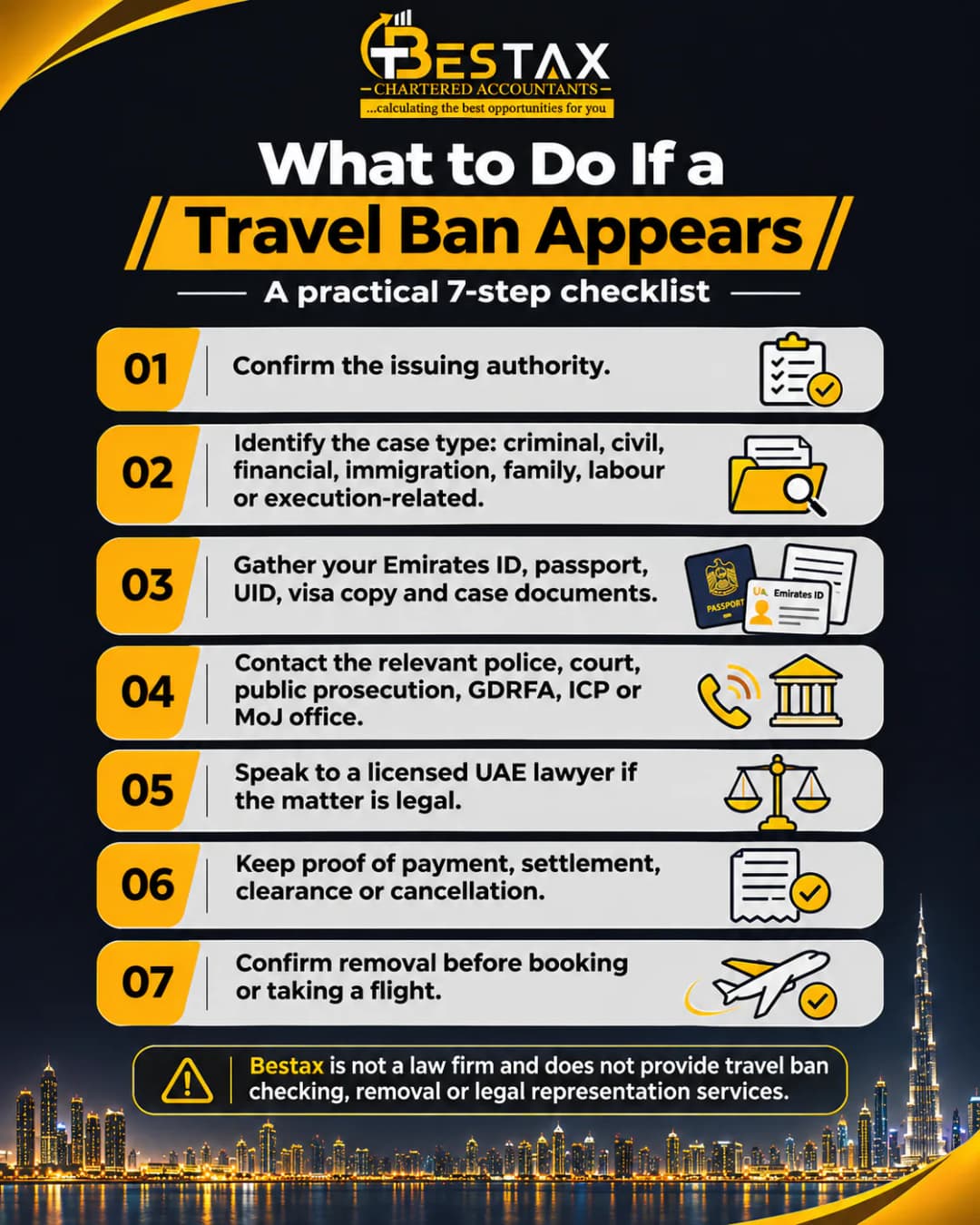
If a travel ban appears, do not ignore it and do not try to travel without confirming the reason. The right action depends on the type of case and the authority that issued the restriction.
- Confirm which authority issued the ban.
- Check whether the matter is criminal, civil, financial, immigration, family, labour or execution-related.
- Collect your Emirates ID, passport, UID, visa copy, case number and any court or police documents.
- Contact the relevant police station, court, public prosecution, GDRFA, ICP, MoJ or ADJD office.
- If the matter is legal, speak to a licensed UAE lawyer.
- Keep proof of payment, settlement, clearance, judgment or official cancellation once the issue is resolved.
- Confirm the ban is removed before booking or taking a flight.
Some bans now lift automatically once the case is resolved, but you should still verify that the restriction has been updated in the system before travelling. For the removal steps, read our guide on how to remove a travel ban in the UAE.
How Long Does a UAE Travel Ban Last?
The duration depends on the reason behind the ban. Some restrictions are removed after payment, settlement, case closure, a court decision or official cancellation. Others last longer if the matter is still under investigation, under execution, or linked to an immigration or criminal issue.
There is no single fixed duration for every travel ban in the UAE. A financial case, immigration issue, labour matter, criminal case or court execution file may each follow a different process.
The safest step is to check with the authority that issued the ban and confirm, in writing or through the official system, that the restriction has been lifted before travelling.
Check Your Status Now, Not at the Airport
Don't wait until immigration stops you at the airport. Take these steps before you book your next flight:
- Run a check today. Use Dubai Police for Dubai cases, Estafser for Abu Dhabi cases, or contact the relevant court, public prosecution or immigration office for other emirates.
- Act on what you find. If a restriction appears, confirm which authority issued it and what is needed to resolve it.
- Clear it properly. Settle the case, pay any ordered amounts and keep every receipt, settlement or clearance letter.
- Confirm before you fly. Check again that the ban has been removed from the system before you head to the airport.
A few minutes of checking now can save you a missed flight and a much bigger problem later. Once any legal matter is resolved, our UAE visa services team can help with residence visa renewals, cancellations and status changes.
FAQs on Checking a Travel Ban in the UAE
How Do I Check If I Have a Travel Ban in the UAE?
You can check through official channels such as Dubai Police, the ADJD Estafser service, the Ministry of Justice, GDRFA, ICP, police stations, courts or public prosecution offices. The correct channel depends on the emirate and the type of case.
Can I Check My Travel Ban Status Online in the UAE?
Yes, for many cases. Dubai Police offers its Circulars and Travel Bans service for Dubai-related financial cases, accessed with UAE PASS. Abu Dhabi residents can use the ADJD Estafser service for Abu Dhabi judicial or public prosecution claims. Other cases may need direct contact with the issuing authority.
What Information Do I Need to Check for a Travel Ban?
Dubai Police's online service uses UAE PASS, which is linked to your Emirates ID. Estafser commonly uses your UID (unified number). A passport number alone is usually not enough for online checks. Keep your Emirates ID, passport copy, visa copy, UID and any case number ready.
How Long Does It Take to Verify a Travel Ban?
Dubai Police's online service lets you check eligible financial circulars and travel restrictions digitally, and results may be available immediately, depending on the case. For eligible rental-related bans, Dubai Police said restrictions are lifted within seconds after a successful online payment. ADJD reported that in the first quarter of 2025, Estafser received 6,292 enquiries, answered 97% within one working day and 99% within three days. Checks through courts, police stations or immigration authorities may take longer.
What Are the Reasons for a Travel Ban in the UAE?
Common reasons include pending criminal cases, unpaid court-ordered debts, civil execution cases, rental disputes and family or custody matters. Overstaying and other immigration violations are handled separately and usually lead to fines or immigration restrictions rather than a judicial travel ban.
Can I Appeal a Travel Ban in the UAE?
Yes. A civil travel ban order can usually be challenged through the court's grievance procedure, for example if the legal conditions were not met. Criminal and family court bans follow their own procedures. A licensed UAE lawyer can advise on the right route.
How Do I Remove a Travel Ban in the UAE?
You usually need to resolve the reason behind the ban, such as paying a judgment amount, settling a case or completing court procedures. Since August 2024, eligible bans handled through Federal Public Prosecution services are removed automatically once the legal conditions are met. In other cases, a cancellation request or court decision may be needed. Our guide on removing a UAE travel ban covers each route.
What Are the Consequences of a Travel Ban in the UAE?
You cannot leave the UAE until the ban is lifted. This can disrupt work travel, family plans and business commitments, and you may only find out at the airport. The underlying case may also lead to further enforcement action, so resolve it early.
Can a Travel Ban Affect My UAE Residency Status?
A travel ban by itself stops you from leaving the country. It does not automatically cancel your residency. However, the case behind it, or related restrictions such as immigration violations or unpaid immigration fines, can affect visa renewals or status changes. You can check your UAE visa status online through GDRFA or ICP.
Who Can Impose a Travel Ban in the UAE?
A travel ban may be ordered by a court, the public prosecution, police or another competent authority, depending on the case. Entry and immigration bans are handled by immigration authorities.
Bestax is not a law firm and does not provide travel ban checking, removal or legal representation services. For current fees, procedures or advice about your specific case, contact the relevant UAE authority or a licensed UAE lawyer.
Disclaimer: The information provided in this blog is for general informational purposes only. For professional assistance and advice, please contact experts.

With over six years of experience in tax, accounting, bookkeeping, and business setup processes, Neha Ghauri provides expert insights through meticulously researched content.
Learn More About Neha