





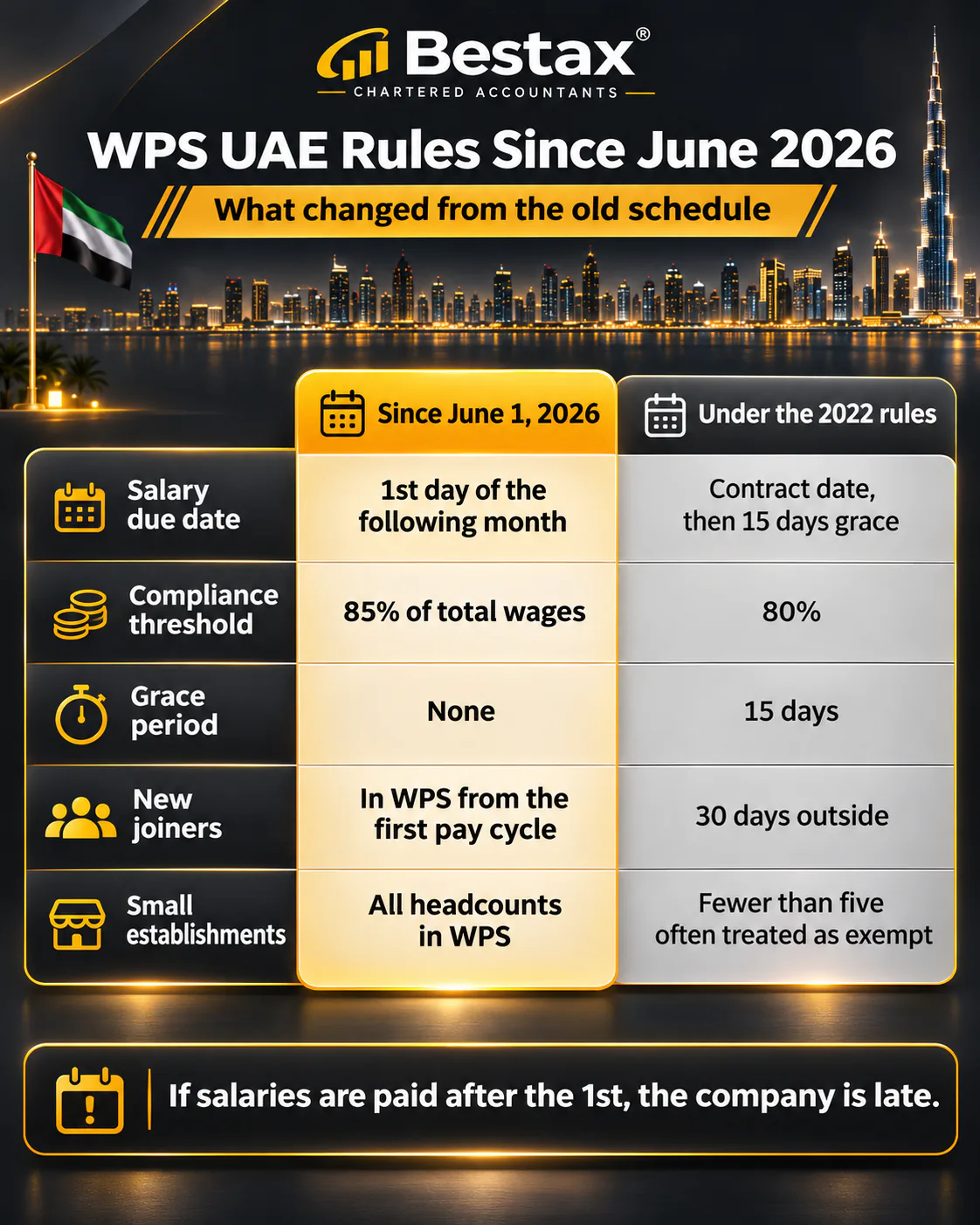
Since June 1, 2026, every private-sector employer registered with MOHRE has had one salary deadline. Wages for the previous month are due on the first day of the next. The 15-day grace period that used to follow is gone, and the WPS rules now treat any payment after the first as late.
If you still run payroll on the old schedule, you are non-compliant every month without having changed a thing.
The guide below covers who has to pay through the system and how.
How the Wage Protection System Works in the UAE
The Wage Protection System is an electronic channel that routes your salaries through the Central Bank to approved banks, exchange houses and wallets. MOHRE sees every transfer you make. That is how it knows whether you paid on time.
Who Has to Use WPS and What a SIF File Is
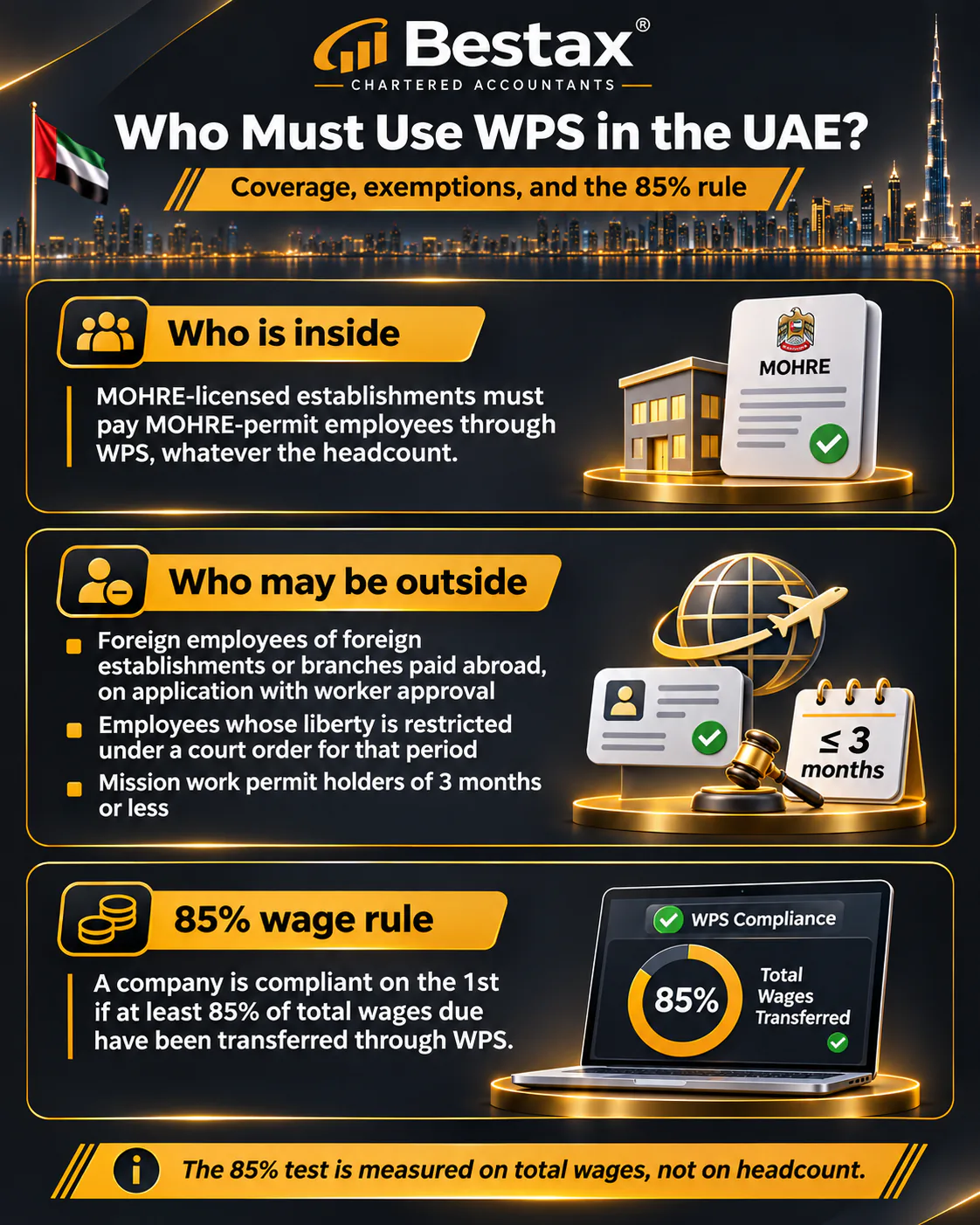
If your establishment is licensed with MOHRE, you pay every MOHRE-permit employee through WPS, whatever your headcount. The old understanding that companies with fewer than five workers sat outside the system is no longer reliable. MOHRE expects a file for every worker on a permit, and cash payment does not count even where the worker signs a consent form.
The file is the SIF, the Salary Information File. Your payroll produces it each month with one record per employee. Each record carries the labour card number, the bank routing details, the basic wage, the allowances, the days worked and any deductions.
You send the file to your bank or exchange house, which transmits it to the Central Bank's WPS platform, and MOHRE records the result. Since the December 2025 platform upgrade, transfers are tracked against MOHRE's systems in close to real time rather than in delayed batches. A rejected record shows on the same day, which gives you time to fix it before the deadline if the file went in early.
The Salary Deadline and the 85 Percent Rule
Ministerial Resolution No. 340 of 2026 sets the first day of each Gregorian month as the due date for the previous month's wages. You are compliant on that day if at least 85 percent of the total wages due have been transferred through WPS. Below 85 percent, your establishment is late from day one and the escalation begins on day two.
The 85 percent test is measured on total wages, not on headcount. A company with 40 workers that has paid 36 of them in full will usually pass. A company that has paid everyone except its three highest earners can fail.
The remaining 15 percent still has to be paid. What the threshold changes is the trigger. A small shortfall does not start the timeline by itself, and a large one does even when most workers were paid. The resolution also requires you to keep and submit documentation evidencing the payments in the form MOHRE specifies.
Free Zone WPS and Exempt Workers
DIFC and ADGM run their own employment regimes, and the federal system does not apply inside them. Other free zones, such as JAFZA and DMCC, operate a free zone WPS under their own authorities. Their timing rules have not all moved to the first-of-month deadline, so the deadline that applies to a free zone company is the one its authority sets.
The resolution lists the workers outside the system, and the list is longer than before. Foreign employees of foreign establishments or their UAE branches who are paid abroad are excluded on application with the workers' approval. So are employees whose liberty is restricted under a court order for the period of the restriction, and holders of a mission work permit of three months or less. The 30-day exemption for new joiners under the old rules has been removed, so everyone else on a MOHRE permit is inside from their first cycle.
If you hold both a mainland licence and a free zone entity, the two run on separate files with separate deadlines. A single payroll calendar built to the earlier of the two keeps both compliant. Several free zones have aligned with the federal date since June, which makes the earlier date the first of the month in most cases.
| Rule | Since June 1, 2026 | Under the 2022 rules |
|---|---|---|
| Salary due date | First day of the following month | Contract date, then 15 days grace |
| Compliance threshold | 85 percent of total wages | 80 percent |
| Grace period | None | 15 days |
| New joiners | In WPS from the first pay cycle | 30 days outside |
| Small establishments | All headcounts in WPS | Fewer than five often treated as exempt |
WPS Penalties in the UAE: The Day-by-Day Escalation
The resolution replaces the old fixed penalties with a timeline. Each day past the first without 85 percent paid moves your establishment one step further. The steps do not reverse until the wages are paid and MOHRE closes the file.
Days Two to Five: Warnings and the Work Permit Block
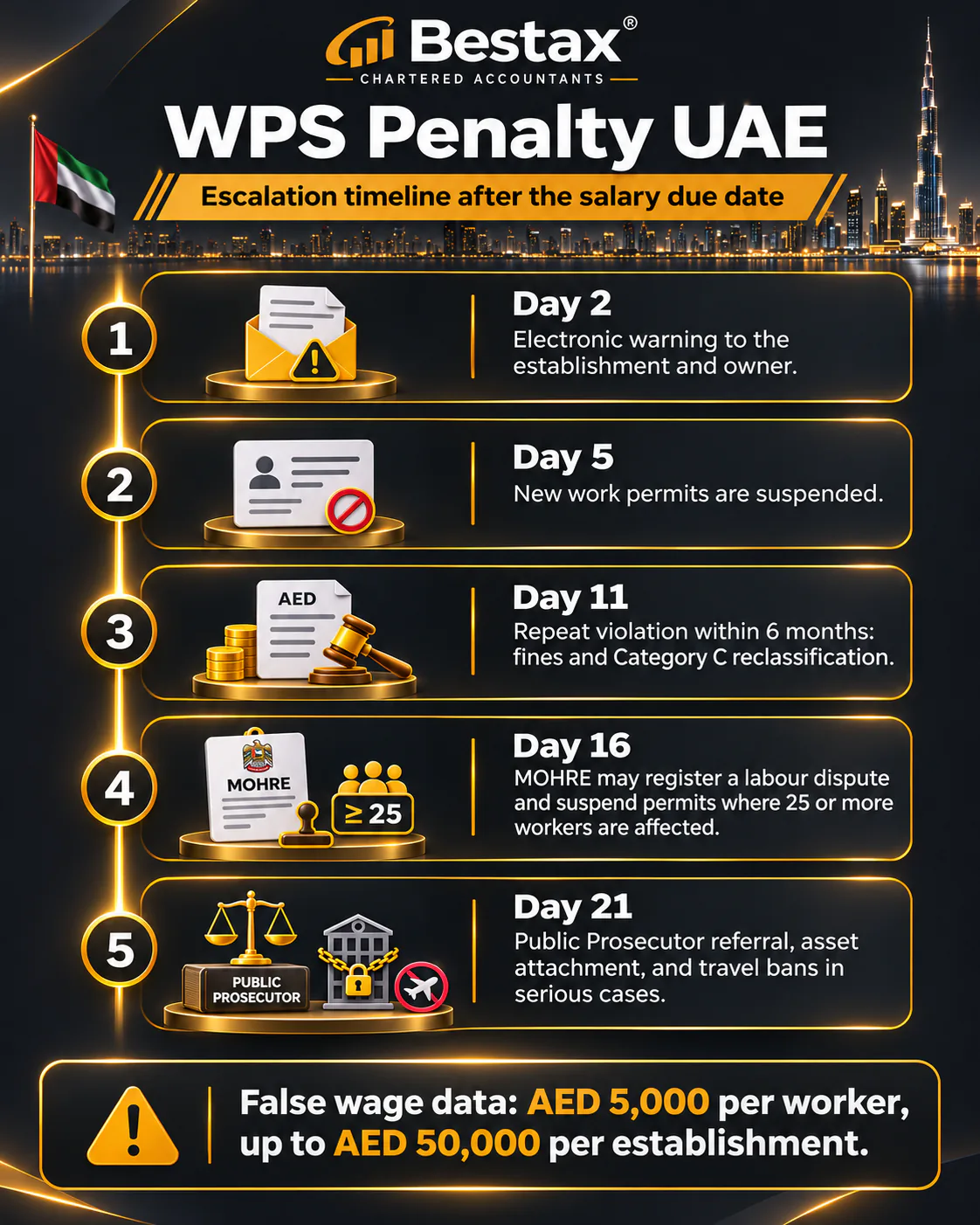
On day two MOHRE sends an electronic notification to your establishment and to you as owner, by SMS and through the establishment's account. On day five the work permit block begins. MOHRE suspends the issuance of new work permits to the establishment.
That means no new hires, no transfers in and no renewals until the wages are paid. For a company mid-recruitment, day five is where the cost starts. A candidate whose permit cannot be issued does not wait, and the offer you made goes to a competitor.
Subscribing the owner and the payroll lead to MOHRE's SMS alerts is the cheapest protection against day five. The day-two warning arrives on a phone, and the three days between it and the block are enough to fix a rejected file. A warning nobody reads is the usual story behind a blocked establishment.
Days Eleven to Sixteen: Fines and Labour Dispute Registration
On day eleven, an establishment with a repeated violation within six months faces administrative fines. The establishment is also reclassified to Category C, the lowest MOHRE category and often called the third category. That raises the cost of every permit and transaction it runs from then on. The reclassification outlasts the late payment, so a second bad month inside six months is paid for across the following year.
On day sixteen, MOHRE can register a labour dispute on the workers' behalf and suspend work permits. That step applies to any establishment, in any sector, where 25 or more workers are affected. Commonly owned group companies are counted together to reach the 25 in the sectors the resolution targets, such as construction, transport and storage, security services, cleaning and recruitment offices. The matter moves toward the labour courts without any worker having filed a complaint.
For establishments below the 25-worker line, the day-sixteen step does not normally apply, but the warnings, the block and the fines do. The distinction is about the dispute route, not about who is inside the system. A ten-person company is late on the same day as a thousand-person one.
Day Twenty-One and Beyond: Prosecution and False Data Fines
On day twenty-one the resolution provides for referral to the Public Prosecutor and attachment of the establishment's assets to cover the wages. Travel bans on the responsible persons follow in serious or repeat cases. At that point the wages are collected rather than paid.
Separate fines apply for not registering in the system at all or for filing false wage data. Under the penalty schedule in Cabinet Resolution No. 21 of 2020, false wage data carries AED 5,000 per worker, up to AED 50,000 per establishment. A recorded wage that differs from the contract, or from what the worker actually receives, is false data whichever way the difference runs.
| Day after the due date | What MOHRE does |
|---|---|
| Day 2 | Electronic warning to the establishment and owner |
| Day 5 | Suspension of new work permits |
| Day 11 | Administrative fines for a repeat within six months, reclassification to Category C |
| Day 16 | Labour dispute registered and permits suspended where 25 or more workers are affected, with commonly owned groups counted together in targeted sectors |
| Day 21 | Prosecution referral, asset attachment, travel bans in serious cases |
| Any time | AED 5,000 per worker, up to AED 50,000, for false wage data under Cabinet Resolution 21 of 2020 |
Every step above runs against the establishment's MOHRE file. That file is the same one that carries your labour card requirements and permits. A block on it stops the next hire. A Category C classification raises the fee on the one after, from about AED 250 to as much as AED 3,450 for a two-year permit. Payroll and permits are one system, whatever your organisation chart says.
How to Run Payroll to the WPS Deadline
A WPS salary transfer that lands on the first is the product of a calendar that ends on the twenty-eighth. Three parts of the process decide whether your money arrives in time. Each one is yours to control, and each is where most WPS penalties start.
The Monthly Payroll Calendar
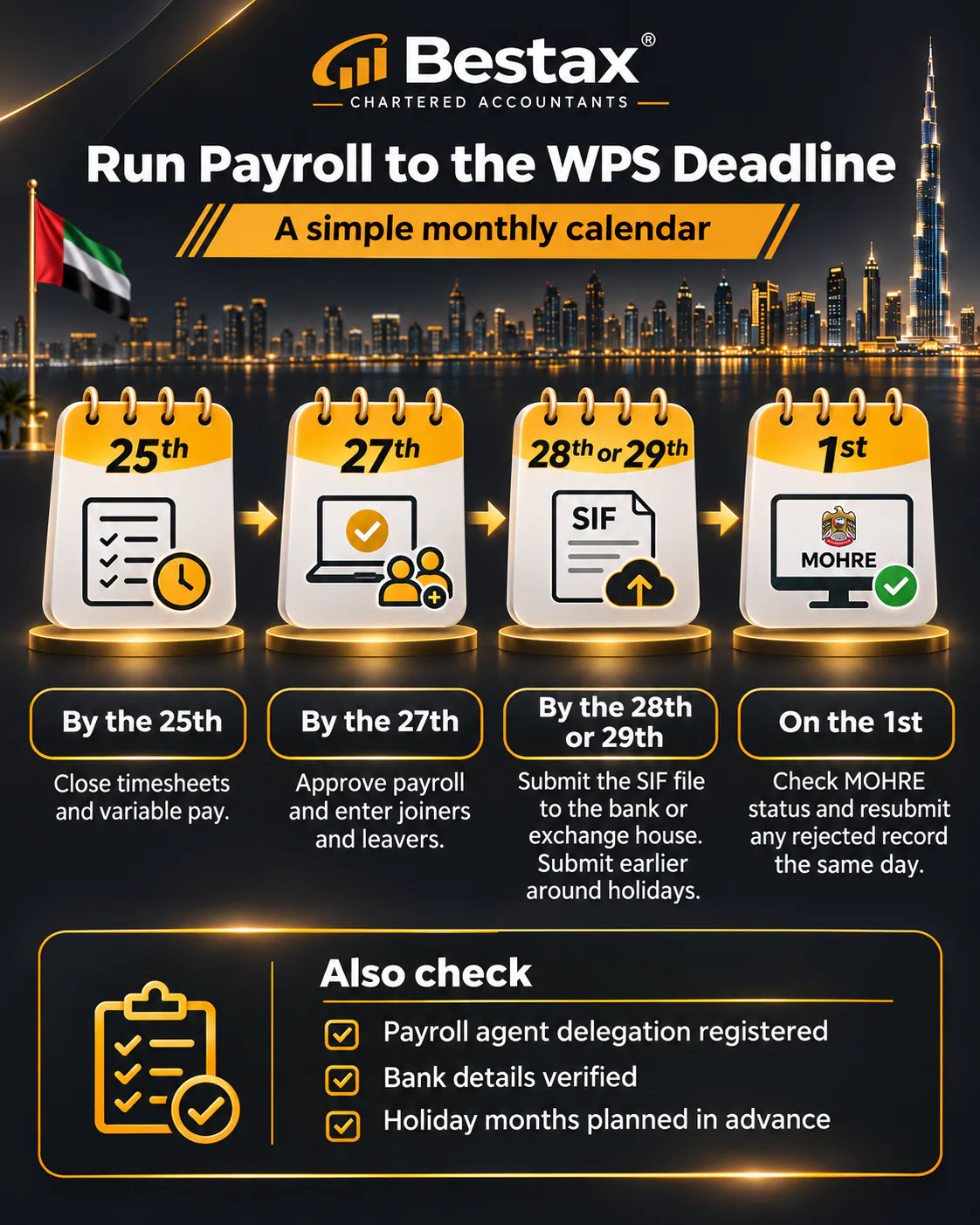
Your bank or exchange house needs one to two working days to process a SIF file. To credit by the first, you submit by the twenty-eighth or twenty-ninth, and weekends and public holidays move that date earlier. If you start payroll on the first, you are already late.
Working back from submission, payroll has to be approved by the twenty-seventh. Timesheets and variable pay close by the twenty-fifth. Joiners and leavers for the month are entered before that, with their bank details verified against the SIF format.
The calendar has to survive the months with holidays in them. Eid and the National Day weekend fall across payroll dates in most years, and a file submitted on the twenty-ninth before a three-day closure credits on the fourth. Set the submission date for those months in January, not the week before.
The Payroll Agent and Who Is Liable
You can delegate the SIF to a payroll agent, and many companies do. The resolution requires MOHRE to hold the agent's details and a current copy of the delegation contract. An informal arrangement with a bookkeeper does not meet that, and the delegation has to be registered on your establishment file.
Delegating the work does not delegate the liability. If the agent submits late or wrongly, the escalation runs against your establishment. The fines, the block and the reclassification are yours, and the agent's contract decides only whether you can recover from them.
Choose the agent on process rather than price. Ask when the agent submits, how it confirms the MOHRE status, and what it does on the first when a record is rejected. An agent that submits on the thirtieth and checks the status on the third is the cause of the warning, not the cure.
Joiners, Leavers, Deductions and Final Settlements
A new joiner is in the system from their first pay cycle. Their labour card and bank details have to be in the file before the first payroll they are due. A joiner whose account is not yet open is paid through a wage card or an exchange house, not in cash.
A leaver's final settlement goes through WPS as well. That includes accrued leave and the gratuity calculated on the basic wage and years of service. The labour law gives you 14 days from the end of the contract to pay it. A final settlement paid outside the system reads as an unpaid wage on the file.
The 85 percent rule also applies per worker. A worker counts as paid where they receive at least 85 percent of their wage and the shortfall is a lawful deduction under the labour law. The labour law allows deductions of up to 20 percent for a loan, and more where several grounds combine. Where lawful deductions push the amount received below 85 percent, keep the deduction documentation ready, because the file can show the worker as underpaid until the evidence is accepted.
Run this checklist every month:
- Timesheets and variable pay closed by the twenty-fifth
- Payroll approved by the twenty-seventh, with joiners and leavers entered
- SIF submitted to the bank by the twenty-eighth, earlier around holidays
- MOHRE status checked on the first, with any rejected record resubmitted the same day
- Payroll agent delegation registered with MOHRE and renewed with the contract
Our payroll services in the UAE run that calendar for you as a registered payroll agent. The work runs from the timesheet close through the SIF submission to the MOHRE status check on the first. We hold the delegation contract MOHRE requires on file. The holiday months are scheduled at the start of the year.
Check the Date Your Last SIF File Was Submitted
Open your bank's WPS portal and find the submission date of last month's file. If it was after the twenty-ninth, your salaries credited after the first, and your establishment has already had the day-two warning. If it was before, check the MOHRE status for the month, because a rejected record leaves the total below 85 percent even when the file went in early.
Then check three more things. Was any worker paid outside the system, did any joiner miss their first cycle, and is the payroll agent's delegation registered. Those are where otherwise compliant companies fail.
If any of them is unclear, our payroll team will audit your last three files against the resolution and set the calendar for the next one. The first of next month then passes without a warning. The audit takes a day and the fix is usually a date.
FAQs About WPS Rules in the UAE
My contract pays staff on the 25th. Do I still have to pay by the 1st?
Paying earlier is allowed. The resolution sets the first of the month as the latest date for the previous month's wages. Early payment is recognised as compliant in the system, although the resolution does not say so in terms. A company that pays on the 25th of the same month is ahead of the deadline. What is no longer allowed is paying after the first, whatever the contract says.
If one employee's bank rejects the transfer, is the whole company late?
Not on its own. Compliance is measured on 85 percent of total wages paid through WPS by the first. One rejected record for a mid-salary worker usually leaves the establishment above the threshold. The rejected wage still has to be resubmitted, and a rejection for a high earner can pull the total below 85 percent.
Does the work permit block stop renewals as well as new permits?
The suspension covers the issuance of new work permits. In practice MOHRE holds renewals and transfers on the same blocked file. A company blocked on day five cannot onboard, renew or transfer until the wages are paid and the file is cleared. Recruitment has to be planned around the payroll date.
Can I pay part of a salary in cash and the rest through WPS?
No. Every dirham of the wage recorded with MOHRE has to pass through the system, and a cash portion does not register. A worker's consent does not change that. A recorded wage above what the worker receives reads as unpaid, and a recorded wage below the contract reads as false data.
What if my free zone still has a later deadline than the 1st?
Follow the deadline your free zone authority sets, because the federal resolution applies to MOHRE-licensed establishments. The federal escalation does not run against a free zone file, but the zone's own penalties do, and those include permit and licence renewal holds. Check the authority's current circular each quarter, since several have aligned with the federal date since June 2026.
Disclaimer: The information provided in this blog is for general informational purposes only. For professional assistance and advice, please contact experts.

Khadija Raees holds a Bachelor's degree and brings over five years of experience in creating authoritative content in the areas of tax, accounting, company formation, and VAT in the UAE.
Learn More About Khadija