




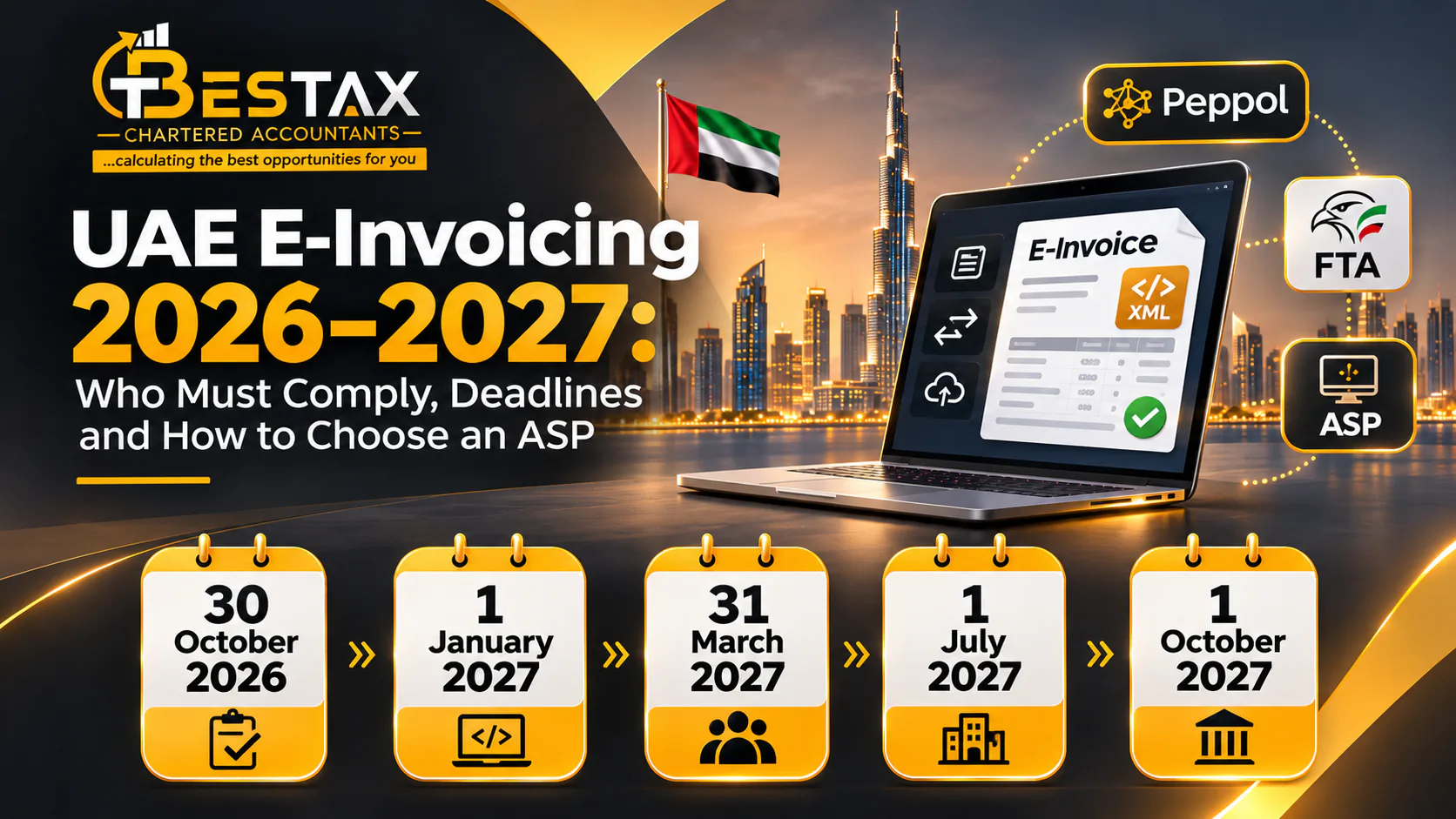
Mandatory e-invoicing in the UAE starts on 1 January 2027 for businesses with annual revenue of AED 50 million or more. Smaller businesses follow on 1 July 2027, and government entities on 1 October 2027.
Under the UAE e-invoicing mandate, a PDF or paper invoice alone will no longer meet the requirement for transactions in scope. Businesses must issue structured electronic invoices through the prescribed system. Every invoice moves through an Accredited Service Provider (ASP) on the Peppol network, and tax data goes to the Federal Tax Authority (FTA).
If your revenue is AED 50 million or more, your ASP appointment deadline was 30 October 2026 and you go live on 1 January 2027. If you have not appointed an ASP yet, do it now.
Who Must Comply With UAE E-Invoicing
Any person doing business in the UAE falls under the mandate for business transactions, unless a specific exclusion applies. VAT registration is not the test.
A business that is not VAT registered can still be in scope. If your business does not have a Tax Identification Number (TIN), you must register with the FTA to get one.
Transactions in Scope
The mandate covers invoices and credit notes between businesses and the government, subject to exclusions:
- B2B: sales between businesses
- B2G: sales by businesses to government entities
- G2B: supplies by government entities to businesses
- G2G: transactions between government entities
B2C sales are outside the system. Supplies to or from individuals who are not doing business are not covered, so shop receipts for personal purchases do not become e-invoices.
Transactions Excluded From the Mandate
Ministerial Decision No. 243 of 2025, as amended by Ministerial Decision No. 197 of 2026, excludes specific transactions, not whole sectors:
- Transactions between members of the same VAT tax group, for 24 months from 1 January 2027 to 31 December 2028
- Sovereign activities of government entities that do not compete with the private sector
- International passenger flights sold with an electronic ticket, plus certain ancillary airline services
- International air cargo using an airway bill, for a temporary 24-month period
- Certain VAT-exempt or zero-rated financial services
Do not assume every exempt or zero-rated supply is excluded. The legal conditions are narrow, so check each transaction type.
The VAT group exclusion is temporary and ends on 31 December 2028. It covers only transactions between group members. Each member must still meet its applicable deadlines for other transactions in scope.
How the AED 50 Million Revenue Threshold Works
Revenue means gross income in your most recent accounting period, based on your financial statements. The test is revenue, not profit. A business with AED 50 million in gross income and a small profit is still in the January 2027 phase.
If you have no financial statements, the FTA accepts other documentation.
If your revenue sits close to AED 50 million, confirm the figure before you plan for the July 2027 phase. Getting the phase wrong means missing the January deadline.
UAE E-Invoicing Deadlines: The 2026–2027 Implementation Timeline
Your place in the UAE e-invoicing timeline depends on your revenue and entity type. Each group has two deadlines: one to appoint an ASP, and a later implementation date when it must go live.
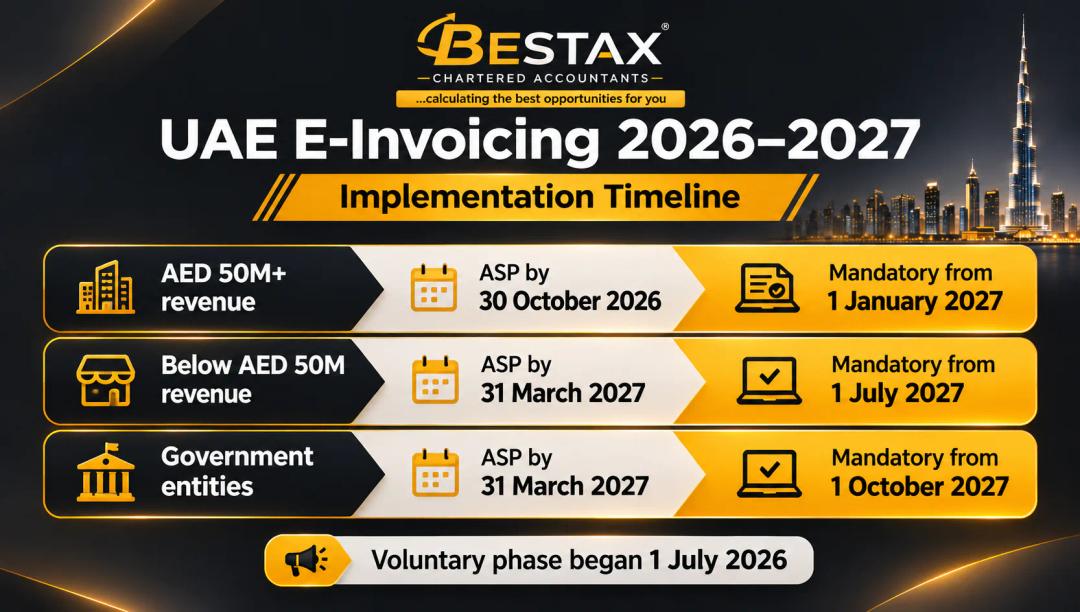
| Who | Appoint an ASP by | Mandatory e-invoicing from |
|---|---|---|
| Businesses with revenue of AED 50 million or more | 30 October 2026 | 1 January 2027 |
| Businesses with revenue below AED 50 million | 31 March 2027 | 1 July 2027 |
| Government entities | 31 March 2027 | 1 October 2027 |
Transactions between members of the same VAT tax group are temporarily excluded from 1 January 2027 through 31 December 2028. Each member must still meet its applicable deadlines for other transactions in scope.
The pilot and voluntary phase began on 1 July 2026. Any business can join early, and no penalties apply to voluntary invoices.
How the ASP Appointment Deadline Moved in 2026
The original deadline for large businesses to appoint an ASP was 31 July 2026. Ministerial Decision No. 66 of 2026 moved it to 30 October 2026.
The go-live date did not move. Large businesses still start mandatory e-invoicing on 1 January 2027, which leaves about two months between appointment and go-live.
The FTA confirmed the 30 October 2026 date on 29 September 2026, and the Ministry's updated guidelines, version 2.1 of 25 November 2026, now show it in the deadline table.
Ministerial Decision No. 197 of 2026: Four Rules Relaxed
The Ministry of Finance issued Ministerial Decision No. 197 of 2026 to reduce the compliance burden on businesses. It took effect on 1 October 2026 and changed four rules:
| Rule | Before | Now |
|---|---|---|
| System failure notice | Notify the FTA within 2 business days | Requirement removed |
| Data storage | Must be stored within the UAE | Location requirement removed |
| VAT tax group transactions | In scope | Excluded for 24 months from 1 January 2027 |
| Issuance deadline for non-VAT registrants | 14 days | 14 business days |
The storage change is about location only. You must still keep e-invoices, credit notes and related data for the period the Tax Procedures Law requires, and give them to the FTA when it asks.
Ministerial Decision No. 168 of 2026: New ASP Accreditation Rules
Ministerial Decision No. 168 of 2026 changed how providers become ASPs. It took effect on 1 October 2026 and replaced Ministerial Decision No. 64 of 2025 and its amendments, including Decision No. 56 of 2026.
| Rule | Before | Now |
|---|---|---|
| Route to approval | Preliminary approval, then full accreditation | Direct accreditation only |
| When a provider can offer services | After preliminary approval | Only after full accreditation |
| Providers with preliminary approval | Could keep operating | Must finish accreditation within 30 days of 1 October 2026, or approval ends |
| Outsourcing | Allowed under Decision No. 56 | Still allowed; the ASP stays fully responsible |
The decision also defines procedures for accreditation renewal, ongoing evaluation, termination and objections to termination decisions.
1 October 2026 is the start date for the new accreditation rules. It is not a go-live date for businesses.
Deadlines for Issuing E-Invoices and Credit Notes
VAT-registered issuers must issue and transmit e-invoices and electronic credit notes within the applicable VAT-law deadlines, and follow the tax invoice format in the UAE. For other issuers, the deadline is 14 business days from the date of the business transaction. That date is the earlier of the transaction date or receipt of payment, so advance payments count.
How the UAE E-Invoicing System Works: Peppol, the 5-Corner Model and PINT AE
A UAE e-invoice is a structured invoice in XML format that systems read automatically. A PDF, scan, Word file or image sent by email is not an e-invoice, even if it looks correct.
The 5-Corner Model
The UAE runs on Peppol, an international network for exchanging e-invoices. Each invoice passes through five corners:
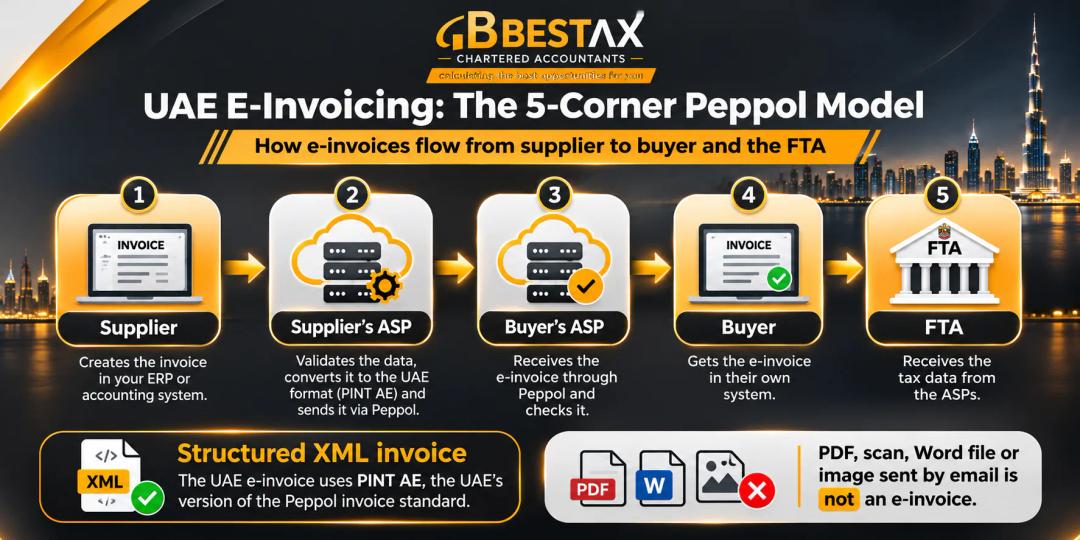
- Supplier: your ERP or accounting system creates the invoice data.
- Supplier's ASP: validates the data, converts it to the UAE format and sends it.
- Buyer's ASP: receives the invoice and checks it.
- Buyer: gets the invoice in their own system.
- FTA: receives the tax data from the ASPs.
The first four corners match the Peppol model used in Europe and Asia. The fifth corner is what lets the FTA see invoice data in near real time.
PINT AE and the XML Format
PINT AE is the UAE's version of the Peppol invoice standard. It defines which fields each invoice carries, such as tax identifiers, line items, tax categories and totals.
You do not have to build XML files yourself. Your ERP sends invoice data to your ASP in an agreed format, and the ASP converts it to PINT AE.
What E-Invoicing Changes for Incoming Supplier Invoices
E-invoicing changes accounts payable as well as accounts receivable. Once your suppliers go live, their invoices arrive as structured data through your ASP.
Your team needs a process for incoming invoices, rejected invoices and credit notes from day one.
How to Choose an Accredited Service Provider (ASP) in the UAE
An accredited service provider in the UAE is a company the Ministry of Finance has approved to send, receive and report e-invoices. You must appoint one ASP, and it handles both your sales invoices and your purchase invoices.
Only use a provider on the Ministry of Finance's official ASP list. The list grows as new providers finish accreditation, so check it on the day you sign.
Check that your provider holds full accreditation, not preliminary approval. Providers with only preliminary approval had 30 days from 1 October 2026 to complete accreditation, and their approval ended if they missed it. That window closed at the end of October 2026, so confirm your provider's status in writing before you sign.
What to Compare Between ASPs
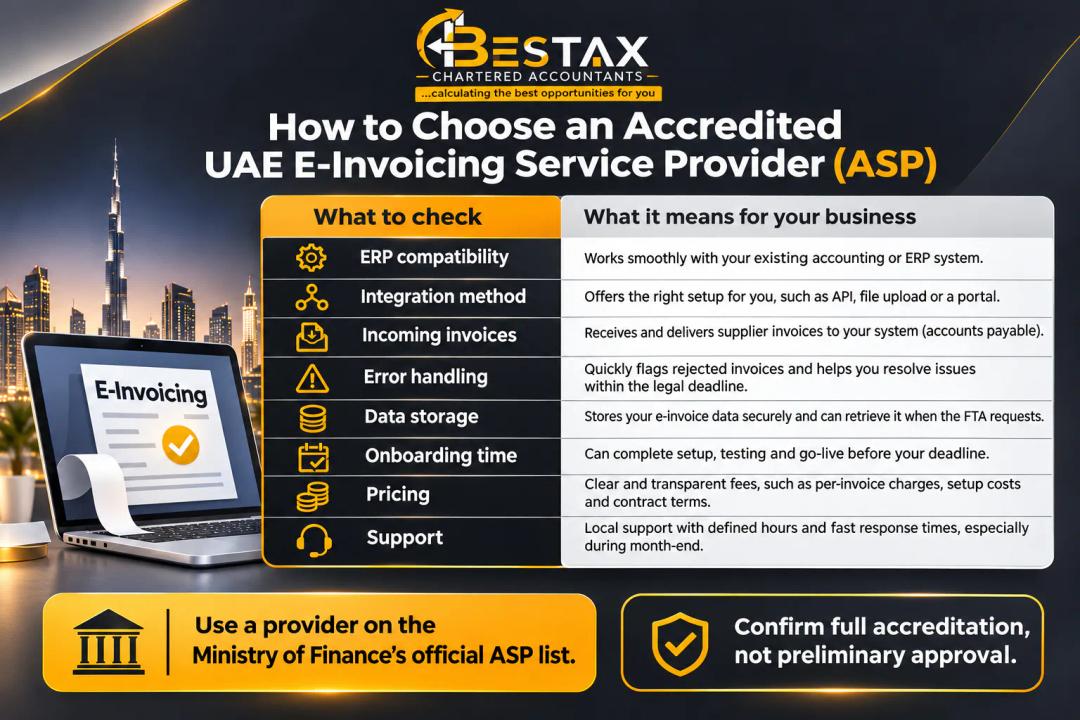
Every listed ASP meets the same legal standard. The differences are in how well each one fits your business:
- ERP compatibility: does it connect to your accounting system out of the box, or does it need custom work?
- Integration method: API, file upload or a manual portal, and which suits your invoice volume
- Incoming invoices: how it delivers supplier invoices into your system for accounts payable
- Error handling: how it flags rejected invoices and helps you resolve errors within the applicable legal deadline
- Data storage: where it stores your invoice data, and how quickly it can retrieve records if the FTA asks
- Onboarding time: whether it can test and go live before your deadline
- Pricing: per-invoice fees, setup costs and minimum contract terms
- Support: local support hours and response times during month-end
Questions to Ask an ASP Before You Sign
Ask each shortlisted ASP for a reference client on the same ERP as yours. Ask how long their last three onboardings took from contract to go-live.
Ask who fixes a failed invoice: you, your ERP partner or the ASP. Unclear ownership is where most go-live problems start.
Ask what happens when their system goes down. The FTA notice rule is gone, but your issuing deadline still applies during an outage.
Ask whether the ASP runs its own Peppol technology or uses a third party's. Outsourcing is allowed, but the ASP stays responsible for compliance and service delivery, so you should know who actually runs your invoices.
Steps to Appoint Your ASP
- Map where your sales invoices, supplier invoices and credit notes come from today.
- Clean customer and supplier data, especially tax identifiers and legal names.
- Shortlist two or three ASPs from the official list that support your ERP.
- Sign with one fully accredited ASP before your appointment deadline.
- Complete the e-invoicing procedures on EmaraTax.
- Test outgoing invoices, incoming invoices, credit notes and rejections end to end.
- Go live on or before your mandatory date.
Data cleanup takes longer than ASP selection, so we recommend starting your e-invoicing preparation with steps 1 and 2 now, even if your deadline is March 2027.
UAE E-Invoicing Penalties Under Cabinet Decision No. 173 of 2026
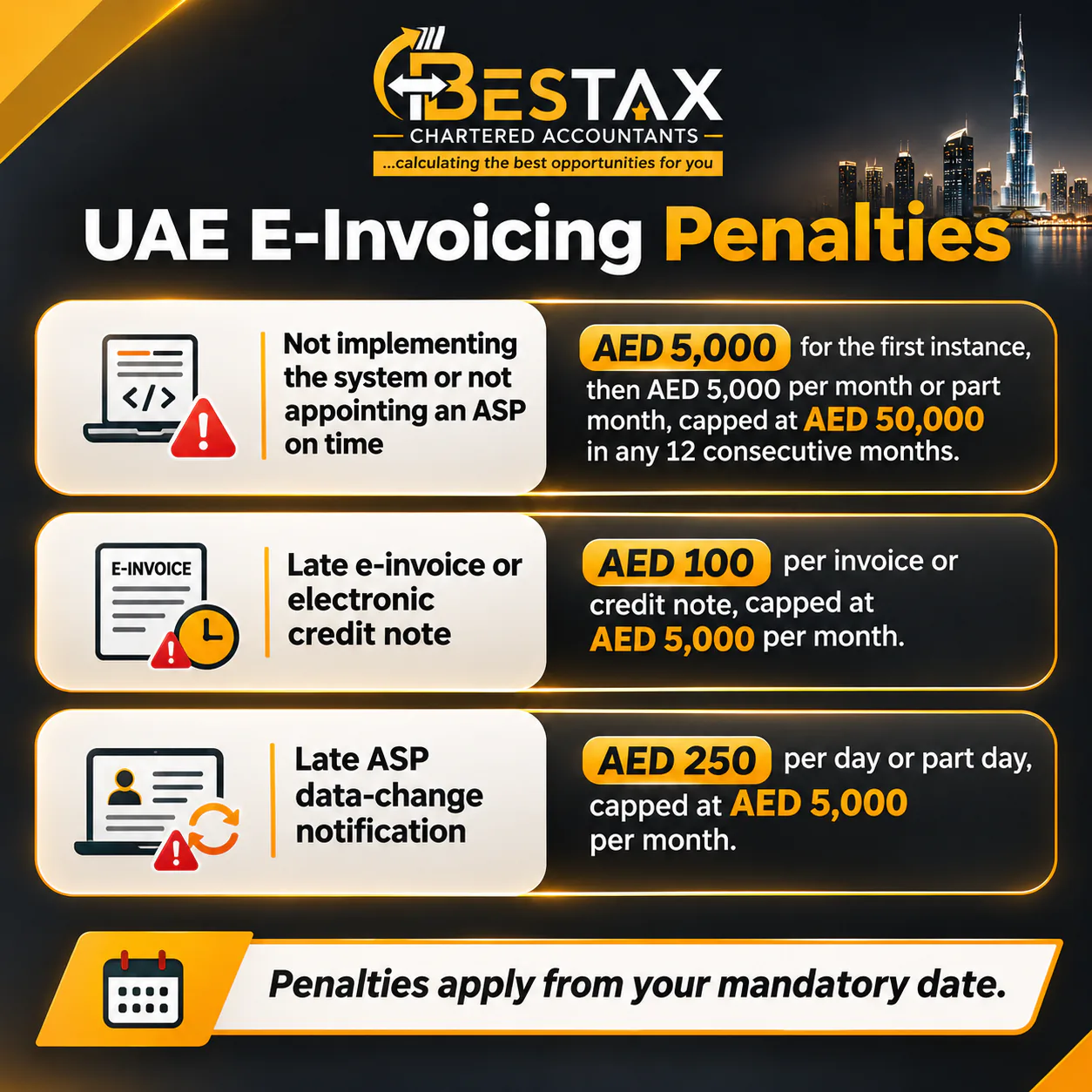
Cabinet Decision No. 173 of 2026 sets the penalties, replacing Cabinet Decision No. 106 of 2025 from the end of October 2026. They apply from your mandatory date, with no warning period.
| Violation | Penalty |
|---|---|
| Not implementing the system or not appointing an ASP on time | AED 5,000 for the first instance, then AED 5,000 for each month or part of a month, capped at AED 50,000 in any 12 consecutive months |
| Not issuing or transmitting an e-invoice on time | AED 100 per invoice, capped at AED 5,000 per month |
| Not issuing or transmitting an electronic credit note on time | AED 100 per credit note, capped at AED 5,000 per month |
| Not notifying your ASP in writing within 5 business days of receiving FTA confirmation of a change to your registered data | AED 250 for each day or part of a day, capped at AED 5,000 per month |
The per-invoice caps sound small, but they apply every month and stack with the implementation penalty. A business that misses its go-live date can face several penalties at once.
Invoices issued during the voluntary phase carry no penalties.
UAE E-Invoicing Readiness Checklist Before Your Deadline
Large businesses had to appoint an ASP by 30 October 2026 and go live on 1 January 2027. Smaller businesses must appoint by 31 March 2027 and go live on 1 July 2027.
Before your deadline, make sure you have:
- Confirmed your phase from your most recent accounting period's revenue
- Cleaned customer and supplier data, including tax identifiers
- Appointed one fully accredited ASP from the official list
- Completed the e-invoicing procedures on EmaraTax
- Tested sales invoices, supplier invoices and credit notes end to end
- Set up record keeping so you can give e-invoice data to the FTA on request
Bestax helps UAE businesses move from PDF invoices to full e-invoicing, from readiness checks to go-live. Talk to our e-invoicing team before your deadline arrives.
FAQs About UAE E-Invoicing
What does e-invoicing cost?
Your main costs are the ASP's fees and any ERP integration work. ASPs set their own pricing, usually a setup fee plus a per-invoice or volume-based charge, so get written quotes from your shortlist.
Do I need a new ERP or accounting system?
Not necessarily. Your current system needs to send invoice data to your ASP and receive supplier invoices back. Many systems can do this through an integration your ASP or ERP partner provides.
Can I start e-invoicing before my mandatory date?
Yes. The voluntary phase opened on 1 July 2026, and no penalties apply to invoices issued in it. Going live early gives you time to fix errors before penalties start.
Is an ASP with preliminary approval enough?
No. Under Ministerial Decision No. 168 of 2026, a provider can only offer e-invoicing services once it has full accreditation. Preliminary approval no longer counts, so ask your provider to confirm its accreditation status before you appoint it.
Are transactions within a VAT group covered?
Not yet. Transactions between members of the same VAT tax group are excluded for 24 months, from 1 January 2027 to 31 December 2028. Your sales to customers outside the group are still in scope from your mandatory date.
Does a foreign business without a UAE establishment need to comply?
Yes, if it must issue UAE VAT tax invoices. A business without a Tax Identification Number has to register with the FTA to get one before it can e-invoice.
Can my customer issue the invoice on my behalf?
Yes, where both the supplier and customer are VAT registered and the self-billing conditions are met. The customer must also be on the e-invoicing system. Self-billing is not available for invoices from suppliers who are not VAT registered.
Will UAE e-invoices carry a QR code?
No. The Ministry of Finance guidelines confirm UAE e-invoices do not use a QR code or barcode, unlike Saudi Arabia's system.
Where must I store e-invoices?
You can store them inside or outside the UAE. Ministerial Decision No. 197 of 2026 removed the UAE storage requirement. You must still keep e-invoices, credit notes and related data for the period the Tax Procedures Law requires, and give them to the FTA on request.
Disclaimer: The information provided in this blog is for general informational purposes only. For professional assistance and advice, please contact experts.

Khadija Raees holds a Bachelor's degree and brings over five years of experience in creating authoritative content in the areas of tax, accounting, company formation, and VAT in the UAE.
Learn More About Khadija