



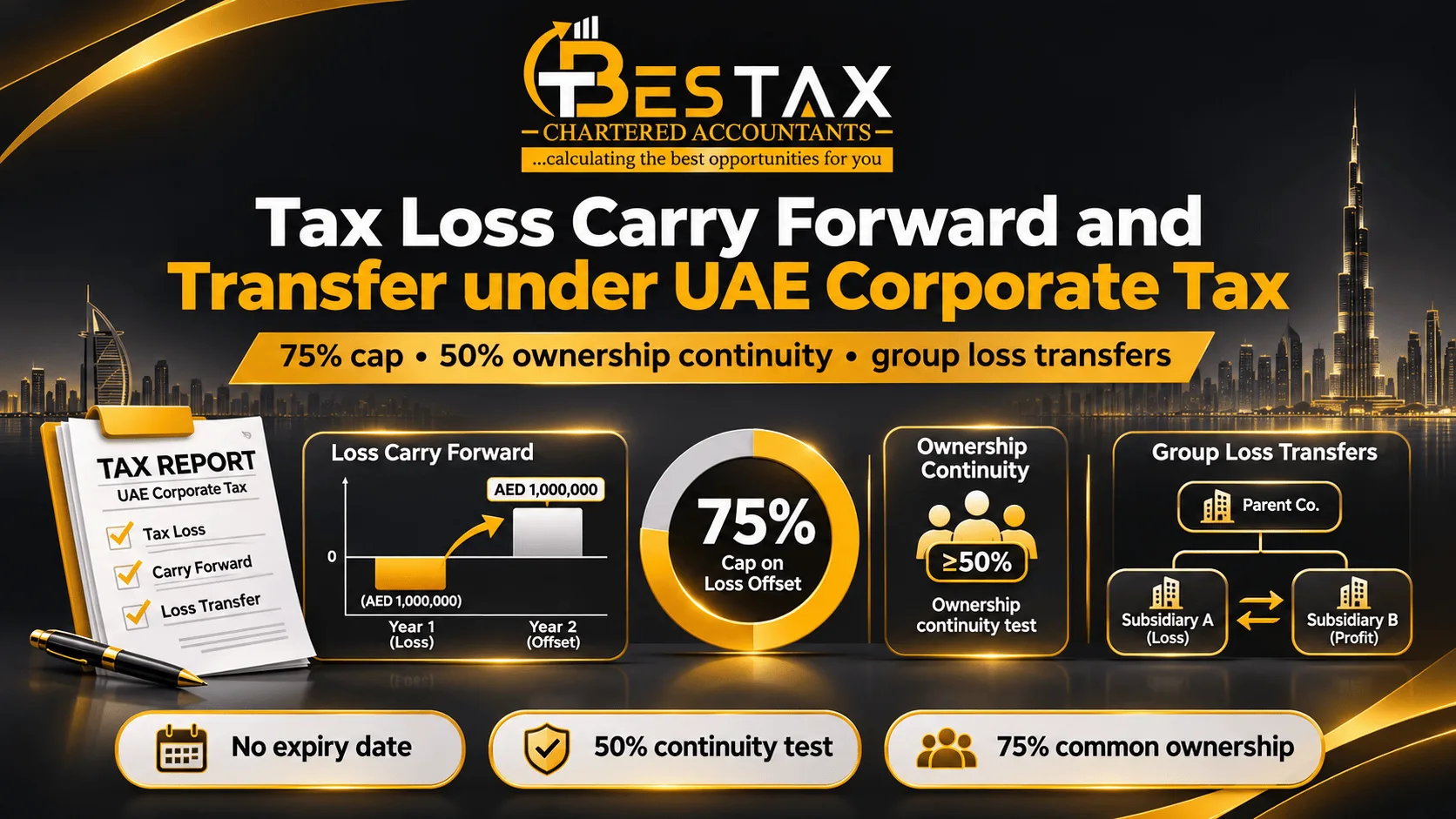
A tax loss in the UAE is an asset with no expiry date. Tax loss carry forward rules in the UAE let you set it against future profits indefinitely, capped at 75 percent of each year's taxable income. They also let you move it to a group company under common ownership. The same rules take it away if ownership changes hands and the business changes shape.
The guide below covers how a loss is carried forward and used, the tests that decide whether it survives a change, and the transfer of losses between companies. It follows the corporate tax law and the FTA's Basic Tax Information Bulletin on Corporate Tax Losses, issued on June 25, 2026.
How Tax Loss Carry Forward Works Under Article 37
A tax loss arises when your deductible expenses exceed your taxable income for a period. UAE corporate tax losses are carried forward under Article 37 of the corporate tax law and set against later profits, subject to a cap and an order of use.
The 75 Percent Cap and the Order of Use
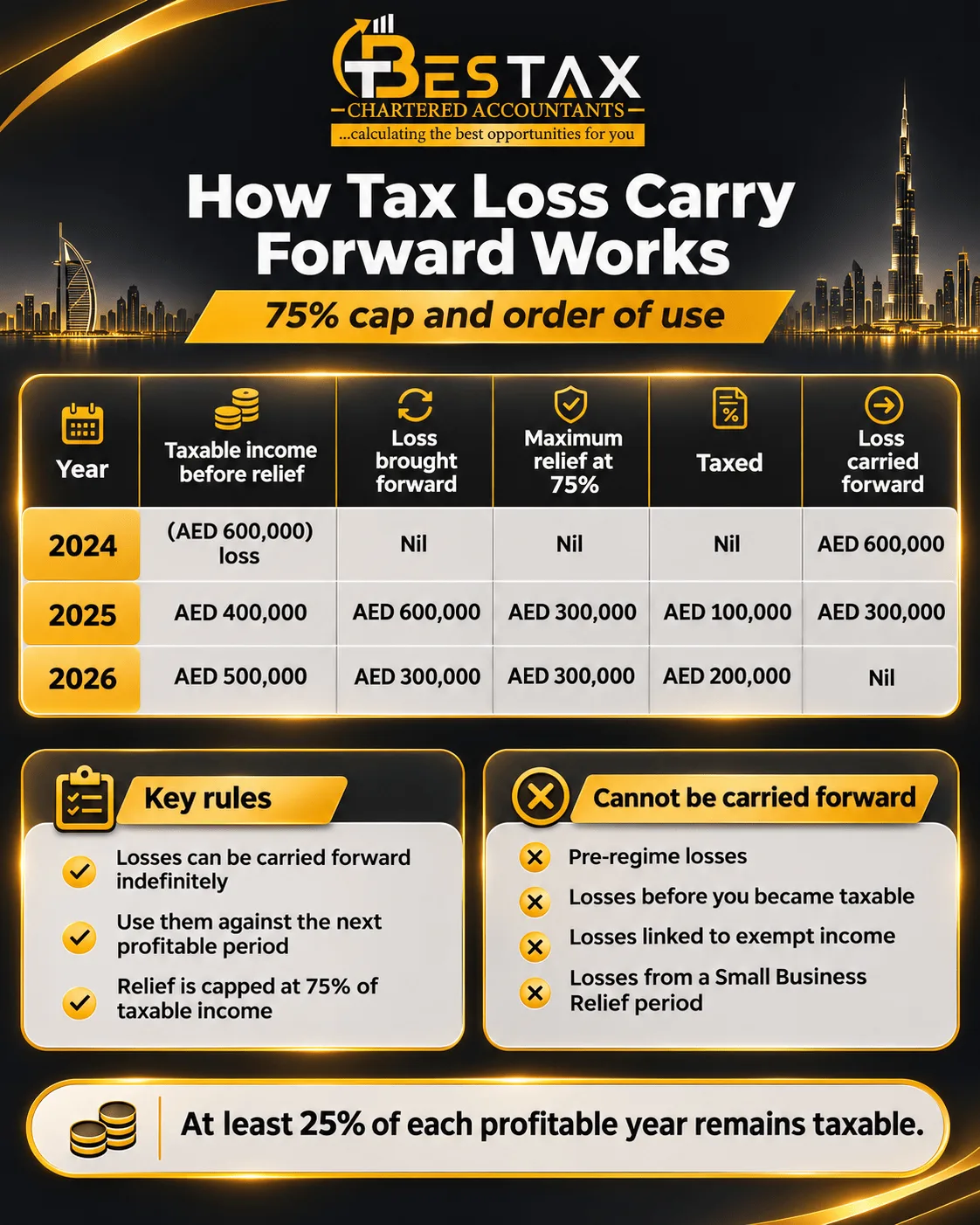
You can offset carried-forward losses against up to 75 percent of the taxable income of a later period, before the loss relief is applied. At least 25 percent of each profitable year is taxed, however large the loss you carry. A loss has to be used against the next period with taxable income before any balance is carried further, and the oldest losses are used first. You cannot skip a profitable year and save the loss for a larger one.
| Year | Taxable income before relief | Loss brought forward | Maximum relief at 75 percent | Taxed | Loss carried forward |
|---|---|---|---|---|---|
| 2024 | (AED 600,000) loss | Nil | Nil | Nil | AED 600,000 |
| 2025 | AED 400,000 | AED 600,000 | AED 300,000 | AED 100,000 | AED 300,000 |
| 2026 | AED 500,000 | AED 300,000 | AED 300,000 | AED 200,000 | Nil |
The 2026 relief is limited by the loss remaining, not the cap. Seventy-five percent of AED 500,000 is AED 375,000, and only AED 300,000 is left. Taxable income after relief in each year is then taxed at 0 percent up to AED 375,000 and 9 percent above.
The Losses You Cannot Use
Not every loss on your accounts is a tax loss you can use. Some are excluded from the start, and others are forfeited later.
- Pre-regime losses, meaning losses from periods before your first corporate tax period. The law applies to tax periods starting on or after June 1, 2023, so for a company with a calendar financial year the whole of 2023 is pre-regime and the first tax period is 2024
- Losses from periods before you became a taxable person
- Losses attributable to exempt income, such as dividends covered by the participation exemption or profits of a foreign permanent establishment you have elected to exempt
- Losses from a period in which you elected Small Business Relief, which cannot be carried forward. The relief is available for tax periods ending on or before December 31, 2029, following the Ministry of Finance extension announced on August 7, 2026
- Losses carried forward when ownership changes by more than 50 percent and the business does not continue as the same or a similar business, covered below
- Losses still unused when you deregister for corporate tax, which are forfeited on deregistration
The pre-regime exclusion is the one that surprises most owners. A company that lost money for five years before its first tax period starts the corporate tax regime with no tax losses at all. The accounting losses remain on the balance sheet. The tax losses do not exist.
How a Tax Loss Is Calculated and Reported
Tax losses are calculated from taxable income, not accounting profit, so the adjustments that turn one into the other apply to a loss year as well. Non-deductible expenses, exempt income and the interest limitation all change the figure. The loss you carry is the figure those adjustments produce, not the loss on your accounts.
The loss you can use is the loss recorded in the return. A loss left out of a return, or reported at the wrong amount, has to be corrected through the proper procedure under the Tax Procedures Law before it can be relied on. A loss-making company therefore still files, and files the loss correctly.
The Tests That Decide Whether a Loss Survives an Ownership Change
Article 39 stops a profitable company buying a loss-making one for its losses. A carried-forward loss survives a change in ownership only if one of two tests is met. Ownership continuity is the first test, and the business itself is the second.
The 50 Percent Ownership Continuity Test
The loss can be used if the same person or persons held at least 50 percent of the ownership interests in your company continuously. The holding is measured from the start of the period in which the loss arose to the end of the period in which it is used. A change in the other 50 percent does not matter. A change that takes the continuing owners below 50 percent fails the test, unless the second test is met.
- Measure the holding from the first day of the loss year, not the day of the sale
- Count direct and indirect holdings, so a sale of the parent counts as a change in the subsidiary
- Companies whose shares are listed on a recognised stock exchange are outside the test, because their ownership changes daily
The Same or Similar Business Test
Where ownership has changed by more than 50 percent, the loss still survives if you continue the same or a similar business. Article 39(2) lists the three factors that decide it, and the table below sets them out.
| Factor under Article 39(2) | Points to the same business | Points to a different business |
|---|---|---|
| Use of the same assets | The same assets continue in use | The assets are sold and replaced with different ones |
| Changes to core identity or operations | No significant change to the core identity or operations | The core activity or operations change significantly |
| Source of any changes | Changes come from developing or exploiting existing assets, services, processes, products or methods | Changes come from new assets or a new line of business brought in from outside |
A logistics company sold to a new owner who keeps the trucks and keeps running the same freight operation passes. The same company sold to an owner who sells the fleet and opens a restaurant in the warehouse does not. The losses belong to the business, and the business has to be recognisably the same.
What Happens When Both Tests Fail
If ownership changes by more than 50 percent and the business changes as well, the losses carried forward to that point are forfeited. A planned transfer to a sister company does not automatically protect them either, because a transfer has its own 75 percent common ownership condition over the period of use. A loss used by a group company in a period that ends before the sale may still qualify, so the timing needs checking against both sets of conditions.
Our corporate tax services in the UAE include a review of any planned sale or restructuring against both tests before it is signed. The losses at stake are often worth more than the fee on the deal.
Transferring a Tax Loss to Another Group Company
Article 38 lets a company offset all or part of its tax loss against the taxable income of another company, without forming a tax group. The loss can be one from the current period or one carried forward. The conditions are stricter than the carry-forward rules, and both companies have to meet them.
The Conditions for a Transfer
Article 38 sets eight conditions, and all of them have to be met.
- Both companies are juridical persons
- Both are resident persons for corporate tax
- One holds at least 75 percent of the other, directly or indirectly, or a third person holds at least 75 percent of both
- The 75 percent common ownership is held continuously from the start of the period in which the loss arose to the end of the period in which it is used, including every period in between
- Neither is an exempt person
- Neither is a Qualifying Free Zone Person
- Both have the same financial year end
- Both prepare financial statements under the same accounting standards
The transfer itself is made through the corporate tax returns of the two companies for the period of use. That is a filing step, not one of the conditions in the law.
The 75 percent threshold is deliberately lower than the 95 percent needed for a tax group. A group that cannot consolidate because of a minority partner can still move a loss between its members. The partner has to hold no more than 25 percent.
How Much Can Be Transferred and What It Does
The receiving company uses its own carried-forward losses first and transferred losses after. Its own and transferred losses together can offset no more than 75 percent of its taxable income for the period. The transferring company also has to use its own losses against its own income before it can transfer what remains. It then reduces its available losses by the amount transferred, so the loss is used once. Neither company has to pay the other for the loss, although many groups do so under a tax sharing agreement.
The example below assumes Company B has no carried-forward losses of its own, and that both companies meet all eight conditions.
| Company A, loss-making | Company B, profitable | |
|---|---|---|
| Taxable income for 2026 | (AED 800,000) | AED 1,200,000 |
| Maximum loss B can absorb at 75 percent | AED 900,000 | |
| Loss transferred | AED 800,000 | AED 800,000 |
| Taxable income after transfer | Nil, no loss left to carry | AED 400,000 |
| Corporate tax at 9 percent above AED 375,000 | Nil | AED 2,250 |
Without the transfer, Company B pays 9 percent on AED 825,000, which is AED 74,250. Company A carries its loss forward to a profitable year that has not arrived. With the transfer, the group pays AED 2,250 this year and the loss is used at full value. If Company B had its own losses brought forward, those would be used first, and less of Company A's loss would fit under the 75 percent cap.
Group Companies, Tax Groups and Free Zone Members
A transfer under Article 38 and a tax group under Article 40 are alternatives. A company inside a tax group does not transfer losses, because the group's income is already combined. When a company joins a tax group, its earlier losses are pre-grouping losses. They can be used only against the share of the group's taxable income attributable to that company, still within the 75 percent cap.
Since Ministerial Decision 301 of 2024, a tax group can instead opt to forfeit those pre-grouping losses, which spares it the work of calculating each member's share of the group's income. When a member leaves the group, losses incurred by the group stay with the group. The FTA's updated Tax Groups Guide (CTGTGR1), published on November 11, 2026, sets out how pre-grouping losses are used and what happens when a group chooses not to use them.
Free zone members sit outside both routes while they claim the 0 percent rate. A Qualifying Free Zone Person cannot transfer or receive a loss, and losses on its qualifying income do not arise for corporate tax at all.
What to Check Before You Claim a Loss
Every loss on your return has to pass three checks in order, and one record has to sit behind it.
- Confirm the loss is a tax loss, not a pre-regime, exempt-income or Small Business Relief period loss, and that it has not been forfeited
- Compare the ownership on the first day of the loss year with the ownership today, and apply the same or similar business test where the continuing owners are below 50 percent
- Identify any profitable company under 75 percent common ownership with the same year-end and accounting standards, because a transfer this year beats a carry-forward to a year that has not arrived
- Keep the loss-year return, the ownership register and the continuity evidence. Article 56 requires records to be kept for seven years after the end of the tax period they relate to, so in practice keep the loss-year file until seven years after the last period in which the loss is used
Our corporate tax team runs those checks from your structure chart and your returns. We apply both tests to every loss and prepare the transfer in the returns of each pair of companies that qualifies.
FAQs About UAE Tax Loss Carry Forward and Transfer
Can I carry a loss back to an earlier profitable year and claim a refund?
No. The corporate tax law allows carry-forward only. A loss in 2026 reduces tax in 2027 and later, and tax already paid on 2025 profits stays paid.
If I sell 60 percent of my company but keep running it, do I lose the losses?
Not if the business stays the same. The 50 percent ownership test fails, but the same or similar business test applies instead. If the company keeps using the same assets, its core identity and operations do not change significantly, and any changes come from developing what it already had, the losses survive. Document the continuity at the time of the sale rather than when the FTA asks.
Can a loss be transferred to a company that is 70 percent owned by the same parent?
No. The transfer needs at least 75 percent common ownership held continuously from the start of the loss period to the end of the period of use. A 70 percent subsidiary can carry its own losses forward under Article 37 but cannot give them to a sibling or receive a sibling's.
Do losses of a Qualifying Free Zone Person carry forward?
Losses on qualifying income do not arise for corporate tax, because that income is taxed at 0 percent. Losses on non-qualifying income taxed at 9 percent can be carried forward against future non-qualifying income within the same company. They cannot be transferred to or from another company while the company holds qualifying status.
What records support a loss claim in a later year?
Four things. The return in which the loss was first reported and the financial statements and adjustments behind it. The ownership register for every year from the loss year to the year of use. Where ownership changed, evidence that the business continued. Article 56 sets a seven-year retention period from the end of the tax period the records relate to, and keeping the loss-year file until seven years after the loss is last used is the safe practice. Since April 2026, records must be kept for an additional two years where you have filed a refund application and the FTA has not yet decided it.
Disclaimer: The information provided in this blog is for general informational purposes only. For professional assistance and advice, please contact experts.

Khadija Raees holds a Bachelor's degree and brings over five years of experience in creating authoritative content in the areas of tax, accounting, company formation, and VAT in the UAE.
Learn More About Khadija