



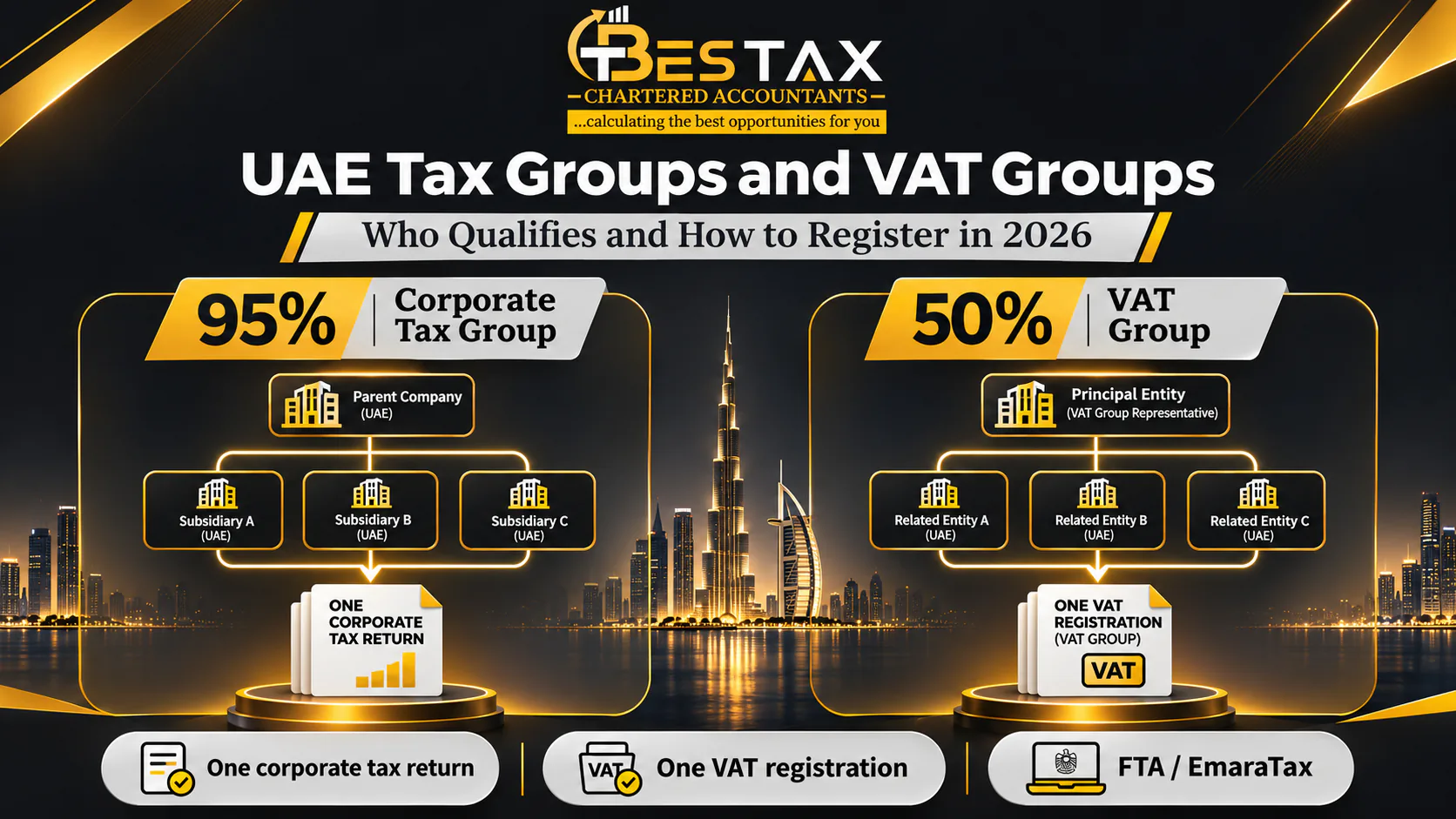
Before you apply to consolidate your companies for tax, you need to know that the UAE runs two separate group regimes with two separate tests. A corporate tax group in the UAE needs 95 percent common ownership and files a single return. A VAT group needs 50 percent control and a single registration. A group of companies can qualify for one, both or neither, and the membership of each can differ.
In this guide we take you through who qualifies for each and what changes once the group exists.
Who Qualifies for a Corporate Tax Group in UAE
Under UAE corporate tax law, a tax group is a set of resident companies the FTA treats as one taxable person. The parent files one return for all of them, and your members' profits and losses are combined. Three conditions decide whether your companies can form one.
The 95 Percent Ownership Test
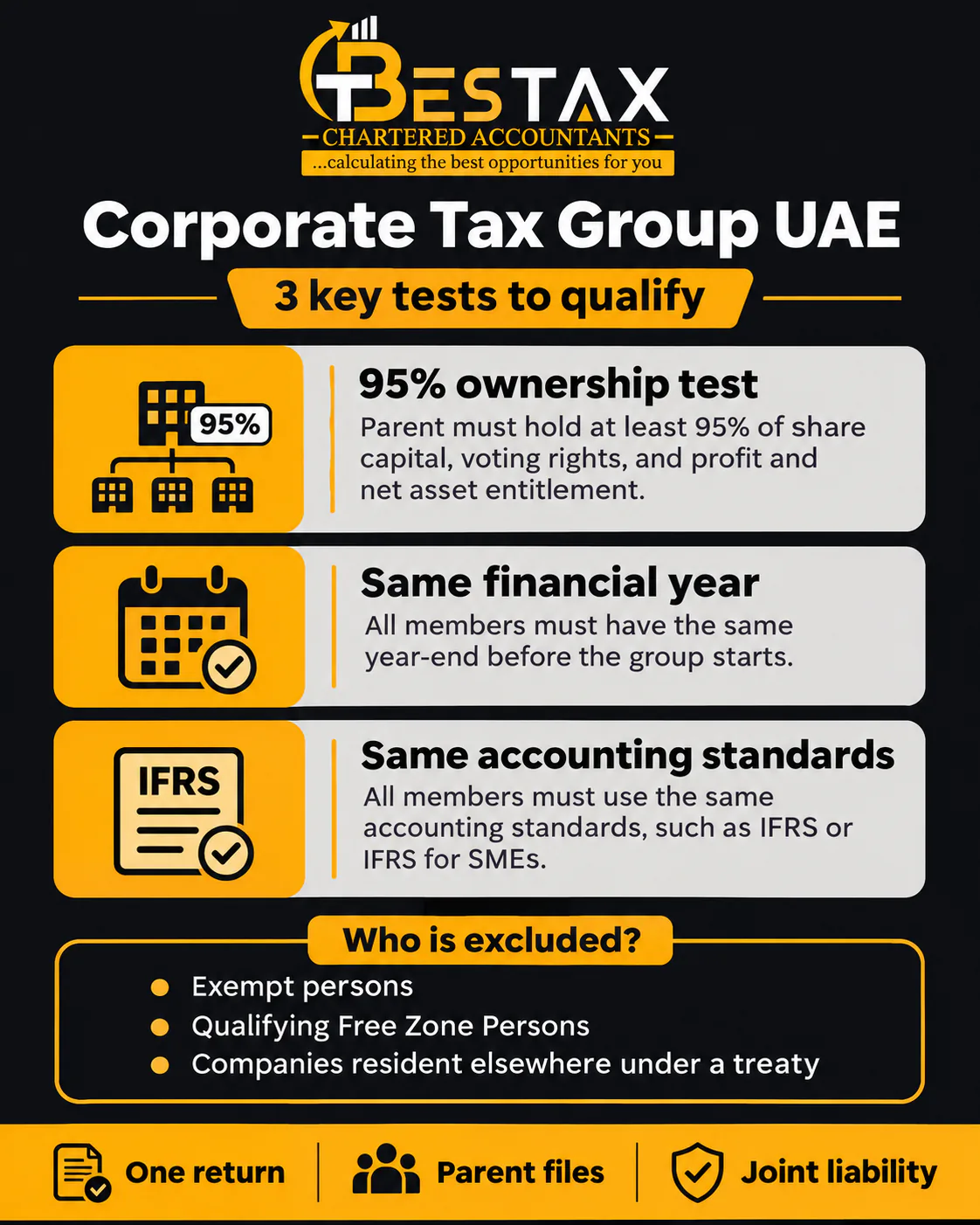
Your parent has to hold, directly or indirectly, at least 95 percent of each subsidiary's share capital, voting rights and entitlement to profits and net assets. The 95% ownership test applies to all three at once. Ministerial Decision No. 125 of 2023 measures share capital on nominal issued or paid-up capital, weighted by nominal value where a subsidiary has more than one share class.
Indirect holdings count. If you own 100 percent of a company which in turn owns 96 percent of a third company, you pass the test for both. If you hold 90 percent of a subsidiary with a 10 percent minority partner, you do not, and that subsidiary stays outside the group however closely you manage it.
The 95 percent threshold is the one most groups fail on. If you have a minority relative in a family business, a joint venture partner, or an employee shareholder, that company falls short. Those companies can still transfer assets to group members on a no gain or loss basis under the separate qualifying group rules at 75 percent ownership. They cannot consolidate.
The Same Financial Year and Accounting Standards
Every member has to have the same financial year as the parent and prepare its financial statements under the same accounting standards. If your parent has a December year-end, you cannot group a subsidiary with a March year-end until the subsidiary changes its year. The FTA has to approve that change, and the approval takes time.
The standards condition means IFRS across the group, or IFRS for SMEs across the group where each member's revenue is AED 50 million or less. One member on IFRS and another on IFRS for SMEs cannot group until one of them switches. The switch has to be in place before the first group period starts.
Aligning year-ends takes a tax period of its own. The subsidiary applies to the FTA to change its tax period and runs a short or long transitional period to reach the parent's year-end. If you want a group from January 2027, the change-of-period application belongs in 2026.
Who Is Excluded
Your parent and every subsidiary have to be resident juridical persons under the corporate tax law, and none can be tax resident in another country under a treaty. An exempt person, such as a government entity or a qualifying public benefit entity, cannot be a member. A qualifying free zone person cannot be a member either. A free zone company that wants to join gives up its 0 percent rate on qualifying income to do so.
A company incorporated abroad can still qualify. If it is effectively managed and controlled in the UAE, it is a resident person under the corporate tax law and can be a parent or a subsidiary. What it cannot be is resident in its country of incorporation under a treaty at the same time.
| Condition | Requirement | Where groups fail |
|---|---|---|
| Ownership | 95 percent of share capital, voting rights and profit entitlement, direct or indirect | Minority partners, joint ventures, employee shareholders |
| Financial year | Identical across all members | Subsidiaries with different year-ends |
| Accounting standards | Identical across all members | A mix of IFRS and IFRS for SMEs |
| Residency | All members resident in the UAE, not resident elsewhere under a treaty | Foreign-incorporated members without UAE effective management |
| Status | No exempt persons, no qualifying free zone persons | Free zone members on the 0 percent rate |
If your structure fails one condition today, the fix is usually structural. Our corporate tax services in the UAE include restructuring the holdings, aligning year-ends and standards, and filing the group application once the conditions are met. The restructuring is done before the period the group is to cover begins.
Who Qualifies for a VAT Group in UAE
A VAT group treats two or more legal persons as a single taxable person for VAT. VAT group registration gives you one VAT return for the group and one tax registration number in place of your members' separate numbers. The test is control rather than ownership, and it sits lower than the corporate tax test.
Related Parties and the 50 Percent Control Test
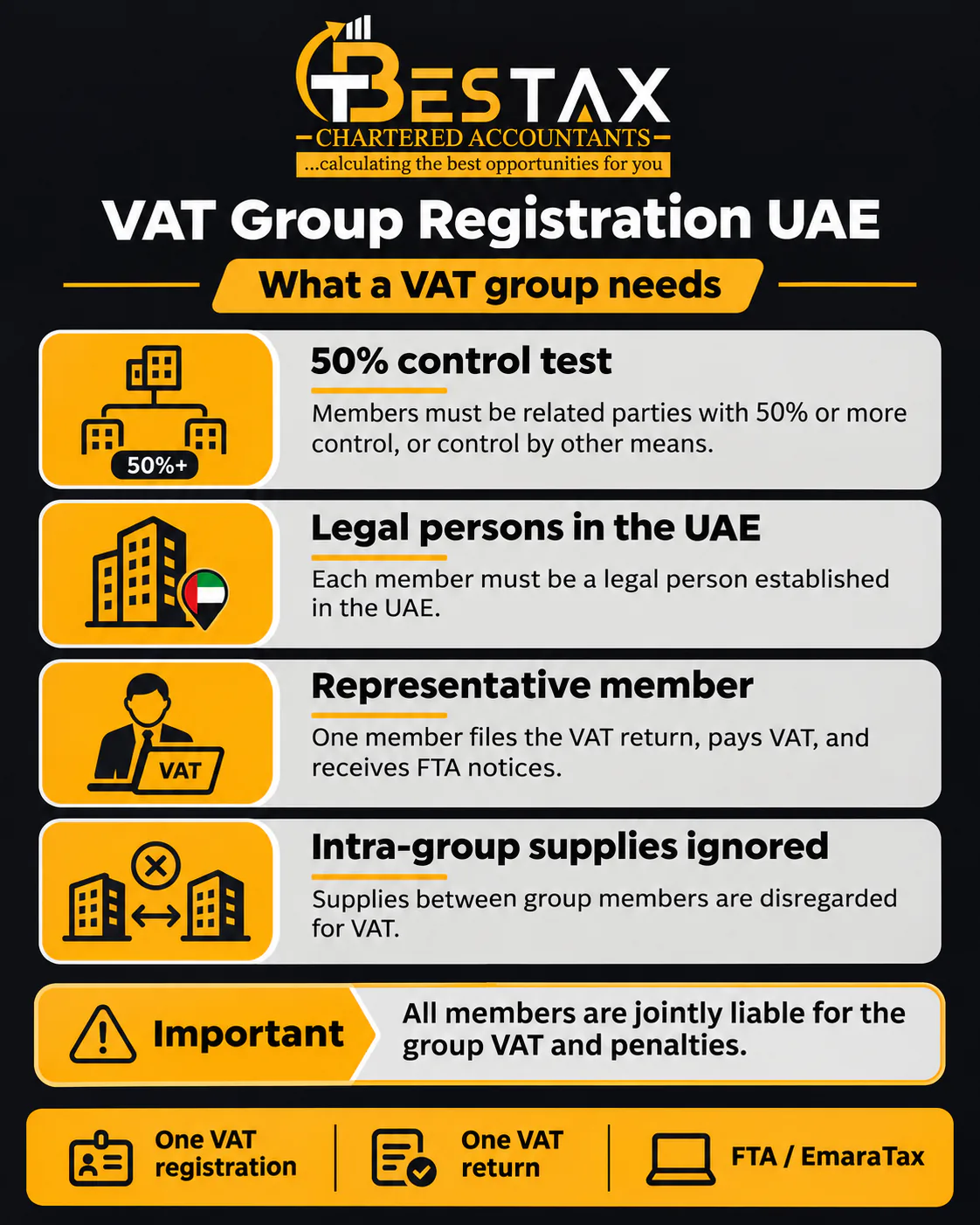
Your companies can form a VAT group where each is a legal person established in the UAE and they are related parties. Under the VAT executive regulation, persons are related where one controls the others, or a third person controls all of them. Control means 50 percent or more of the voting interests or of the market value of the interests, or control by other means.
The 50 percent threshold means your VAT group can include companies your corporate tax group cannot. A 60 percent subsidiary with a 40 percent partner qualifies for VAT grouping and fails corporate tax grouping. Many groups end up with different members in each.
Control by other means covers cases where the 50 percent test is not met on paper. A shareholders' agreement that gives one company the right to appoint the board, or a management contract that gives it direction of the business, can establish control. The FTA looks at who decides, not only at who owns.
The Representative Member
You nominate one member as the representative member. That member holds the group's tax registration number, files the group's VAT return, makes the payments and receives the FTA's correspondence. Every other member's supplies and purchases are reported through it.
The representative member does not have to be the parent. Groups often nominate the member with the largest transaction volume or the strongest finance function, because that member's systems carry the return. You can change the nomination by application to the FTA.
One consequence of a single taxable person is that input tax recovery is calculated for the group as a whole. If one member makes exempt supplies, such as residential rent, the group's recovery ratio is diluted for every member. A company that recovers all its input tax on its own can recover less inside a group, and the modelling before you apply has to include that.
Joint Liability and Intra-Group Supplies
Every member of a VAT group carries joint liability for the group's VAT and any penalties for the period of its membership. If the representative member fails to pay, the FTA can collect from any other member. Your profitable subsidiary can find itself paying VAT arising from a loss-making one, which is the price of a single registration.
Supplies between members are disregarded for VAT. A management fee from the parent to a subsidiary, a rent charge between two members, or goods moved between warehouses carry no VAT. The saving in cash flow and administration is the main reason groups apply.
Where your companies pass the control test but not all are registered yet, the individual registrations come first. Our VAT registration services in Dubai cover those and the group application in one sequence. The group then starts on the day you planned rather than a period later.
How to Register Each Group and What Changes After
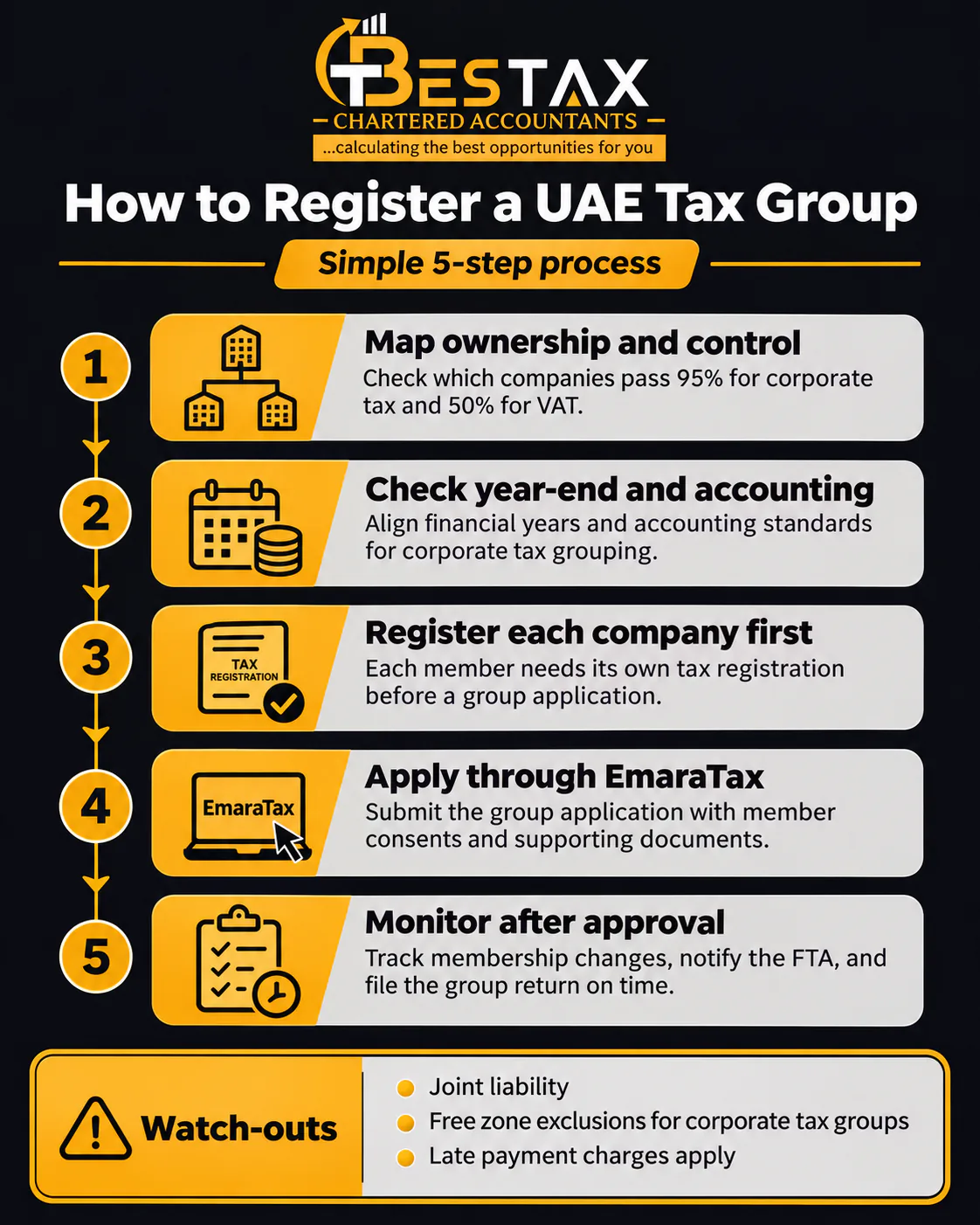
Both groups are formed by application to the FTA through EmaraTax, and the corporate tax group is the more demanding of the two. The requirements after formation are where the work sits. Both are set out below.
Applying for a Corporate Tax Group
Your parent applies on behalf of itself and every subsidiary, with each subsidiary consenting. The application names the tax period from which the group is to be formed, and the FTA approves it from the start of that period. Each member has to hold its own corporate tax registration first. A subsidiary that missed its corporate tax registration fixes that before the group application, with the penalty that follows.
The conditions have to be met throughout every tax period, not only at formation. If your parent's holding in a subsidiary drops below 95 percent mid-year, that subsidiary leaves the group from the start of the period in which the drop occurs. You notify the FTA within 20 business days, the standard period for any change to your tax record. A group that misses that notification carries the subsidiary's income on the wrong return.
The application itself needs evidence for each condition. You provide the ownership structure with percentages, the trade licences, each member's financial statements on the common standard, and the consent of each subsidiary. Apply before the end of the tax period you want the group to cover. Earlier in that period is safer, because a refused application leaves each member filing alone for the year.
Applying for a VAT Group
The representative member applies for the group, listing every member, and the FTA issues the group registration number. The FTA can refuse an application or remove a member. The grounds are that the group would enable tax evasion or reduce the tax due in a way the regulation does not intend. The FTA can also add a person to your group where that person meets the conditions and its exclusion would reduce the tax due.
Members who were separately registered before the group formed have their individual registrations absorbed. Their final individual returns cover the period to the day before the group takes effect. The group return begins the next day.
The group takes effect from the first day of the tax period after approval, not the application date. If your members are on different VAT return periods, the FTA aligns them to the group's period at the same time. Plan the application a full period ahead of the date you want.
Eliminations, Group Accounts and What Survives Grouping
In a corporate tax group, your parent prepares aggregated financial statements from each member's standalone accounts, and intra-group transactions are removed through eliminations in calculating taxable income. A management fee, an interest charge or a sale between members has no effect on the group's tax. Since tax periods starting January 1, 2025, those aggregated statements have to be audited special-purpose financial statements whatever the group's revenue, prepared in the form FTA Decision No. 7 of 2025 sets out.
Two items survive the eliminations. A subsidiary's tax losses from before it joined can be used only against its own taxable income, and only up to 75 percent of that income. The parent and each subsidiary are jointly and severally liable for the group's tax for the periods they were members.
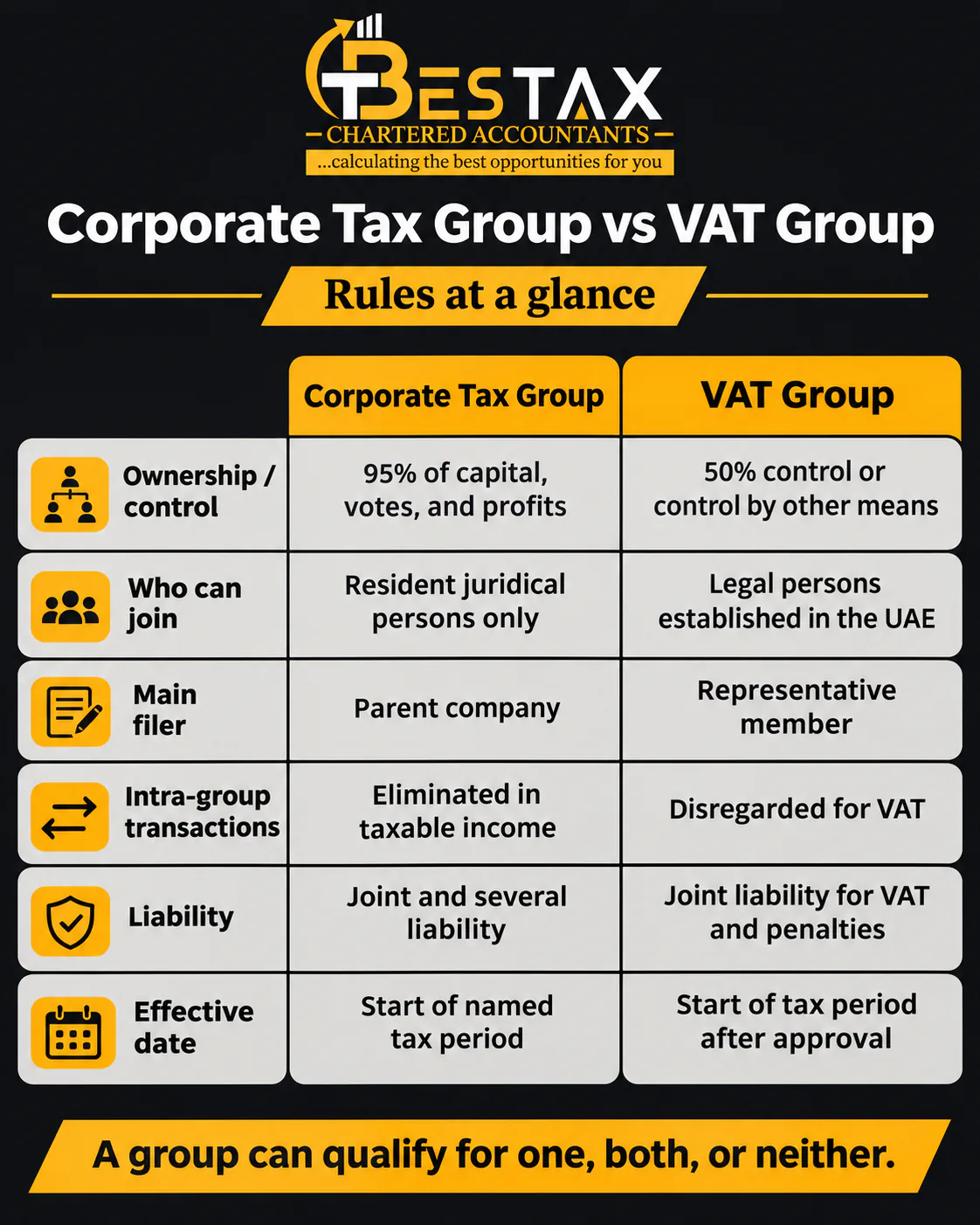
| Corporate tax group | VAT group | |
|---|---|---|
| Ownership or control | 95 percent of capital, votes and profits | 50 percent control, or control by other means |
| Members | Resident juridical persons, no exempt or free zone persons | Legal persons established in the UAE, related parties |
| Filer | Parent files one return | Representative member files one return |
| Intra-group transactions | Eliminated in taxable income | Disregarded for VAT |
| Liability | Joint and several, parent and subsidiaries | Joint and several, all members |
| Effective date | Start of the tax period named in the application | Start of the tax period after approval |
| Ongoing test | Conditions met throughout each period | Control maintained, FTA can add or remove members |
Penalties for a group are the same as for a single taxpayer, applied to the group. Since April 2026, late payment of corporate tax or VAT carries a flat 14 percent annualised charge under the revised penalty framework. The joint liability above decides who the FTA collects it from.
Map Your Ownership Percentages Before You Apply for Either Group
Draw your structure with the percentage your parent holds in each company, directly and through intermediate holdings. Mark every company below 95 percent and every company below 50 percent. The first mark tells you which companies stay outside your corporate tax group, and the second which stay outside your VAT group. Then note each company's financial year, accounting standard and free zone status.
Most groups that do this find they qualify for a VAT group in full and a corporate tax group in part. That is a workable result once you know it, because the two applications are independent and the members can differ. What does not work is applying for both on the assumption that they match, then filing your returns on the wrong membership for a year.
Our corporate tax services in the UAE start with that map. We confirm which of your companies qualify for each group and model the tax effect of grouping against filing separately. We then prepare both applications with the consents and financial statements the FTA asks for.
For the VAT side, our VAT registration services in Dubai bring every member to the same registration status before the group application goes in. Your group then takes effect on the first day you intended. Both applications are filed from the same map.
FAQs About UAE Tax Groups and VAT Groups
Can a free zone company join a corporate tax group without losing its 0 percent rate?
No. A qualifying free zone person cannot be a member of a corporate tax group. A free zone company that joins gives up qualifying status and is taxed at 9 percent on its income as part of the group. The decision has to be modelled against the value of the 0 percent rate on its qualifying income.
If the same company is in both groups, does one return cover both taxes?
No. The corporate tax group return and the VAT group return are separate filings on separate cycles. Your corporate tax return is annual and filed by the parent nine months after year-end. Your VAT return is monthly or quarterly and filed by the representative member, which does not have to be the same company as the parent.
What happens to a subsidiary's losses when it joins a corporate tax group?
Losses it carried before joining stay with it. You can use them only against that subsidiary's share of the group's taxable income, and only up to 75 percent of that share in any period. Losses the group makes after formation belong to the group and can be used against any member's income.
Can I remove one company from a VAT group without dissolving the whole group?
Yes. Your representative member applies to the FTA to remove a member, and the member leaves from the start of the tax period the FTA specifies. The remaining members continue under the same registration number. The departing member registers separately if its own taxable supplies exceed the mandatory threshold.
Does grouping remove the need for transfer pricing documentation?
Only for transactions inside the group. Transactions between group members are eliminated for corporate tax and disregarded for VAT, so no arm's length pricing or documentation applies to them. Transactions with related parties outside the group still require arm's length pricing and the disclosure form where the thresholds are met. Foreign affiliates and companies below the 95 percent line are the usual cases.
Disclaimer: The information provided in this blog is for general informational purposes only. For professional assistance and advice, please contact experts.

Khadija Raees holds a Bachelor's degree and brings over five years of experience in creating authoritative content in the areas of tax, accounting, company formation, and VAT in the UAE.
Learn More About Khadija