




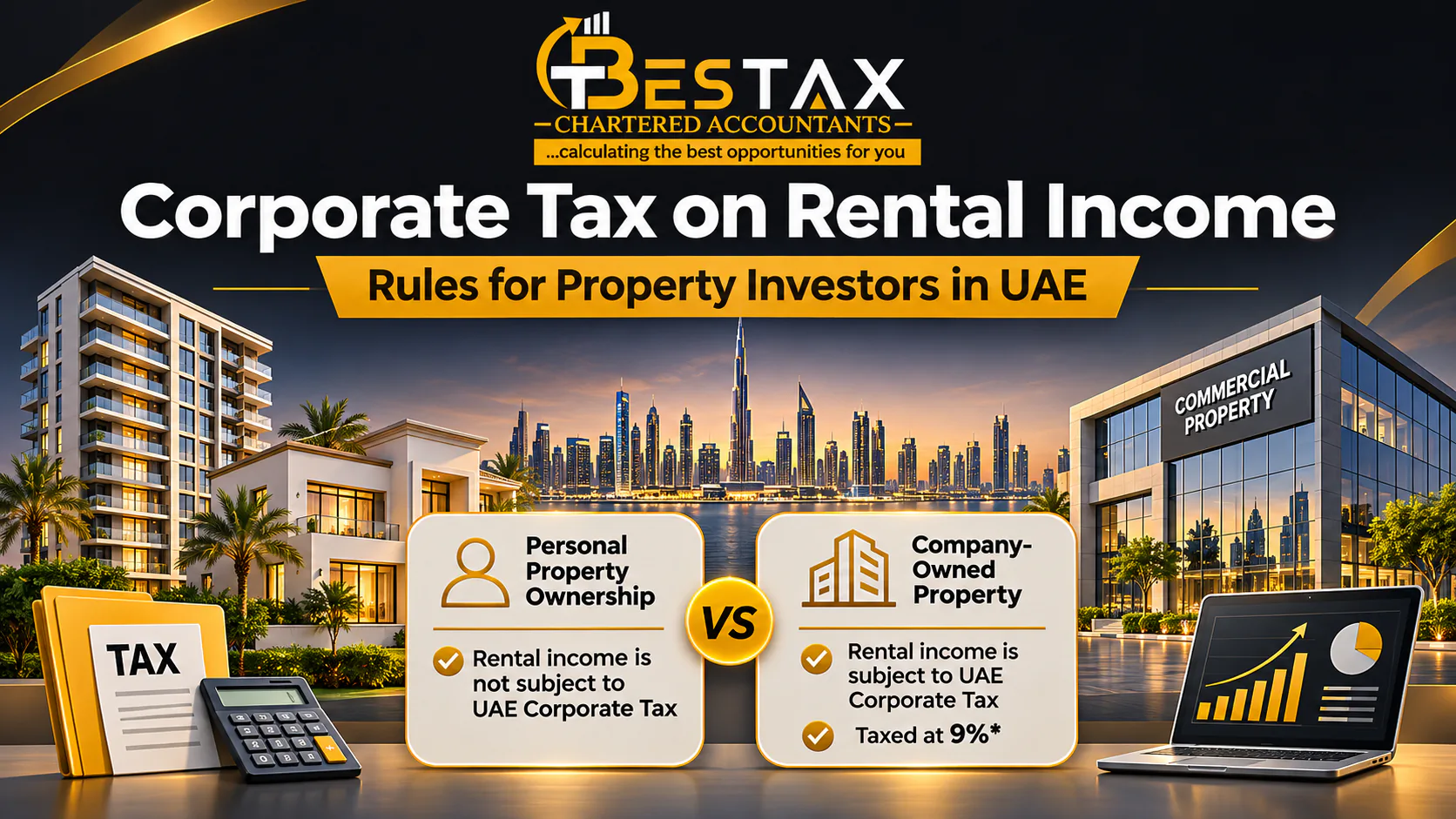
Before you assume your rental income is tax-free because you are an individual, you need to know which side of a single line you sit on. The UAE’s corporate tax rules on rental income draw that line at how the property is held and whether the activity needs a licence. An individual letting an apartment without a licence pays nothing.
If you let the same apartment through a company, you pay 9 percent above AED 375,000. If you run licensed holiday homes with more than AED 1 million in turnover, you are treated like the company. Everything below follows from which side you are on.
In this guide we take you through how the rules apply to each kind of owner and what changed in 2025.
Is Rental Income Taxable in UAE for Individuals?
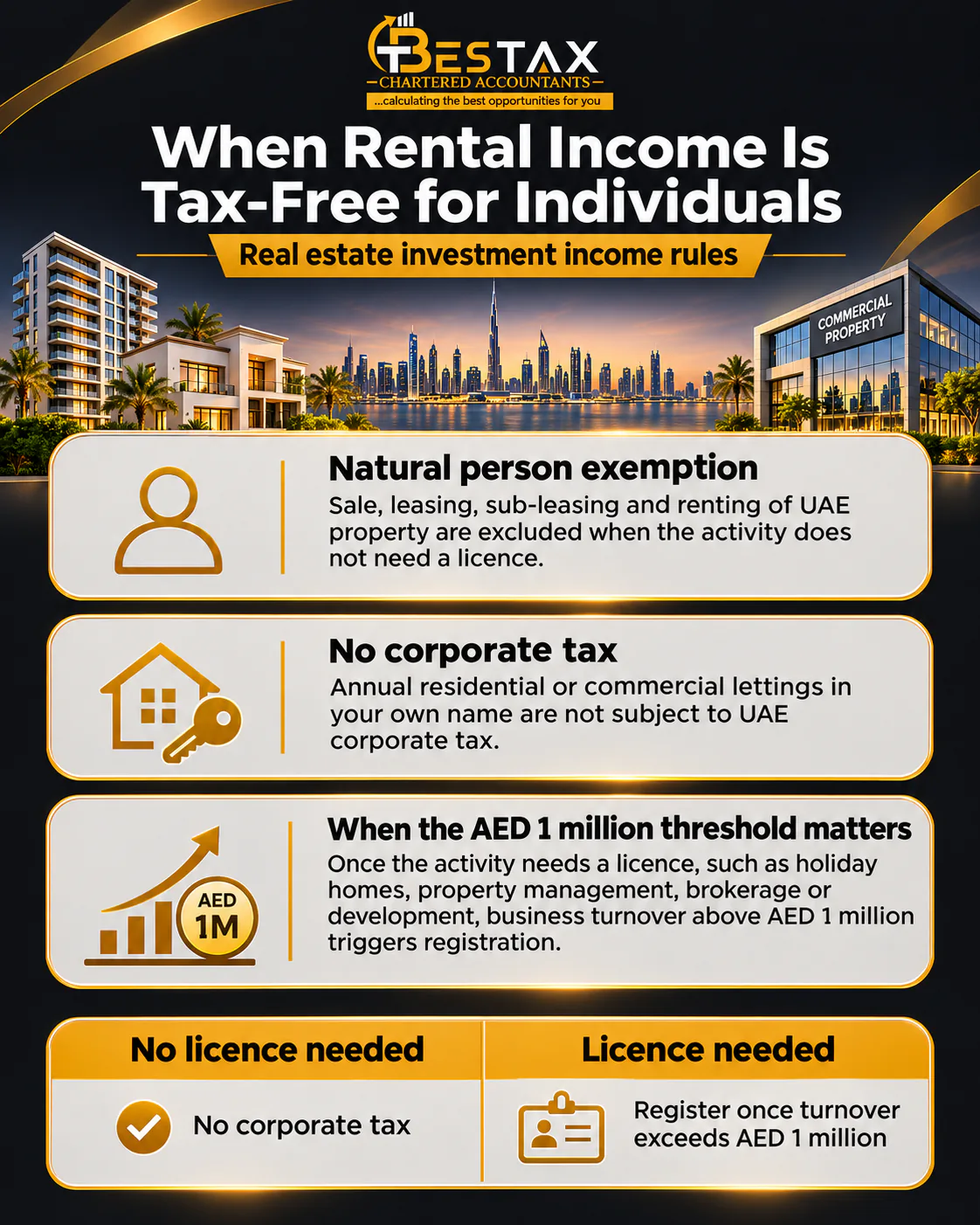
The answer for most individual landlords is no. The reason is a specific exclusion in the law rather than a general absence of tax. Three conditions decide whether you keep it.
The Natural Person Exemption for Real Estate Investment Income
Cabinet Decision No. 49 of 2023, which many owners search for as Ministerial Decision 49, sets out when an individual is subject to corporate tax. A natural person is taxed only on business activity with turnover above AED 1 million in a calendar year. Three kinds of income are excluded from that test entirely, whatever the amount. Those are wages, personal investment income and real estate investment income.
Real estate investment income covers the sale, leasing, sub-leasing and renting of land or property in the UAE. The condition is that the activity does not need a licence from a licensing authority. If you own three apartments in Dubai Marina and let them on annual tenancies, that is real estate investment income. You pay no corporate tax on it, and you do not register because of it.
The exclusion applies whether your property is residential or commercial, and whether your tenant is an individual or a company. Joint ownership between family members does not change it, because each owner's share is real estate investment income in their own hands. What changes it is a licence.
Where the AED 1 Million Threshold Applies
The threshold matters once your property activity needs a licence. Short-term holiday letting in Dubai requires a licence from the Department of Economy and Tourism. Property management for other owners, brokerage and development all need licences. Income from a licensed real estate activity is business income.
Once your total business turnover passes AED 1 million in a calendar year, you register for corporate tax. You then pay 9 percent on taxable income above AED 375,000. The registration deadline is 31 March of the year following the calendar year in which you crossed the threshold, and registering late carries an AED 10,000 penalty.
The test is whether a licence is required, not whether you hold one. An individual running holiday homes without the licence the activity needs does not escape corporate tax by staying unlicensed. The FTA's guide on real estate investment for natural persons is explicit on that point.
What the Exclusion Costs You
Excluded income comes with excluded expenses. If your rental income is real estate investment income, the mortgage interest, service charges, maintenance and agent fees on those properties are not deductible against anything. There is no taxable income to deduct them from. For an owner with a heavily financed portfolio, that is the trade-off, and it is one reason some investors hold property through a company instead.
The arithmetic decides it. If you have AED 1.2 million of rent and AED 700,000 of interest and charges as an individual, you keep the AED 500,000 net. There is no tax and there are no deductions. A company with the same figures pays 9 percent on the AED 125,000 above the threshold, which is AED 11,250. The company pays tax and you do not, but the company grows the portfolio on deductible interest.
| Individual owner | Licence needed | Corporate tax | Registration |
|---|---|---|---|
| Annual residential or commercial lettings | No | None, real estate investment income | Not required for this income |
| Sale of owned property | No | None | Not required |
| Licensed holiday homes or short-term letting | Yes | 9 percent above AED 375,000 once turnover passes AED 1 million | Required once the threshold is crossed |
| Property management, brokerage, development | Yes | 9 percent above AED 375,000 once turnover passes AED 1 million | Required once the threshold is crossed |
If you are unsure whether your letting activity needs a licence, or whether your turnover has crossed the line, ask. Our real estate advisory team in Dubai will confirm your position against the FTA's guide and tell you whether you have a registration deadline to meet.
Corporate Tax Rules for Company-Owned Property in UAE
The exclusion belongs to natural persons. Once your property sits in a company, the rental income is business income and the corporate tax law applies in full. Three rules shape what your company pays.
The 9 Percent Rate on Taxable Income Above AED 375,000
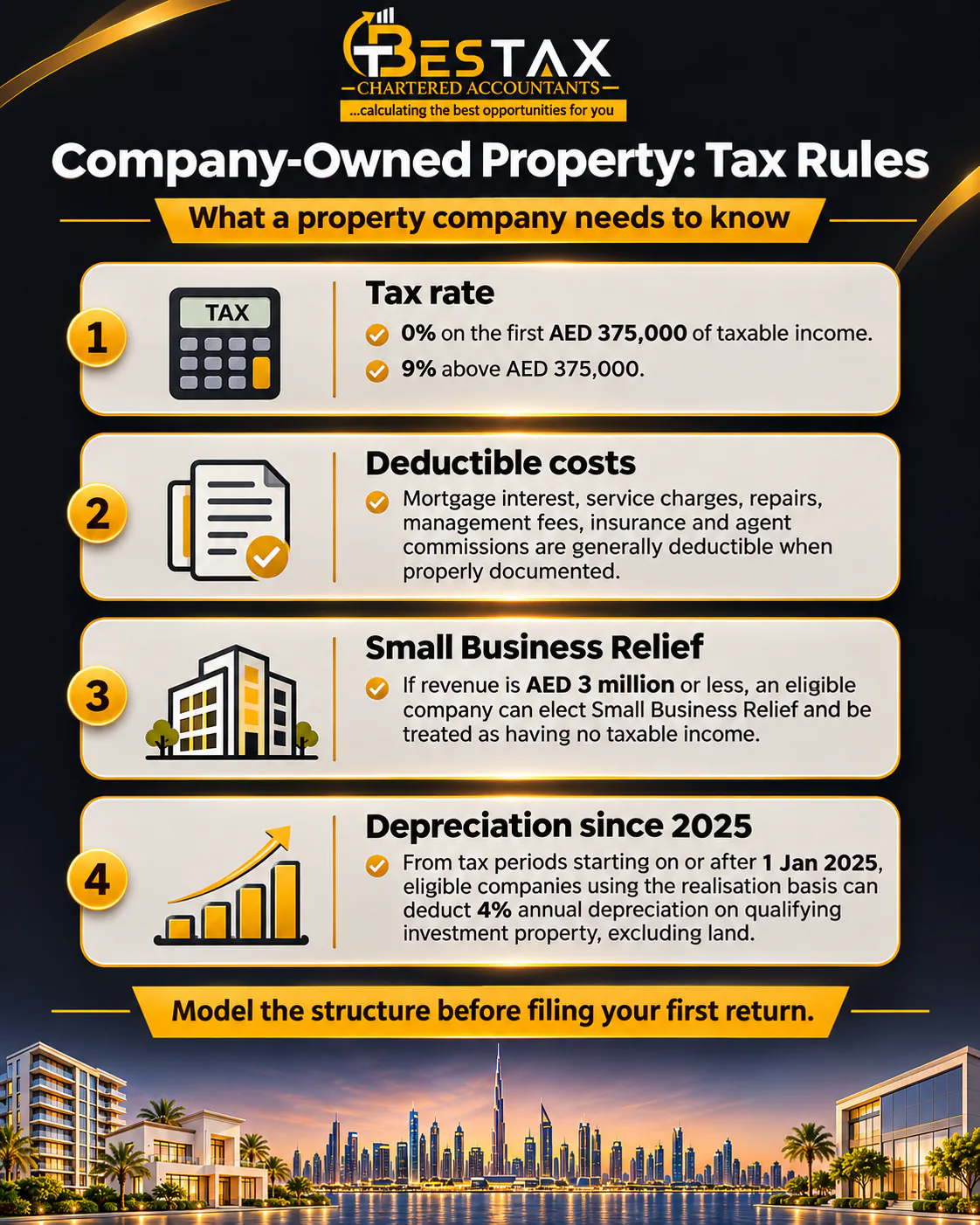
A UAE company that owns rental property pays corporate tax at 0 percent on its first AED 375,000 of taxable income and 9 percent above it. Rental income counts in full. Deductible expenses reduce it, and for your property company those are the ones an individual cannot claim.
Mortgage interest is deductible within the general interest limitation rules. Service charges, repairs, management fees, insurance and agent commissions are deductible when they are incurred wholly for the business. Each one has to be documented to the invoice.
If your company's revenue is AED 3 million or less in the tax period, you can elect Small Business Relief and be treated as having no taxable income. That election is available until the end of 2029. A property company with two or three units often qualifies. One with a larger portfolio does not, and you plan around the 9 percent rate instead.
Depreciation on Investment Property Since 2025
Companies that carry investment property at fair value in their accounts had no depreciation deduction until last year, because fair value accounting does not depreciate. Ministerial Decision No. 173 of 2025 changed that for tax periods starting on or after January 1, 2025. A company that has elected the realisation basis can now deduct depreciation each year. The deduction is 4 percent of the property's original cost, or its tax written-down value where that is lower. Land is excluded, and buildings held for rent or appreciation are covered.
The election is irrevocable and applies to all your investment property held at fair value. The depreciation you claim is added back on disposal, so the relief is a timing benefit rather than a permanent one. If you hold property for the long term, the timing benefit is worth having. The election belongs in your first return for a period starting in 2025, and if you miss it you forfeit the regime. The election also interacts with Small Business Relief: electing the relief is a realisation event that claws back the depreciation already claimed, so a company weighing both should model them together before filing.
The opening value is not the purchase price. A property you bought for AED 1 million in January 2020 and hold at fair value carries a deemed 4 percent depreciation for each full year before 2025. Its opening value on January 1, 2025 is therefore AED 800,000, and depreciation runs from that figure.
Free Zone Companies and Property Income
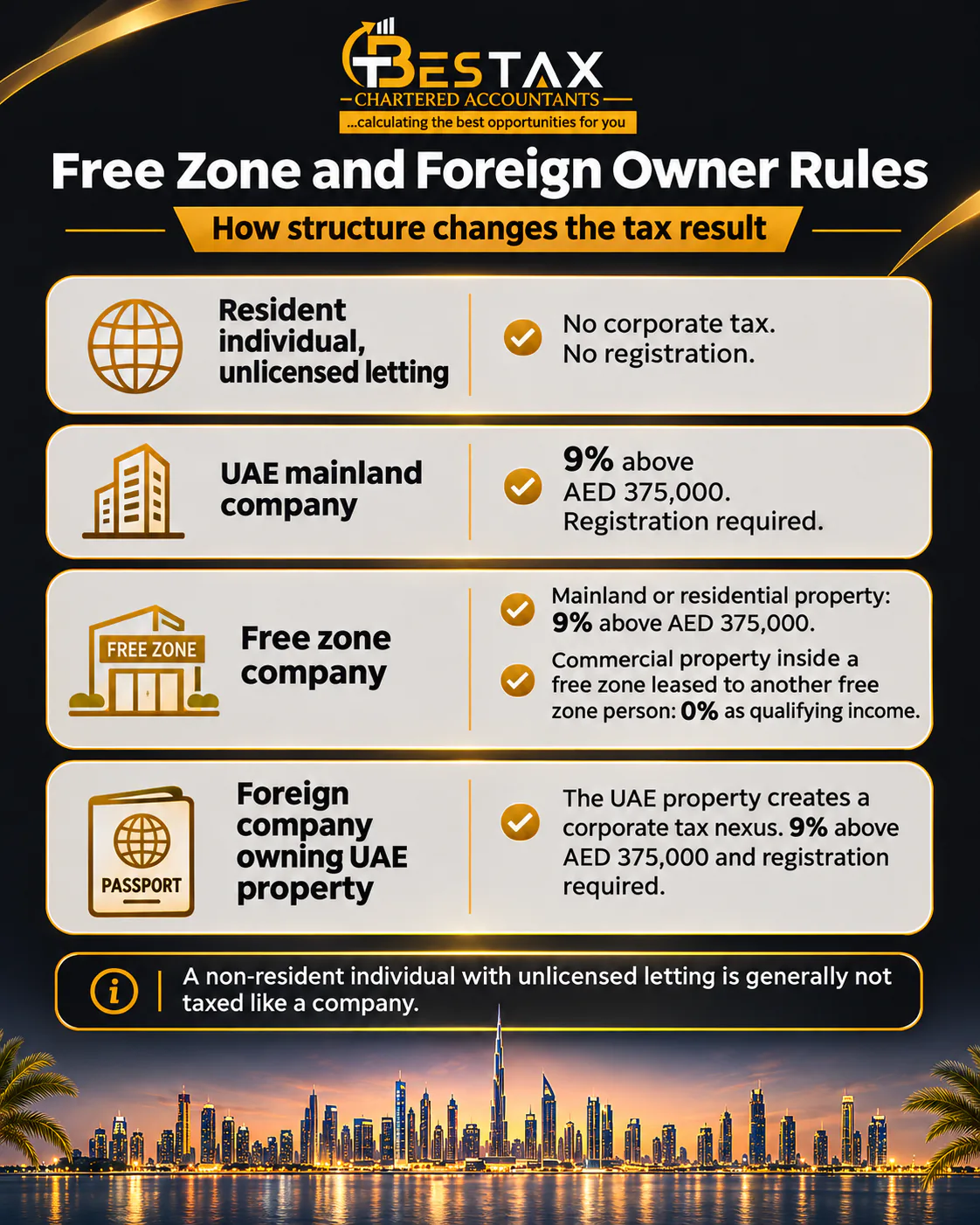
A qualifying free zone person pays 0 percent on qualifying income, and most property income is not qualifying. Income from immovable property is an excluded activity under Ministerial Decision No. 265 of 2023, as updated by Ministerial Decision No. 229 of 2025. If your free zone company owns a mainland apartment or a Downtown office, it pays 9 percent on the rent, whatever its free zone status.
The one exception is commercial property inside a free zone, leased to another free zone person. That income is qualifying and taxed at 0 percent. Residential property inside a free zone does not qualify, and neither does commercial property leased to a mainland tenant.
| Owner | Corporate tax on rent | Registration |
|---|---|---|
| Resident individual, unlicensed letting | None | No |
| Non-resident individual, unlicensed letting | None | No |
| UAE mainland company | 9 percent above AED 375,000 | Yes |
| Free zone company, mainland or residential property | 9 percent above AED 375,000 | Yes |
| Free zone company, commercial property leased to a free zone person | 0 percent as qualifying income | Yes |
| Foreign company owning UAE property | 9 percent above AED 375,000, through the nexus rule | Yes |
Structuring a portfolio across these categories is a direct tax question with indirect tax consequences. Our direct and indirect tax team models the corporate tax and VAT position of each holding structure before you commit to it. The structure sets the rate for as long as you hold the property.
Property Tax in UAE and Other Rules Every Owner Faces
The UAE has no annual property tax, and that fact leads owners to overlook the charges that do apply. The three below sit beside corporate tax.
Foreign Owners and the Nexus Created by UAE Property
Investors outside the UAE own a large share of Dubai's rental stock. The UAE’s corporate tax rules on real estate investment reach them through a nexus most did not expect. Under Cabinet Decision No. 56 of 2023, a non-resident company that earns income from immovable property in the UAE has a nexus for corporate tax. A British Virgin Islands company holding a villa in Emirates Hills is caught as fully as a UAE company holding the same villa.
If you are a non-resident individual, you are in a different position. The natural person exemption applies to you as it does to residents. A foreign individual letting a Dubai apartment without a licence has real estate investment income and no corporate tax. The nexus rule catches foreign companies, not foreign people.
A foreign company registers for corporate tax within the deadline the FTA sets for non-resident persons with a nexus, usually through an FTA-registered tax agent acting on its behalf. No tax is withheld on rent, because the UAE's withholding rate is 0 percent, and the 9 percent is paid through a return filed nine months after year-end. Late registration costs AED 10,000, and the FTA has issued those penalties to property-holding companies that assumed the law did not reach them. Where the owner's home country taxes the same income, the treaty position decides the credit.
VAT on Rent
Under the VAT rules for UAE real estate, residential leases are exempt from VAT, so you charge no VAT on residential rent and recover no input VAT on the costs of those units. Commercial leases are standard-rated at 5 percent. If your taxable supplies pass AED 375,000 in 12 months, you register for VAT, charge 5 percent on commercial rent and recover the VAT on commercial property costs. A mixed portfolio needs the input VAT apportioned between the two, which is the calculation our VAT consultants in Dubai run for landlords each quarter.
The first supply of a new residential building within three years of completion is zero-rated rather than exempt. A developer or an investor selling or leasing a new residential unit for the first time recovers the VAT on construction, and the buyer pays none. Later supplies of the same unit are exempt, and the recovery stops.
VAT and corporate tax run on separate registrations and returns. An individual landlord with commercial units can be registered for VAT while having no corporate tax obligation. A company is usually registered for both, and the two returns have to agree on the rent.
Transfer Fees, Records and Filing
A property purchase in Dubai carries a Dubai Land Department transfer fee of 4 percent of the price, usually split by agreement between buyer and seller. Residential tenants in Dubai pay a housing fee of 5 percent of annual rent through their utility bill. A landlord sees it only in the rent the market will bear.
Neither is a tax on your income as landlord. Neither is deductible against corporate tax if you are an individual, because your rental income is not taxable in the first place. For a company, the transfer fee forms part of the property's cost.
If your company owns property, it keeps its accounting records for seven years under the corporate tax law and files its return within nine months of year-end. Financial statements have to be prepared under IFRS, or IFRS for SMEs where revenue is AED 50 million or less. A company that elects the depreciation deduction keeps a register of original cost and tax written-down value for each property from the year of election.
Check How Each Property Is Held Before You File Anything
List every property you own or control in the UAE and note three things for each. Note whether it is held in your own name, a UAE company, a free zone company or a foreign company. Note whether the letting activity needs a licence, with short-term letting the usual trigger. Note whether any company in the list has revenue above AED 3 million or holds the property at fair value.
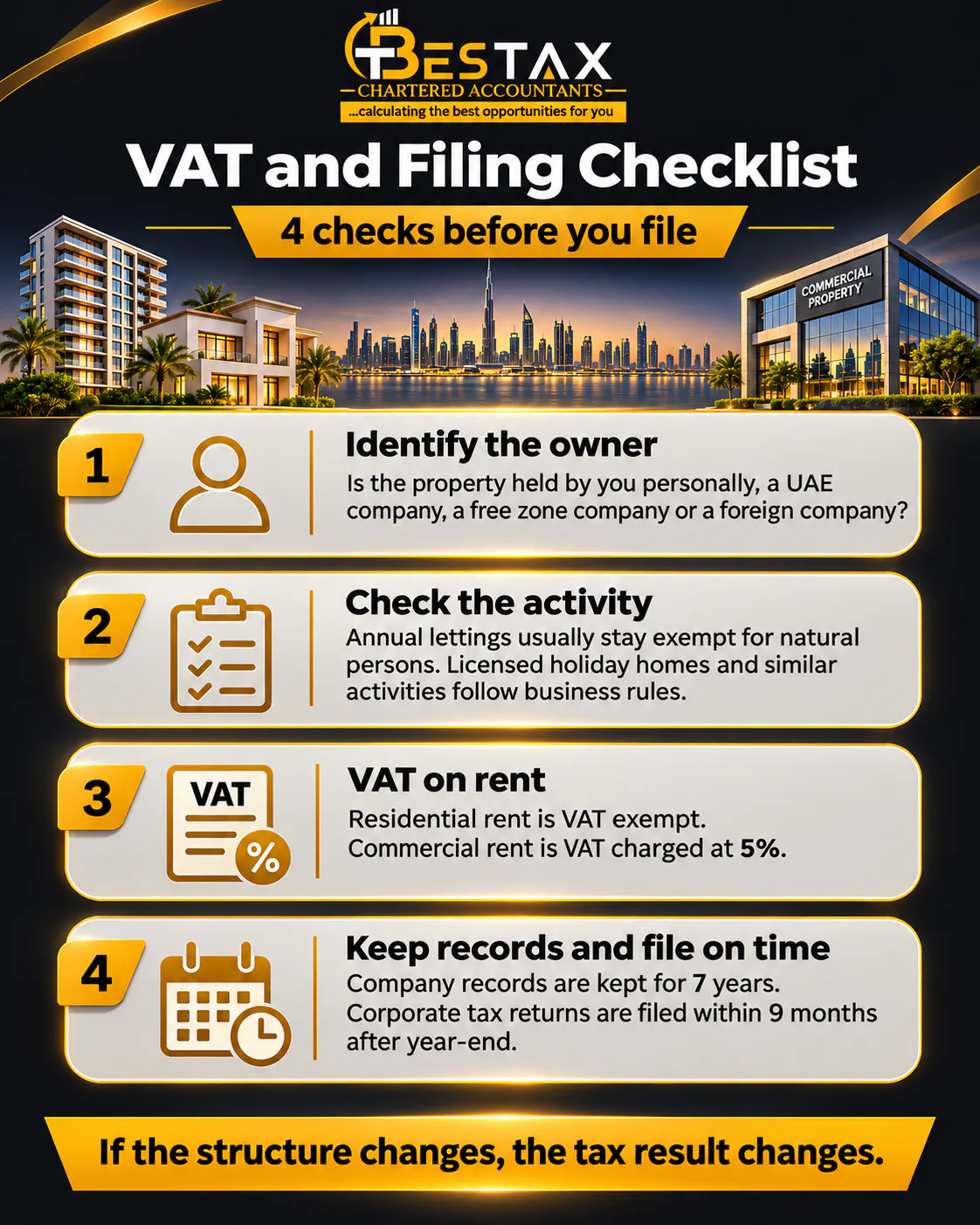
Those three notes place every property in one row of the tables above. The row you are least likely to expect is licensed activity in your own name. The AED 1 million threshold turns an exempt owner into a registered taxpayer in a single strong year.
If your list has more than one row, or a property that fits two, book a consultation with our real estate advisory team. We confirm the classification of each property and calculate the corporate tax and VAT position of the structure you have. We then show you what the alternatives would cost.
For your company-owned portfolio, our direct and indirect tax team handles the registration, the depreciation election and the return. Your first year under the rules is then filed correctly and on time.
FAQs About Corporate Tax on Rental Income in UAE
If I hold one apartment in my own name and two in a company, how are they taxed?
Separately. The apartment in your own name is real estate investment income with no corporate tax and no registration. The two in the company are business income taxed at 9 percent above AED 375,000. The exception is where the company's revenue is AED 3 million or less and you elect Small Business Relief. You cannot offset the company's costs against the personal apartment's rent.
Does the AED 1 million threshold count gross platform receipts or what I receive after commission?
Gross turnover. The threshold is measured on the total amount you derive from the licensed activity in the calendar year, before platform commissions, cleaning and management costs. An owner with AED 1.1 million of bookings and AED 250,000 of platform and cleaning costs has crossed the line. Those costs are then deductible against the taxable income.
Can I move a property from my own name into a company to claim the depreciation deduction?
You can, but the transfer has its own costs. A Dubai Land Department transfer fee applies, and the company's opening value for depreciation is its cost at transfer, not your original purchase price. The move has to be modelled on the after-tax return over your holding period, and for many individual owners the exemption is worth more than the deduction.
What happens if my foreign company owning Dubai property never registered?
The nexus rule has applied since the corporate tax law took effect, so the company has an unfiled obligation and a late-registration penalty of AED 10,000. Registering now through a tax agent, filing the outstanding returns and paying the tax with interest is the route back. Waiting adds a penalty for each late return on top. The FTA also waives the AED 10,000 penalty where the company files its first return within seven months of the end of its first tax period, so registering promptly can cost nothing extra.
Do I pay corporate tax when I sell a property I hold personally?
No. The sale of land or real estate by an individual is real estate investment income under Cabinet Decision No. 49, provided the activity does not require a licence. A company selling property pays corporate tax on the gain, and if it elected the depreciation deduction, the amounts deducted are added back on the sale.
Disclaimer: The information provided in this blog is for general informational purposes only. For professional assistance and advice, please contact experts.

Khadija Raees holds a Bachelor's degree and brings over five years of experience in creating authoritative content in the areas of tax, accounting, company formation, and VAT in the UAE.
Learn More About Khadija