





Yes. Corporate tax for freelancers in the UAE starts once your combined business turnover exceeds AED 1 million in a calendar year. You then have to register and file, but your tax may still be zero. Wage income, qualifying personal investment income and real estate investment income don’t count toward the threshold. See how corporate tax on rental income in the UAE works for property owners.
The rule comes from Cabinet Decision No. 49 of 2023. It applies the same way to freelancers, sole establishment owners and anyone running a side business.
Below: what counts toward the AED 1 million, what relief is available, and the deadlines that follow.
Do Freelancers Pay Corporate Tax in the UAE?
Most freelancers aren’t exempt; they’re tested against a turnover threshold. Three rules decide whether you’re in.
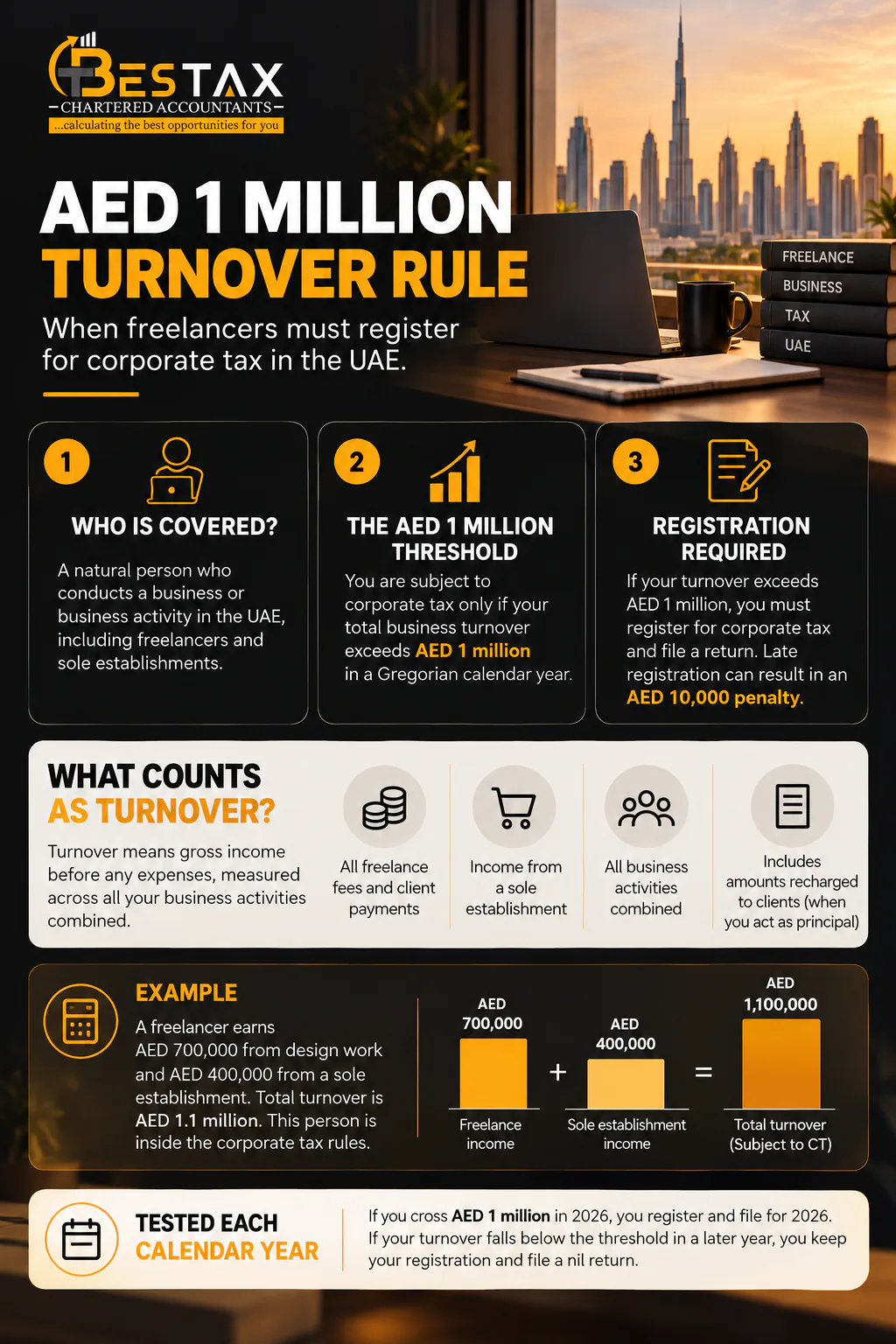
Who Counts as Doing Business
The law taxes a natural person who carries on a business activity regularly and independently in the UAE, licensed or not. A freelance designer, a consultant on retainers and a sole establishment trader all qualify.
The license isn’t the test. The activity is. See the FTA guide on taxation of natural persons.
Residency rarely changes the answer. Non-resident natural persons with a UAE permanent establishment must register within three months of meeting the conditions for being subject to UAE corporate tax.
The AED 1 Million Turnover Rule
Turnover means gross income before expenses, added up across all your business activities.
- AED 700,000 from design + AED 400,000 from a sole establishment = AED 1.1 million. You’re in.
- The test repeats every calendar year.
- If turnover later drops below AED 1 million, you stay registered and keep filing a tax return each year. You can only deregister once you stop doing business.
- If a platform deducts a 15% commission from your client fees, your turnover is the gross fee. An AED 900,000 payout means about AED 1.06 million in turnover.
Income That Doesn’t Count
| Income | Counts toward AED 1M? |
|---|---|
| Freelance fees, consulting, sole establishment sales | Yes |
| Income from licensed real estate activity (e.g. holiday homes) | Yes |
| Salary and allowances from an employer | No |
| Dividends, interest and gains qualifying as personal investment income | No |
| Qualifying personal property rent and sale proceeds, where the activity is neither conducted through nor requires a license | No |
Close to AED 1 million? Bestax Chartered Accountants, an FTA-approved tax agency, counts your turnover across every income source and tells you if you need to register. Get your turnover checked
Sole Establishments, Freelance Permits and LLCs
For corporate tax, a sole establishment, a freelance permit and an unlicensed side business are treated the same way. The difference comes when you work through a company instead.
Sole Establishment Corporate Tax
A sole establishment isn’t separate from you. You register in your own name, and its turnover is added to your other business income. See the difference between an LLC and a sole establishment.
Freelance Permits, Including Free Zones
If you work under a freelance permit (such as Dubai’s GoFreelance) as an individual, not through a company, you’re taxed as a natural person. Free zone freelancers can’t get the 0% qualifying free zone rate; that’s only for companies.
Working Through an LLC
A newly incorporated UAE LLC must register within three months of incorporation, whatever its turnover.
- AED 1M–3M turnover: usually no tax difference if both qualify for Small Business Relief.
- Above AED 3M: an LLC can deduct a salary paid to you for real work, if it meets the business-purpose rules and stays within market value. That can lower the tax, but setup and running costs eat into the saving.
| Point of comparison | Freelancer or sole establishment | LLC |
|---|---|---|
| Taxable person | You | The company |
| When to register | Turnover above AED 1M in a calendar year | Within 3 months of incorporation (new LLCs) |
| Tax period | Calendar year | Company’s financial year |
| 0% free zone rate | Not available | Available if the company qualifies |
| Owner’s salary | Not applicable | Deductible at market value, if incurred for the business |
| Small Business Relief (≤ AED 3M) | Available if eligible | Available if eligible (not for qualifying free zone persons or certain multinational groups) |
Moving to a company? Bestax is a business setup partner for Dubai free zones. We set up your company and register it for corporate tax. Need audited financial statements, for example as a qualifying free zone person? We arrange internal and external audits through our approved auditor network. Explore free zone company setup.
Corporate Tax for Individuals in the UAE: What Happens Next
Once you cross AED 1 million, three obligations follow in order. Each has a fixed date, starting with your registration deadline.
1. Register by March 31 If You’re a UAE Resident
Under FTA Decision No. 3 of 2024, resident individuals register by March 31 of the year after crossing AED 1 million. Cross it in 2026, register by March 31, 2027. Non-resident natural persons must register within three months of meeting the conditions for being subject to UAE corporate tax. Late registration costs AED 10,000.
Register on EmaraTax in your own name with your Emirates ID or passport and license or permit. One tax registration number covers all your activities.
2. Know the Rate and Relief
- 0% on taxable income up to AED 375,000
- 9% above AED 375,000
- Eligible business expenses are deductible, subject to the corporate tax rules. Salary and qualifying personal investment and real estate investment income are excluded.
Small Business Relief: if you’re a UAE resident and your revenue is AED 3 million or less in this and every earlier tax period, you can elect it in each return. You’re then treated as having no taxable income. Qualifying free zone persons and certain multinational group members can’t use it.
Ministerial Decision No. 131 of 2026, announced by the Ministry of Finance in August 2026, extends the relief to tax periods ending on or before December 31, 2029.
One catch: a year under the relief can’t create a tax loss to carry forward. Compare both options in our free corporate tax calculator.
3. File and Pay by September 30
| Item | Rule |
|---|---|
| Return and payment due | September 30 of the following year |
| Late return | AED 500 for each month or part of a month (months 1–12); AED 1,000 for each month or part of a month from month 13 |
| Late payment | 14% per annum on unpaid tax, applied monthly for each month or part of a month |
| Records | Keep supporting records for at least 7 years after the relevant tax period ends |
Missed the March 31 Deadline?
Register right away. Under FTA Public Clarification CTP006, the AED 10,000 penalty is waived automatically if you file your first return within seven months of your first tax period ending. This covers past and future first periods, so a first period ending December 31, 2026 means filing by July 31, 2027.
Filing within seven months only qualifies you for the waiver. Any tax is still due by the normal nine-month deadline (September 30, 2027 in this example).
Your Corporate Tax Checklist
- Count turnover across all business activities for the calendar year.
- If it’s above AED 1 million, register by March 31 of the next year (residents) or within three months of becoming subject to tax (non-residents).
- If eligible, elect Small Business Relief in each return, provided revenue hasn’t exceeded AED 3 million in the current or any previous tax period.
- File your return by September 30 every year, even if no tax is due.
- If you stop doing business, apply to deregister within three months.
Corporate Tax vs VAT
They’re separate. For UAE-resident businesses, VAT registration is mandatory once taxable supplies and imports exceed AED 375,000 over the past 12 months, or are expected to in the next 30 days. That can apply even if you’re far below the AED 1 million corporate tax threshold. Voluntary registration is possible when supplies, imports or taxable expenses exceed AED 187,500.
Don’t confuse it with the AED 375,000 corporate tax 0% band. Same number, different rule.
Check Your Business Turnover Before the Year Ends
Add up this year’s business revenue before expenses. Leave out salary and qualifying investment and property income.
- Above AED 1 million: register by March 31 next year (non-residents: within three months of becoming subject to tax).
- AED 3 million or less every year: if you’re eligible, Small Business Relief can bring your tax to zero.
- Close to the line: include December’s expected income. If you’ll pass AED 1 million by December 31, plan to register.
Let Bestax handle it. Bestax Chartered Accountants is an FTA-approved tax agency (No. 30008692) with 10+ years of experience in Dubai. We do your turnover count, EmaraTax registration and first return, so you meet every deadline and avoid the AED 10,000 penalty. Book a free 20-minute consultation
Frequently Asked Questions
Quick answers to the questions freelancers ask us most.
I have a freelance permit and earned AED 600,000 this year. Do I need to register?
No, if you’ve never registered and this is your total turnover across all business activities. You’re below the threshold. Keep your invoices, as the count repeats every year. If you registered in an earlier year, you still file a tax return.
My salary is AED 900,000 and my freelance income is AED 300,000. Am I over the threshold?
No. Wage income is outside the scope of corporate tax for natural persons, so it doesn’t count. Only the AED 300,000 freelance income does.
I run two sole establishments. Are they tested separately?
No. Two establishments at AED 600,000 each total AED 1.2 million. One registration covers both.
Can I deduct my home office and laptop?
Yes, for the business-use share. A laptop used as a business asset is generally deducted through depreciation. Deductions lower taxable income, not turnover.
If I set up an LLC, does my personal registration end?
Only if the LLC takes over all your business. Apply to deregister within three months of stopping; it ends once the FTA approves. Keep some work in your own name and you hold both registrations.
Disclaimer: The information provided in this blog is for general informational purposes only. For professional assistance and advice, please contact experts.

With over six years of experience in tax, accounting, bookkeeping, and business setup processes, Neha Ghauri provides expert insights through meticulously researched content.
Learn More About Neha