





A permanent establishment in the UAE can turn your foreign company into a UAE taxpayer without you ever setting anything up. No licence, no branch, no local staff. A founder working from a Dubai co-working desk, or one agent closing deals for you, can be enough.
Once that line is crossed, your company owes 9% corporate tax on its UAE profits and has six months to register. Miss it and you face an AED 10,000 penalty, with no UAE paperwork to claim tax relief back home.
In this guide, we’ll cover what creates a PE, how remote staff and agents fit in, how double tax treaties change the picture and what happens once you have one.
What Is a Permanent Establishment in the UAE?
Article 14 of the Corporate Tax Law defines a permanent establishment (PE). It is a place of business or other presence in the UAE through which a non-resident runs all or part of its business.
The idea follows the OECD model used by most countries. If your business has real roots in the UAE, the UAE gets to tax the profit those roots produce.
Three Ways a Foreign Company Becomes Taxable
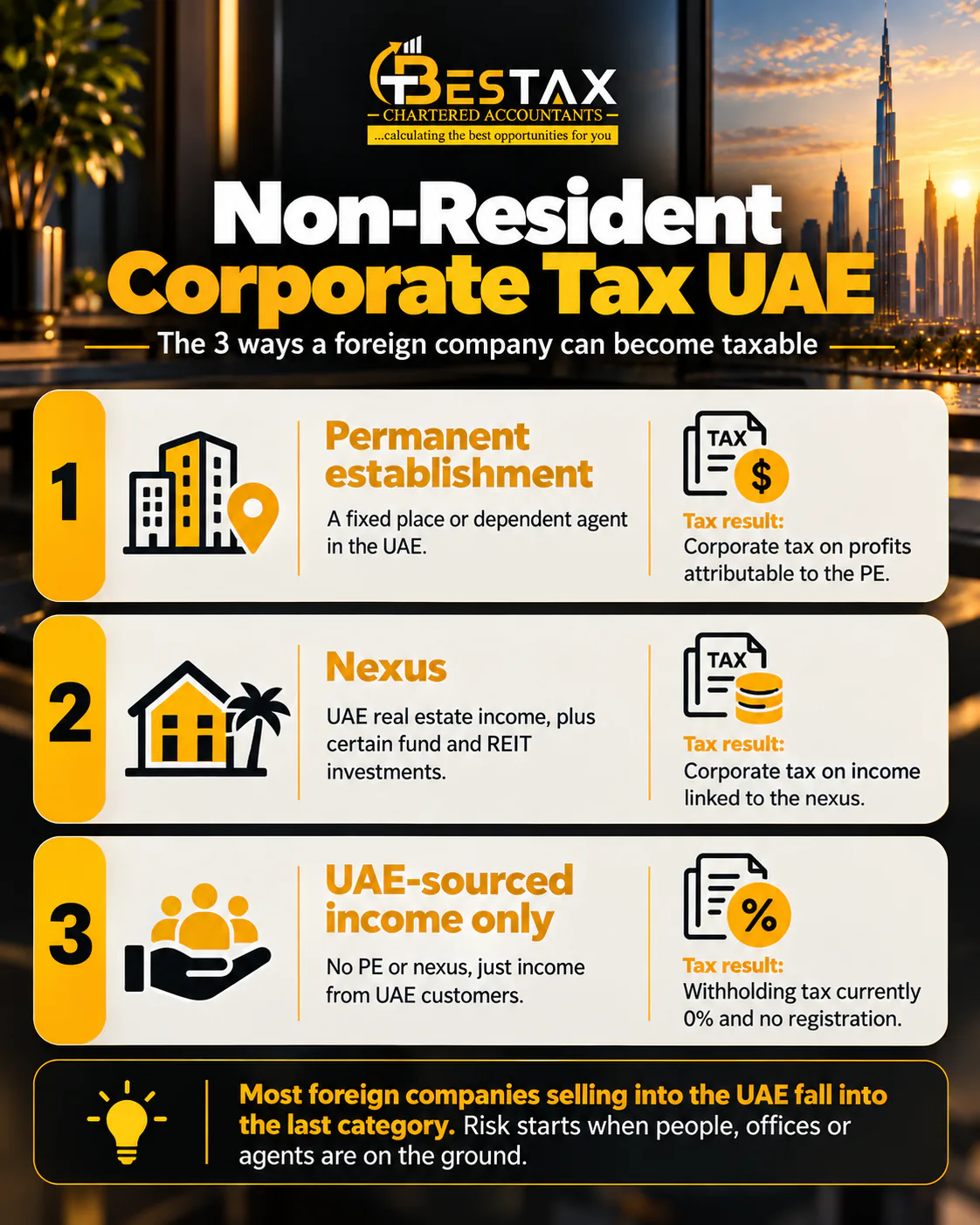
A foreign company becomes a taxable non-resident in three main ways:
| Trigger | What it means | Tax result |
|---|---|---|
| Permanent establishment | A fixed place or dependent agent in the UAE | Corporate tax on profits attributable to the PE |
| Nexus | Income from UAE real estate, plus certain fund investments | Corporate tax on income linked to the nexus |
| UAE-sourced income only | No PE or nexus, just income from UAE customers | Withholding tax, currently at 0%, with no registration |
Most foreign companies selling into the UAE fall into the last row. The risk starts when people, offices or agents end up on the ground.
The Two Types of PE
The FTA recognises two kinds of PE:
- Fixed place PE: an office, branch, factory or other fixed place the business operates through.
- Dependent agent PE: a person in the UAE who regularly concludes or negotiates contracts for the foreign company.
Either one is enough. A company can also have both.
What Counts as a Fixed Place PE
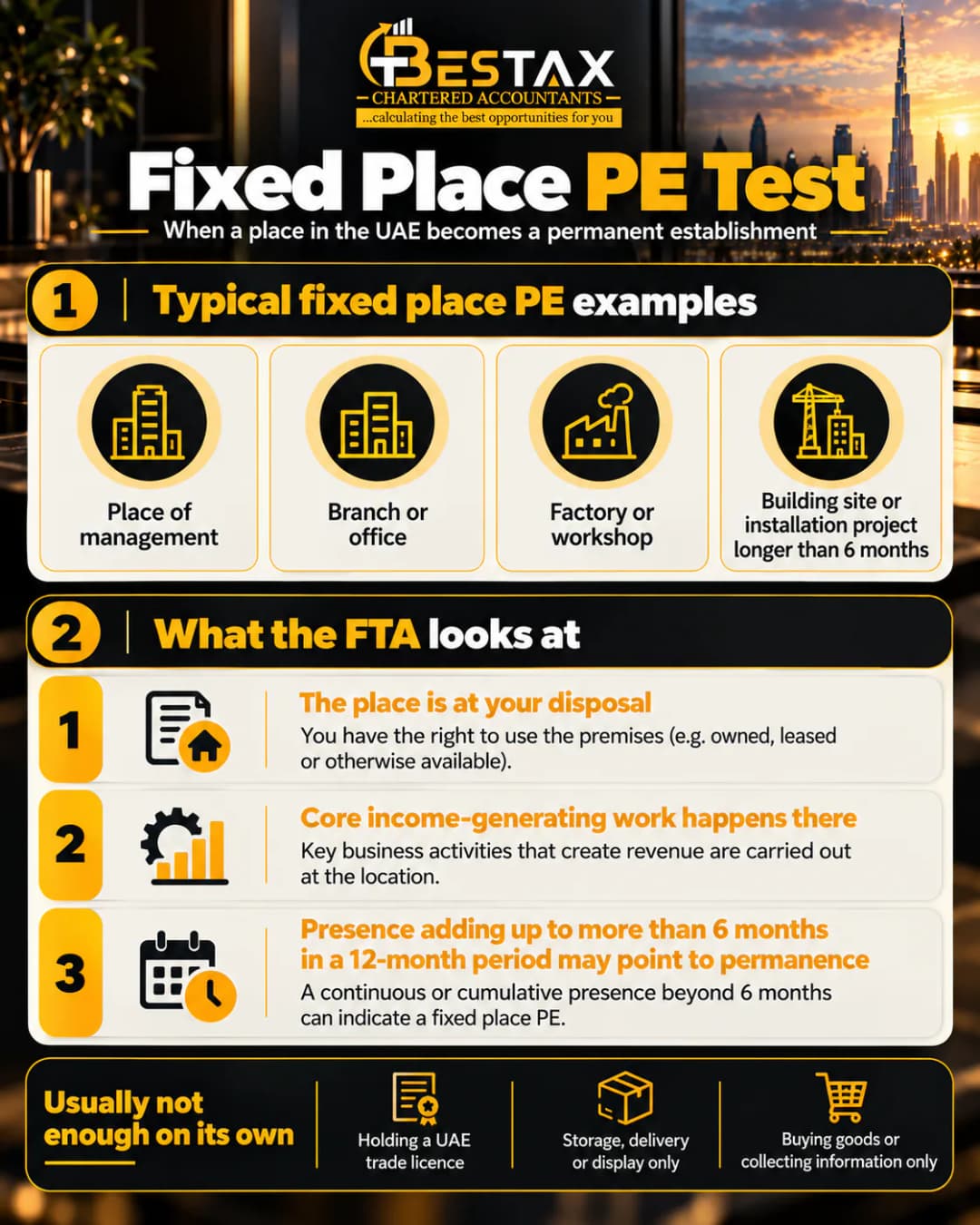
A fixed place PE exists when your business runs through a fixed or permanent place in the UAE. The FTA’s PE summary gives typical examples:
- A place of management
- A branch or office
- A factory or workshop
- A building site or installation project lasting more than six months
The place has to be at your disposal and used for real business, not just visited.
How Long Is "Permanent"?
There is no single day count in the law. In its Summary of FTA Private Clarifications issued up to May 2026, published in July 2026, the FTA indicated that presence adding up to more than six months in a 12-month period may point to permanence. It also looks at whether core income-generating work happens at that place. Private clarifications legally bind only the taxpayer who requested them, but they show how the FTA reads the rules.
Building and installation projects have a clear rule. A site that runs longer than six months creates a PE, even if each worker is there for only a few weeks. Under Article 14, sites, projects and supervisory activities count separately or together, and connected work that the non-resident’s related parties do at the site counts toward the six months. Splitting one contract across group companies doesn’t reset the clock.
The same summary confirms that holding a UAE trade licence doesn’t automatically create a PE. A PE depends on what actually happens on the ground.
The Place of Management Trap
A place of management is where key business decisions are made in practice. This is where many foreign companies get caught.
Say a UK founder moves to Dubai and keeps running her UK company from a co-working desk. She approves budgets, signs contracts and sets strategy there. The UK company may now have a UAE PE, without any local licence, branch or staff.
When the Whole Company Becomes UAE Resident
The risk can go further than a PE. A foreign company that is effectively managed and controlled in the UAE is treated as a UAE resident under the Corporate Tax Law.
A resident pays UAE tax on its worldwide income, not just the profit of a UAE office. If the home country also treats the company as resident, the tie-breaker rule in the double tax treaty decides where it is taxed.
Preparatory and Auxiliary Activities
Some uses of a fixed place don’t create a PE. These include storing or delivering goods, displaying stock, buying goods and collecting information for the foreign company.
The exemption only covers support work. A sales office that negotiates prices with UAE customers is core business, not auxiliary.
The Anti-Fragmentation Rule
You can’t split one business across related companies so each piece looks auxiliary. If the activities together form a single business operation in the UAE, the exemption falls away for all of them. The building site rule follows the same logic, since related parties’ connected work counts toward its six months.
When Agents and Remote Staff Create a PE
You don’t need an office to have a PE. People acting for you in the UAE can create one too. Bestax reviews your agent, distributor and remote staff arrangements to show you exactly where that line sits for your business.
Dependent Agent PE
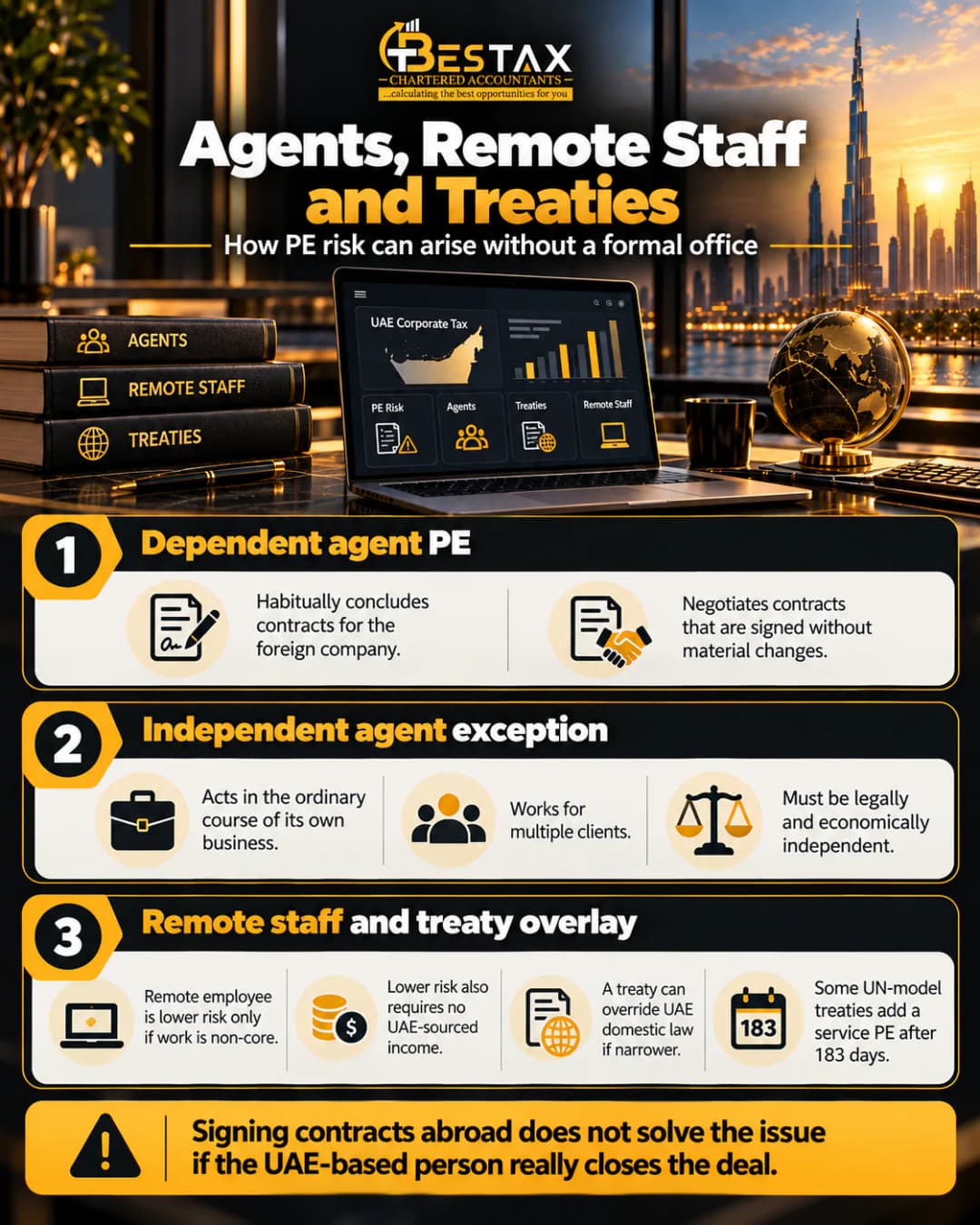
A dependent agent PE arises when someone in the UAE habitually does either of these for your company:
- Concludes contracts on your behalf.
- Negotiates contracts that you then sign without material changes.
Signing abroad doesn’t fix this. If your UAE representative finds the customer, agrees the price and sends you a contract to sign, the FTA looks at who really closed the deal.
The Independent Agent Exception
An independent agent acting in the ordinary course of its own business doesn’t create a PE. A distributor working for many manufacturers under its own licence is the classic example.
The exception fails if the agent works exclusively or almost exclusively for you. It also fails if the agent isn’t legally or economically independent of you.
Regulated investment managers have their own protection. Under Article 15, a licensed UAE investment manager acting for a non-resident person, such as a foreign fund, can be treated as an independent agent if it meets all the Article 15 conditions. These include acting in the ordinary course of its business and in an independent capacity. If it does, it doesn’t create a PE for the non-resident.
Remote Employees in the UAE
More foreign companies now have staff working remotely from Dubai. Article 14(7)(b) of the Corporate Tax Law excludes an employee’s presence from PE status when both of these are true:
- The employee’s UAE activities are not part of the core income-generating activities of the company or its related parties.
- The foreign company has no UAE-sourced income.
For a group, that means checking the core activities of every related company, not just the employer. A remote developer supporting a foreign product with no UAE customers is lower risk. A remote salesperson closing UAE deals is a different story.
Temporary and Exceptional Presence
Ministerial Decision No. 83 of 2023 covers people stuck in the UAE by events beyond their control, such as travel bans or a medical emergency. Their presence doesn’t create a PE only if all of these conditions are met:
- The presence results from exceptional circumstances, public or private, beyond the person’s control.
- The circumstances could not reasonably have been predicted by the person or the company.
- The person didn’t express any intention to stay in the UAE once the circumstances end.
- The company had no UAE PE before the circumstances arose.
- The company didn’t treat the person as creating a PE or earning income in the UAE under another country’s tax law.
Nexus and Double Tax Treaties
A PE isn’t the only way a foreign company ends up paying UAE tax. Nexus works differently, and treaties can narrow what counts as a PE.
Nexus: Real Estate and Fund Investments
A foreign company earning income from UAE real estate has a nexus in the UAE. It must register and pay corporate tax on that income, even with no office or staff.
Cabinet Decision No. 35 of 2025 replaced Cabinet Decision No. 56 of 2023 for tax periods starting on or after 1 January 2025. It is one of the new tax rules for foreign investors, and it adds nexus triggers for some investors in qualifying investment funds and REITs.
How Double Tax Treaties Change the Picture
The UAE has a wide network of double tax treaties. If your company is resident in a treaty country, the treaty’s PE definition can override UAE domestic law where the treaty is narrower.
To rely on a treaty, you need a valid tax residency certificate from your home country. Without one, UAE domestic rules apply in full.
OECD vs UN Model Treaties and the 183-Day Rule
Treaties based on the OECD model recognise fixed place and dependent agent PEs. Treaties based on the UN model often add a service PE: staff providing services in the country for more than 183 days in a 12-month period.
If your home country’s treaty has a service PE clause, a long consulting project can create a PE even with no UAE office. Construction PE time limits also vary from treaty to treaty.
Reading the right treaty clause decides whether you owe UAE tax at all. Our double tax treaty advisory team checks your specific treaty before you commit people to a UAE project.
Corporate Tax Obligations Once You Have a PE
A PE turns a foreign company into a UAE taxpayer. The obligations look much like a local company’s.
Registration Deadlines
Under FTA Decision No. 3 of 2024, a foreign company must register on EmaraTax within these timeframes:
| Situation | Registration deadline |
|---|---|
| PE that existed before 1 March 2024 | 9 months from the date the PE came into existence |
| Nexus that existed before 1 March 2024 | 31 May 2024 |
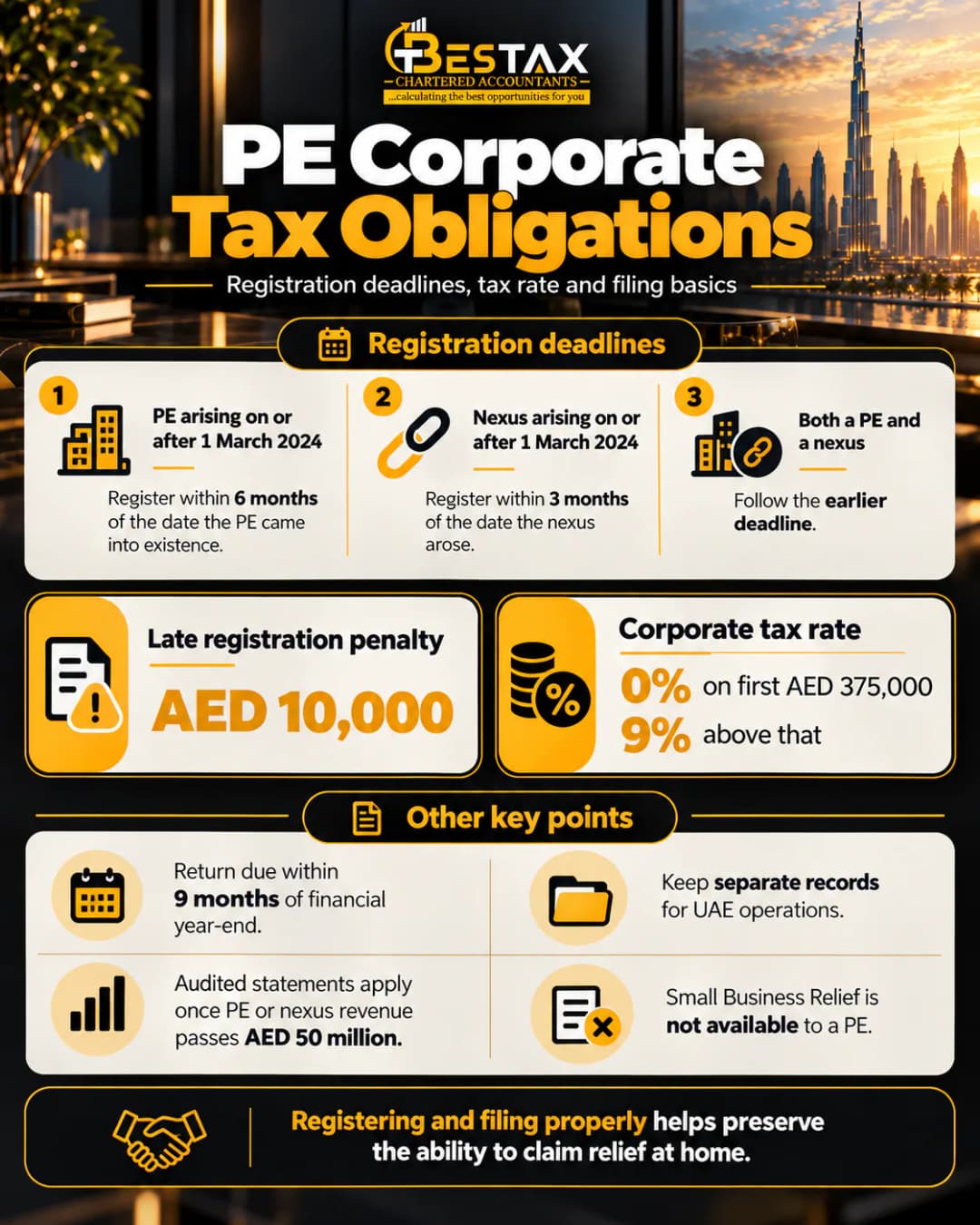
| PE arising on or after 1 March 2024 | 6 months from the date the PE came into existence |
| Nexus arising on or after 1 March 2024 | 3 months from the date the nexus arose |
| Both a PE and a nexus | The earlier of the two deadlines |
Late registration costs AED 10,000. The FTA waives this penalty if you file your first tax return within seven months of the end of your first tax period, under Public Clarification CTP006. The waiver covers the first tax period only.
Registration applies even if the PE makes a loss in its first year. Our corporate tax registration team files the EmaraTax application for non-residents.
Tax Rate and Profit Attribution
A PE pays the standard corporate tax rate in the UAE: 0% on the first AED 375,000 of taxable income and 9% above that.
Only the profit attributable to the PE is taxed. The PE is treated as if it were a separate business dealing with its head office at arm’s length. That usually means a transfer pricing analysis of what the PE actually does.
Filing and Records
The PE files a corporate tax return within nine months of its financial year-end, the same corporate tax deadline as local companies. It needs its own financial statements for its UAE operations.
Under Ministerial Decision No. 84 of 2025, audited financial statements are required once revenue passes AED 50 million. For a non-resident, only the revenue of the PE or nexus counts toward that figure.
No Small Business Relief
Small business relief is only for UAE resident persons. A PE can’t claim it, even with revenue under AED 3 million.
Relief at Home
UAE tax paid by a PE can usually be credited in the home country under a treaty or local rules. That only works if the PE is registered and filing in the UAE. An unregistered PE leaves you with no UAE tax paperwork to claim relief, and a real risk of being taxed twice.
How Bestax Assesses Your PE Risk
PE status depends on facts, not paperwork. Bestax reviews how your business actually operates in the UAE and gives you a clear answer before the FTA asks the question.
The Bestax PE Review
- Activity mapping: who works in or travels to the UAE, what they do there and for how long.
- Fixed place and management review: offices, co-working desks and where key decisions are really made.
- Agent review: contracts with UAE agents, distributors and sales staff, tested against the independent agent rules.
- Treaty check: the PE clause in your home country’s treaty, including any service PE or construction time limit, plus your tax residency certificate.
- Nexus check: UAE property income and fund investments under Cabinet Decision No. 35 of 2025.
- Action plan: registration, profit attribution and filing where a PE exists, or the records that show it doesn’t.
Signs You Should Book a Review
- A founder or director now lives in the UAE.
- Staff spend long stretches in the UAE on client projects.
- A UAE-based person negotiates deals for your company.
- You have a UAE project expected to run close to six months.
- You earn rent or other income from UAE property.
If any of these apply, book a PE review with our treaty team. The review costs far less than a missed registration and years of unfiled returns.
Frequently Asked Questions
Does a foreign company pay tax in the UAE just for selling to UAE customers?
No. Without a PE or nexus, UAE-sourced income is only subject to withholding tax, which is currently 0%. The company doesn’t need to register.
Can related companies’ activities be combined to create a PE?
Yes. Under the anti-fragmentation rule, activities that look preparatory or auxiliary on their own lose that exemption if, together with a related company’s UAE activities, they form one business operation. On building and installation projects, connected work by related parties also counts toward the six-month test.
Can a foreign individual have a UAE PE?
Yes. A non-resident individual with a UAE PE must register once the turnover linked to that PE passes AED 1 million in a calendar year.
We may have had an unregistered PE for a while. What now?
Register as soon as possible and file the returns you missed. If your PE existed before 1 March 2024, your deadline was nine months from the date it came into existence, so it has most likely passed. Coming forward through a voluntary disclosure before the FTA contacts you generally leads to lower penalties than waiting for an audit.
Is a branch better than an unregistered PE?
Often, yes. A registered branch or a UAE subsidiary puts your UAE activity on a formal footing. It makes profit attribution, filing and claiming relief at home far simpler.
Can a free zone branch of a foreign company get the 0% rate?
A branch of a foreign company registered in a free zone counts as a Free Zone Person. It can benefit from the 0% rate on qualifying income only if it meets all the Qualifying Free Zone Person conditions.
Does a PE also mean we must register for VAT?
Not automatically. VAT has its own rules, based on the supplies you make in the UAE. A foreign company making taxable supplies in the UAE may need to register for VAT separately.
We’re part of a large multinational group. Does anything else apply?
Yes. Groups with consolidated revenue of at least EUR 750 million in at least two of the four financial years before the year in question may also face the UAE’s Domestic Minimum Top-up Tax, which applies to financial years starting on or after 1 January 2025 and brings the effective rate up to 15%. A UAE PE is counted in that calculation.
What happens if our UAE activity stops?
You must apply to deregister for corporate tax within three months of the PE ceasing to exist. You’ll also need to file a final return for the last tax period.
Disclaimer: The information provided in this blog is for general informational purposes only. For professional assistance and advice, please contact experts.

With over six years of experience in tax, accounting, bookkeeping, and business setup processes, Neha Ghauri provides expert insights through meticulously researched content.
Learn More About Neha