




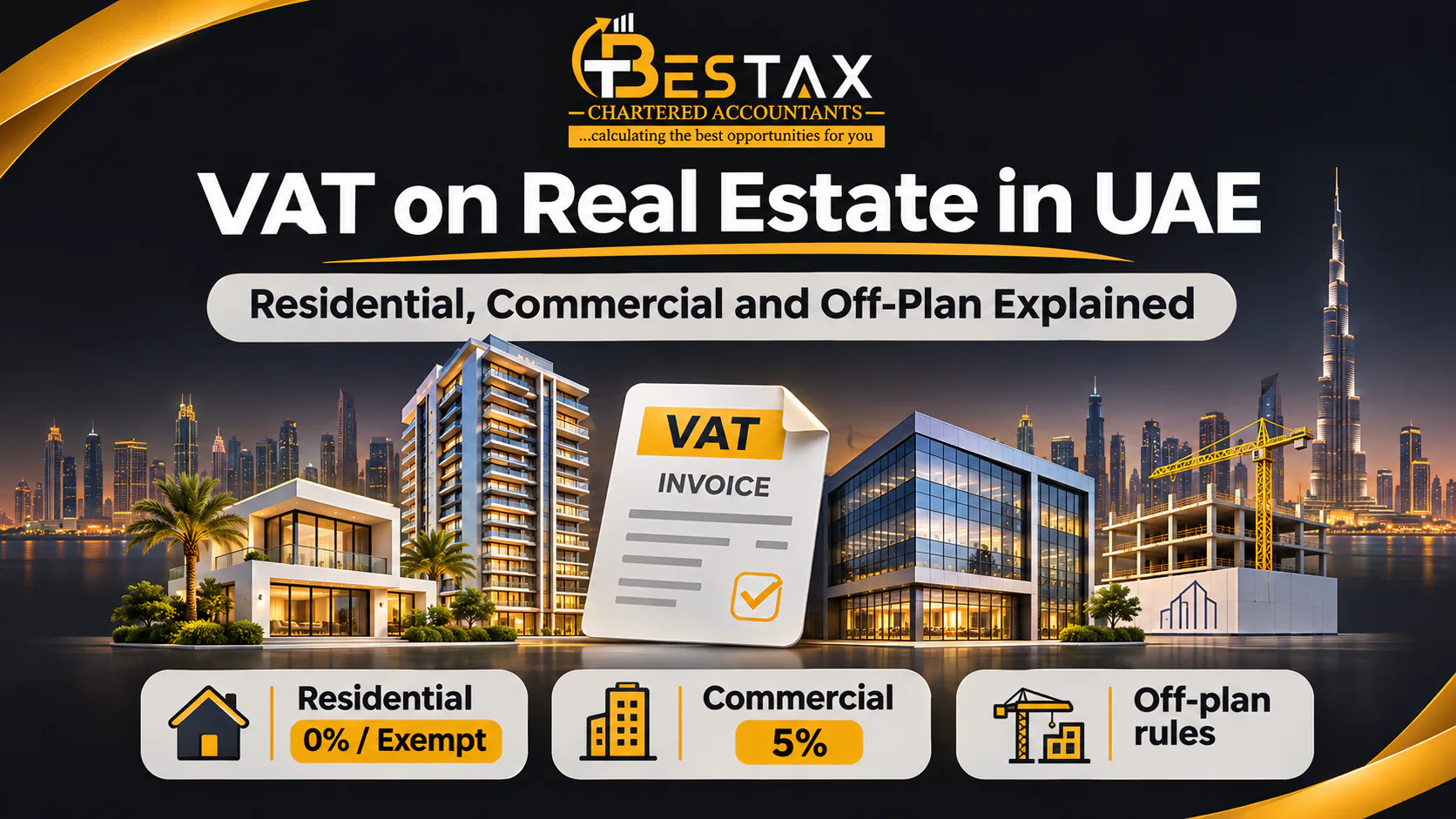
VAT on real estate in the UAE depends on what you are selling or leasing: a commercial building, a home, or a plot of land. Commercial property is taxed at 5%, while most residential property and all bare land are exempt.
New homes follow a different rule. When you sell or lease a new residential building for the first time within three years of completion, the supply is zero-rated, so you can still recover the VAT you paid to build it.
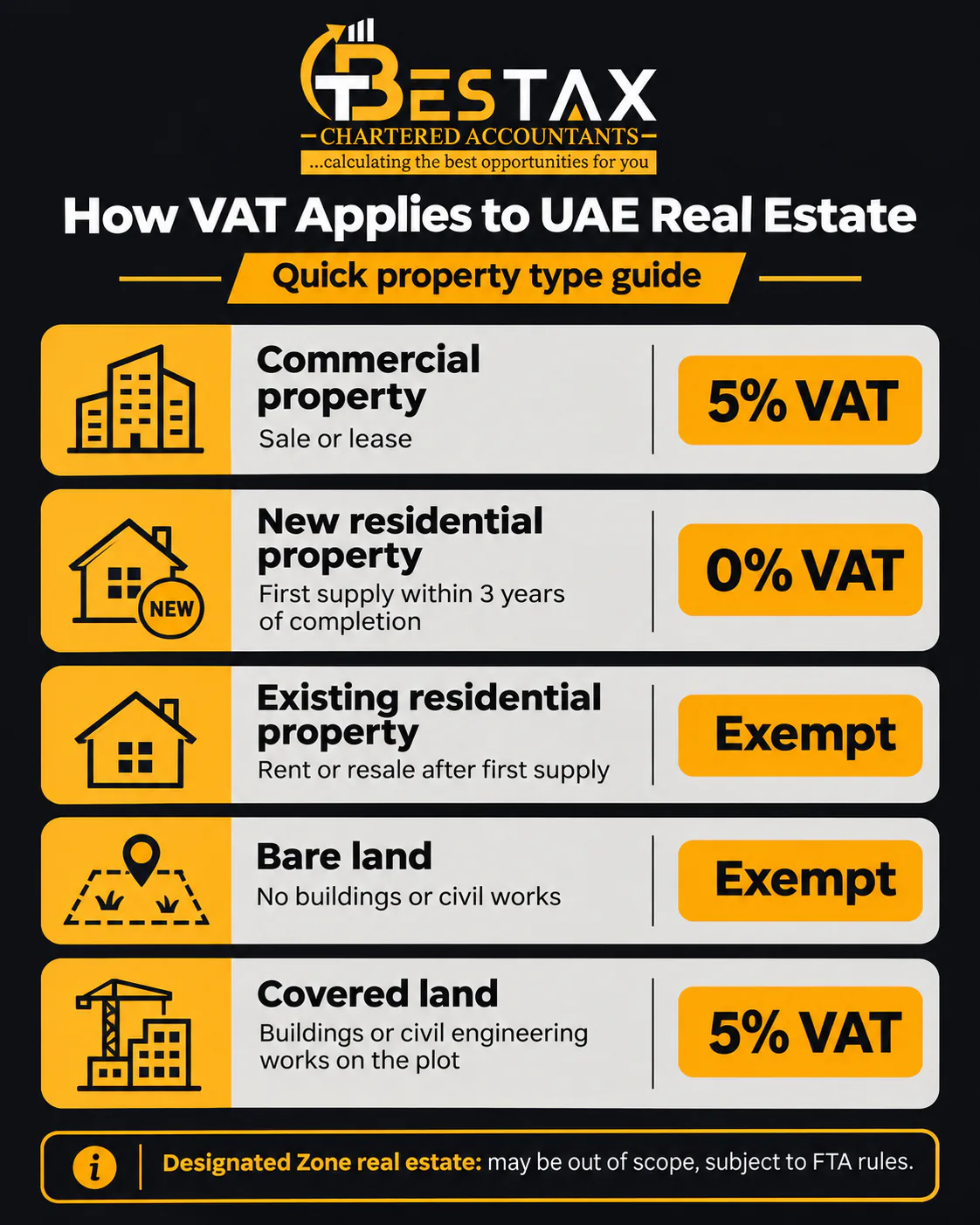
| If you supply | VAT treatment |
|---|---|
| Commercial property, by sale or lease | 5% |
| A new residential property (first supply within three years of completion) | 0% |
| An existing residential property | Exempt |
| Bare land | Exempt |
| Land covered by buildings or civil engineering works | 5% |
| A charitable building, first supply | 0% |
| A charitable building, later supplies | 5% |
| Property inside a Designated Zone | Out of scope |
These rules come from Federal Decree-Law No. 8 of 2017 and its Executive Regulations, as explained in the FTA’s Real Estate VAT Guide (VATGRE1).
How Does VAT Apply to Residential Property?
VAT on residential property in the UAE is exempt for most sales and leases. When you sell or lease an existing home, you do not charge VAT on the transaction, although VAT on related expenses usually cannot be recovered, as explained below.
What Counts as a Residential Building?
A residential building is designed for people to live in. The FTA includes:
- Homes that you or your tenant use as a principal place of residence
- Accommodation for students and school pupils
- Accommodation for the armed forces and police
- Orphanages, nursing homes and rest homes
Hotels, motels, bed and breakfasts, hospitals and serviced apartments that offer extra services do not count. Neither do buildings constructed or converted without lawful authority.
When Is the First Supply Zero-Rated?
Your first sale or lease of a new residential building is zero-rated if it happens within three years of completion. The rule applies to whoever the buyer or tenant is, including a related party.
The completion date is normally the date a qualified party certifies the building as complete. However, if people move in earlier, the date they occupy the building becomes the completion date.
As a developer, you can recover all the VAT you paid on construction, because those costs relate to the zero-rated first supply.
The zero rate also covers off-plan purchases. If you buy a home directly from the developer before construction, or buy a partly completed residential building, the sale is zero-rated, provided the property meets the residential definition.
Is There VAT on Residential Rent and Resales?
Any supply of a residential building after the first one is exempt. That includes rent you charge tenants and any resale, even within the three-year window.
For example, if you buy a new apartment from a developer and rent it out, the developer charges you 0% VAT. The rent you then collect is exempt, and so is any later sale.
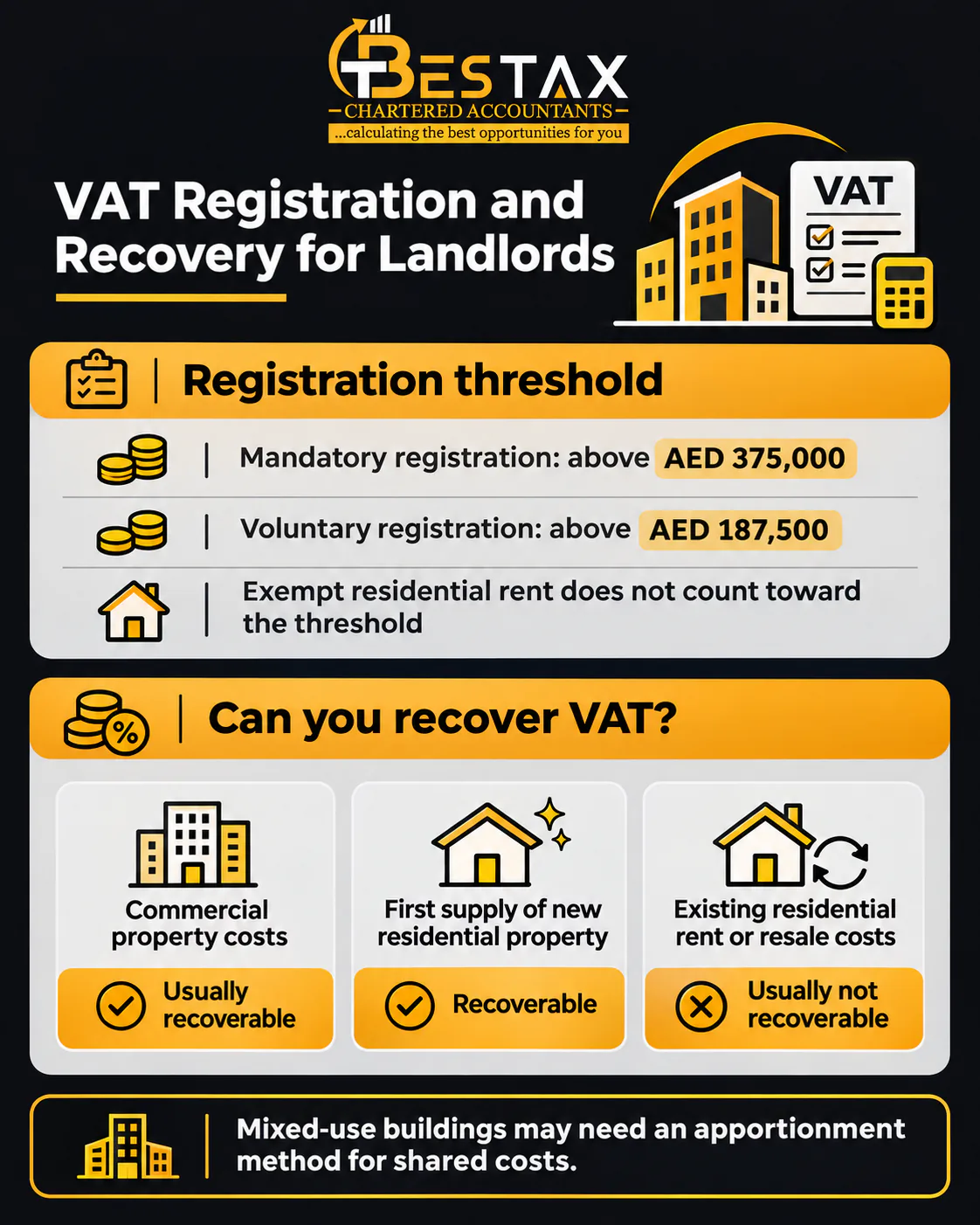
Because these supplies are exempt, you cannot recover VAT on related costs, such as agent fees or maintenance. You can see how other exempt supplies work in our guide to VAT exemptions in the UAE.
How Does VAT Apply to Commercial Property?
VAT on commercial property in the UAE is charged at 5% on both sales and leases. VAT applies to the full price. If you pay in instalments, VAT is due on each one, at the earliest of the invoice date, the payment due date or the date payment is received.
What Counts as Commercial Property?
Commercial property is any land or building that is not a residential building, a charitable building or bare land. Offices, shops, warehouses and hotels all fall into this group.
How Much VAT Do You Pay on Commercial Rent?
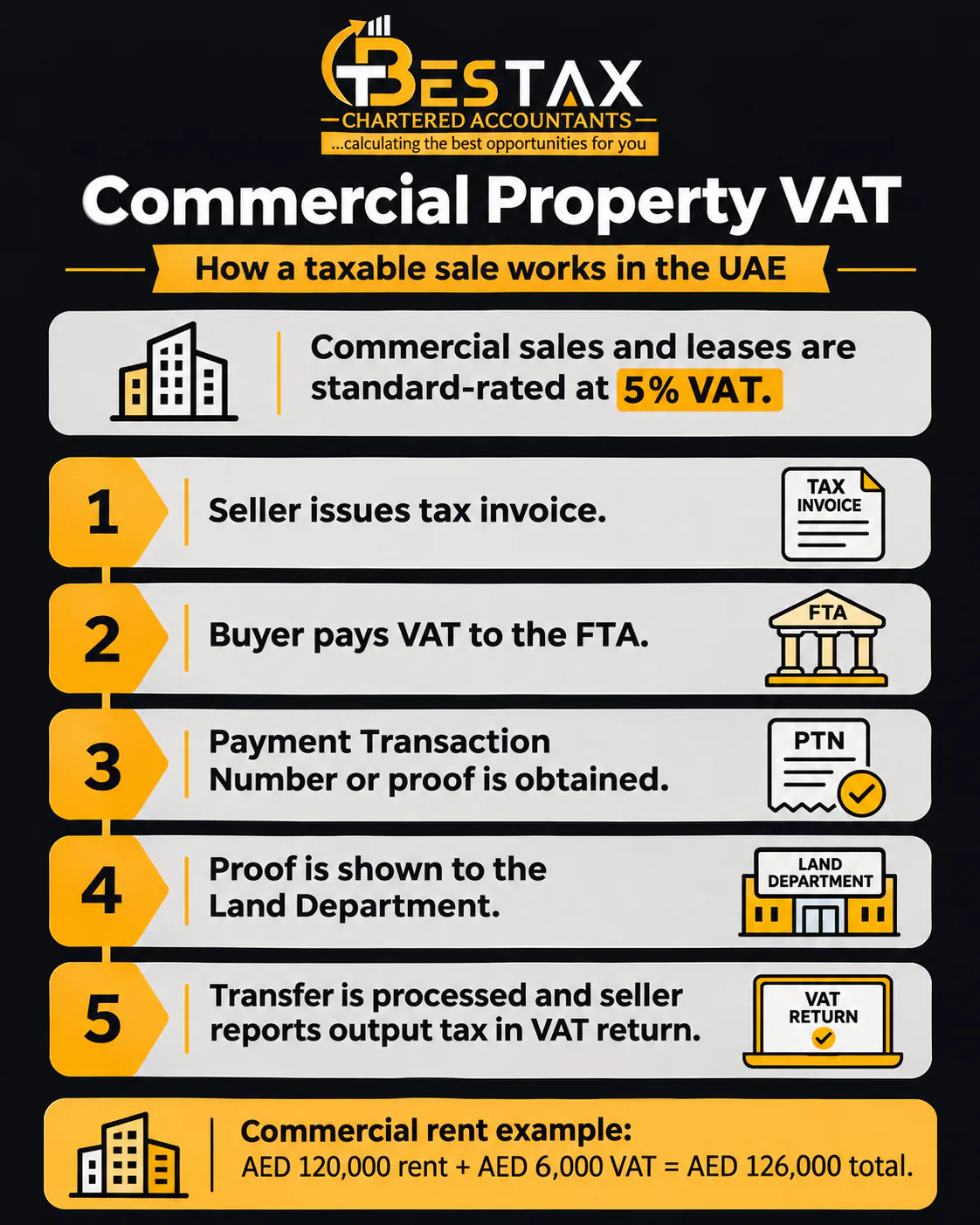
VAT on commercial rent is 5% of the rent you agree. For example, if you lease an office for AED 120,000 a year, your landlord adds AED 6,000 in VAT, bringing your total to AED 126,000.
As a VAT-registered landlord, you can generally recover the VAT on costs linked to that lease, because the rent is a taxable supply. The normal input tax recovery rules still apply.
How Is VAT Paid When You Buy Commercial Property?
The FTA runs a special payment process for certain commercial property sales in the UAE, where the seller is not the developer. The process does not apply to developer sales, leases, residential sales or a sale of let property that qualifies as the transfer of a business.
The buyer pays the VAT directly to the FTA before the Land Department will transfer ownership:
- The seller issues you a tax invoice for the sale price.
- You pay the VAT to the FTA, or through an FTA-nominated bank where your emirate offers one.
- You receive a Payment Transaction Number, or keep your bank’s proof of payment.
- You show that number or proof to the Land Department, which then processes the transfer.
- The seller reports the output tax on its VAT return and enters the same amount as an adjustment, so the tax is not paid twice.
The Land Department cannot complete your purchase without proof that the VAT is paid, so a missing step delays the whole transfer. Our team can talk you through the VAT position before your transfer date, so you know what to expect at each stage.
How Does VAT Apply to Land, Off-Plan Buildings and Service Charges?
Land, unfinished buildings and service charges each follow their own rule, and the answer often turns on what is physically on the plot.
Is Bare Land Exempt From VAT?
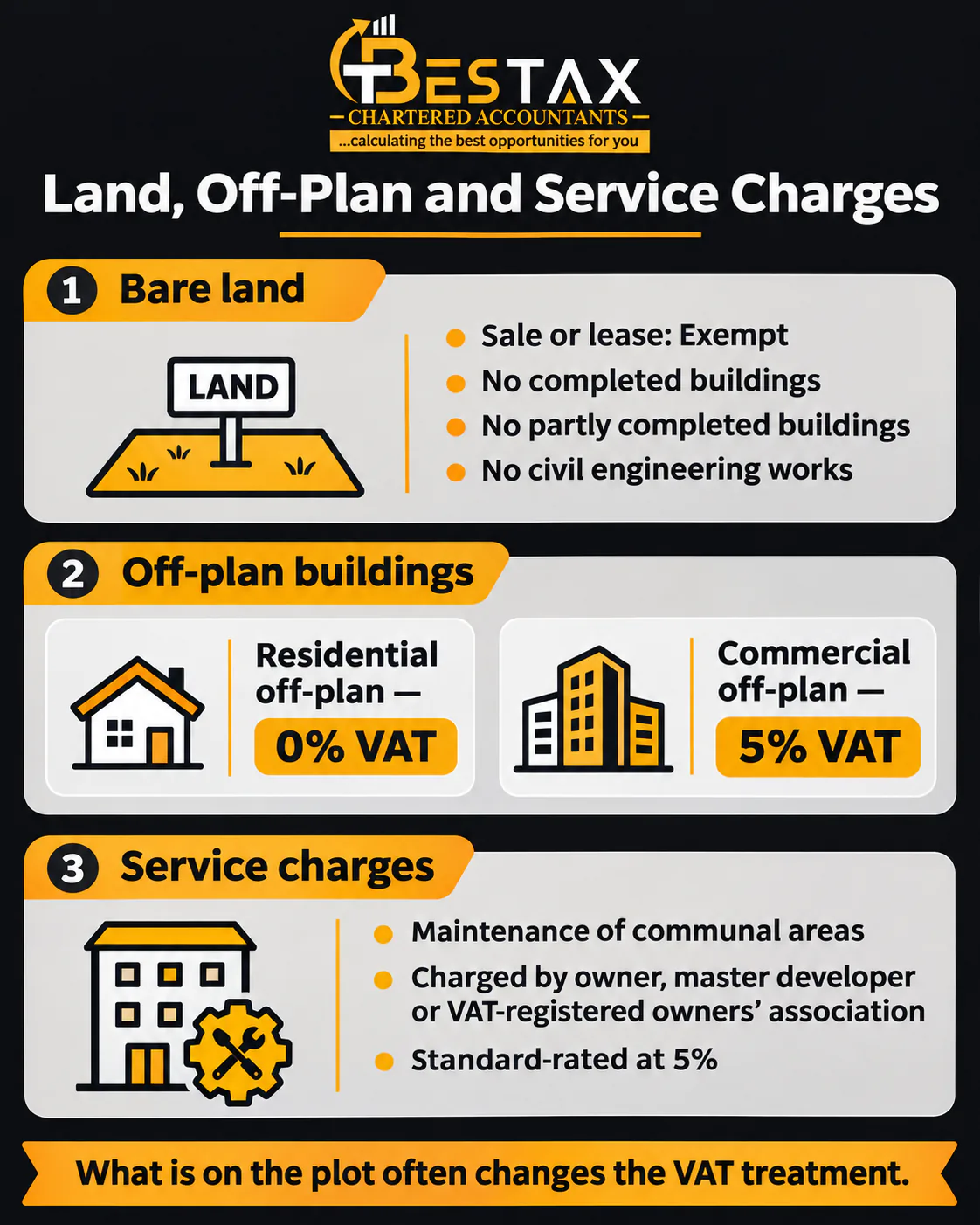
Yes, the sale or lease of bare land is exempt. Land counts as bare only if it has no completed buildings, partly completed buildings or civil engineering works on top of it.
The line is often finer than owners expect:
- Foundations: construction that has not gone beyond foundation level does not, by itself, make a building partly completed. However, the work can still count as civil engineering works, which would make the land covered and taxable at 5%.
- Fences and temporary structures: these do not stop land from being bare.
- Pipes: pipes buried under the surface keep the land bare, but pipes that rise above the surface to connect the plot make it covered.
- Nearby infrastructure: roads and utilities that stop at the edge of your plot do not count as works on your land.
Once land is covered, its sale or lease is standard-rated at 5%. Farm land is usually treated as covered, because irrigation, roads and utility connections are normally built into it. The FTA still assesses each plot on its facts. Movable hosepipes do not necessarily make land covered, while a substantial irrigation system fixed into the land counts as civil engineering works and makes the land covered.
If you lease bare land to a tenant who then builds on it, your later supplies change. For a lease paid monthly, VAT at 5% applies from the point the land stops being bare. For a one-off lease paid in full upfront, the VAT treatment stays the same.
How Does VAT Apply to Off-Plan Commercial Property?
If you sell a partly completed commercial building before completion, the sale is standard-rated at 5%. The exception is a sale that qualifies as the transfer of a going concern.
Off-plan residential sales, by contrast, are zero-rated, as covered above.
Is There VAT on Service Charges?
Yes, when a master developer, building owner or VAT-registered owners’ association charges for the upkeep of communal areas, the charge is standard-rated at 5%, even in a residential building. The charge pays for maintenance services, not for the home itself, so neither the exemption nor the zero rate applies.
Owners’ associations and management entities that run a building are treated as persons for VAT. If their taxable supplies pass the registration threshold, they must register, charge 5% on service charges and can then recover VAT on the services they buy to maintain the building.
How Does VAT Apply to Mixed-Use Buildings?
A mixed-use building has separate areas with different VAT treatment, such as shops on the ground floor and apartments above. When you supply one unit, its own use sets the rate: 5% for a commercial unit, and exempt for a residential unit unless it is the first supply.
How Is VAT Split When You Sell the Whole Building?
If you sell the whole building, you must split the price between its commercial and residential parts. The residential share is exempt, or zero-rated on a first supply, and the commercial share is standard-rated.
Can You Recover VAT on Construction and Maintenance?
You can recover the VAT on building a mixed-use development in full. The commercial part makes taxable supplies, and the residential part’s costs relate to its zero-rated first supply.
Repair and maintenance costs need more work. You recover VAT in full on costs that relate only to the shops, and none on costs that relate only to the apartments. Shared costs, such as roof repairs, are residual input tax, and you recover only a share of them.
Under the standard method, your recoverable share equals your taxable supplies divided by your total supplies, rounded to the nearest whole number. For example, if your shop rents are AED 600,000 and your exempt apartment rents are AED 400,000, you recover 60% of the VAT on roof repairs.
The FTA also accepts alternative methods, such as a floorspace method for real estate businesses, where the standard result does not reflect actual use. A special method needs the FTA’s written approval before you use it, so it helps to confirm which method suits your building before you apply.
Do You Need to Register for VAT as a Landlord?
You must register for VAT once your taxable supplies and imports exceed AED 375,000 a year, and you can register voluntarily above AED 187,500, according to the Ministry of Finance. Exempt residential rent does not count toward these limits, but taxable rent and any other taxable supplies and imports you make do.
| Your rental income | Counts toward the AED 375,000 threshold? |
|---|---|
| Commercial rent at 5% | Yes |
| First lease of a new home within three years of completion, at 0% | Yes |
| Rent from existing homes, which is exempt | No |
For example, if you earn AED 400,000 a year from shop rents, you must register and charge 5% VAT. If you earn the same amount only from existing apartments, the rent does not count, and you do not need to register for it.
The rule is stricter if you live abroad. For non-resident landlords, the registration threshold is nil, so any taxable rent from UAE property means you must register, charge and account for VAT. You cannot rely on a UAE tenant to account for the VAT through the reverse charge, because property is already in the UAE and cannot be imported. However, if your property creates a fixed establishment for you, with enough staff and resources in the UAE to make the supply, you are treated as a UAE resident and the normal threshold applies.
Once you are registered, you must charge VAT on taxable rent, keep proper records and file returns on time. Our team can help you check whether you have crossed the VAT registration threshold and explain what registration involves.
Can UAE Nationals Reclaim VAT on Building a New Home?
Yes, if you are a UAE national and build or commission your own home on land in the UAE, you can claim back the VAT on construction from the FTA. The home must be newly built and used only as a residence for you or your family.
You can claim VAT on:
- Contractor services, including builders, architects and engineers
- Building materials fixed into the home, such as doors, central air conditioning, sanitary ware, fitted kitchens, window frames and embedded wiring
You cannot claim VAT on furniture that is not fixed, appliances, carpets or landscaping such as trees and grass.
You submit the claim through the FTA e-Services portal, within 12 months of the home’s completion under the FTA’s guide. Each invoice can mix eligible and ineligible items, so a careful review before you submit helps you claim everything that qualifies.
How Can Our VAT Consultants Help With Your Property?
Property VAT turns on details such as the type of building, its completion date and whether a supply is the first one. A wrong call can mean charging VAT you should not, or losing VAT you could have recovered.
As an FTA-approved tax agency, we help you understand how VAT applies to your property and what it means for your obligations. Where your situation needs further support, we can connect you with the right people and guide you through the next steps.
Explore our VAT consultancy services in Dubai, or contact our team for a free consultation.
Frequently Asked Questions
Do you pay VAT on property in a free zone?
The sale or lease of real estate inside a Designated Zone is outside the scope of VAT, subject to the FTA’s conditions. That treatment covers only the sale or lease of the property itself, so hotel accommodation, estate agent services and construction services in that zone are still standard-rated at 5%.
Is a rent-free period subject to VAT?
No, a rent-free period is not a supply if your tenant gives nothing in return and is not a related party. If the tenant agrees to do something in exchange, such as refurbishing the property, the arrangement becomes a barter, and both sides may need to account for VAT.
What happens to VAT if an off-plan project is cancelled?
If the project is cancelled and you refund the buyer, you issue a tax credit note, which reverses the output tax you declared on the payment. If you keep the money, its VAT treatment depends on why you keep it. Where the amount is payment for a service you supplied, 5% VAT applies and no credit note is needed.
Can a new developer register for VAT before making sales?
Yes, you can register voluntarily once your expenses exceed AED 187,500, even before you make your first sale. Registering early lets you recover VAT on development costs from the start.
Sources
- Federal Tax Authority: Real Estate VAT Guide (VATGRE1), April 2021
- Ministry of Finance: Value Added Tax (VAT)
- UAE Government Portal: Value Added Tax (VAT)
- Federal Tax Authority: FAQs on commercial property
- Federal Tax Authority: FAQ on how real estate is treated
- Federal Tax Authority: VAT legislation
Disclaimer: The information provided in this blog is for general informational purposes only. For professional assistance and advice, please contact experts.

Khadija Raees holds a Bachelor's degree and brings over five years of experience in creating authoritative content in the areas of tax, accounting, company formation, and VAT in the UAE.
Learn More About Khadija