



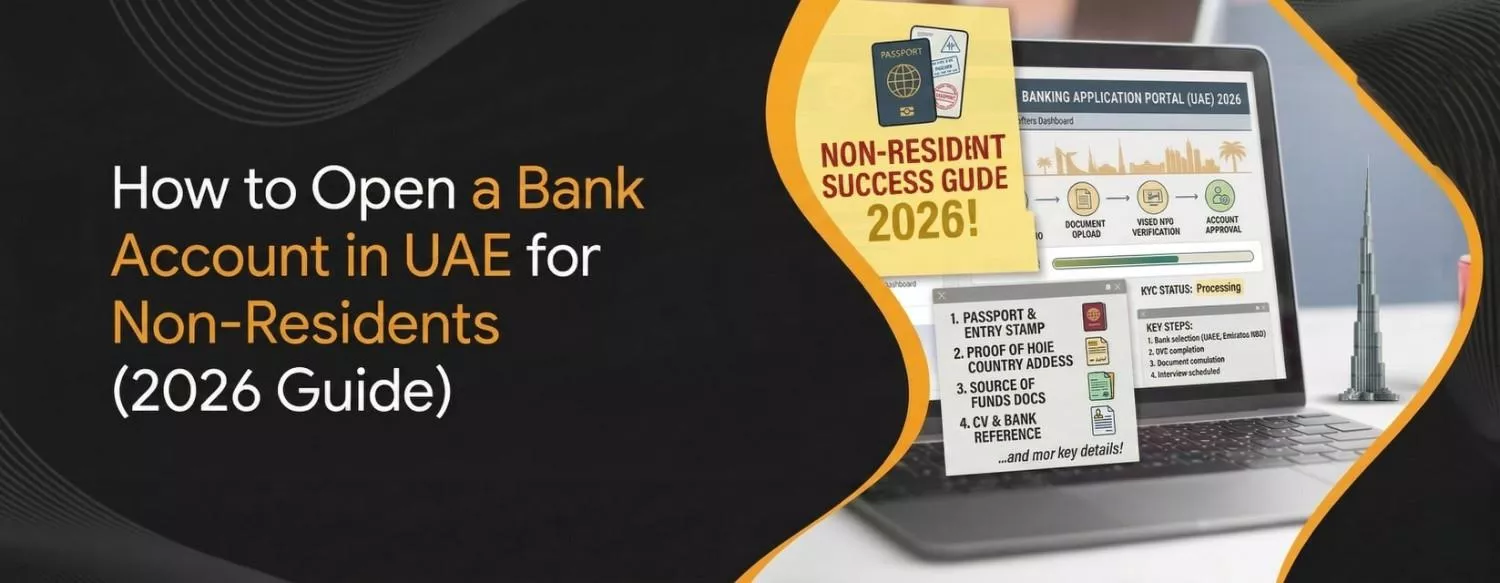
Opening a bank account in the United Arab Emirates (UAE) used to be something that only residents could do. However, we are here to prove to you that it is just a myth. In fact, Non‑residents can open a bank account in the UAE, provided they meet the bank’s stricter “Know Your Customer” checks.
In this guide, we’ll explain how to open a bank account in the UAE, especially for non‑residents. We will be covering everything from eligibility and required documents to choosing the right bank, seasonal travel tips, and common mistakes to avoid.
Why open a UAE bank account as a non‑resident?
Opening a local account gives you benefits that offshore solutions cannot match:
- Stable, USD‑pegged currency and zero personal income tax: Dubai and Abu Dhabi use the Emirati Dirham (AED), which is pegged to the USD. Your savings aren’t subject to personal income tax, and your money sits in a stable-currency zone.
- Efficient international transfers: Local accounts offer low‑cost domestic transfers, SWIFT payments and multi‑currency options. Many banks allow transfers in AED, USD, EUR and GBP.
- Local credibility: Landlords, employers and service providers often require a UAE account for salary deposits or rental payments. A local IBAN makes daily life smoother.
- Asset protection: Holding assets in a stable jurisdiction diversifies your risk.
- Access to premium services: Priority or Private Banking packages offer dedicated relationship managers, concierge services and investment products.
In 2026, major banks provide easy-to-use mobile apps and digital account opening for residents, while some neobanks offer zero‑balance accounts. As a non‑resident, you still need to visit a branch at least once, but the process is faster than in previous years.
UAE Bank’s Policies for Non‑residents
The UAE’s banking sector is regulated by the Central Bank and comprises commercial, Islamic, investment and digital banks. While residents enjoy full‑service current accounts with cheque books and credit cards, non‑residents are generally limited to savings or fixed‑deposit accounts.
Non‑resident accounts:
- Do not include cheque books or overdraft facilities.
- May offer an international debit card but rarely issues a credit card.
- Have higher minimum balance requirements, often starting at AED 25 000 and rising to AED 100 000 or more.
- Require in‑person verification in most cases, although some international banks allow remote onboarding for premium clients.
Eligibility: Most banks require non‑resident applicants to be at least 18 years old (some insist on 21) and hold a valid passport with a UAE entry stamp or visit visa. The Emirates Central Bank allows minors to hold accounts only via a guardian.
Since non‑resident accounts are regarded as higher risk, banks conduct enhanced due diligence. Expect comprehensive background checks and requests to substantiate the source of funds. Banks may refuse applicants with incomplete documentation or unclear reasons for banking in the UAE.
Benefits despite limitations
Non‑resident accounts still offer valuable features:
- Multi‑currency accounts allow you to hold USD, EUR, GBP and AED, enabling you to diversify and avoid exchange surprises.
- International transfers and card access, you can send money worldwide and withdraw cash from ATMs using the provided debit card.
- Access to wealth management products, particularly if you maintain a high balance.
If you plan to become a resident later, the non‑resident savings account can usually be upgraded to a current account once you obtain your Emirates ID and residence visa.
Required documents for non‑resident accounts
Each bank has its own checklist, but most require the following:
- Valid passport (original and copy) with at least six months’ validity and a UAE entry stamp or a copy of your visit visa.
- Proof of address abroad: recent utility bill, lease agreement, or bank statement showing your name and home address.
- Six‑month bank statements from your home country. Banks use these to assess your financial habits and income.
- Bank reference letter from your current bank confirming the account’s good standing and duration.
- Evidence of income or source of funds, salary certificate, employment letter, business documents or investment proofs.
- Resume or professional background summary (some banks ask for a CV).
- Passport‑sized photographs meeting UAE banking standards.
Minimum balance and fees
Non‑resident accounts carry higher minimum balance requirements than resident accounts. Typical figures in 2026:
- AED 25 000 to 100 000 for standard non‑resident savings accounts.
- AED 50 000 to 100 000 or more for multi‑currency or premium accounts at banks like HSBC or FAB.
- AED 250 000 to 500 000 for elite or priority banking at institutions such as RAKBANK or private banks.
Some banks accept modest deposits of AED 10 000 to 25 000 for ordinary savings accounts. However, premium packages may require relationships starting from AED 200 000 to 500 000. Fees vary by bank. Make sure to refer to the bank you want to open your account in, before starting the process.
Step‑by‑step process: Opening a non‑resident account
Opening a bank account in the UAE involves preparation and patience. Follow this sequence to improve your chances of approval:
Step 1: Research and choose the bank
Compare banks based on minimum balance requirements, currencies offered, digital services, branch accessibility and fees. RAKBANK and ADCB are popular entry points due to transparent criteria and competitive minimums. Emirates NBD has the widest branch network and offers non‑resident savings products, while international banks like HSBC appeal to those already in the HSBC ecosystem.
Step 2: Gather and certify your documents
Prepare the documents listed in section 2. Many banks require six months of bank statements, proof of address, a bank reference letter and a passport with UAE entry stamp. Have certified copies ready.
Step 3: Travel to the UAE and book an appointment
Most banks require at least one in‑person visit for identity verification. Contact the bank ahead of time to schedule a meeting and confirm their non‑resident offerings. Bring all documents and your initial deposit.
Step 4: Submit the application and complete KYC
Fill out the application form at the branch. The bank will perform a Know Your Customer (KYC) check and may ask detailed questions about your occupation, reason for opening the account and source of funds. For some digital banks you can submit documents online and complete biometric verification via app, but final approval still often requires a visit.
Step 5: Wait for approval and activate your account
Approval typically takes 1–2 weeks for non‑residents due to enhanced compliance checks. Once approved, you’ll receive your account details and debit card. Activate your card via an ATM or mobile app and set up online banking. Keep your account active by making regular transactions; dormant accounts may be closed after a few months.
Best banks for non‑residents and their features
Emirates NBD: Large network, established option
Emirates NBD offers a non‑resident Nile Account. Documentation includes a passport, proof of address and a bank reference letter. The minimum balance is around AED 15 000 for the Nile account, while Priority Banking starts from AED 500 000. The bank provides multi‑currency options, a strong mobile app and a large ATM network. Expect to deposit at least AED 30 000 within the first week, and prepare for a compliance interview.
Mashreq Bank: Digital pioneer
Mashreq explicitly advertises non‑resident savings and current accounts. Requirements are simple: passport, two months of bank statements and proof of address abroad. Its Mashreq Neo digital platform offers comprehensive mobile banking with multilingual support. Minimum balances start from around AED 5 000, making it attractive for those with modest deposits.
Abu Dhabi Commercial Bank (ADCB): Reliable and multi‑currency
ADCB accepts non‑resident clients but follows a conservative approach. You’ll need a passport with a UAE entry stamp, three months of bank statements and sometimes a letter of introduction from an existing ADCB client. Deposits above AED 200 000 unlock the Privilege Club, which offers higher transaction limits and dedicated advisors. ADCB provides an intuitive online platform and multi‑currency support.
RAKBANK: Friendly minimums and personal touch
RAKBANK is known for its pragmatic approach and relatively low minimums. It provides non‑resident savings accounts and issues debit cards but no cheque books. The bank requires a minimum deposit of USD 100 000 (around AED 367 000) and can open an account in about three days, provided documents are complete. You’ll access your account through secure digital platforms and have a relationship manager available via phone or video chat.
If you want detailed information, read this article: RAK Bank Account Opening | How to Open a Business Account at RAK Bank
First Abu Dhabi Bank (FAB): Ideal for high income and multi‑currency
FAB offers comprehensive non‑resident accounts with minimum deposits from AED 50 000. Clients gain access to private banking and wealth management services. FAB’s iSave Account (available to residents) earns up to 4% interest and accepts remote opening through its mobile app until 31 March 2026; non‑residents must still visit a branch but can benefit from the bank’s wide product range.
New digital banks in 2026: Wio Bank, Liv, and more
The UAE’s digital banking sector has expanded. Wio Bank and Mashreq Neo offer 100% digital accounts with zero‑balance requirements for residents. While non‑residents still need to visit a branch, these platforms show where the market is headed: smartphone onboarding, biometric verification, instant virtual cards, and 24/7 chat support. Liv, backed by Emirates NBD, is popular among young professionals, and YAP collaborates with RAKBANK to provide digital services.
Opening a business bank account in Dubai as a non‑resident
If you intend to trade or invest through a UAE company, you’ll need a corporate bank account. Corporate accounts require a registered company (mainland, free zone or offshore) and at least one authorised signatory with a UAE residence visa and Emirates ID.
The bank will ask for:
- Trade licence and certificate of incorporation;
- Memorandum and articles of association;
- Share certificates and board resolution empowering the signatory;
- Passports and visa copies of shareholders and authorised signatories;
- Company bank statements or business plan, depending on the bank.
It is possible for nonresidents to begin the application remotely, but they must usually complete it in person. Approval may take two to four weeks. Because corporate accounts involve larger transactions, banks look at the company’s source of funds, ownership structure and tax residency. In short, you have to be prepared for extensive compliance questions.
Pro tips for a smooth experience
- Clarify your purpose: Banks will ask why you want a non‑resident account. Be clear: property purchase, business investment, or diversifying savings. Whatever your reason may be.
- Maintain the minimum balance: Falling below the threshold triggers maintenance fees and could lead to account closure. Set reminders to top up your account.
- Keep the account active: Make regular transactions to avoid dormancy.
- Avoid applying to multiple banks at once: Multiple applications can raise red flags during compliance reviews.
- Stay updated on regulations: Banking rules evolve. Check the Central Bank’s announcements and your chosen bank’s website before travelling.
- Consider a multi‑currency e‑wallet: Services like Wise or Revolut can provide temporary access to AED and international transfers while your account is pending. They do not provide local IBANs but are useful stopgaps.
- Use a professional service if necessary: Business setup firms and consultants can pre‑qualify you with banks, saving time. However, verify their credentials and avoid paying large upfront fees.
Conclusion
Opening a bank account in the UAE without residency is straightforward and increasingly common. All you have to do is bring the required documents, choose a bank that accepts non-residents, and plan for an in-person visit. In return, you’ll get multi-currency access, local banking presence and an entry point into Middle East business opportunities. Non-resident accounts have some limitations, but the process is worth it if you’re serious about tapping into one of the world’s fastest-growing financial markets.
If you need personalised assistance with your non‑resident bank account or business setup, reach out to our team of consultants. Contact us today and take the first step toward your financial future in the Emirates.
Frequently asked questions (FAQ)
Can I open a UAE bank account online as a non‑resident?
Remote opening is rare. Most banks require at least one visit to a branch for document verification. Some international banks allow remote onboarding for existing Premier clients. Always confirm with the bank before applying.
How long does it take to open a non‑resident account?
Processing usually takes 1–2 weeks. If your documentation is incomplete or the bank needs additional compliance checks, it can take longer.
What if I’m under 21?
UAE law requires individuals to be at least 18 (21 in some banks) to open an account. Minors need a parent or guardian to open a joint or custodial account.
Do I need a UAE residence visa?
No, non‑residents can open savings accounts with just a visit visa. However, current accounts and full banking services require a residence visa and Emirates ID. Obtaining residency upgrades your account and reduces balance requirements.
Are there Sharia‑compliant options?
Yes, Islamic banks such as Dubai Islamic Bank and Emirates NBD’s Al Islamic division offer Sharia‑compliant non‑resident accounts, including savings and fixed‑deposit accounts. These accounts follow profit‑sharing principles instead of interest.
What happens if I don’t maintain the minimum balance?
The bank will charge a monthly “fall‑below” fee ranging from AED 25 to AED 100. Repeated non‑compliance may lead to account downgrade or closure.
Can I open a business bank account without residency?
A corporate account requires a UAE‑registered company and at least one director with a residence visa and Emirates ID. Without residency you can prepare documents and incorporate your company, but final activation waits until a local signatory is appointed.
What if my application is rejected?
Banks may reject applications if documents are incomplete, the source of funds is unclear or the profile is high‑risk. Rectify the issue and reapply with improved documentation. Avoid sending multiple applications simultaneously, as that raises suspicion.
Disclaimer: The information provided in this blog is for general informational purposes only. For professional assistance and advice, please contact experts.
