



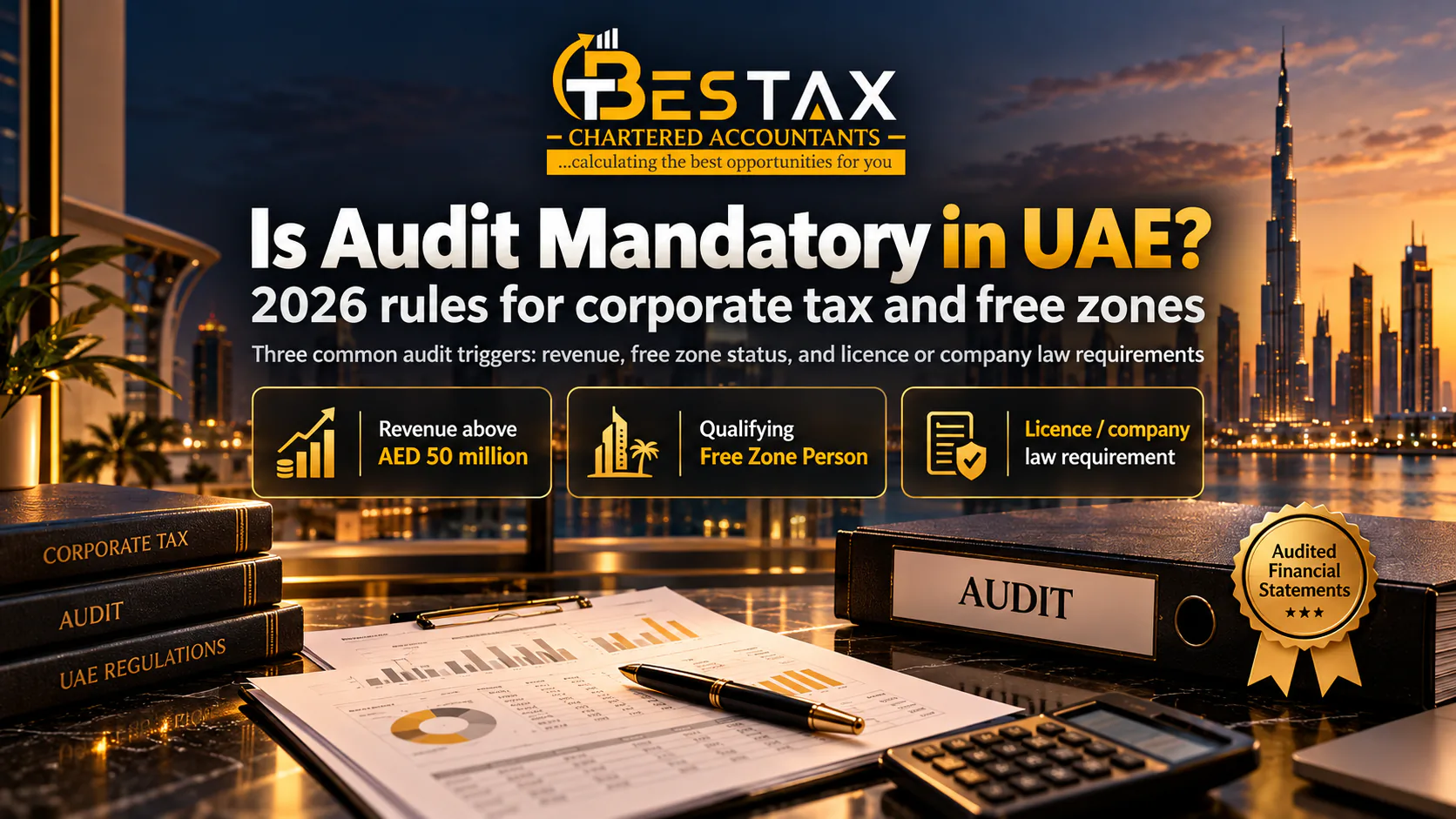
Before you decide an audit is optional because your company is small, you need to know that three separate rules can require one, and each has its own trigger. Whether an audit is mandatory in UAE for your company depends on three things. Those are your revenue, whether you hold free zone status, and what your licence and the Commercial Companies Law say. A company can pass one test and fail another, and the failure costs more than the audit.
The guide below covers the corporate tax rule under Ministerial Decision 84, the free zone rule that runs through licence renewal, and the company law rule for mainland companies.
Is Audit Mandatory in UAE for Corporate Tax?
The corporate tax law does not require every taxable person to be audited. The Ministry of Finance sets the categories that have to prepare and maintain the audited financial statements UAE corporate tax returns are built on. Since 2025 there are three.
The Three Categories Under Ministerial Decision 84
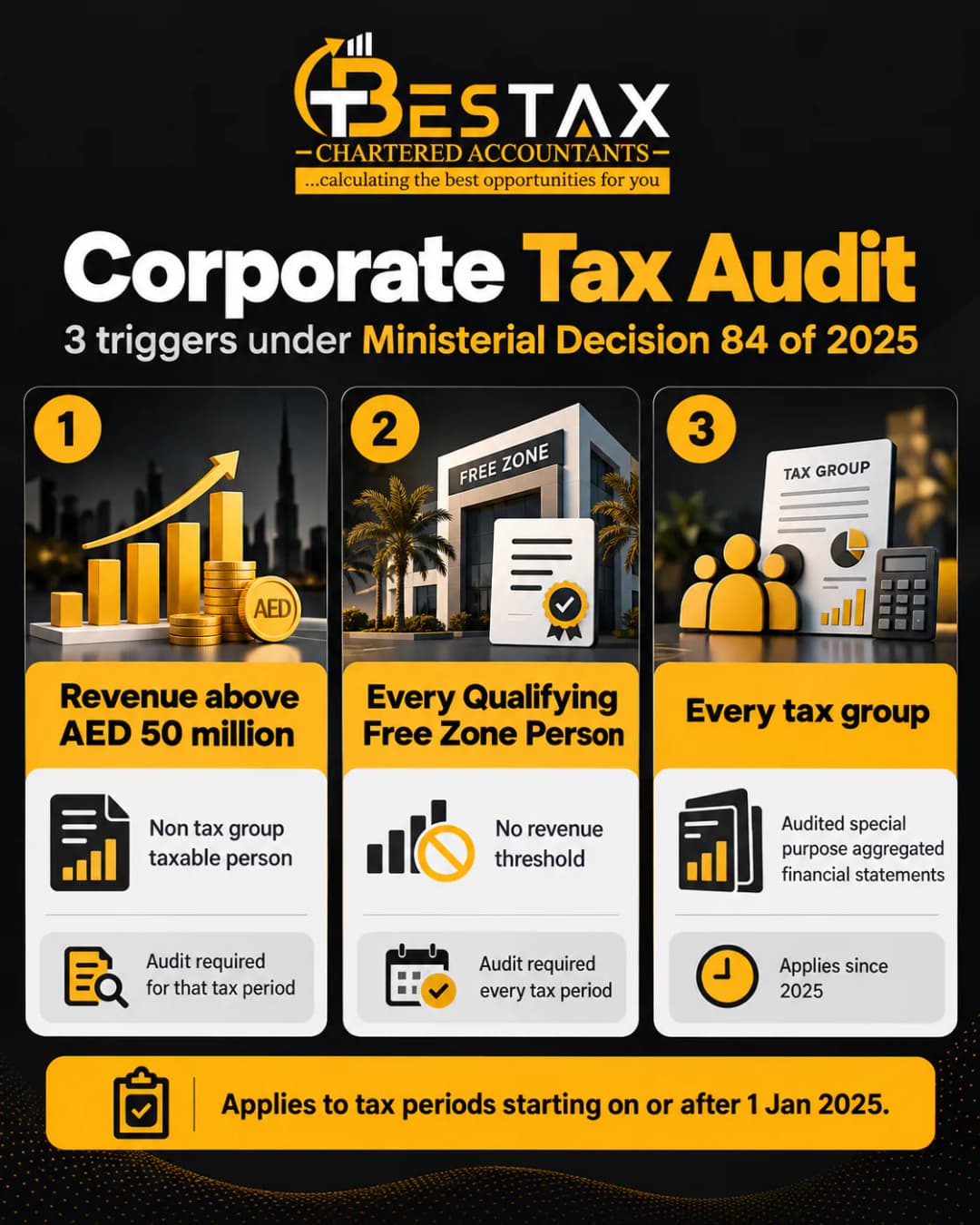
Ministerial Decision No. 84 of 2025 applies to tax periods starting on or after January 1, 2025. The decision replaced Ministerial Decision 82 of 2023, which still governs periods that began before that date. Under the current decision, you need an audit for corporate tax if you fall into any one of the three categories below.
- A taxable person that is not part of a tax group, with revenue above AED 50 million in the tax period
- Every Qualifying Free Zone Person, whatever its revenue
- Every tax group, through audited special-purpose aggregated financial statements
For a non-resident person, only revenue earned through a UAE permanent establishment or nexus counts toward the AED 50 million. A foreign company with a UAE branch earning AED 20 million and worldwide revenue of AED 300 million is below the threshold. Its home-country audit is a separate matter.
What the AED 50 Million Revenue Test Measures
Revenue means gross income for the tax period, before expenses, as reported in your financial statements under IFRS. The test is applied to each tax period on its own. A company that passes AED 50 million once needs an audit for that period even if it falls back the next year.
| Your position | Audited financial statements for corporate tax | Basis |
|---|---|---|
| Mainland company, revenue AED 30 million, not in a tax group | Not required | Below the threshold |
| Mainland company, revenue AED 60 million | Required | Above AED 50 million |
| Free zone company claiming 0 percent on qualifying income, revenue AED 4 million | Required | Qualifying Free Zone Person, no threshold |
| Free zone company taxed at 9 percent, revenue AED 4 million | Not required for corporate tax | Not a Qualifying Free Zone Person, below the threshold |
| Parent and subsidiaries in a tax group, combined revenue AED 12 million | Required, special-purpose aggregated statements | Every tax group since 2025 |
| Foreign company, UAE branch revenue AED 20 million | Not required | Only UAE nexus revenue counts |
The corporate tax column is only one of three tests. A mainland LLC that needs no audit for corporate tax still falls under the company law rule further down.
The Standards and the Deadline
Financial statements for corporate tax are prepared under IFRS, or IFRS for SMEs where revenue is AED 50 million or less. A company that needs an audit because of its revenue is therefore on full IFRS by definition. A Qualifying Free Zone Person or a tax group below the threshold can still use IFRS for SMEs. The audit is conducted under International Standards on Auditing by an auditor registered with the Ministry of Economy and Tourism.
The audited statements support the corporate tax return, which is due nine months after the end of the tax period. A December 2026 year-end files by September 30, 2027, and the audit has to be complete before the return can be. Our external audit services in Dubai are scheduled from the year-end date backward. The signed report then lands before the return is due rather than the week it is due.
Audit Requirements for Free Zone Companies: Two Rules, Not One
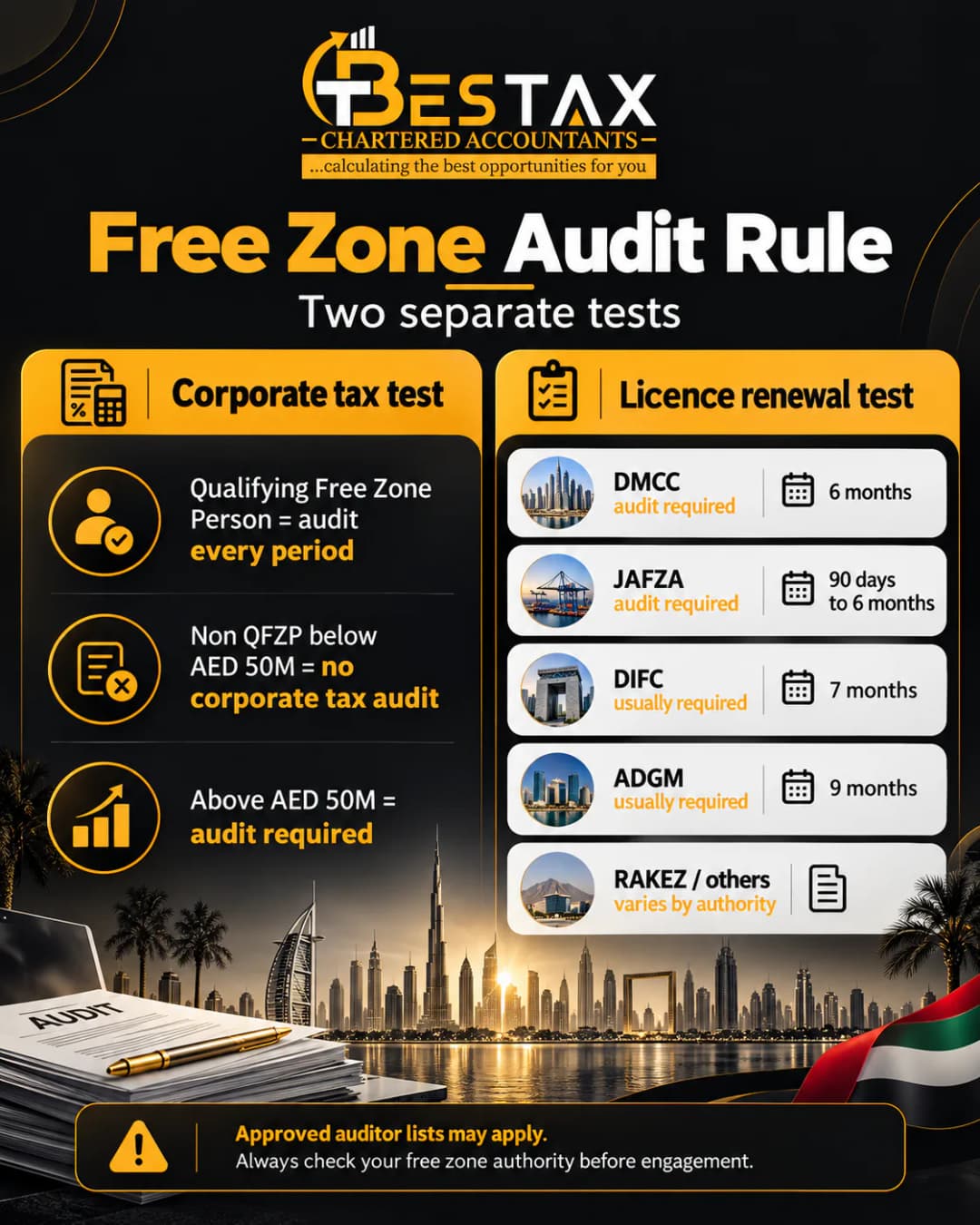
A free zone company faces the corporate tax rule above and a second rule set by its own free zone authority. The two are independent. Meeting one does not satisfy the other.
The Qualifying Free Zone Person Rule
The 0 percent rate on qualifying income is conditional, and an audit is one of the conditions. A Qualifying Free Zone Person has to prepare and maintain audited financial statements for every tax period, whatever its revenue. Skip the audit and you fail the conditions for that period. The standard rate then applies for that tax period and the four tax periods that follow.
- Audited financial statements every period, with no revenue floor
- Adequate substance in the free zone, with staff, assets and expenditure there
- Qualifying income from qualifying activities under Ministerial Decision 229 of 2025
- Non-qualifying revenue inside the de minimis limit
- Transfer pricing compliance on related-party transactions
A Qualifying Free Zone Person distributing goods in or from a designated zone also has to follow any additional procedures the FTA sets for that activity. The audit is the condition most often missed. The company’s revenue is small, and the owner assumes small companies are exempt.
The Free Zone Annual Audit Renewal Rule
Most free zone authorities require an audited financial statement as a condition of renewing your trade licence each year, independent of corporate tax. The requirement, the deadline and the format are set by the authority. They differ from zone to zone, as the table shows.
| Free zone | Audit at licence renewal | Submission window after year-end |
|---|---|---|
| DMCC | Required, from an auditor on the DMCC approved list, through the DMCC portal | Six months (June 30, 2027 for a December 2026 year-end). DMCC has extended past deadlines, so check your renewal notice |
| JAFZA | Required for FZE and FZCO licences, from an approved auditor, through the Dubai Trade portal | From 90 days up to six months depending on licence type |
| DIFC | Required, except small private companies with turnover of US$5 million or less and fewer than 20 shareholders. DFSA-regulated firms and Qualifying Free Zone Persons must be audited. Filed with the DIFC Registrar under IFRS | Within seven months of year-end; confirm the current window with the DIFC Registrar |
| ADGM | Required, except small companies with turnover of US$13.5 million or less and no more than 35 employees, outside regulated groups. Qualifying Free Zone Persons must be audited. Filed with the ADGM Registration Authority | Within nine months of year-end for private companies |
| RAKEZ, IFZA, Meydan and others | Varies by licence type and authority | RAKEZ six months; others per the renewal notice |
The free zone annual audit renewal rule catches companies the corporate tax rule does not. A DMCC company taxed at 9 percent with AED 3 million of revenue has no corporate tax audit requirement and still needs an audit to renew its licence. The cost of an audit for a small company is usually a fraction of the renewal fees and fines a lapsed licence produces.
The Approved Auditor Requirement
Several free zones accept audit reports only from firms on their own approved auditor list, as DAFZA does. An audit by a firm outside the list is rejected at renewal, and you pay for a second one. Before you engage an auditor, confirm three things with your authority.
- Whether the authority keeps an approved auditor list, and whether the firm is on it
- Whether the authority requires the auditor’s registration number on the report
- Whether the report has to be submitted through the authority’s portal rather than by email
Bestax prepares the audit file and manages the audit, and the opinion is signed by an approved auditor in our network. We confirm that the signing auditor is on your free zone’s list before the engagement letter is signed. The report you receive is then the one your authority accepts.
What UAE Company Law Adds, and What Happens If You Skip an Audit
The corporate tax and free zone rules sit on top of a company law rule that has applied to mainland companies for years. Together they decide whether your company is audited. The penalties for skipping fall under all three.
The Commercial Companies Law Rule
Federal Decree-Law No. 32 of 2021 requires every mainland limited liability company to appoint a registered auditor and have its annual financial statements audited, whatever its revenue. The audited accounts are approved at the annual general assembly and kept for at least five years. A single-shareholder LLC is inside the rule, and so is a branch of a foreign company on the mainland, which files audited accounts with the Ministry of Economy and Tourism.
Enforcement has historically been light, and many small mainland companies have never been audited. That is changing, because corporate tax returns, bank facilities and licence transactions now ask for the same statements. A company that has never been audited discovers the gap when it applies for a loan or sells a stake.
The Penalties for Skipping a Required Audit
The consequences run under whichever rule you breached. A free zone company can breach two at once. The list below gives the four.
- Corporate tax: failure to maintain the required records and statements carries an administrative penalty of AED 10,000, rising to AED 20,000 for a repeat within 24 months
- Qualifying Free Zone Person: loss of the 0 percent rate for the tax period of the failure and the next four tax periods
- Free zone renewal: licence renewal refused or delayed, with late renewal fines and a block on visa transactions until the audit is filed
- Company law: fines under the Commercial Companies Law and exposure for the managers who approved unaudited accounts
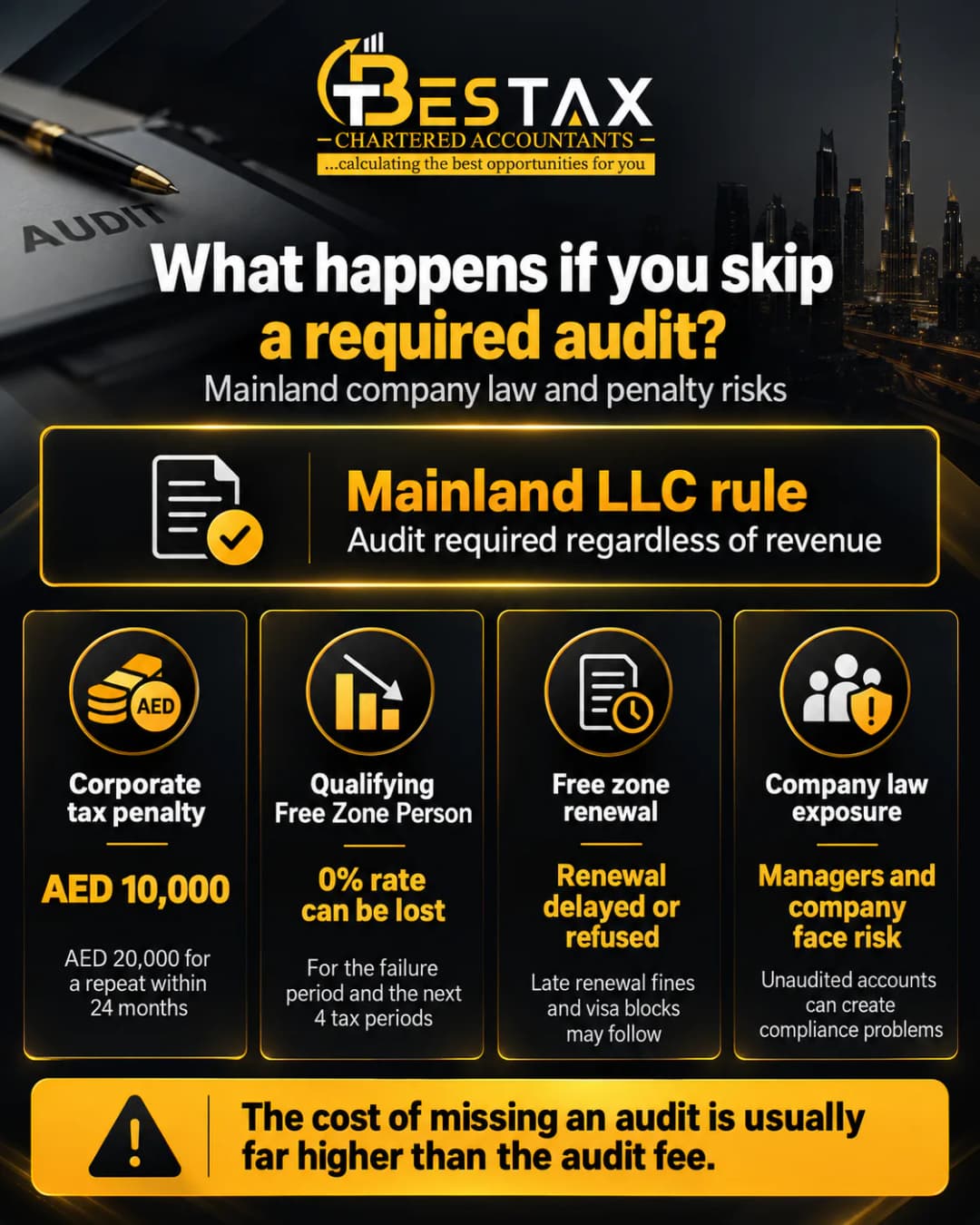
The largest cost is rarely the fine. A Qualifying Free Zone Person with AED 4 million of qualifying income that skips an AED 10,000 audit pays 9 percent on the lot. That is AED 326,250 on the income above the AED 375,000 threshold, and the same treatment applies for the next four tax periods.
Getting an Audit Done in Time
An audit takes four to eight weeks for a small company with clean books, and longer where the ledger has not been reconciled. The deadlines above set the end date. Working back from them, the calendar for a December year-end looks like the one below.
| Step | When | Who |
|---|---|---|
| Year-end close and reconciliations | January | Your accountant |
| Auditor engaged, planning and document request | February | Auditor and your finance team |
| Fieldwork and queries | March | Auditor |
| Draft statements and management letter | April | Auditor |
| Signed report, filed with the free zone if required | May, inside the shortest window that applies to your zone | Auditor and you |
| Corporate tax return filed on the audited statements | By September 30 | Your tax agent |
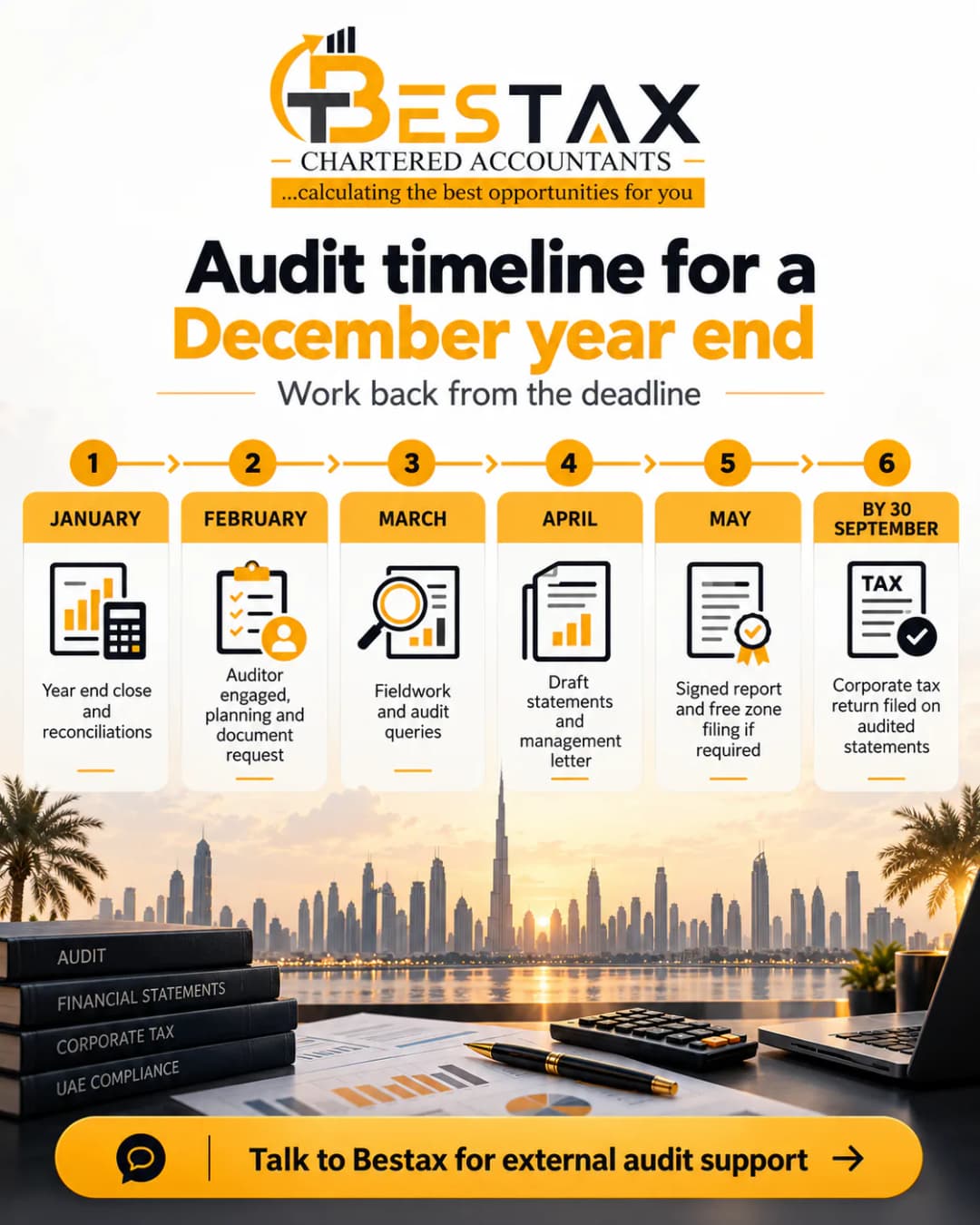
A company that engages its auditor in August for a December year-end has missed the shorter free zone windows and is racing the tax return. Our auditing services start with the close in January. The signed report is in your hands before the renewal notice arrives.
Check Which of the Three Rules Applies to You Before Your Year-End Closes
Write down three things about your company. Note your revenue for the current period against AED 50 million. Note whether you claim the 0 percent rate as a Qualifying Free Zone Person or sit in a tax group. Note what your licence authority’s renewal notice says about audited accounts. Any one of the three can make the audit mandatory, and most free zone companies find at least one does.
If the answer is that you need one, engage the auditor now rather than after year-end, because the planning and the document request are what compress the timeline. If the answer is unclear, our external audit team will confirm which rules apply to your company and that the signing auditor is on your free zone’s list. You then get the calendar to the signed report. The audit is a fixed cost with a known date, and the alternative is a variable one with none.
Frequently Asked Questions
My free zone company is taxed at 9 percent and earns AED 2 million. Do I need an audit?
Not for corporate tax, because you are not a Qualifying Free Zone Person and you are below AED 50 million. You do need one if your free zone authority requires audited accounts at licence renewal, which most do. Check the renewal notice rather than the tax rule.
Does a company in a tax group need its own audited statements as well as the group’s?
Ministerial Decision 84 requires the group to prepare audited special-purpose aggregated financial statements. It does not set a separate standalone audit rule for members, and the FTA is expected to issue further guidance on tax group statements. A member still needs its own audit if its free zone or its licence requires one.
I crossed AED 50 million this year for the first time. When does the audit apply?
To this tax period. The threshold is tested period by period. The year you cross it is the year you need audited statements, and the return for that year is filed on them. Engage the auditor as soon as the crossing is likely, not after the year closes.
Can I use an auditor who is not on my free zone’s approved list?
For corporate tax, any auditor registered with the Ministry of Economy and Tourism is acceptable. For licence renewal, a free zone that keeps an approved list will reject a report from a firm outside it, and you will pay for a second audit. Confirm the list before you sign an engagement letter.
What if my books are not ready for an audit?
The auditor cannot sign on unreconciled ledgers, and the audit stalls until the books are fixed. In that case the accounting cleanup comes first, and the audit follows. Start the cleanup at least three months before the deadline that applies to you, because the audit itself still needs its four to eight weeks after it.
Disclaimer: The information provided in this blog is for general informational purposes only. For professional assistance and advice, please contact experts.

With over six years of experience in tax, accounting, bookkeeping, and business setup processes, Neha Ghauri provides expert insights through meticulously researched content.
Learn More About Neha