



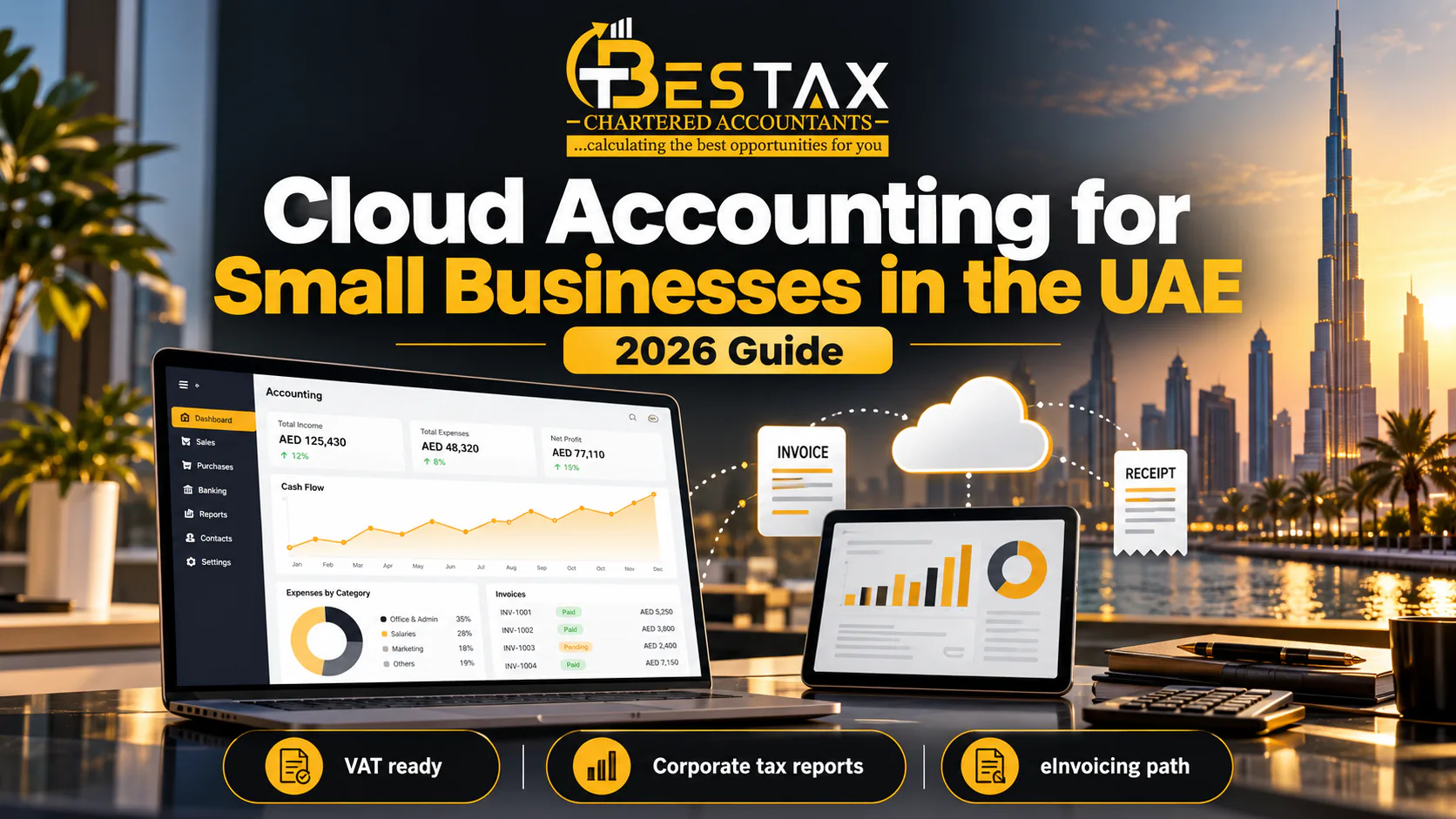
Cloud accounting means keeping your business books in online software that you log into from any device, instead of on one office computer or in spreadsheets. For a small business in the UAE in 2026, it is the most practical way to stay on top of VAT, corporate tax and the eInvoicing rules that start in 2027, because the software records every sale and expense as it happens and produces the reports the Federal Tax Authority (FTA) expects.
This guide explains small business cloud accounting from the ground up: what it does, whether it is legal and safe, how to choose software, what free plans leave out, and how to move your books without losing anything.
Some Definitions Before You Start
Accounting has its own vocabulary. These are the terms you will meet in this guide and in any conversation with an accountant or software vendor.
| Term | What it means in simple words |
|---|---|
| Cloud accounting | Accounting software that runs on the internet. Your data lives on the provider’s secure servers, not on your laptop, and you access it through a browser or app. |
| Bank feed | A live connection between your bank account and your accounting software. Transactions flow in automatically, so nobody types them in by hand. |
| Reconciliation | Matching the transactions in your books against your bank statement to confirm nothing is missing or duplicated. |
| VAT | Value Added Tax. A 5 percent tax on most goods and services in the UAE, collected by businesses and paid to the FTA. |
| Corporate tax | A federal tax on business profits, charged at 0 percent on taxable income up to AED 375,000 and 9 percent above that. |
| TRN | Tax Registration Number. The unique number the FTA gives your business when you register for VAT, and which must appear on your tax invoices. |
| EmaraTax | The FTA’s online portal where businesses register, file returns and pay tax. |
| eInvoicing | A system where invoices are sent as structured digital data through an accredited provider to your customer and to the FTA, rather than as a PDF or paper. |
| Accredited Service Provider (ASP) | A company approved by the Ministry of Finance to transmit eInvoices on your behalf. |
| Audit trail | A record inside the software of who created, changed or deleted each entry, and when. |
| IFRS | International Financial Reporting Standards. The accounting rules UAE businesses must follow when preparing accounts for corporate tax. |
Why 2026 Is the Year UAE Small Businesses Are Moving to the Cloud
Small businesses are the backbone of the UAE economy. According to the Ministry of Economy and Tourism, small and medium enterprises make up nearly 95 percent of all companies in the country, number about 1.33 million, provide more than 85 percent of private sector jobs and contribute 63 percent of GDP. The Ministry of Finance adds that 82 percent of UAE businesses are micro businesses with annual turnover below AED 3 million.
Those same businesses now operate inside a fully digital tax system. The FTA reported that corporate tax registrants passed 640,000 in 2025. In the first half of 2026 it carried out 103,680 field inspection visits, up 21 percent from around 86,000 a year earlier, resulting in more than AED 174 million in tax and penalties linked to seized non-compliant excise goods. Registration, returns and payments all run through EmaraTax, which is integrated with the Central Bank and UAE PASS.
Three developments make cloud accounting more than a convenience in 2026.
New Rules for Electronic Records
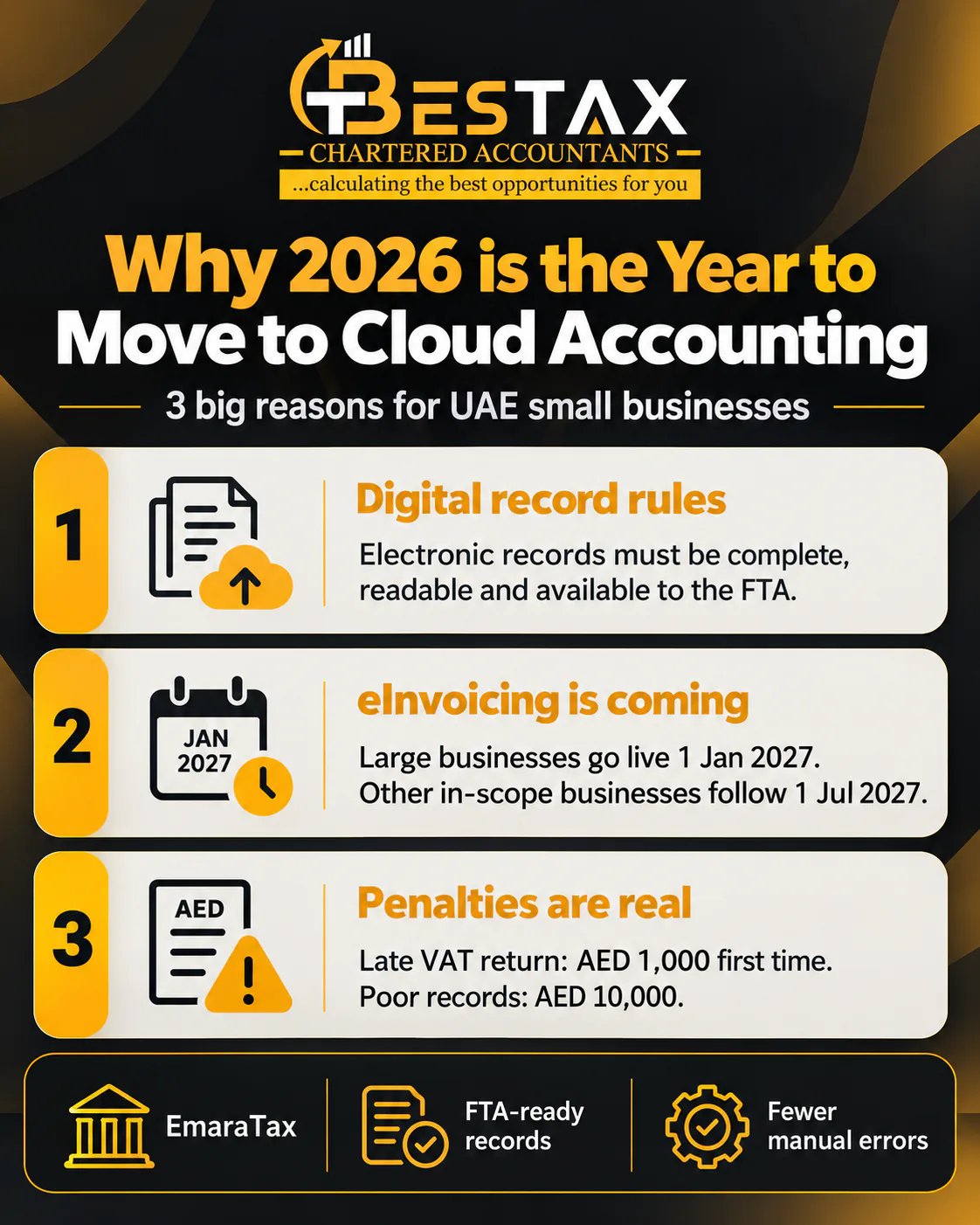
FTA Decision No. 4 of 2026 took effect on 30 July 2026. It sets the standard for accounting records kept electronically: they must be complete, accurate, readable on screen, identical to the original documents, and available to the FTA on request, including any passwords or encryption keys needed to open them. A business can use a third party to keep its records, but the business remains responsible for compliance.
eInvoicing Is Arriving
Businesses with revenue of AED 50 million or more must appoint an Accredited Service Provider by 30 October 2026 and start issuing eInvoices on 1 January 2027. Businesses below AED 50 million must appoint a provider by 31 March 2027 and go live on 1 July 2027. Government entities must appoint a provider by 31 March 2027 and go live on 1 October 2027. eInvoicing applies to every business operating in the UAE whether or not it is registered for VAT, unless it is specifically excluded. A PDF, a Word file, an image or an email is not an eInvoice under the new system.
Penalties Have Been Reset
Cabinet Decision No. 129 of 2025, effective 14 April 2026, sets the late VAT return penalty at AED 1,000 for a first offence and AED 2,000 if repeated within 24 months, charges 14 percent per year on late tax payments, and fines AED 10,000 for failing to keep proper records, rising to AED 20,000 on repeat.
Put simply, the FTA now expects your numbers to be digital, complete and available on demand. Cloud software is the easiest way to meet that expectation.
What Cloud Accounting Actually Does for a Small Business
Traditional desktop software sits on one machine. If that machine fails, the books go with it. Spreadsheets are worse: no audit trail, no automatic VAT calculation, and formulas that break quietly.
Cloud based accounting software replaces both with a single online system that does the following every day.
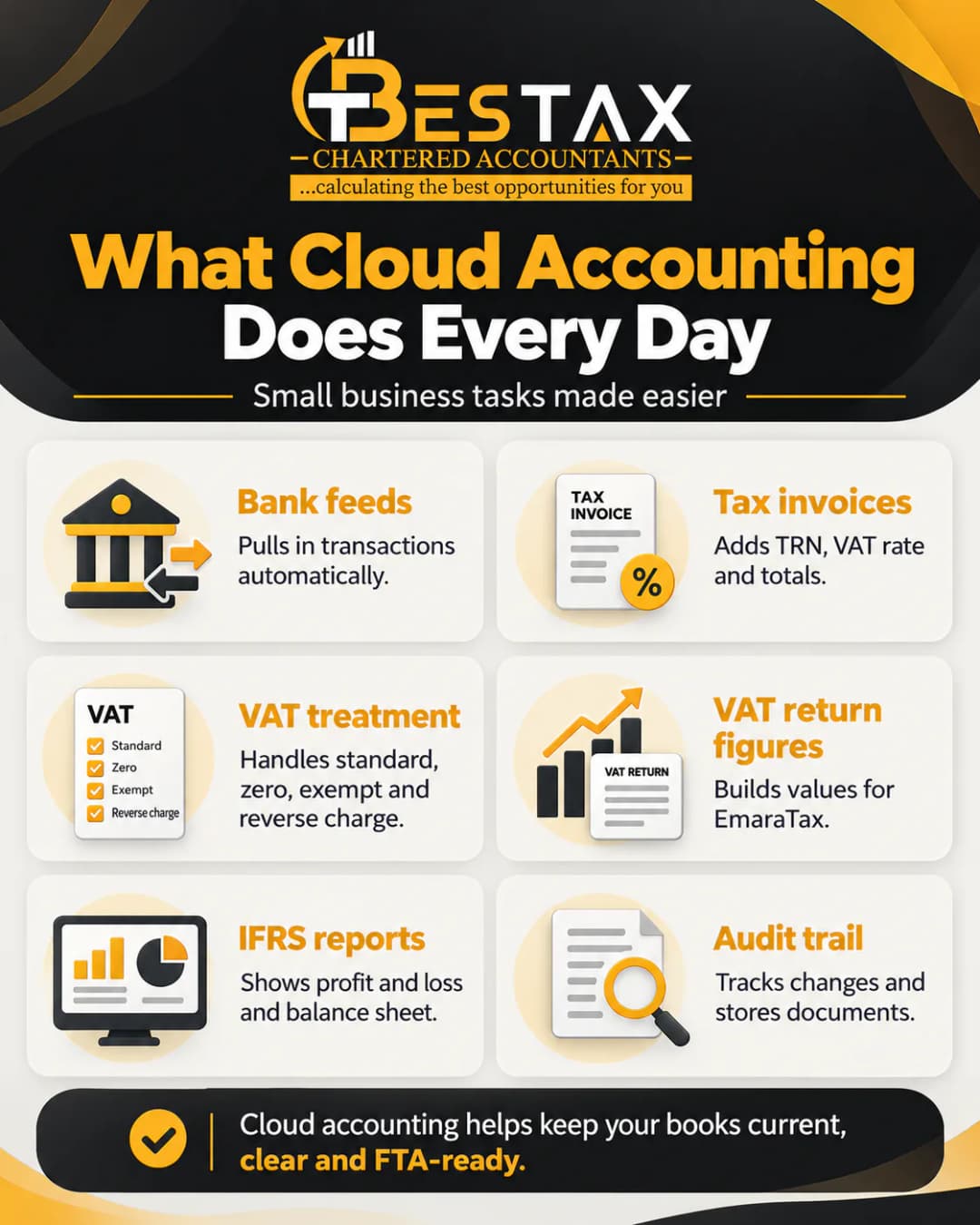
- Pulls in bank and card transactions through bank feeds, so your books update without typing.
- Issues tax invoices that carry your TRN, a sequential number, the VAT rate and the VAT amount, which are the fields the FTA requires on every tax invoice.
- Applies the right VAT treatment to each sale and purchase: 5 percent standard rated, zero rated, exempt or reverse charge on imports.
- Builds your VAT return figures automatically, ready for EmaraTax within the 28 day filing window after each tax period.
- Produces a profit and loss statement and balance sheet on IFRS principles, which is what your corporate tax return is built from.
- Keeps an audit trail and stores every attached invoice and receipt, which is exactly what FTA Decision No. 4 of 2026 asks for.
- Lets your accountant log in remotely, so a monthly review takes an hour rather than an office visit.
The Ministry of Finance itself notes that structured digital invoicing can cut invoice processing costs by up to 66 percent and allows VAT return fields to be pre-populated from invoice data. Cloud accounting is how a small business connects to that system.
Is Cloud Accounting Safe and Legal in the UAE?
Yes. UAE tax law has allowed electronic records for years. The Executive Regulation of the Tax Procedures Law states that records can be kept as originals or as an electronic copy that is identical to the original, as long as the FTA can access the information as if the original had been preserved. FTA Decision No. 4 of 2026 simply spells out what “identical” and “accessible” mean in practice.
Security is usually stronger in the cloud than on a laptop. Reputable providers encrypt data, run automatic backups and log every change. Your job is to use strong passwords, switch on two factor authentication, control who has access, and keep a note of how the FTA could be given access if they ask.
One more legal point. The Personal Data Protection Law, Federal Decree Law No. 45 of 2021, governs how customer and employee personal data is stored and transferred abroad. The Ministry of Finance’s own guidance on choosing an eInvoicing provider tells businesses to ask whether data is stored locally in the UAE or overseas. Ask your accounting software vendor the same question.
How to Choose the Best Cloud Accounting Software for Small Business in the UAE
Every vendor claims to be the best. As accountants who set up and run these platforms daily, we judge them on six tests. If a product fails any of the first three, it is not a serious option for a UAE business.
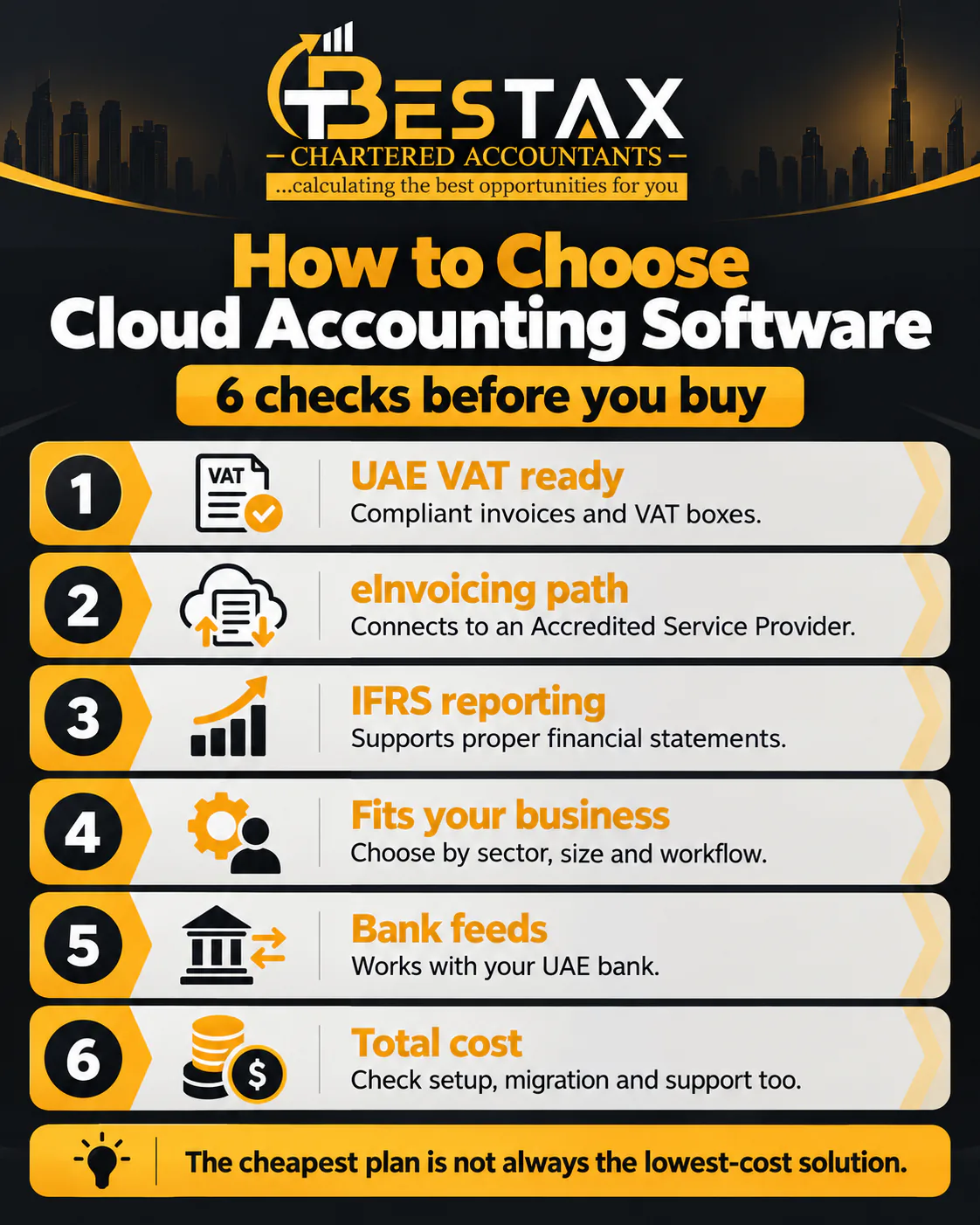
1. UAE VAT Out of the Box
The software must issue compliant tax invoices, handle all four VAT treatments and produce the exact figures your VAT return needs. The FTA maintains a list of accredited tax accounting software vendors, updated in August 2026, which currently includes 42 products. Accreditation is a useful signal, but correct configuration matters just as much.
2. A Clear Path to eInvoicing
From 2027, invoices must flow as Peppol PINT AE format data through an Accredited Service Provider. The Ministry of Finance has now accredited more than 50 providers, and the number is still growing, so check the live list of accredited eInvoicing service providers before you decide. Ask the vendor which providers their software connects to and whether that integration is live.
3. IFRS Based Reporting and a Seven Year Record
Corporate tax records must be kept for at least seven years after the end of the tax period. Businesses with revenue of AED 50 million or less may use IFRS for SMEs, and those with revenue of AED 3 million or less may use the cash basis. Your software should support whichever applies to you.
4. Fit for Your Size and Sector
A freelancer needs invoicing and expenses. A trading company needs inventory and landed costs. A contractor needs project costing. Paying for modules you never open is as wasteful as outgrowing a basic plan in a year.
5. Bank Feeds for UAE Banks
Check that your bank is supported. A platform without a working feed for your bank pushes you back to manual entry.
6. Total Cost, Not Sticker Price
Subscription is only the start. Add implementation, data migration, training and support before comparing.
For a detailed comparison of the platforms most UAE small businesses shortlist, read our guide to the best accounting software in Dubai for VAT and reporting in 2026 and our checklist on choosing the right accounting software for your UAE business.
A Quick Comparison of the Platforms We Implement Most
| Platform | Best suited to | Strength | Watch out for |
|---|---|---|---|
| Zoho Books | Startups and small businesses on a budget | Strong UAE VAT features, low cost, wider Zoho suite | Advanced inventory needs an add-on |
| QuickBooks Online | Small service businesses | Easy to learn, widely known by accountants | Fewer UAE specific localisations |
| Xero | Growing businesses with advisors abroad | Clean interface, strong bank feeds, large app marketplace | Payroll and some add-ons cost extra in the UAE |
| TallyPrime | Trading businesses and Tally trained teams | Powerful inventory, popular across the region | Desktop first, remote access needs setup |
Bestax is a Zoho Authorised Partner, and we say so openly. We still recommend QuickBooks, Xero or Tally when they fit a client better.
Free Cloud Accounting Plans: What You Get and What You Give Up
Free cloud accounting software does exist, and for a brand new business with a handful of invoices a month it can be a sensible starting point. Several major vendors offer a free tier for very small businesses, and others offer free trials of 14 to 30 days.
Before you rely on a free plan, understand the trade-offs.
- Caps. Free tiers usually limit users, invoices or annual revenue. The moment you cross the cap, you must upgrade, often mid year.
- VAT reporting. Some free plans issue invoices but do not produce a proper UAE VAT return summary, so you still build the return by hand.
- eInvoicing. Free tiers are the last to receive Accredited Service Provider integrations. eInvoicing applies whether or not you are VAT registered, so if you fall in scope from 1 July 2027, you will need a paid plan or a separate connection.
- Audit trail and records. Corporate tax records must be kept for seven years, and FTA Decision No. 4 of 2026 requires electronic records to stay complete, readable and accessible for that whole period. Check that a free plan lets you export everything if you leave.
- Support. Free means community forums, not a phone line, when something goes wrong two days before a filing deadline.
Our rule of thumb: a free plan is fine for now while you are under the voluntary VAT registration threshold of AED 187,500 and have no staff. Staying below the VAT threshold does not exempt you from eInvoicing, though. A business under AED 187,500 still needs to issue eInvoices from 1 July 2027 unless it is specifically excluded, so plan the move to a paid plan before then. Once you register for VAT at the AED 375,000 mandatory threshold, the cost of a paid plan is small next to the AED 1,000 penalty for one late return.
What the Rules Say Your Software Must Handle in 2026
Here is the compliance picture for a typical UAE small business, in one place. Your cloud system should be configured to deal with every line.
| Obligation | The rule in 2026 | What your software must do |
|---|---|---|
| VAT registration | Mandatory at AED 375,000 taxable turnover in the past 12 months or expected in the next 30 days; voluntary at AED 187,500 | Track rolling 12 month turnover |
| VAT returns | Filed and paid within 28 days of the end of each tax period | Produce return figures by box |
| Tax invoices | Must show the words Tax Invoice, your name, address and TRN, date, sequential number, description, VAT rate and amount | Template with all required fields |
| Corporate tax filing | Return due within 9 months of the end of the tax period; a business with a 31 December 2026 year end files by 30 September 2027 | IFRS based profit and loss and balance sheet |
| Small Business Relief | Available if revenue is AED 3 million or less; extended to tax periods ending on or before 31 December 2029 | Revenue tracking and simplified return support |
| Record retention | VAT records at least 5 years; corporate tax records at least 7 years; electronic records must be complete, readable and accessible to the FTA | Document storage, export and audit trail |
| eInvoicing | Revenue of AED 50 million or more: ASP by 30 October 2026, live 1 January 2027. Below AED 50 million: ASP by 31 March 2027, live 1 July 2027. Government entities: ASP by 31 March 2027, live 1 October 2027. Applies regardless of VAT registration unless excluded | Integration with an Accredited Service Provider |
The Small Business Relief extension is significant. On 7 August 2026 the Ministry of Finance issued Ministerial Decision No. 131 of 2026, extending the relief, which Ministerial Decision No. 73 of 2023 had limited to tax periods ending on or before 31 December 2026, to tax periods ending on or before 31 December 2029. If your revenue stays at or below AED 3 million, you can elect to be treated as having no taxable income, but you must still register, keep records and file a simplified return on time. We show where the election fits in our guide on how to calculate corporate tax in Dubai.
Missing a deadline is expensive even with the reduced penalty framework. Our summary of the 2026 changes to UAE tax penalties walks through every figure.
Getting Ready for eInvoicing With Cloud Software
eInvoicing is the biggest change to UAE invoicing since VAT began, and cloud accounting is the practical route into it.
The system works on a five corner model. You create an invoice in your accounting software, your Accredited Service Provider converts it to the Peppol PINT AE format and sends it to your customer’s provider, and a copy of the data goes to the FTA. Voluntary adoption has been open to all businesses since 1 July 2026, with no penalties during the voluntary phase. eInvoice data must be retained for five years.
Penalties for the mandatory phase are set by Cabinet Decision No. 106 of 2025: AED 5,000 per month for failing to appoint a provider or implement the system on time, and AED 100 per eInvoice not issued, capped at AED 5,000 per month.
Practical steps for a small business:
- Confirm your revenue band, because it sets your deadlines: below AED 50 million, appoint a provider by 31 March 2027 and go live on 1 July 2027.
- Check which Accredited Service Providers your cloud software already connects to.
- Clean your customer master data, especially TRNs and addresses, because eInvoices are validated against them.
- Run a voluntary test before your deadline rather than after it.
Our eInvoicing readiness service handles the provider connection and testing for you, and our guide to the UAE tax invoice format covers the fields every invoice needs today.
How to Move Your Books to the Cloud Without Losing Anything
Migration worries stop many owners from switching. Done properly, it is routine. From our own implementations, a standard cloud accounting setup with data migration usually completes in two to four weeks. This is the sequence we follow.
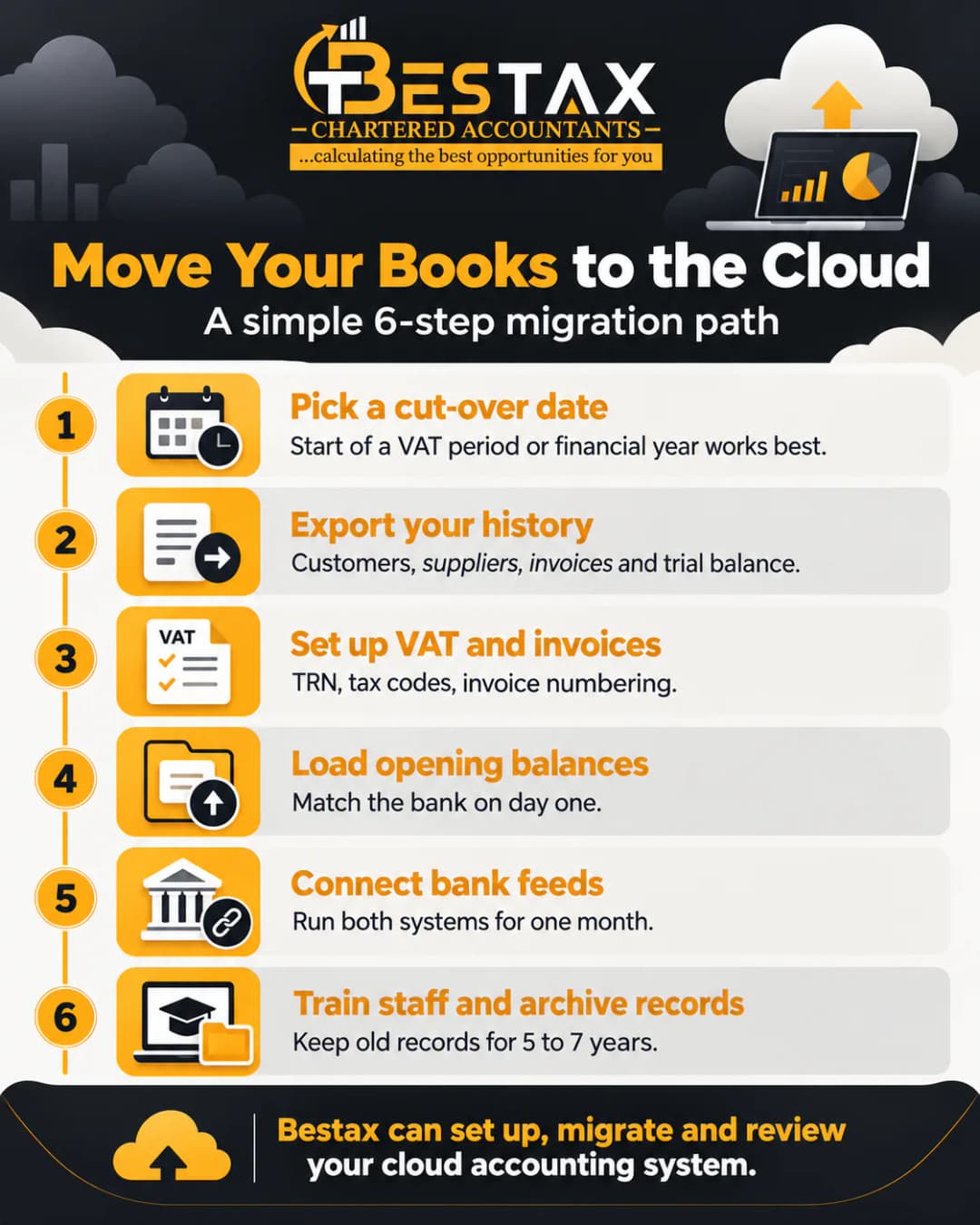
- Pick a cut-over date. The start of a VAT period or the start of your financial year keeps reporting clean.
- Export your history. Customers, suppliers, chart of accounts, open invoices and bills, and the trial balance at the cut-over date.
- Configure VAT and invoices first. TRN, tax codes for each treatment, invoice numbering and the invoice template.
- Load opening balances and reconcile. The bank balance in the new system must equal the bank statement on day one.
- Connect bank feeds and run in parallel. Keep the old system for one month and compare.
- Train your staff and archive the old records. Most errors come from staff, not software, so train the person who will actually use it. Then archive the old system’s data, because the FTA can ask for records from five to seven years back, regardless of which software created them.
For the record keeping side, our guide on how to maintain accounting records under UAE corporate tax rules lists the common mistakes we see, from mixing personal and business expenses to skipping monthly reconciliations.
Doing It Yourself or Working With an Accountant
Cloud software makes bookkeeping easier. It does not make judgement easier. The software will not tell you whether an expense is deductible for corporate tax, whether a supply is zero rated or exempt, or whether you should elect Small Business Relief this year.
Most of our small business clients use a hybrid model. They or a staff member issue invoices and approve bank feed transactions in the cloud system, and our team reconciles the accounts monthly, reviews VAT treatment, files returns from the same data, and prepares the corporate tax return at year end. Because everyone works in the same live system, the numbers on the return always match the books behind them.
Cost is usually the deciding factor. An in-house accountant in the UAE costs roughly AED 4,000 to 12,000 per month. Outsourced bookkeeping services for a small business cost a fraction of that, often with the cloud subscription included in the package.
What Clients Say About This Arrangement
“Bestax have been managing my accounts for the past 1 year now and I must say they do an amazing job. My tax returns are always on time and I never faced any penalty.”
Melvin Ross, Google review
“Anusha at Bestax keeps our financials in top shape. Her budgeting advice has improved our cash flow significantly. Highly reliable team!”
Dorothy Underwood, Google review
“Bestax Chartered Accountant supported us with Accounting and VAT work. Their team was easy to communicate with and helped us stay on track with business compliance.”
Theodore, Google review, June 2026
Cloud Accounting Mistakes We Fix Most Often
After more than ten years and thousands of client files, the same problems appear again and again. Each one is avoidable.
- The software was never configured for UAE VAT. Invoices go out without a TRN, or imports are posted without reverse charge. The platform was capable; the setup was not.
- Bank feeds connected but never reconciled. Transactions pile up unmatched, and the VAT return is built from incomplete data.
- Anyone can delete a posted invoice. User roles were left open, which breaks the audit trail the FTA now expects.
- Documents live in WhatsApp. Receipts and supplier invoices are never attached to the transaction, so the seven year record has holes.
- Nobody exports before cancelling a plan. A business switches provider and loses three years of history.
If any of these sound familiar, a short configuration review usually fixes them in days. It is far cheaper than an FTA inspection.
Ready to Move Your Books to the Cloud?
Bestax Chartered Accountants is an FTA registered tax agency (Tax Agency Approval Number 30008692) with more than ten years in Dubai, 35 plus qualified professionals, and a 4.8 out of 5 rating from over 290 Google reviews. We choose, set up and run cloud accounting systems for small businesses across the UAE, and our accounting software services team includes a free trial of our software support so you can see the monthly reports before you commit.
Whether you need a full accounting service in Dubai, help with VAT return filing, or your corporate tax return prepared straight from your cloud system, start with a free consultation.
Frequently Asked Questions
What is small business cloud accounting?
It is the practice of keeping your company’s books in online accounting software instead of desktop programs or spreadsheets. Your sales, expenses, bank transactions and tax records are stored securely online, updated automatically through bank feeds, and available to you and your accountant from any device. In the UAE it also gives you the VAT returns, IFRS based reports and audit trail that the Federal Tax Authority expects.
What is cloud based accounting software and how does it work?
It is a program hosted on the provider’s servers that you use through a web browser or mobile app. You log in, connect your bank, and the software records transactions, creates tax invoices, calculates VAT and produces financial reports. There is nothing to install and updates happen automatically, which is why most UAE small businesses now prefer it to desktop software.
What is the best cloud accounting software for small business in the UAE?
The best option for a UAE small business is the one that handles UAE VAT correctly, connects to an Accredited Service Provider for eInvoicing, supports your bank’s feed and fits your industry and budget. For most startups and small service businesses that means Zoho Books, QuickBooks Online or Xero. Checking the FTA’s list of accredited tax accounting software is a good starting point, and a short consultation with an accountant settles the choice quickly.
Is there any free cloud accounting software for UAE businesses?
Yes, several vendors offer free plans, usually as a limited plan for very small businesses or as a free trial of 14 to 30 days. Free plans work while you are below the VAT registration threshold and have few transactions, but they often cap users and invoices, lack a full UAE VAT return report, and are slow to add eInvoicing integrations. Being below the VAT threshold does not exempt you from eInvoicing: unless specifically excluded, you still need to issue eInvoices from 1 July 2027. Once you register for VAT, a paid plan is the safer choice.
Is cloud accounting legal for tax records in the UAE?
Yes. UAE tax law allows accounting records to be kept electronically as long as the information is identical to the original and the FTA can access it on request. FTA Decision No. 4 of 2026, effective 30 July 2026, confirms that electronic records must be complete, readable and accessible, including any passwords or encryption keys, and that the business stays responsible even if a third party keeps the records.
How long do I need to keep accounting records in the UAE?
VAT records must be kept for at least five years after the end of the tax period, and corporate tax records for at least seven years. Cloud accounting makes this easy because invoices, receipts and bank data are stored with each transaction, but you should always export a full archive before you cancel or switch any software plan.
Can cloud accounting software file my VAT return in the UAE?
Cloud accounting software calculates your VAT return figures by box, and some platforms can submit directly to EmaraTax. Even where direct filing is available, an accountant should review the treatment of unusual transactions such as imports, exports and exempt supplies before you submit, because the penalty for an incorrect return still applies.
Do small businesses in the UAE need eInvoicing software?
Yes, unless specifically excluded, and whether or not they are registered for VAT. Businesses with revenue of AED 50 million or more must appoint an Accredited Service Provider by 30 October 2026 and go live on 1 January 2027. Businesses below AED 50 million must appoint a provider by 31 March 2027 and go live on 1 July 2027, and government entities must appoint by 31 March 2027 and go live on 1 October 2027. Cloud accounting software that integrates with an accredited provider is the simplest way to comply, and voluntary adoption has been open since 1 July 2026 with no penalties during the voluntary phase.
Is my financial data safe in the cloud?
Reputable cloud accounting providers use encryption, automatic backups and access logs, which is usually more secure than a single office computer. Your side of the bargain is strong passwords, two factor authentication, tight user permissions and knowing where your data is stored. The Ministry of Finance advises businesses to ask providers whether data sits in the UAE or overseas.
How much does cloud accounting cost for a small business in the UAE?
A cloud accounting subscription typically costs a modest monthly fee that rises with users and features, while setup, data migration and training are one time costs. If you outsource bookkeeping, many firms include the software in a fixed monthly fee. Compare the total yearly cost, not the headline subscription, before choosing.
Disclaimer: The information provided in this blog is for general informational purposes only. For professional assistance and advice, please contact experts.

With over six years of experience in tax, accounting, bookkeeping, and business setup processes, Neha Ghauri provides expert insights through meticulously researched content.
Learn More About Neha